1/7 The BofA Global Fund Manager Survey is one of the best monthly maps of institutional consensus.
I use it to see what managers expect, how they’re positioned, and where market asymmetry is building.
This month, all three are moving in the same direction: stronger growth expectations, lower cash levels, and higher equity exposure. 6 charts.
This is not the full GLP-1 market, but the direction is hard to miss. Mounjaro ( $LLY ) now generates more than twice the quarterly revenue of Ozempic ( $NVO ).
Being first does not mean you keep the biggest prize. The companies that follow can learn from the pioneer’s mistakes, improve the product and move faster once demand is proven.
As a Novo Nordisk shareholder, I do not think the company has lost this market. The early decisions under the new management look sensible, and the franchise remains strong.
But the position has changed. What used to be a large lead is now a gap Novo has to close.
Being first opened the market. Staying ahead has to be earned again.
@GlobalMktObserv It was a useful indicator in the previous century. In the era of big tech monopolies getting revenue globally while GDP only counts domestic output, it is mathematically meaningless.
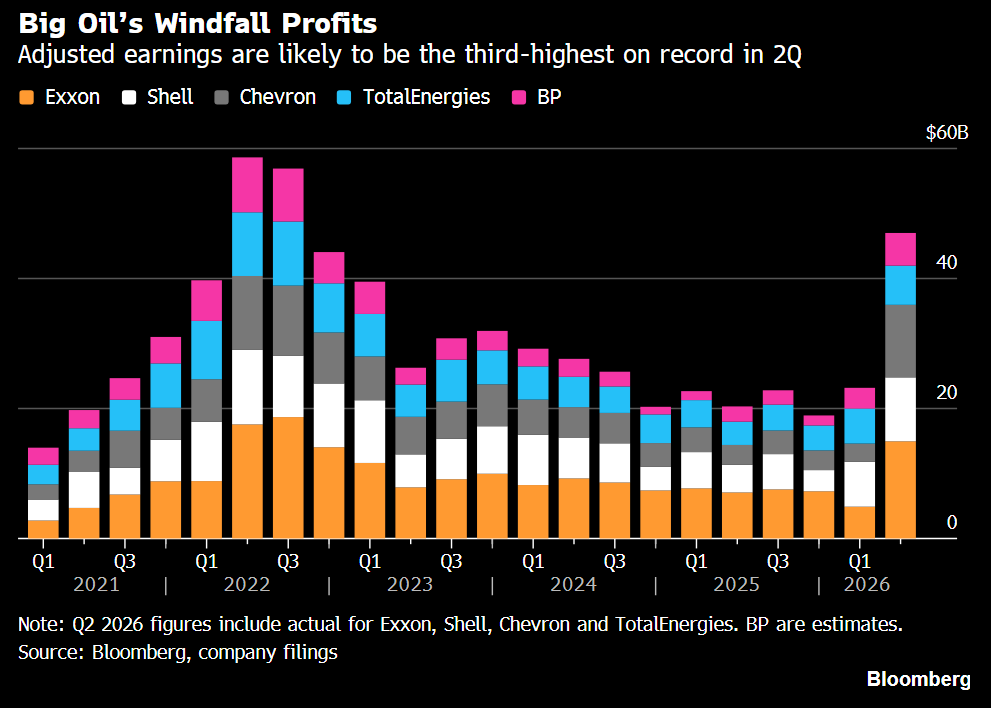
Big Oil is on track for its third-best quarter on record.
The Iran war lifted crude and gas prices, but the profit surge came from more than upstream. Fuel markets tightened, refining margins widened, and volatility created unusually strong opportunities for the large trading desks.
This shows why integrated oil majors can outperform during a supply shock. They make money from producing, refining, transporting and trading the same barrel. The result is stronger free cash flow, more room for buybacks and faster debt reduction.
I would be careful about extrapolating this quarter. If flows through Hormuz recover, oil prices and refining margins could fall quickly. If disruptions continue and inventories remain tight, profits can stay elevated.
The war created this windfall. What management teams do with the cash will decide how much of it shareholders keep.
@GlobalMktObserv Those who dumped record tech exposure at the bottom last week are chasing the green momentum today. The classic buy high, sell low loop never fails to execute.
@amitisinvesting Selling at ATHs is more rational than buying the peak. Especially when markets price in perfection, bond yields peak, and $VIX sits at floor levels, the margin of safety is zero.
@JensenHuang Nvidia executing the perfect commoditize your complement playbook. Make the autonomous software layer a zero-dollar commodity, destroy everyone else's software moat, and force 100% of the value capture back into their chips.
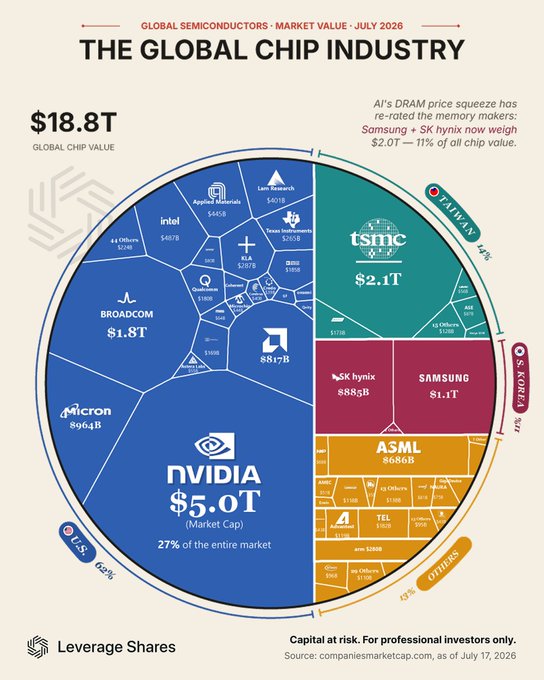
The global chip industry is now worth $18.8 trillion.
$NVDA alone accounts for $5 trillion, or 27% of the entire market, while US companies make up roughly 62% of total value.
This is not one business. Nvidia sells compute, TSMC manufactures it, ASML supplies the tools, and memory makers are benefiting from a shortage that has pushed prices and profits sharply higher.
The long-term battle is over who can control the largest part of the stack, from chips and networking to systems, software and distribution.
The more of that stack one company owns, the harder it becomes to replace and the more of the industry’s profit pool it can keep. That is the kind of moat that can protect monopoly-like margins long after today’s shortages and capex boom fade.
Every industry eventually produces a company that tries to control the market around it. Semiconductors may be no different.
The strongest position will belong to the company that becomes the layer everyone else has to build around.
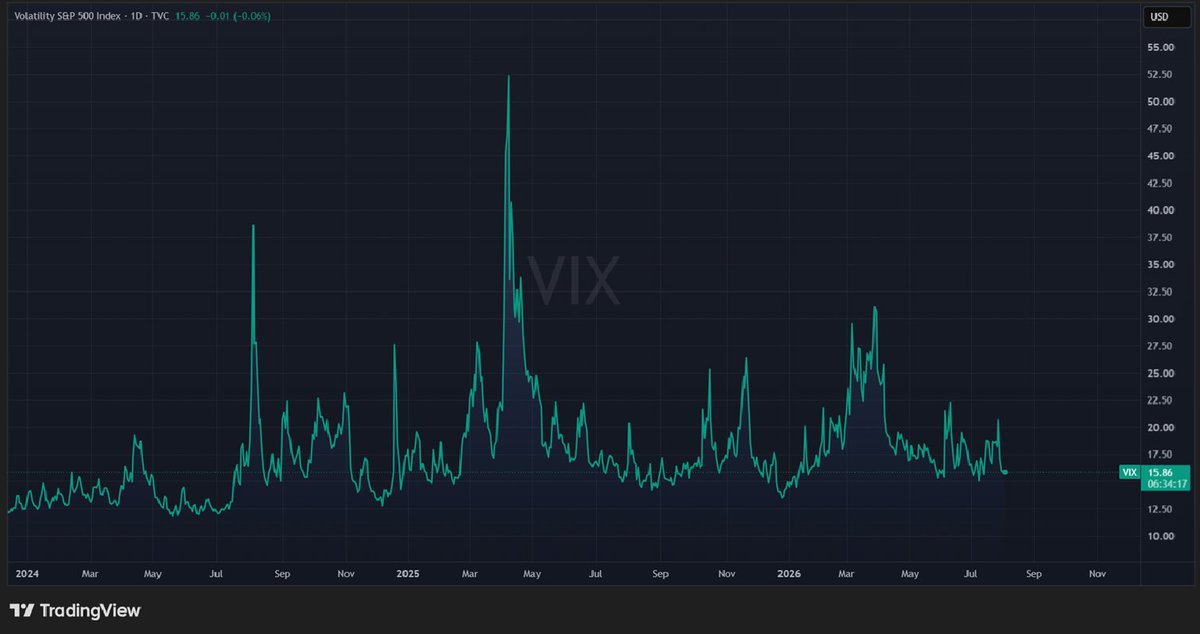
The $VIX is back near the lower end of its recent range, just as markets enter the August to October period when volatility has historically tended to rise.
Still, this needs to be treated carefully. A low VIX is not a sell signal, and seasonality does not guarantee a correction. It simply means the market is pricing in very little trouble at a time of year that has often produced more of it.
When expectations are this calm, it does not take a crisis to shake the market. A modest surprise can be enough.
Calm markets are the easiest to surprise. When everyone is pricing in the good news and positioning leans one way, it does not take much to knock the market off balance.
@AndreasSteno Weaponizing the AI supply chain layer by layer just inflates capex and slows down deployment. Banning the primary source of optical interconnects turns a infrastructure boom into a self-imposed supply bottleneck.
@DeItaone You can build all the land corridors you want, but they are just rounding errors for global grain exports. Global trade runs on deep water. If those ports stay closed, ag commodity inflation is a certainty.