Intermediate macro instructors: You probably need to talk about the impact of AI on the labor market. But to make contact with the notion that this can destroy jobs and potentially reduce wages you need to introduce the task-based model of production. Cobb-Douglas (or CES) just doesn't cut it for this issue.
You might consider using my undergrad textbook chapter on production where I cover this topic in a way that (I hope) is accessible to undergrads (see section 7 of the chapter):
https://t.co/m5lKx5rM3I
I also have a pretty detailed discussion of how technical change affects the labor share and the recent apparent fall in the labor share (section 6), which is obviously related to the AI issue.
New working paper+data! With @kat_bergant, K. Teoh and @MartinUribeEcon, we study a new dataset on cross-border flow restrictions from the 1950s, from official text using LLMs. https://t.co/VlVPEyKlsh. Github: https://t.co/USmjR3egMz. Please RT if interested. Brief thread on it.
🚀 Draft chapters my forthcoming MIT Press book:
𝗛𝗲𝘁𝗲𝗿𝗼𝗴𝗲𝗻𝗲𝗼𝘂𝘀 𝗔𝗴𝗲𝗻𝘁 𝗠𝗮𝗰𝗿𝗼𝗲𝗰𝗼𝗻𝗼𝗺𝗶𝗰𝘀: A Tractable New Keynesian Framework
A modern, analytical roadmap to TANK & HANK models for researchers, students and policy institutions
https://t.co/La1oqEmGEY
👇
RIP Stanley Fischer
"Stan the Man": On Stanley Fischer and MIT, by Olivier Blanchard is highly recommended (written in June 2023).
"...the style of research, with an emphasis on simplicity and transparency and on finding simple but formal models to get insights about difficult questions. Not that techniques were not valued when they were useful, and indeed we students were in awe of Stan’s use of stochastic calculus in his macro finance papers; but there was no attempt to impress or to show off. Insights, not methods, were at a premium."
"In short, it is hard to think of any other macroeconomist alive who has had as much direct and indirect influence, through his own research, his students, and his policy decisions, on macroeconomic policy around the world."
https://t.co/DPHVK5jjAJ
In recognition of his decades of transformative scholarship, John C. Haltiwanger of ECON was named as a new member of the American Academy of Arts and Sciences, one of the nation’s most historic and prestigious honorary societies. https://t.co/ruuCAmDbTL
Unspeakably excited to share HANKSSON, joint work w/ (lucky me!) @sigurdgal@RefetGurkaynak M. Mæhlum K. Molnar
A key question of the HANK literature:
Does (household) heterogeneity amplify the aggregate effects of demand policies and shocks?
Well ... 1/n
https://t.co/RgdJyrlDZC
🚨 We're organizing a one-day workshop on the use of heterogeneous agent models in central banking 🚨
The keynote speaker will be @a_auclert
📆 Submit your papers by April 15!!
https://t.co/Aras1gPSBX
How Immune Is the Federal Reserve From Political Pressure?
I wrote a short piece for @EconoFactOrg - it explains some facts around central bank independence, how the Fed is structured and how politicians might try to interfere with its decisions
https://t.co/RBHG8FxdNx
Need a break from the break? We got you covered:
New WP with @CosminIlut and Martin Schneider:
HANK's Response to Aggregate Uncertainty in an Estimated Business Cycle Model.
Short thread.
https://t.co/rtbODnGfSD
Today I taught the last class of my PhD-level topics course on "Heterogeneous Agents in Macroeconomics". I teach by unit - households, firms, banks, and regions - and break the rep. agent assumption case by case. All teaching materials are available here: https://t.co/oBz8fePUTl
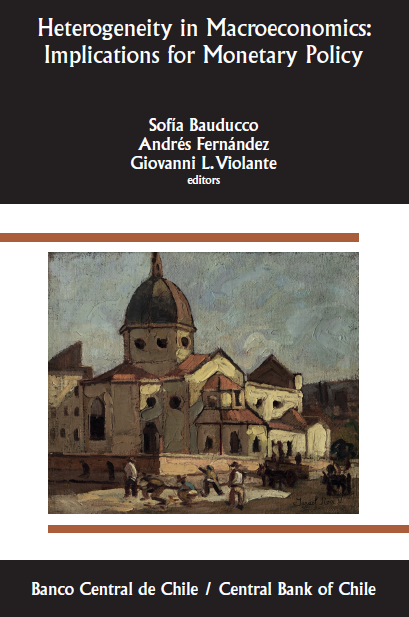
Two years ago, @andresfernanm, Sofia Bauducco, and I had the privilege to organize the 30th annual Bank of Chile conference on Heterogeneity in Macroeconomics: Implications for Monetary Policy at the Bank of Chile. The papers on the program were all examples of cutting-edge research in this exciting area of macro. We have now collected these contributions in a volume which is freely available on the @CBChileresearch website https://t.co/3uPJH4XwGZ
Enjoy!
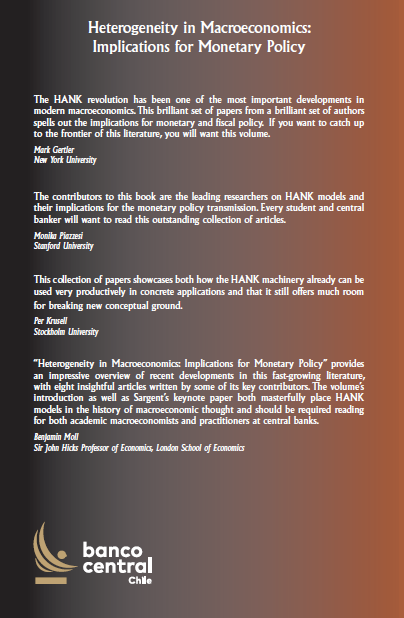
PS Thanks to Mark Gertler, Per Krusell, @ben_moll and Monika Piazzesi for their kind endorsements.
Higher inequality tightens financing conditions of bank-dependent relative to other firms. This has consequences for the macroeconomy and the effects of redistributive policies, from Sebastian K. Doerr, @td_econ, and Donggyu Lee https://t.co/Tmzet1c9FG
Today begins the 25th Jacques Polak Annual Research Conference at @IMFNews! Thrilled to have a paper in the program presented by Boragan Aruoba. You can find more info here https://t.co/2IFecMacGd
🚨 We’re hiring! 🚨
The Department of Economics @decon_uchile at the University of Chile is looking for a talented economist to join our team. Candidates from all economics fields are welcome to apply. Please, help us spread the word!
👇
https://t.co/UQSNgTffLD
It is our great pleasure to invite you to attend the XXVII Annual Conference of the Central Bank of Chile entitled “Medium- and Long-Run Trends in Interest Rates: Causes and Implications for Monetary Policy”.