11 years ago i broke my neck and came a hair close to being paralyzed from the neck down.
this will be the most personal and valuable tweet i'll ever share.
it’s a bit of a long read but there’s a takeaway for you at the end that you’ll enjoy.
september 2014. semester abroad in georgia, USA.
it’s late morning and i’ve just crushed a glorious weighted dips session when my friend challenges me to an obstacle race at the campus fair.
the massive bouncing castle - at least 50 meters long - seems harmless enough so of course, i accept the challenge.
halfway through, i launch myself forward and land directly on the crown of my head.
my cervical spine cracks a dozen times.
the sound echoes through my body like breaking branches and for a millisecond, it feels like a splendid chiropractor session…
…except for the searing pain shooting down my right arm.
my neck locks completely, i can’t move it a centimeter.
i somehow crawl to the exit while my friends laugh at me for losing.
but i’m not laughing. i know something is wrong.
the pain in my right arm is so bad i’m convinced i tore my bicep (don’t know why), but the muscle looks normal.
i also get this weird numbing sensation in my ring finger and pinky that i can’t quite explain.
neck and upper back are so locked i need someone to help me put my shoes on.
back at my dorm, i can’t even climb onto my waist-high bed, so i lay on the floor waiting for relief that never comes.
20 minutes later, the pain has intensified and i know i have to get this checked out.
i somehow manage a shower and find a ride to the local hospital.
a girl i barely knew insists on coming. i say no, but she sneaks into the car anyway. i’m glad she did, but i don’t know it yet.
after the mri, we're joking around and i’m happy i’m not alone.
i'm expecting someone to crack my neck back into place and to be back at campus that night.
then the nurse explodes into the room, neck brace in hand, screaming…
“you broke your neck!! you broke your neck!! DO NOT MOVE or you'll be paralyzed!!”
the words hit like a sledgehammer.
turns out i fractured my c5 and c6 vertebrae and they risk damaging my spinal cord.
the local hospital can’t handle this level of trauma so an ambulance takes me to atlanta.
during the ride, fluorescent lights flashing overhead, i ask every paramedic and nurse about similar injuries…
but their faces tell me everything i need to know.
then i make the fatal mistake of googling “c6 fracture” on my phone.
i now understand the numbing in my fingers - they connect directly to c5 and c6.
but i also learn a fractured c6 or above means paralyzed from the neck down.
which means no more walking and no arm movement either - only control over my face muscles.
but something strange happened.
instead of terror, an irrational optimism to the point of arrogance takes over.
“not me,” i keep thinking. “this cannot happen to me.”
we arrive in atlanta at 2am and i’m told i'll see a doctor soon.
but ‘soon’ meant 15 hours later.
15 hours lying motionless on my hospital bed, feeling trapped inside my own body, told to move as little as possible before the results are in.
that girl sobs beside me while the exchange coordinator cries on the other side. pure chaos.
but i don’t shed a single tear.
15 hours of watching the same episodes of this weird tv show on repeat - ‘pimp my ride’ but instead of cars they’re pimping aquariums (wtf).
somehow i do not even bother to change channels. maybe this was my meditation, in hindsight.
every few hours, nurses keep delivering different death sentences:
“you'll never walk again.”
or “you might walk, but only afters years of rehab, with a walking stick, and you’ll never train like you’re used to.”
each time, extreme arrogance kicks in. i think “bullshit, you know nothing, and i'll prove you wrong.”
i feel challenged instead of diagnosed.
i doze off several times and every time i wake up i feel like i’m having a nightmare.
but this is real life, and there’s no escape. i may never use my legs ever again and i’d give everything just to stand on them one last time.
i can only wait, pray, and hope.
finally, the doctor arrives with the first results.
“you're incredibly lucky. your spinal cord looks intact. wear this neckbrace for a month and you’ll be fine.”
relief floods through me, but it feels familiar somehow. like it was exactly what i was waiting for.
the entire night had been an emotional rollercoaster - brief moments of terror thinking i'll never walk again, followed by this strange certainty that everything would be fine.
the good news doesn't surprise me as much as it should.
wearing that brace makes my neck feel like it's held together by a string - like my head would fall off if i dared to take it off.
the painkillers become my best friend during this time.
it takes me a while to understand what those drugs really are, after a handful of people keep asking me about them with that look in their eyes.
one month later, the second mri reveals c6 had shifted forward and it was now pressing against my spinal cord…
paralysis from the neck down is back on the table.
maybe surgery can save me. maybe not.
final test in 2 months - 3 days before my flight home. then we’ll know what we can do…
…if there’s anything to do.
i broke down in my dorm and wept like a little boy for the first time since the accident.
i couldn’t handle the uncertainty anymore. this was too much of a rollercoaster.
the thought of being paralyzed from the neck down had me thinking about how - and when - to end my life, because i couldn’t live like this.
but after the tears, something pulls me up.
the verdict is not in yet, there is still hope.
and if this is my reality, i'll control what i can control.
so i begin researching bone healing obsessively. and i build a plan.
4,000+ calories a day. 2 bowls of vegetables every meal. supplements. meditation. visualization.
and a sketchy herbal balm from amazon that i apply religiously morning and night to top it all off.
the routine becomes my lifeline.
i keep going to the gym daily, moving carefully around my limitations.
people mention me on yikyak - some comments are nice, others not so much.
“neckbrace guy” becomes campus entertainment.
2 months go by and the final mri day arrives…
i'm terrified and hopeful in equal measure, my palms are sweating as i slide into the machine.
the radiologist studies my scan, then my file, then the scan again…
and i can tell he’s confused.
“what exactly am i supposed to be looking at here?” he asks.
i explain the accident, the fractures, the displacement, the months of uncertainty.
he calls in colleagues. they gather around the screen.
“look, i don't know what to tell you except your neck looks fine. i see no trace of injury.”
there is talk about whether someone switched up the images, or if i was diagnosed properly in the first place.
but they rule it all out after a few minutes.
and then, the radiologist looks at me and says…
“this is a miracle. a textbook medical miracle. the kind we study in med school.”
my hands are shaking as i type these words, 11 years later.
but here's the thing - part of me expects this news. like i knew it would work out.
it's the word ‘miracle’ that actually surprises me.
i fly back home 3 days later and meet my parents like this was all a bad dream.
i hid everything from them the entire time, carefully removing the neck brace and lying on my bed during our weekly skype calls.
the story doesn’t end there as i dealt with chronic neck pain for the next 2 years.
this whole experience became one of the most important of my life.
it led me to discover the power of the subconscious mind, the law of attraction, and the law of assumption.
i discovered how remaining positive, hopeful, and focused on things you can control can literally alter medical predictions.
and it showed me i have way more in me than i'd ever imagined.
those months gave me a crash course in things most people never experience: intense physical pain, moral despair, the fragility of everything we take for granted.
but also the highest highs - the relief, the gratitude, belief in a higher power, the undeniable proof that miracles exist.
it taught me about the danger of painkillers and how quickly addiction can creep in when you're desperate for relief.
it was like living 10 years of personal development compressed into a few months.
there are too many lessons to list, but here’s my most important one:
your life is your story - a hero's journey where trials and tribulations are never permanent and things can always turn out better than you imagine.
when facing a challenge, instead of “why is this happening to me?” i now ask “what if this all works out perfectly?”
instead of lamenting during rough patches, i wonder “how would i be acting right now if i knew this leads somewhere far better than i can expect?”
sometimes our worst moments are actually our origin stories in disguise.
11 years later, that accident remains the foundation of everything good in my life.
it gave me resilience, perspective, and undeniable proof that our assumptions about what's possible are usually too small.
so here's what i'd like you to remember:
your current struggle is not your final destination.
your story is not over yet.
and sometimes the most powerful question you can ask yourself is:
what if this is all working out exactly as it should?
feel free to share this if it resonated with you or if someone you know could use this reminder.
People are getting dumber every year, and if your copy hasn’t caught up, you’re losing buyers…
And I’m not talking about a few here and there, I’m talking about a ton of people who wanted what you sell, were ready to pay, and left for one reason that’s so easy to fix it’s almost unfair…
They couldn’t follow you.
And I’m not being mean, I’m being realistic.
People read less than ever. When they do read, it’s on their phone, with the TV on, while texting 4 people at the same time, on different apps.
So when something feels too complicated to their overwhelmed brain, they’re off to watch a guy pressure-wash a driveway for 40 seconds…
A lot of them couldn’t tell you what the last paragraph they read was about.
Just go on YouTube and watch a street interview from the 1950s. You’ll see some random 17-year-old get stopped on the sidewalk, asked what he thinks about some event, and answer more articulately than most adults today.
It’s kind of terrifying, but it’s also great news if you sell stuff online…
Because it means the fix is simple: write simpler than feels right. Way, way simpler.
Use simple words, one idea at a time, and dumb things down as much as possible… And keep going.
Get to that point where your copy feels embarrassingly simple to you, and it’ll be just right for them.
Everyone says curiosity is the most important quality a copywriter can have, but there’s another one that matters just as much, and almost nobody talks about it…
It’s the ability to NOTICE.
And no, it’s not the same thing as curiosity.
Curiosity is what makes you read reviews, listen to sales calls, and ask a customer one more question than you needed to.
It gets you the material…
…but it doesn’t tell you which part of it matters.
You can read 300 reviews and come back with “people love it.”
Or you can read the same 300 and stop at the one where some woman writes “I’ve tried everything,” and realise she’s not complaining about other brands…
She’s telling you she’s tired.
And when you’re tired, you don’t want the best option on the market. You want the last one you’ll ever have to buy.
That’s a headline, and you just had to notice it.
So why does nobody talk about it?
Because noticing doesn’t look like work.
Research is easy to show off: you can show someone your research doc and your 40 open tabs…
But nobody can see you noticing something.
And it’s not something you switch on either.
People who notice do it all day without trying. They notice why one hook made them stop scrolling, why they opened one email and not the other, they catch what a customer tries not to say, not just what he says…
A lot of it doesn’t get you anywhere, until the day you get exactly what you needed.
So yeah, stay curious…
But if you want to write copy that sells, learn to notice, because that’s where the good ideas come from.
Did you know about 1.5 million Americans will skip work tomorrow to play GTA VI?
That’s about a billion dollars worth of work that won’t get done.
These people are ready to lie to their boss, fake a cough on the phone and burn a sick day because they can’t wait til Saturday to play a video game.
And if you asked any of them last week to work on a side biz, they all would have told you the same thing:
“I don’t have time right now.”
And yet tomorrow, they’ll find an entire day off to play a game..
So were they lying?
No, they believed it when they said it.
But “I don’t have time” almost never means there’s no time…
It means they don’t want it badly enough to make time for.
Because people always find time and money for what they want.
They move appointments around, they skip things, they come up with excuses, and they do it without even thinking about it.
So when a prospect tells you he doesn’t have the time or the money right now, he’s not talking about his calendar or his bank account…
He’s telling you he doesn’t want it bad enough right now.
And that’s a very different problem to solve.
Good friend of mine got married this weekend and I sat next to the priest...
Nice guy, very calm. Almost made me want to confess something.
Halfway through the starter, he asked what I do for a living, and I told him our jobs are kind of similar...
He laughed. “Oh really?”
“Yeah, really.”
“Are you doing the Lord’s work, son?”
“I believe I do, yes.”
And I explained…
We both spend our days with people who are at their lowest. People who’ve tried everything.
He nodded.
And we both tell them it’s not their fault. That they’re not weak. It’s just that nobody ever showed them the way.
He nodded again. A bit slower this time.
We also tell them the answer is simple. That it’s been in front of them the entire time. And that the people in charge always knew about it but never wanted them to know.
“Hmmm, that’s a bit dark,” he said.
“It’s a dark world, Father.”
He thought about that one for a second.
And then I told him the most important part…
Before anyone can be saved, we both need them to do one thing.
“Have faith,” he said.
“HAVE FAITH,” I said.
Because once they believe, everything changes.
He looked at me for a long time.
Then he smiled, and put his hand on my shoulder.
“And faith in what, son?”
“The 7-second Coffee Trick That MELTS Belly Fat.”
Most persuasion gets someone to buy once, but a world gets them to come back, and to bring their friends with them...
My new article shows you how to build one: https://t.co/EXC7yxijpd
Do you want customers who buy every new product you release, who never shop around, and who bring their friends without you ever asking for referrals?
That’s what a world-building does for an offer.
And you don’t need a billion-dollar budget to build one.
Everything you need is in my new article, right there: https://t.co/35er8YoHMv
Above good copy and good offers, there’s one more level of persuasion, and once you reach it, people buy from you simply because of who they are...
That’s world-building.
It’s what the strongest brands have been doing for years, and the same rules work for any business.
It’s all in my new article: https://t.co/35er8YoHMv
Get this right, and your customers will defend you in the comments, for free, against total strangers...
They’ll answer newcomers’ questions for you, bring their friends, and come back every time you release something new, because by then, buying from you is part of who they are.
It’s the closest thing there is to a business that sells on autopilot, and I put all of it in my new article: https://t.co/35er8Yo9WX
You never have to sell someone on a goal if you give him the right role first...
A cop chases the robber. A dad protects his kids.
No need to explain it to them, because the goal comes with the role.
So if your offer is how someone in that role reaches his goal, he’ll buy it the way a cop chases a robber.
My new article shows you how to find that role for your own offer, and the mistake that cost one company a fortune for years: https://t.co/35er8Yo9WX
Before anyone buys anything, there’s one question running in the back of their head, and if the answer is yes, the sale is almost made...
“Do people like me do things like this?”
Do people like me wear this? Drive this? Buy this?
See, belonging is one of the oldest needs we have. For most of human history, getting kicked out of the group was the end of you, so we dress like our people, talk like them, and buy what they buy.
Which means your offer doesn’t only have to work. It has to be what people like them do.
I broke down how to build that in my new article: https://t.co/35er8YoHMv
My new article is about one of my favourite topics in persuasion, and it’s the reason some brands never have to fight for a sale...
It’s called world-building, and it’s how you get people to buy from you because of who they are, not because of what you offer.
It covers everything, from the first small “yes” all the way to an 8-step checklist to build a world around your own offer.
Whatever you sell, people are never paying for your product itself, they’re paying for one of these 6 feelings…
‣ Merit: the feeling that they’ve earned it
‣ Belonging: fitting in with the people they want to be part of
‣ Validation: someone telling them it’s ok to want this
‣ Exclusivity: being one of the few who have it
‣ Pity: being the underdog who finally wins
‣ Power: being in control of what happens next
Find the one your buyer is after, and sell him that.
Your product is just how he gets it.
If your ads spend half their time explaining why someone should care before you can even start selling, there’s a much easier way in…
You make the category the villain.
Yes, the entire category…
Because a stranger who sees your ad doesn’t know you, and most of the time he doesn’t even know he has a problem, so you end up burning most of the ad just getting him up to speed, and he’s gone by the time you get to your product.
But he does know the category.
He’s tried a diet, maybe even bought a diet plan, at least once. That means you don’t need to explain anything there.
All you have to do is blame something everyone in that category treats as normal, and show him how it’s been working against him the entire time.
Something like “you’ve done your best to lose weight, but the food industry makes money keeping you fat.”
Now he’s paying attention, because you’re talking about something he’s been through, and you haven’t even mentioned your product yet.
The catch is that it has to make sense. If it sounds like you’re trashing everybody just to sell your own stuff, he won’t trust you.
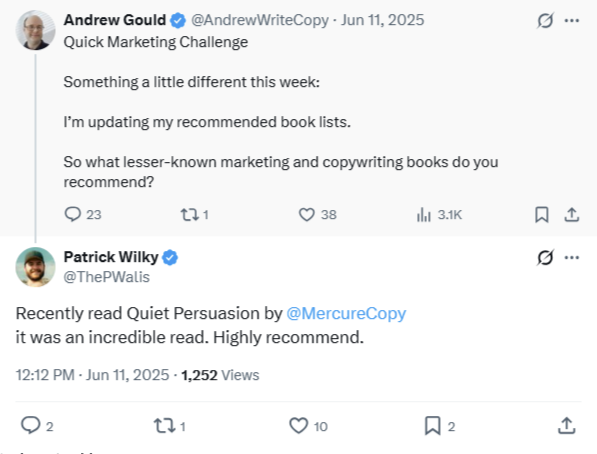
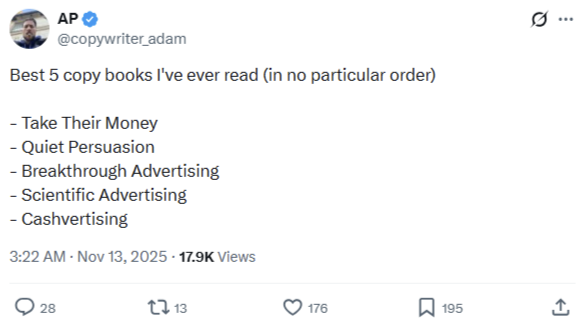
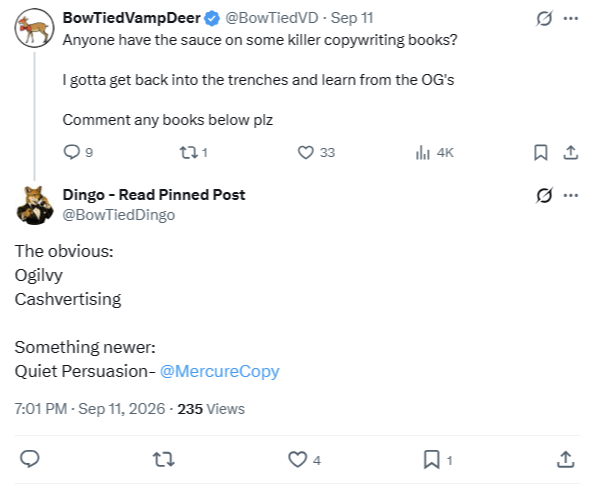
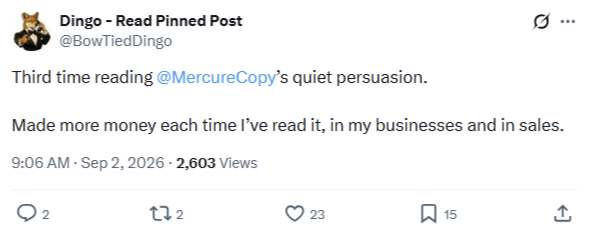
Which is why, in Quiet Persuasion, I say the bad guy has to be easy to beat…
And the only thing that beats him is your mechanism, the reason your product was built differently. Kind of like kryptonite, which works on Superman and on nobody else.
So the villain is what gets him to stop, and the mechanism is what gets him to believe you.
Some people love a brand so much they get its logo tattooed on their arm, and it’s never because the product is the best on the market…
Harley-Davidson is the classic example.
Plenty of bikes are faster or cheaper, and yet you’ll find guys with that logo on them for life, which is pretty wild when you think about it.
See, what those guys are attached to is not the bike…
It’s everything that comes with it: the jacket, the group rides, the way other riders wave at them on the road…
And above all, the feeling of being part of something with its own style and its own way of doing things.
Harley built an entire world around a motorcycle.
And once you’re inside it, buying another jacket or your next bike is not a decision you need to think hard about, because it’s just what someone like you does.
That’s what world-building is, and it’s what my next article is about.
The easiest sale you’ll ever make is to someone who feels like it’s his JOB to buy…
And the best part is, there’s a way to put people in that position without ever pushing them…
Think of someone who gets a dog.
Nobody has to convince him to buy food, a lead, a bed, toys, or pay for trips to the vet. He doesn’t compare prices for hours or wonder if it’s worth it.
He pays for all of it, because that’s what a dog owner does.
The role has rules, and spending money is one of them.
Now what if you could hand people a role like that?
Well, a toy company did it in the 90s...
If you were born earlier than that, you remember Tamagotchis.
A tiny egg-shaped screen with a pixel pet inside. You had to feed it at set hours, clean up its shit, play with it…
And if you forgot, it got sick and died.
Tens of millions of people looked after theirs, hanging the egg-shaped screen to their necks like trophies.
Kids worldwide got so addicted schools had to ban them.
Nobody had to teach anyone how to care for it. People took on a role they already knew, pet owner, and followed its rules on their own.
And yet, Bandai never took advantage of it…
A pet owner expects to pay for food, toys and the vet.
But the original Tamagotchi never sold any of it.
It took its inventors almost 30 years to open a shop inside that world.
And that, is the power of world-building.
You put someone in a role he knows the rules of, and he’ll follow them on his own without questioning them…
Including the ones that involve paying.
You just have to remember to put a shop in your world, preferably without waiting 30 years.