MD, PhD. Gastroenterology and IBD. Norwegian University of Science, NTNU #ECCO National Rep #UEG Education Committee @YOGI_IBD Founder Keen on original ideas!💡
Thanks to #UEG for the invitation to participate in the promo for our new exciting event UEGW 2020 Virtual! 🙌#UEGEdu@myUEG It´s going to be amazing! Tagging @RuiCastroHD@siaq82 See you soon! 🧙♂️
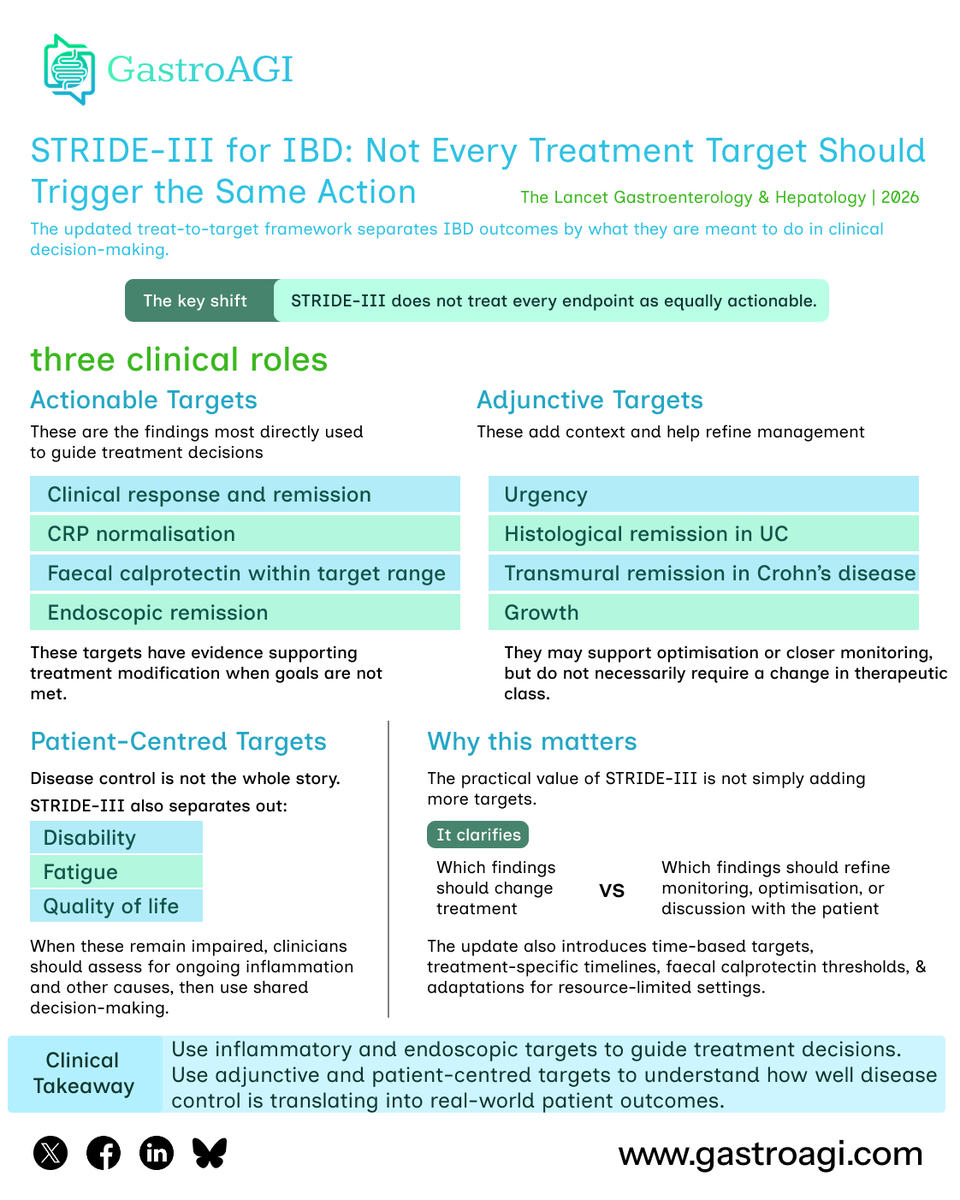
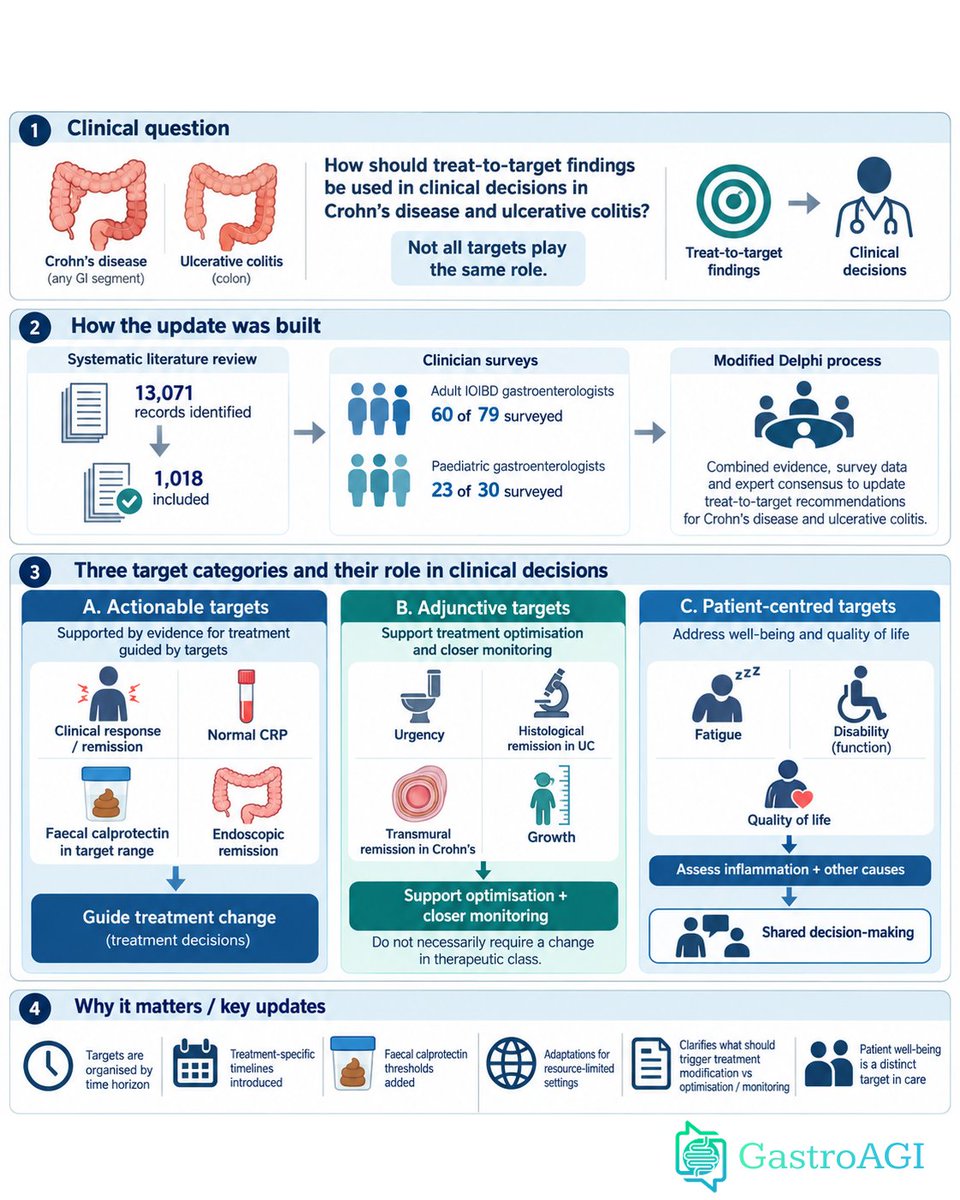
STRIDE-III makes an important distinction: not every IBD target should trigger the same clinical action.
Some guide treatment change, others refine monitoring, and patient-centred outcomes remain part of treat-to-target care.
#IBD#CrohnsDisease#UlcerativeColitis #TreatToTarget #Gastroenterology #ClinicalGuidelines #GastroAGI
First thoughts on VERDICT ... pending publication of the full manuscript by @vipuljairath and colleagues.
672 pts with mod-sev UC randomised to 1 of 3 targets on a vedo-based algorithm (stepped up to q4w if needed), with central reading of endoscopy and histology:
• G1: symptoms
• G2: + endoscopic remission (MES 0–1)
• G3: + histological remission (Geboes <2B.0)
The primary outcome was time to a UC complication over up to 80 weeks from reaching the target.
Mean age was 41, with eight years of disease, a Mayo score of 8.7, nearly two-thirds Mayo 3, almost half on steroids and a fifth after an advanced therapy. By week 48, 74% (G1), 56% (G2) and 52% (G3) had reached their targets.
Treating to endoscopy made a huge difference: 22% of G1 had a UC complication, against 7% in G2 and 9% in G3. The primary comparison, histology (G3) against symptoms (G1), gave a hazard ratio of 0.33 (95% CI 0.17 to 0.67), and endoscopy against symptoms (G2 vs G1) gave 0.30 (0.14 to 0.64).
In the Q&A, Vip said the effect was greater still at Mayo 0 (data not shown). About half the complications were rescue therapy for a flare; only one was an admission and none a colectomy. We don't know what happened to the patients who did not meet their targets, across all groups.
But there was no clear additive benefit from histology: G3 vs G2 had a HR of 1.10 (0.45 to 2.69).
Read that with one more number. 79% of group 2 (99 of 125) were also in histological remission when they reached their endoscopic target, so the groups were clinically similar and the comparison rested on about one in five.
And endoscopy was read centrally. When it is, Mayo 0 is usually free of neutrophils: 84% in LUCENT and over 90% in QUASAR. Local reading is another matter. In OCTAVE, central readers confirmed only 38 to 46% of local Mayo 0 calls.
We do not have the equivalent data on paired centrally read endoscopy plus histology in UC patients not on advanced therapy (as far as I know) - that might matter in the real world. We know histological inflammation carries long-term risk, including cancer. VERDICT covers only one to two years. Most of that long-term evidence comes from scoring old H&E slides, recut from paraffin blocks if needed. You can't go back and re-read an old endoscopy the same way.
So ... with endoscopy read well, histology added nothing we could detect. In the clinic, where we read our own scopes, it may still catch what endoscopy misses.
FINALLY ... in the debate on histology vs endoscopy we must not lose sight of just how important VERDICT is for treat-to-target in UC. It is very clear that treating to endoscopic healing makes a huge difference to important patient outcomes.
Of course, I still want to know if calprotectin is a good enough proxy for the real world ...
ok let's await the full paper!
🌎 Our multinational IBD study in northern Central America found UC predominated, with delayed diagnosis and limited access to testing and advanced therapies.
📖Published in @IBDjournals
🔗 https://t.co/dWkZouIEoK
Thanks to my coauthors and mentors, @DebProctorMD and @AlexLevyMD@YaleDigestive
Heading home after my first #UEGWeek at Barcelona.
Getting updated. Lots of contemplation. New ideas. Motivation.
But most of all, meeting friends and mentors from around the world.
Thank you @my_ueg ! Now leaving Barcelona with wonderful memories :)
Diet can enhance the efficacy of biologics
It’s time to integrate diet AND drugs for better outcomes in patients with CD compared to biologics alone, according to @BonehRotem#UEGWeek2026@my_ueg
Prof Florian Rieder: (OP-003) PALI-2108 (PDE4 inhibitor) for fibrostenosing Crohn’s was safe and possibly effective (n=5) with favorable PK and target engagement #uegweek2026
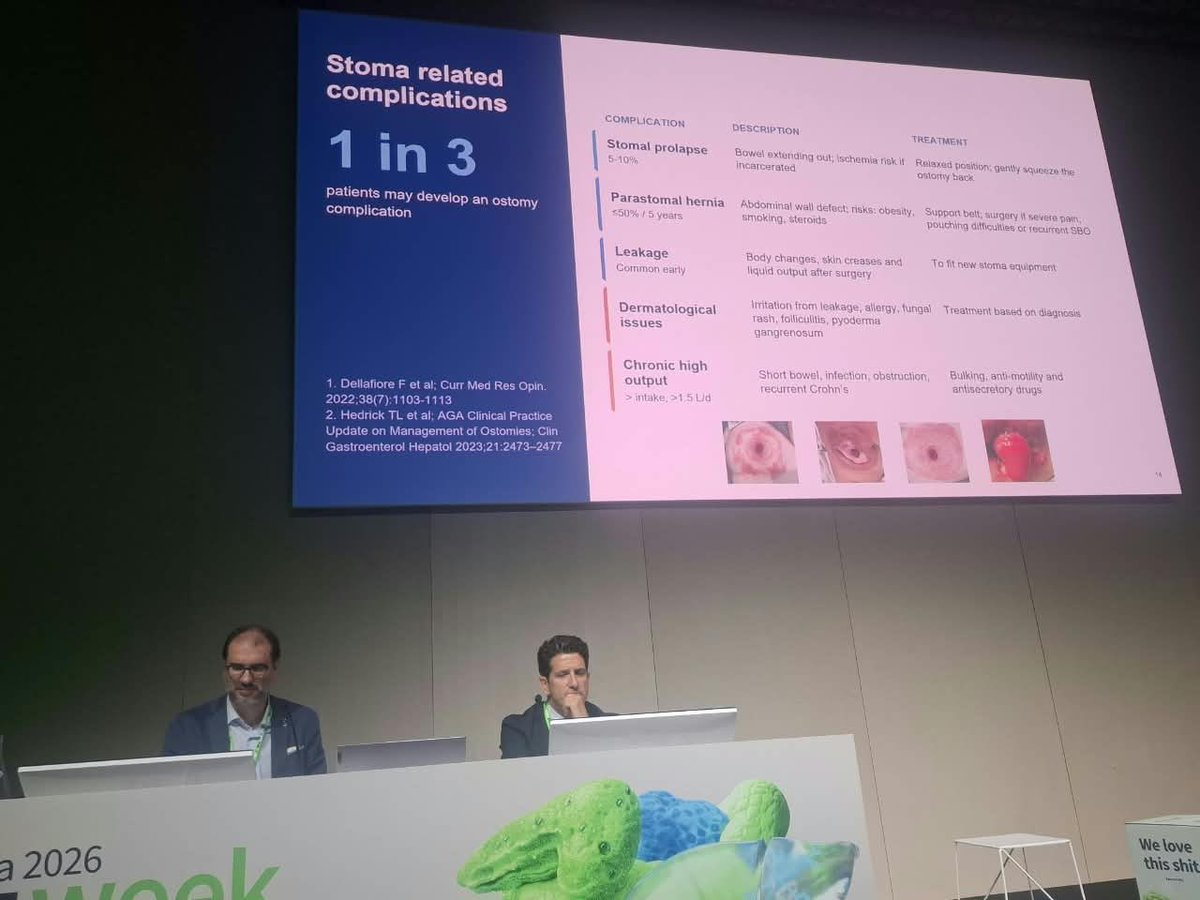
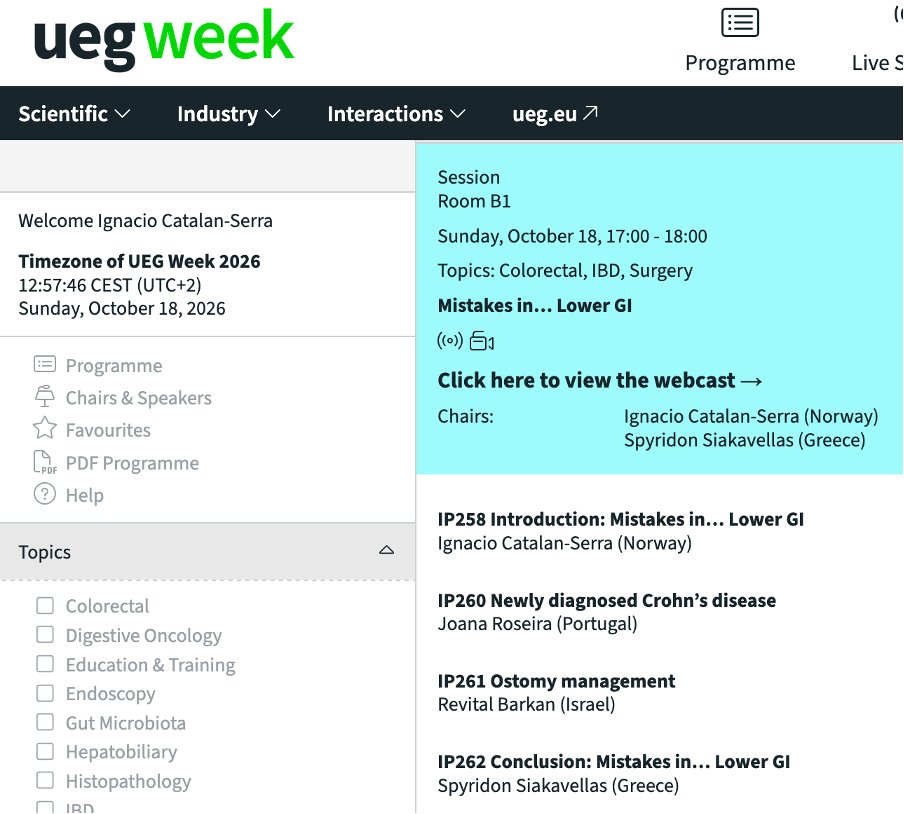
❇️ See you later today for a new "Mistakes in Lower GI" session at @UegWeek 26 Barcelona
Practical approaches to Newly disgnosed Crohn´s patients and Ostomy management. Join the conversation!
Welcome! 🖐️
Dear YOGI-IBD friends! @YOGI_IBD
🖐️ Are you a "young" GI with interest in IBD and want to meet colleagues from all over the 🌍 at @UEGW26 Barcelona?
🟣 This is an invitation together with our friends from @GI_NutritionFdn!
📌 Monday 3 pm
⛺️ Nutrition Hub Fira BCN