Before Machine Learning [Volume 3] - Probability & Statistics for AI: The Fundamental Mathematics for Data Science and AI [400 pages]
Get it here: https://t.co/2FeC0716mu
Also...
Vol. 1 - Linear Algebra: https://t.co/ar2X2fo8Xo
Vol. 2 - Calculus: https://t.co/CZ6GOTlwkT
Now ML - Supervised Learning: https://t.co/nWjirIjQby
Mr. Al-Tayeb Abbas Fadlallh, Senior Specialist, Strategic Planning and Communications at ICIEC, moderated the session “Credit Insurance and Commercial Arbitration: Mechanisms for Enhancing International Trade, Managing Risks, and Recovering Losses” at the Mediterranean Forum for International Trade in Tunisia on 6 October 2026.
Bringing together banking, investment and legal professionals, the session focused on the role of credit insurance and commercial arbitration in managing trade risks, resolving disputes, and recovering losses.
ICIEC’s participation reflects its continued engagement with industry partners to strengthen risk mitigation and facilitate trade and investment across its Member States.
#ICIEC #InternationalTrade #CreditInsurance #RiskManagement #Partnerships
SubDGuide: A Modeler-Inspired Agentic Workflow for Mesh-to-SubD Reconstruction
Mengnan Jiang, Christian Franke, Michele Franco Adesso, Antonio Haas, Grace Li Zhang
https://t.co/0HnHHUVA39
Abstract:
Subdivision surfaces represent free-form geometry through a sparse control cage, but recovering that cage from a dense mesh is not merely a fitting problem: the system must infer where control is needed, which curves encode design features, and when an initial result should be revised. We present SubDGuide, a modeler-inspired agentic workflow for this task. Stage A reads aligned multiview geometric evidence and produces a compact plan for cage resolution, feature mapping, and broad-form fitting. Stage B inspects the resulting surface, requests targeted diagnostics, and chooses repair, rollback, or stopping actions. Geometry tools execute and verify every change; the planner never generates vertices or connectivity.
On a fixed evaluation cohort, SubDGuide improves all five reported metrics over automatic remeshing: median Chamfer-L1 decreases from 0.641% to 0.443% of the target bounding-box diagonal, and F-score at a 1% tolerance increases from 82.00% to 92.78%. Stateful feedback improves four of five reported median metrics over one-shot planning, while verification retains the earlier checkpoint when a proposal is unhelpful. The same interface supports six multimodal planners, showing how semantic judgment can guide a practical, inspectable mesh-to-SubD workflow.
The Cybersecurity #Leadership Handbook for the #CISO and the #CEO
An essential read for all #leaders around #cybersecurity, looking beyond the #technology horizon, into the real dynamics of #security transformation
UPDATED edition now available here >>https://t.co/jumqAWZXvU
Mission-critical electronics built for real-world defense operations: we've welcomed Arctic RAVN to UST, developer of high-performance ESCs and flight controllers for drones and unmanned systems.
Discover Arctic RAVN and their electronics on UST⬇
https://t.co/JDzYssKmI8
Africa’s sustainable textile opportunity starts with what it grows, but cannot end at the farm gate. 🌱
From cotton to yarn, fabric, and apparel, Africa must invest in processing, traceability, and regional value chains to capture more value.
🔗https://t.co/UdKMBeKh2r
Continual Learning for 6-DoF Grasp Synthesis via Experience and Demonstrations
Giulio Schiavi, Andrei Cramariuc, Michael Pantic, Roland Siegwart
https://t.co/X1FI2nvbbY [𝚌𝚜.𝚁𝙾 𝚌𝚜.𝙻𝙶]
💬Accepted to CoRL 2026
Happy first birthday, Arduino UNO Q! 🎉
A year ago, we shared two pieces of news at once. Arduino was joining the Qualcomm Technologies family, and the UNO Q was on its way.
The promise was simple: bring powerful computing and edge AI to makers, students, and professionals, without losing the openness, creativity, and joy that make Arduino what it is.
12 months later, you have responded to our biggest announcement ever in ways we could not have scripted. You’ve built. You’ve experimented. You’ve pushed boundaries. And you’ve shown us what happens when you put new tools in the hands of a curious, creative community.
Today, we’re looking back at year one and celebrating everything you’ve made possible. Thank you for being part of it. This is just the beginning!
Read more in our blog post: https://t.co/Usf0Wb7zpY
La demande mondiale de #TechnologiesPropres s’accélère.
Notre plus récent rapport sur le secteur présente les débouchés qui façonneront la croissance et la compétitivité futures du Canada.
➡️ https://t.co/fysUV7M9aq
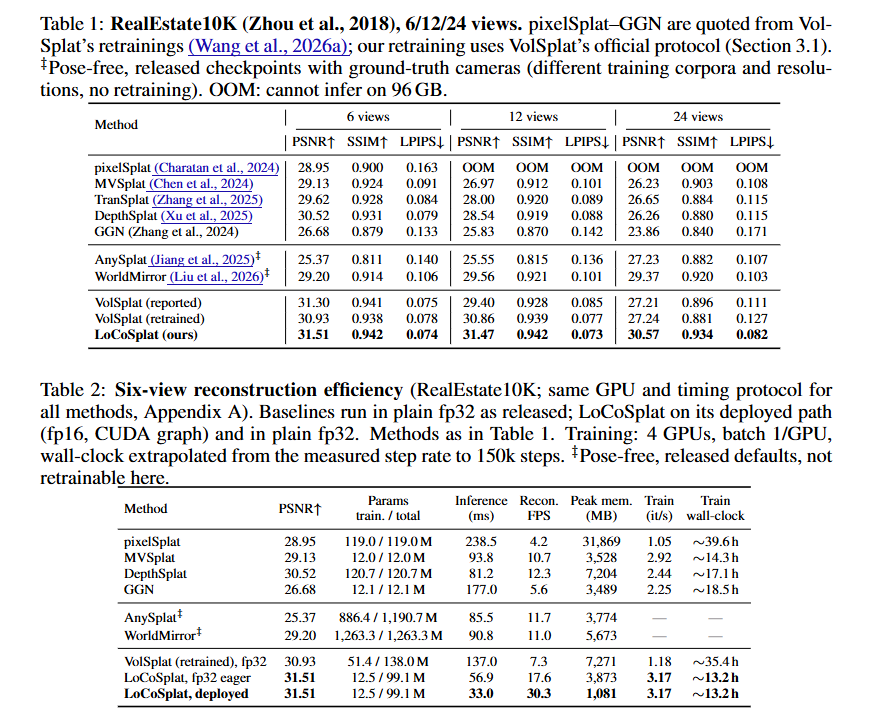
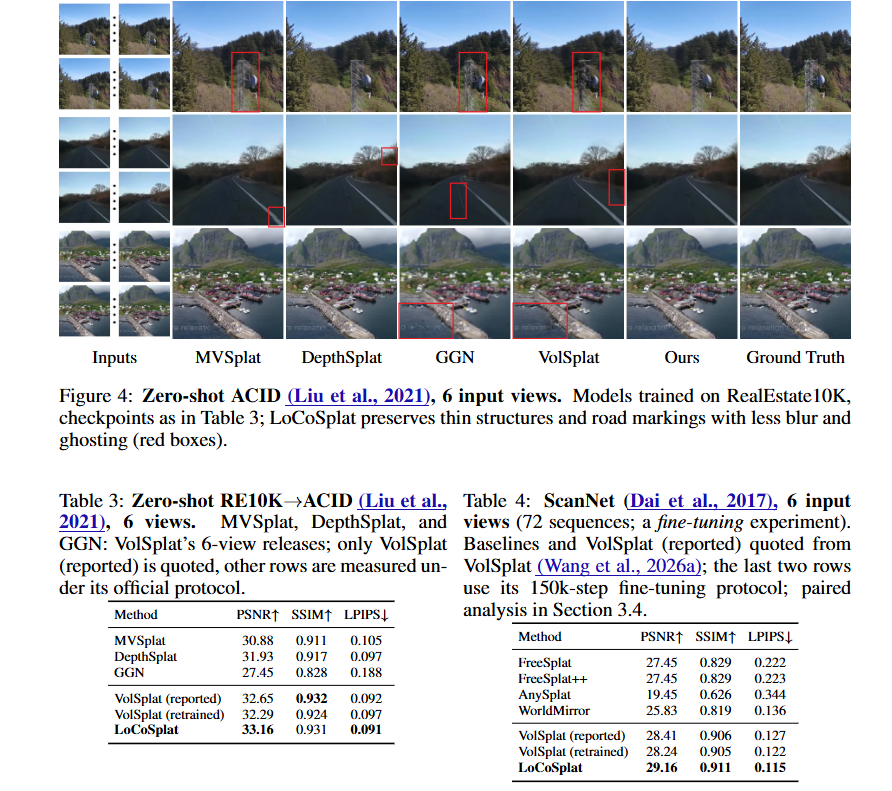
LoCoSplat: Real-Time Feed-Forward 3D Gaussian Splatting with Minimal 3D Reasoning
Sinan Wang, Jinjin He, Yuchen Sun, Duowen Chen, Shenyifan Lu, Bo Zhu
tl;dr: 3D stage has no learned 3D network
https://t.co/jbYsFfJAN0
New Course: A Sim-to-Real VLA Pipeline With Seeed reBot Arm and NVIDIA Isaac
Build an end-to-end physical AI workflow—from LeRobot teleoperation and NVIDIA Isaac Sim digital twins to GR00T VLA fine-tuning and real-time NVIDIA Jetson edge deployment.
Build a Sim-to-Real Workflow: https://t.co/9qDpSJNA3Z
Satellite IoT is not one-size-fits-all. A container tracker sending 20 bytes and a smartphone streaming video do not need the same network. Stop asking which tech is best and start asking what your device actually needs. #IoT#SatelliteIoT https://t.co/Ac1xKOxsuJ
🛠️ Building on NVIDIA Jetson? Learn how to configure a remote development environment with Codex.
This walkthrough covers SSH over USB, connecting your project to the Codex desktop app, and installing NVIDIA Jetson Device Skills.
You’ll also prepare Docker for GPU workloads and verify GPU access with a CUDA container test.
Get started 👉 https://t.co/ploBZ9mAdu
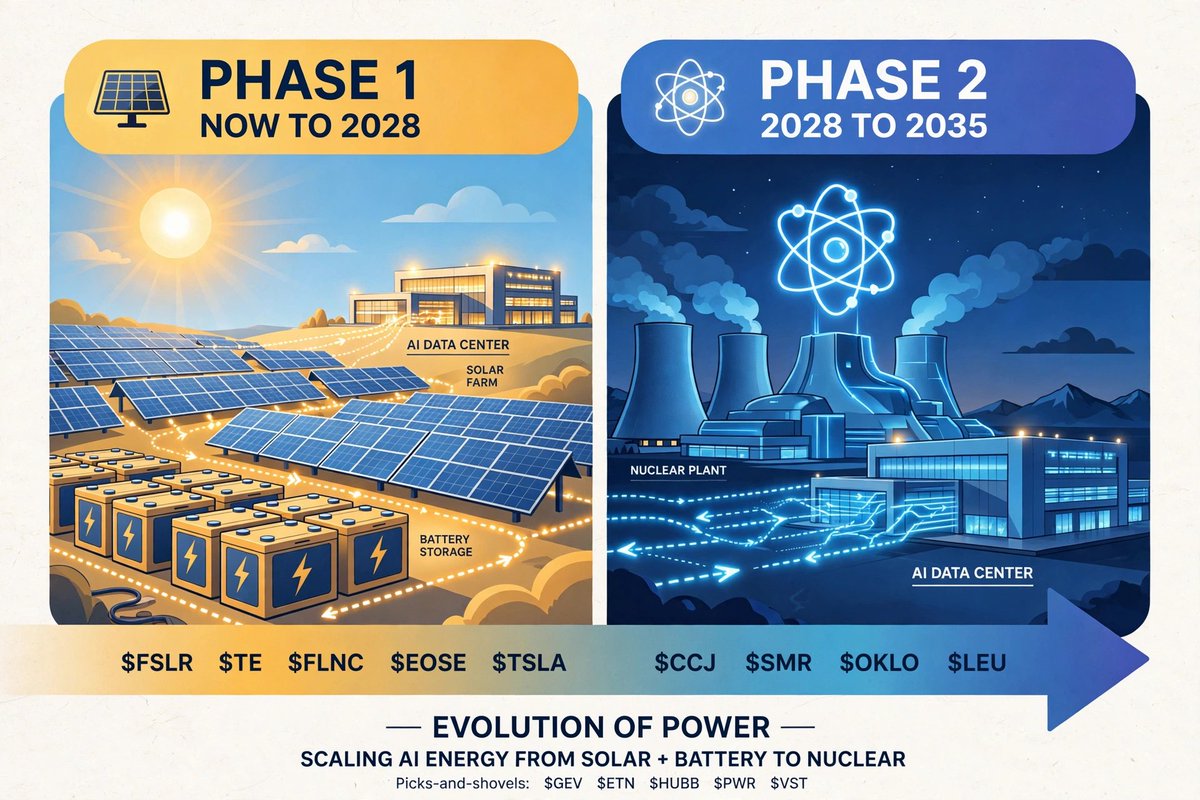
Energy constraints are real and we're still early.
Everyone's modeling AI data center demand like power is infinite. It isn't. Morgan Stanley just put a number on it: 34% net US power shortfall through 2028 — 32 GW. The grid can't build that fast.
Short term, the fix is renewables and batteries. Solar and storage are the only things that deploy in 12-18 months. That's why the Phase 1 names — solar, battery storage, gas peakers — are getting the first bid.
Long term, it's nuclear. Nothing else gives you 24/7 clean baseload at data center scale. SMRs, uranium, enrichment — that's the 2028-2035 buildout.
The market is still pricing power like a free input. It won't be.
Solar now, atoms next.
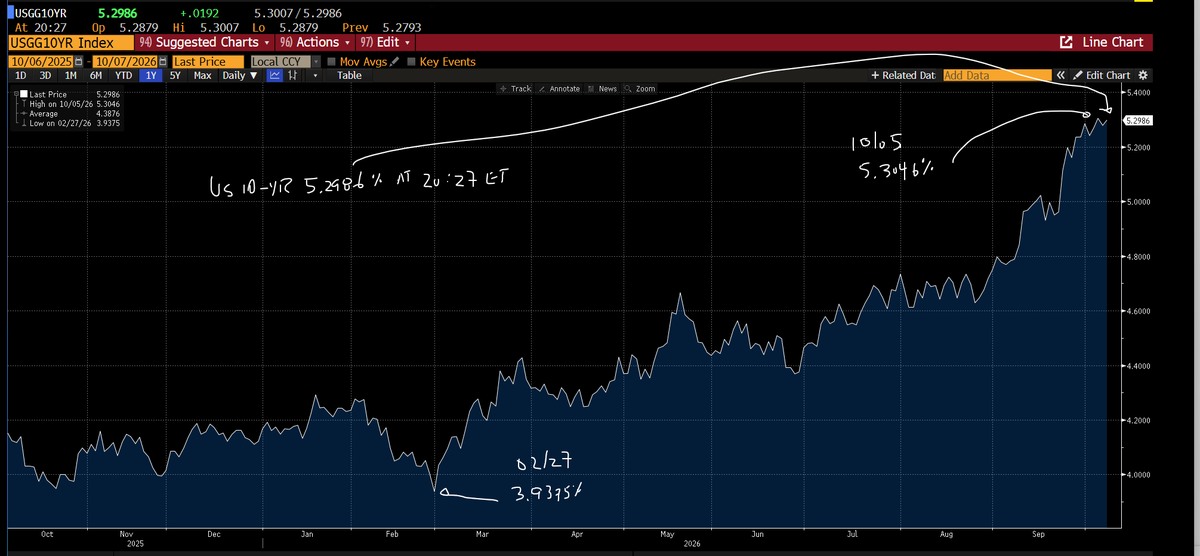
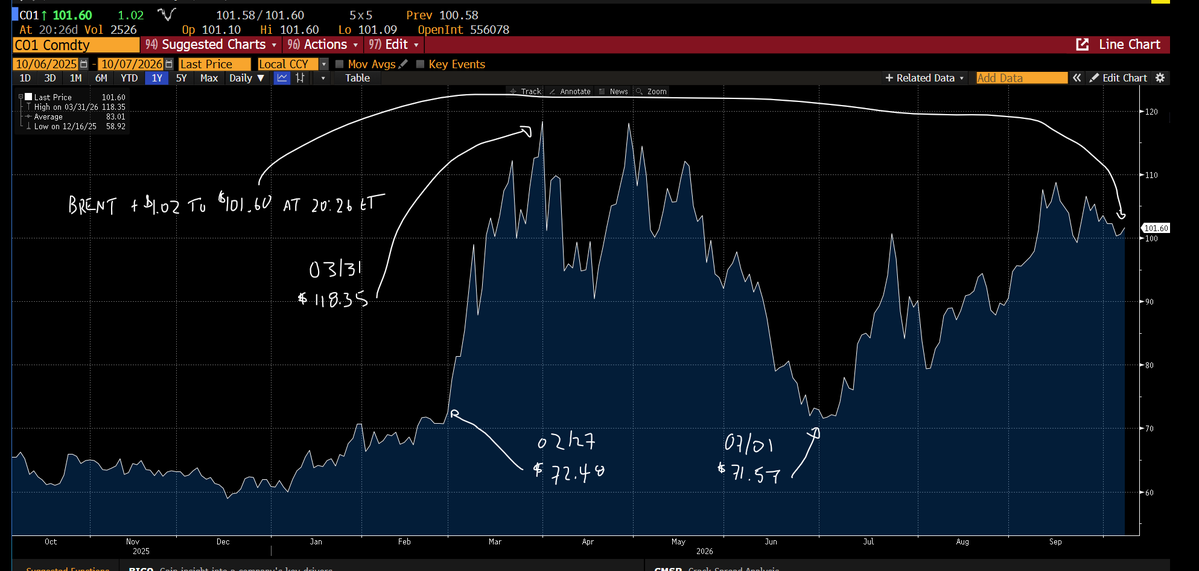
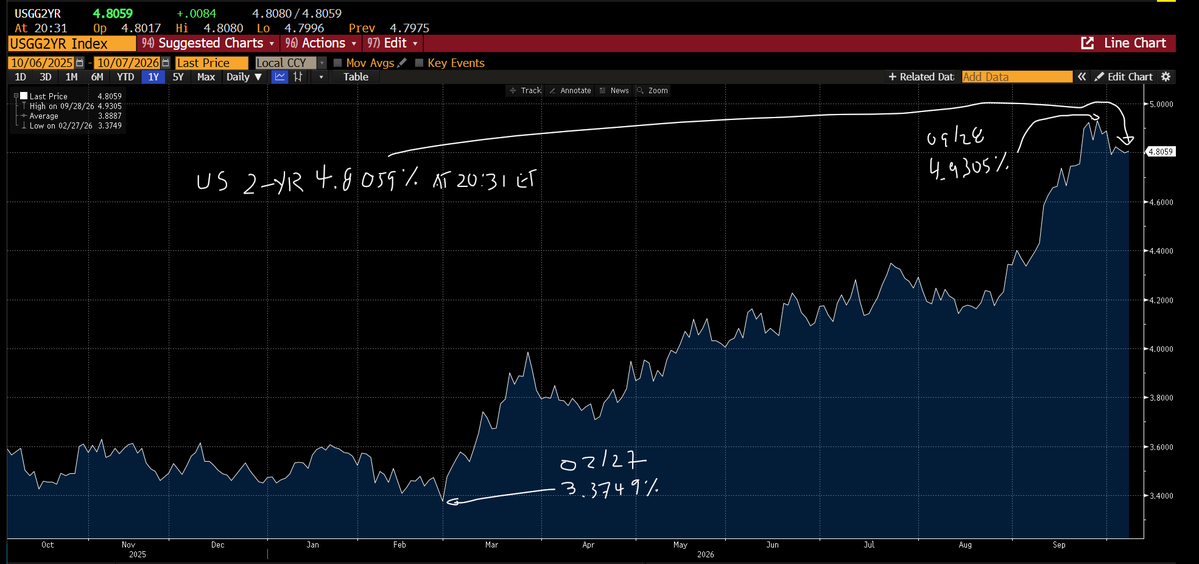
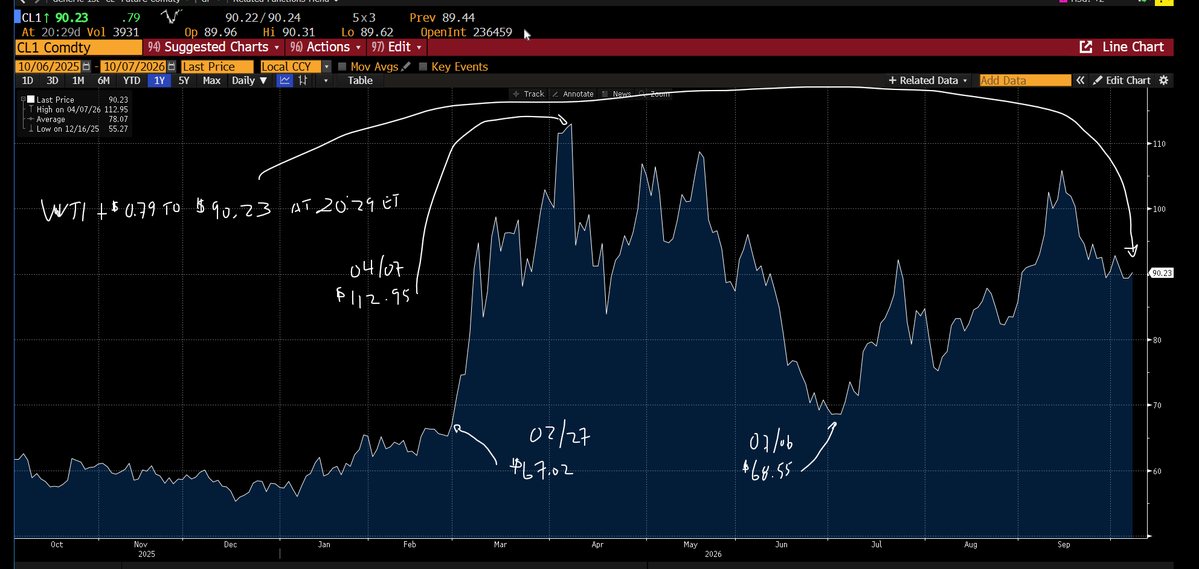
It’s early doors by 2026 standards, but the below ⬇️ is the silliest, shallowest take of the day so far from the “because markets” thinkers at Bloomberg, who are paddling out into deep, dark, shark-infested waters on a shiny intellectual inflatable rubber duck.
Do borrowing costs matter? Hugely.
Are they the metric of hegemony? Hardly.
Were Japan or Germany heading that way when they had negative rates? Of course, their neomercantilist and neo-Merkelcantilist models weren’t dominating global supply chains while deliberately running at a loss, with double digit fiscal deficits on top, all propped up by capital controls and a political rather than “because markets” central bank - and that supply chain domination DOES back real power.
However, there is a Grand Macro Strategy that can match it; and those who know know that U.S. borrowing costs can actually be a weapon vs the rest of the world.
If bad analysis walks like a duck and quacks like a duck…







![KirkDBorne's tweet photo. Before Machine Learning [Volume 3] - Probability & Statistics for AI: The Fundamental Mathematics for Data Science and AI [400 pages]
Get it here: https://t.co/2FeC0716mu
Also...
Vol. 1 - Linear Algebra: https://t.co/ar2X2fo8Xo
Vol. 2 - Calculus: https://t.co/CZ6GOTlwkT
Now ML - Supervised Learning: https://t.co/nWjirIjQby](https://pbs.twimg.com/media/HUN5X02XIAABNV3.jpg)


![OWW's tweet photo. Continual Learning for 6-DoF Grasp Synthesis via Experience and Demonstrations
Giulio Schiavi, Andrei Cramariuc, Michael Pantic, Roland Siegwart
https://t.co/X1FI2nvbbY [𝚌𝚜.𝚁𝙾 𝚌𝚜.𝙻𝙶]
💬Accepted to CoRL 2026 https://t.co/hARywPaXKF](https://pbs.twimg.com/media/HUHc9ovXsAANjrc.png)


![KirkDBorne's tweet photo. Understanding Data — A 21st Century Approach to Statistics and Data Science: https://t.co/xUom8yOyOC
[676 pages. Published April 2026] https://t.co/pkUru8hvuL](https://pbs.twimg.com/media/HUEC5Y4XEAEfYJF.jpg)
![OWW's tweet photo. Benchmarking and Enhancing Skill-Level Memory for Partially Observable Robotic Manipulation
Yansong Shi, Jiange Yang, Xijie Yang, Shaowei Zhang, Yuhan Zhu, Tao Lu, Limin Wang
https://t.co/WjuvgbFJAm [𝚌𝚜.𝚁𝙾]
💬Project: https://t.co/gsrf93w0BJ https://t.co/MRi0CiwEpd](https://pbs.twimg.com/media/HT5GXZuXgAAtkb7.png)


