@KarishmaAziz_ Unknowingly he may have applied 3D success mantras.
Dream: Define a specific, emotionally charged goal.
Determination: Expect and plan for setbacks; treat them as data, not defeat.
Dedication: Build non-negotiable daily systems (even 1-2 focused hours beat all-nighters).
@awesh29@Imranmasood_Inc बड़बोलेपन से हमेशा बचना चाहिए क्योंकि यह व्यक्ति के व्यक्तित्व और विश्वसनीयता दोनों को नुकसान पहुंचाता है। बातचीत में सिर्फ अपनी बात कहने के बजाय दूसरों को भी सुनें। इससे आपको नई चीजें सीखने को मिलेंगी, बिना सोचे-समझे बोलने से बचें। हमेशा यथार्थ और ठोस बातों को ही महत्व दें!
@AaishaaSoomro Her bravery in speaking out about family distrust highlights the strength women show every day in the face of doubt and hardship.
Respect to this incredibly brave girl.
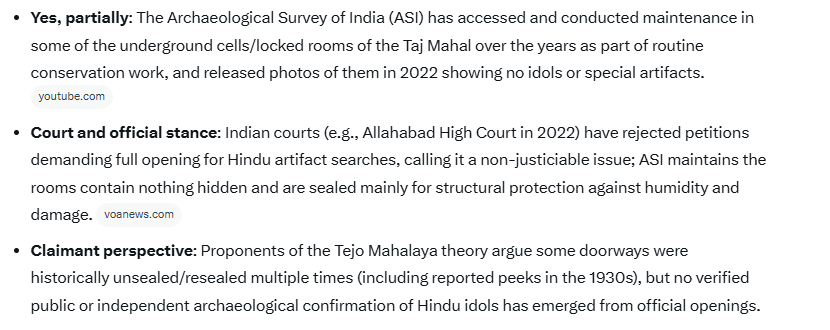
@Vishnu_Jain1 The door was opened before and inside picture was released by ASI. The Allahabad High Court in 2022 have rejected petitions demanding full opening.
https://t.co/ut2OnFe60k
@trainwalebhaiya Your comparison is misleading. Not all old trains have been replaced with new ones. Only a few new trains have been introduced, while most of the older trains are still in service. Meanwhile, local people continue to suffer due to inadequate local train services.
@dilipjain1979@LiveLawIndia A judge may interpret it differently. Since an Indian passport is issued only to Indian citizens, it can be considered evidence of Indian citizenship.
JUST IN: After two people climbed to the top of the Empire State Building and unfurled a banner on top of its spire Wednesday afternoon, one of the climbers appeared to propose to the other. https://t.co/ngG3jOeTBU
@Kapil_Jyani_ Yeh sab to hindi main baat kar rahe hain, phir saudi kaise hogaya? sand rajasthan main bhi hote hain.
Reach ke liye kuch bhi video ke caption daal do?
The discussion sparked by a recent statement on Passport Seva Divas has generated more heat than light.
The Ministry of External Affairs stated that a passport is a travel document, not a document of citizenship. Legally, that is correct. A passport is issued under the Passports Act, while citizenship is governed by the Citizenship Act, 1955. One law regulates the document; the other regulates the legal status.
But law and public understanding are not always the same.
For most Indians, the passport is the most authoritative document the Republic issues. It bears the name of the Republic of India, carries the holder’s identity, and is accepted around the world because foreign governments trust that India has verified the bearer’s nationality before issuing it. It is therefore entirely understandable that many people asked: if a passport is not proof of citizenship, then what is?
The answer requires some nuance.
A passport does not create citizenship. Nor is it the legal instrument that finally determines citizenship if that status is challenged before a court. Like many democracies, India distinguishes between citizenship law and passport law. In rare cases involving fraud, disputed parentage or illegal acquisition, citizenship may have to be established through the provisions of the Citizenship Act and supporting evidence. That is why a passport is not regarded in law as conclusive proof in every conceivable circumstance.
But that should not be confused with its practical significance.
A passport is issued only after the Government has satisfied itself that the applicant is entitled to one. In everyday life, and in international travel, it is the strongest evidence of Indian nationality that most citizens will ever possess. Nothing said by the MEA changes that. No immigration officer abroad will suddenly regard an Indian passport with suspicion because of a legal clarification made in New Delhi.
The episode does, however, remind us of a larger challenge.
India’s systems of civil registration developed unevenly over many decades. Millions of older Indians were born when birth registration was incomplete. Names were recorded differently across school certificates, land records and electoral rolls. The painful experience of the Assam NRC showed how documentary inconsistencies can create profound hardship when citizenship itself becomes the subject of legal scrutiny.
The lesson, therefore, is not that passports have somehow lost their value. It is that India needs stronger and more comprehensive civil registration, universal birth registration and reliable archival records so that citizenship can never become hostage to missing or inconsistent paperwork.
Sometimes a legally precise statement can create unnecessary public anxiety if it is not accompanied by explanation. A better way of putting it might have been this:
A passport is issued only after the Government has verified that the applicant is an Indian citizen. While citizenship itself is governed by the Citizenship Act, the passport remains the Republic’s most trusted document for international travel and, in ordinary life, the clearest evidence of Indian nationality.
That is both legally accurate and reassuring. The law need not be diluted, but neither should public confidence in one of the Republic’s most important documents.
To distil the argument:
A passport is issued because the Government has satisfied itself that you are an Indian citizen. It is therefore powerful evidence of citizenship in ordinary life and in international travel. But in a legal dispute over citizenship itself, the governing law remains the Citizenship Act, and a passport is not conclusive proof that overrides all other evidence
@NavitaSrikant@Javedakhtarjadu You're creating the impression that Indians living abroad may not be genuine citizens of India, that some might have obtained passports through forged documents. Such a claim risks undermining the credibility of legitimate citizens and casts unwarranted doubt on their nationality
@PMNehru Podcasters often allow false or misleading statements to remain unchallenged, not out of ignorance but as a deliberate strategy. By fostering controversy and debate, they increase audience engagement and boost viewership.