@poojaofficial5 Any new adaptation may attract early buyers, but it is almost always subject to some challenges.
If it was me, I’d not go for hybrid variants other than Petrol-CNG which has been around for a while, baaki normal petrol diesel cars to hain hi.
Explore XUV700
Kailasa was just scanned with lasers, and if you haven’t been following this place, hold on.
What’s being uncovered here won’t just rewrite Indian history. It could rewrite human history and prove Ancient India had tools far more advanced than we’ve been told.
But first, you have to understand what you’re looking at. Kailasa wasn’t built. It was removed from the side of a mountain. That means there was no room for mistakes while carving one of the hardest rocks on Earth. Between 200,000 and 400,000 tons of basalt were removed to create it. The first mystery is simple: we don’t know where it all went. We also don’t truly know when it was built. The main dating sources are two land grants, but that doesn’t tell us when the actual carving began. Dating matters because it would tell us what tools they had. Ancient India had steel by 600 BC, which later became the famous Damascus steel. But basalt is hardened lava. It’s around a 6 on the Mohs scale, meaning steel barely scratches it. In 1682, a Mughal emperor ordered 1,000 workers to destroy Kailasa. They failed. That alone shows how hard this stone is. Even with modern alloys, humans barely make a dent. Russian researchers tested this by having people strike basalt with modern tools, then measuring the removed volume with photogrammetry. The result? One person working every day for 3 years could remove only about 1 cubic meter. And since Kailasa is unfinished, we still have tool marks. Those marks show cuts deeper than what modern hydraulic breakers can achieve. To penetrate basalt that deeply, we’d normally need huge machinery. But machines that size wouldn’t fit in many of these spaces. So clearly, they had different tools. Not just powerful tools. Precision tools. The detail in Kailasa’s carvings looks like work done in soft soapstone, except it’s carved into basalt. What we know for sure is that our assumptions about ancient India are wrong. At minimum, they were far more advanced than we give them credit for. At most, something was happening back then that we still don’t fully comprehend.
@gregisenberg I was literally thinking about this yesterday.
That now everyone is creating AI agents, will the be employed and interviewed as well?
And then reading this today!! 😃
Interesting time to be alive !!
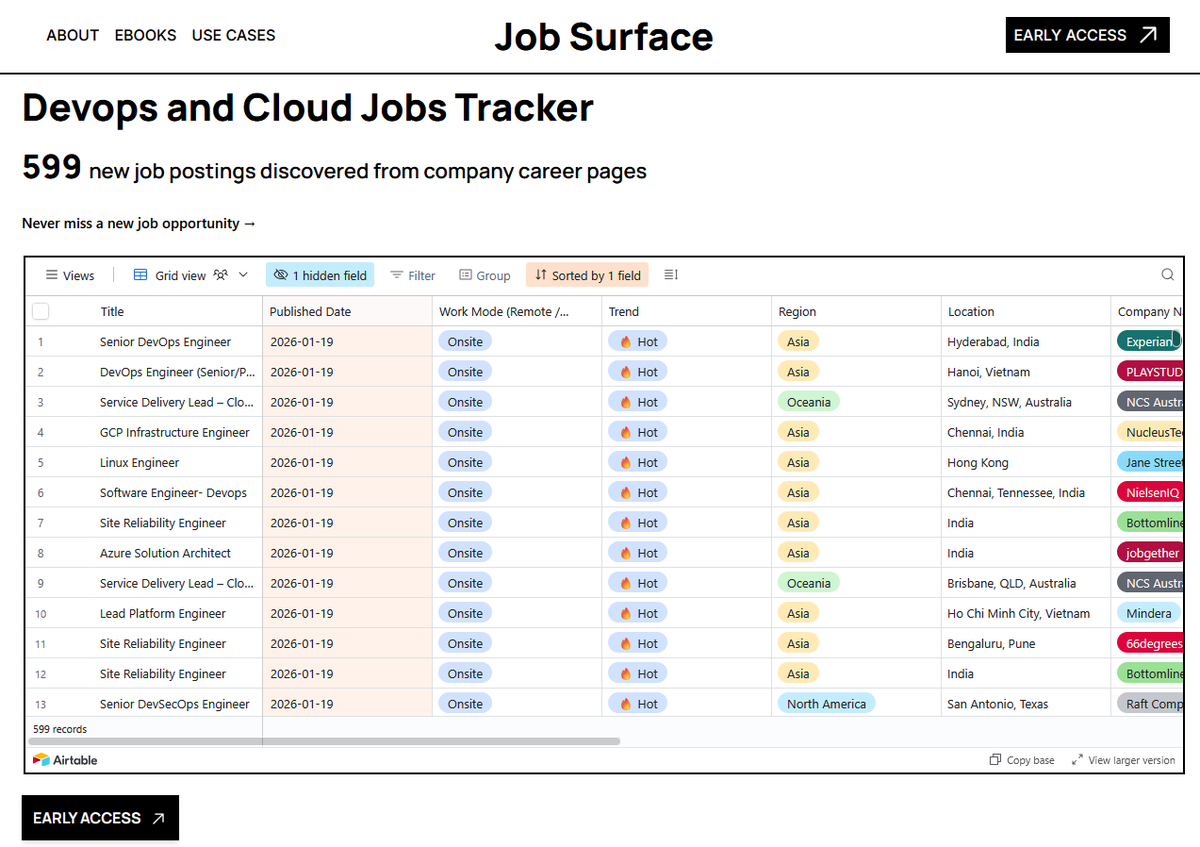
Happy to announce Job Surface – a tracker of DevOps and Cloud job roles not listed on LinkedIn or popular job boards.
Most job boards rely on user-submitted postings.
We scan the internet for hidden DevOps and Cloud jobs, so you do not have to, giving you an edge with lower competition.
Receive job opportunities straight to your inbox.
First Edition is scheduled to go tomorrow (21 Jan, 7:15 PM IST / 8:45 AM EST)
Join here: https://t.co/vbZnVHROLv
👋 100% free. FOREVER.
🔁 Consider a Repost if this is helpful
@svembu 3. Those who are at par from the above two steps, include them along with the Architects in tech discussions
4. For the ones who didn’t qualify after 2, either can stay on course as per their career interests, or can be utilized as IC in projects.
@svembu 2Let the Junior engineers present the solution in an Architect forum (internal to the company/department of course). White-boarding skills can be evaluated as well.
Hey @AxisBank,
Your incapable team can’t even change the account type from PRC to Basic for 2 months.
I went to the branch with the request on 1-Nov-2025
Is it so hard to do a simple change?
@AxisBankSupport
If you don’t care for your customer, I’ll be glad to close the acc
If you are in DevOps and Cloud, these are realistic salary targets for 2026 if you play this correctly:
2 years experience: 10+ LPA
5 years experience: 20+ LPA
7 years experience: 30+ LPA
10 years experience: 40+ LPA
12 years experience: 50+ LPA
15 years experience: 70+ LPA
If I were starting my career today, I would do this:
- Target global remote product companies
- Find engineers owning the platform
- Follow them on Twitter and LinkedIn
- Study their public GitHub repositories
- Build a clone matching their stack
- Push code with clear commit history
- Write README explaining design decisions
- DM with repo link
- Ask for feedback, not jobs
- Let conversation turn into interview
The market never pays for loyalty.
It pays for proof.
And today, proof is finally in your control.
58K+ read my DevOps and Cloud newsletter: https://t.co/WBucLdwLhJ
What do we cover:
DevOps, Cloud, Kubernetes, IaC, GitOps, MLOps
🔁 Consider a repost if this is helpful.