We have multiple position opening at NVIDIA Cosmos, including
- Research Scientist of different seniority.
- System Software Engineer of different seniority
- Technical Program Manager
- Product manager
Please send your cv and a short description to [email protected]
Our team at Google Cloud AI Research is looking for a Student Researcher Intern this Fall to dive deep into long-horizon coding agents.
We’re looking for a builder. Someone who doesn’t just read about agentic workflows, but actively creates them.
What we’re looking for:
🎓 Academic Rigor: Currently pursuing a Ph.D. with a strong publication record.
💻 Technical Chops: Excellent, hands-on coding skills are an absolute must.
🤖 Agent Experience: If you’ve built or experimented with long-horizon coding agents (like Claude Code, Gemini CLI, or similar frameworks), we want to talk to you.
Come help us push the boundaries of LLM-based software engineering. 🚀
If this sounds like you, please fill out the interest form below:
🔗 https://t.co/kx7h3uJ8Rg
Please share or tag anyone who might be a good fit!
#Google #AI #PhD #LLM #AIAgents #Internship
Our Gemini Vision team @GoogleDeepMind is hiring in MTV/SF.
Join us to push the frontiers of visual perception, reasoning and generation, and contribute to Gemini, Nano Banana and Omni. Also get to do cool research such as Vision Banana 🍌: https://t.co/qphm5TxvXU.
Job posting below.
It's one of the best times to be working on Vision as the frontier is moving rapidly, come join us!
📢📢
I'm expanding my group at the ELLIS Institute Tübingen and the Max Planck Institute for Intelligent Systems and hiring 3-4 PhD students, and also visiting PhD students for funded 3-6 months stays ��💥
Research areas broadly span the safety, security, and trustworthiness of AI agents including:
• Sycophancy, decision-making, and societal implications of AI
• Autonomous agents and memory
• Multi-agent safety, security, and privacy
• Training dynamics of LLMs
• AI control and oversight
• AI for science
I'm looking for:
- Visiting PhD students with a strong computer science background and research experience.
- Students with a Master's degree and demonstrated research experience.
What we offer in Tübingen: amazing compute, collaborators, environment, and a lovely town!
If you're interested, please fill out the Google form on my website: https://t.co/oCryUUIIUR
@ELLISInst_Tue @MPI_IS
#phd #AIsafety
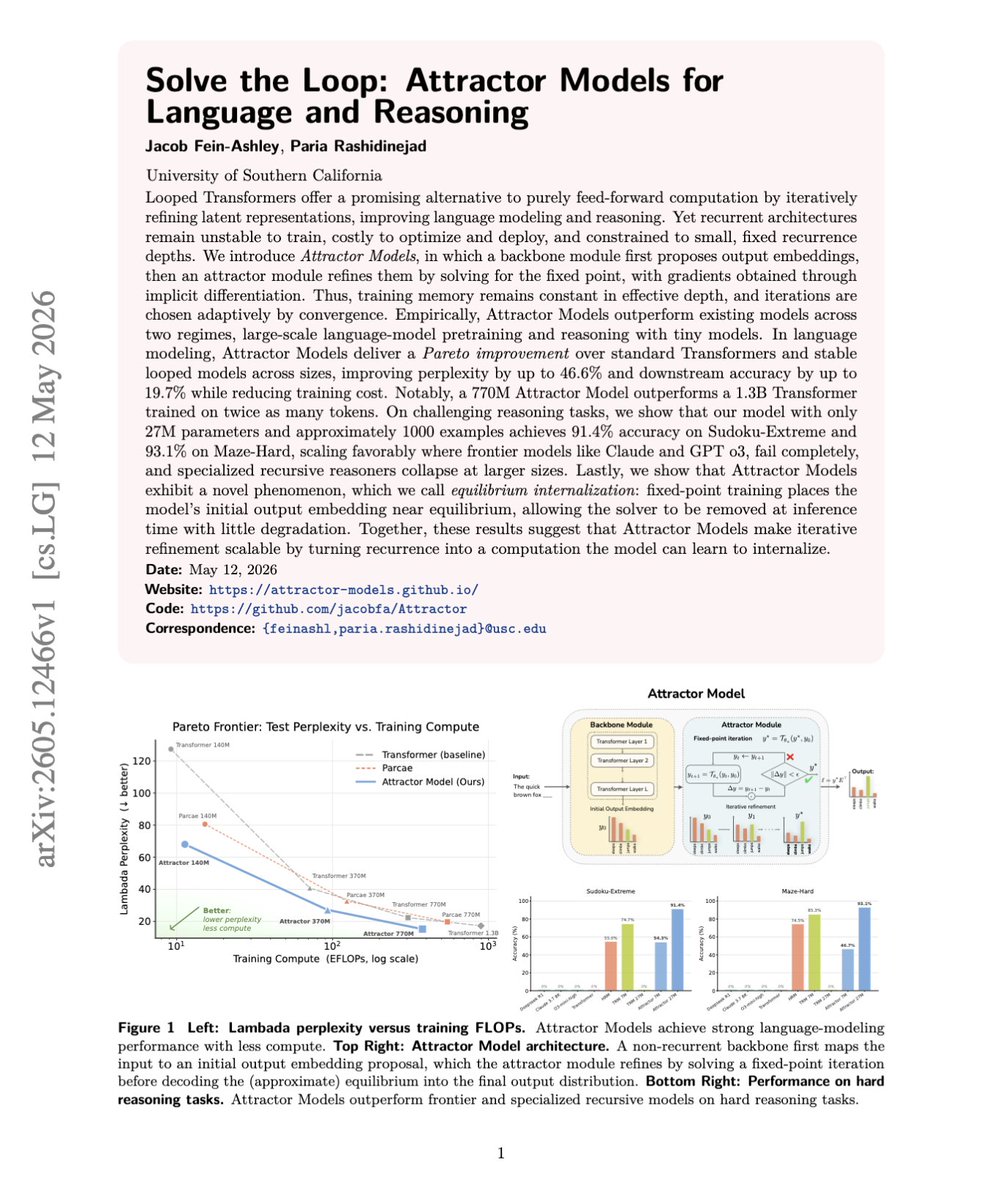
“Solve the Loop: Attractor Models for Language and Reasoning”
Looped Transformers can refine their thoughts internally, but they are usually unstable and tied to a fixed number of loops.
So this paper turned recurrence into a fixed-point problem, where a Transformer first makes an output-embedding guess, then an attractor module refines it until convergence.
This makes iterative reasoning trainable with constant memory, adaptive depth, and less compute.
The surprising part is equilibrium internalization because after training, the model learns to start near the fixed point, so the solver can almost disappear at inference.
In their experiment, a 770M Attractor Model beats a 1.3B Transformer trained on twice the tokens, and a 27M model gets 91.4% on Sudoku-Extreme and 93.1% on Maze-Hard.
Attention @arxiv authors: Our Code of Conduct states that by signing your name as an author of a paper, each author takes full responsibility for all its contents, irrespective of how the contents were generated. 1/
𝗧𝗵𝗲 𝗿𝗲𝗰𝗼𝗿𝗱𝗶𝗻𝗴 𝗼𝗳 𝗟𝘂𝗰𝗮𝘀 𝗕𝗲𝘆𝗲𝗿'𝘀 (@giffmana) 𝗹𝗲𝗰𝘁𝘂𝗿𝗲 𝗮𝘁 @ETH 𝗶𝘀 𝗻𝗼𝘄 𝗹𝗶𝘃𝗲 𝗼𝗻 𝗬𝗼𝘂𝗧𝘂𝗯𝗲 𝗳𝗼𝗿 𝗲𝘃𝗲𝗿𝘆𝗼𝗻𝗲 𝘄𝗵𝗼 𝗰𝗼𝘂𝗹𝗱���'𝘁 𝗷𝗼𝗶𝗻 𝘂𝘀 𝗶𝗻 𝗽𝗲𝗿𝘀𝗼𝗻!
This past Monday, we had the pleasure of hosting Lucas (@Meta @AIatMeta Superintelligence Labs) for our "Robot Learning: From Fundamentals to Foundation Models" course. He joined us to talk about: "𝗩𝗶𝘀𝗶𝗼𝗻 𝗶𝗻 𝘁𝗵𝗲 𝗔𝗴𝗲 𝗼𝗳 𝗟𝗟𝗠𝘀".
Drawing from a remarkable track record in computer vision and multimodal AI (𝗩𝗶𝗧, 𝗦𝗶𝗴𝗟𝗜𝗣, 𝗣𝗮𝗹𝗶𝗚𝗲𝗺𝗺𝗮) 🧠, Lucas delivered a masterclass on the frontier of multimodal foundation model training: from pre-training to post-training, where the field stands today, and what comes next 🚀
📽️ YouTube Recording: https://t.co/wNz1NwYkvb
📚 Course Website: https://t.co/DoQUYy3MjB
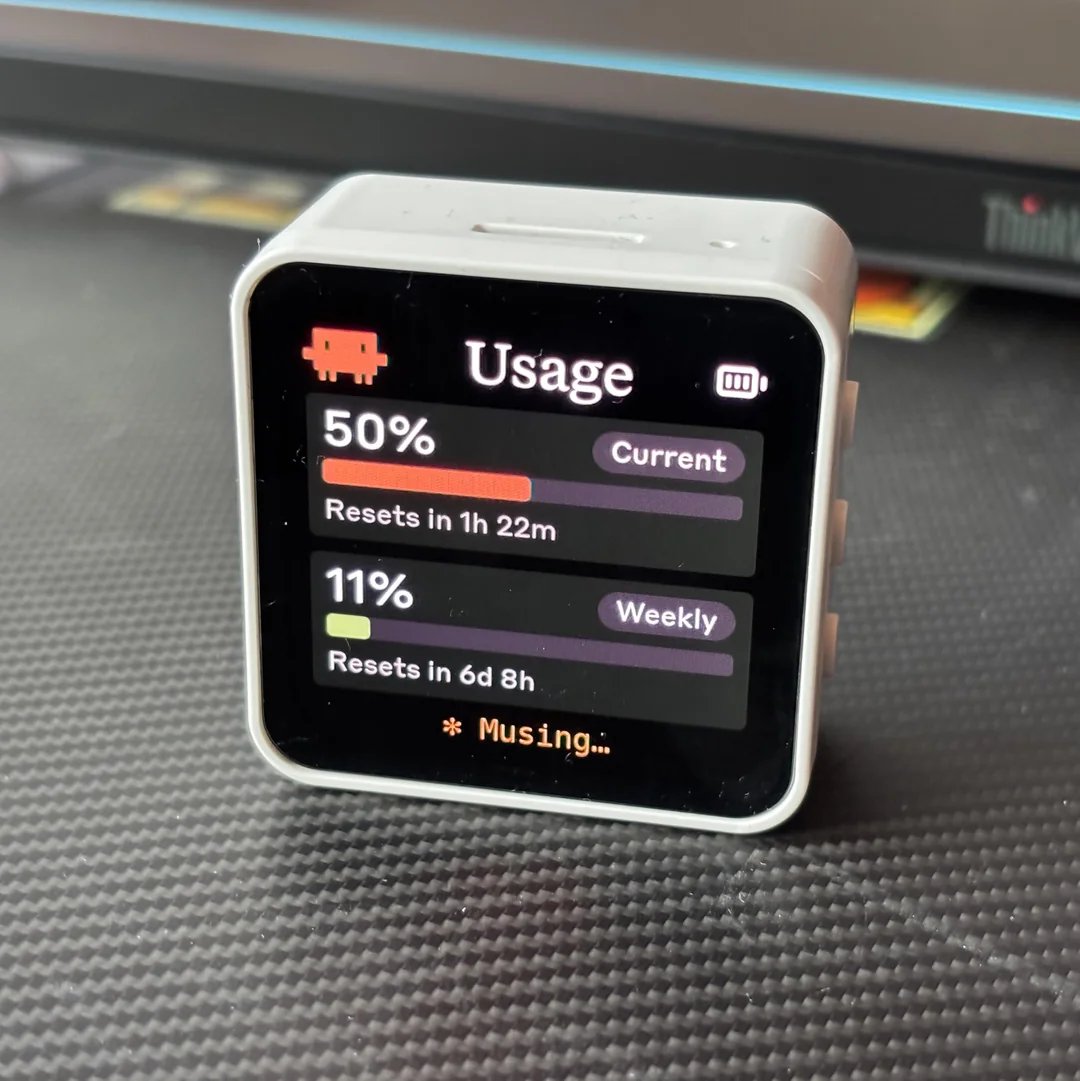
THIS GUY BUILT A PHYSICAL DEVICE THAT SITS ON YOUR DESK AND SHOWS YOUR CLAUDE CODE USAGE LIMITS IN REAL TIME
it's called clawdmeter. it runs on a $32 waveshare ESP32 dev board with a 480x480 AMOLED display
instead of checking the claude code UI or guessing how much usage you have left, you can now just glance at your desk
at this point anthropic should just mail these to us for free
but i also don't need MORE claude usage anxiety
AND it's open source on github.
this situation says EVERYTHING about the current state of the product
the claude code accessory market is booming in real time
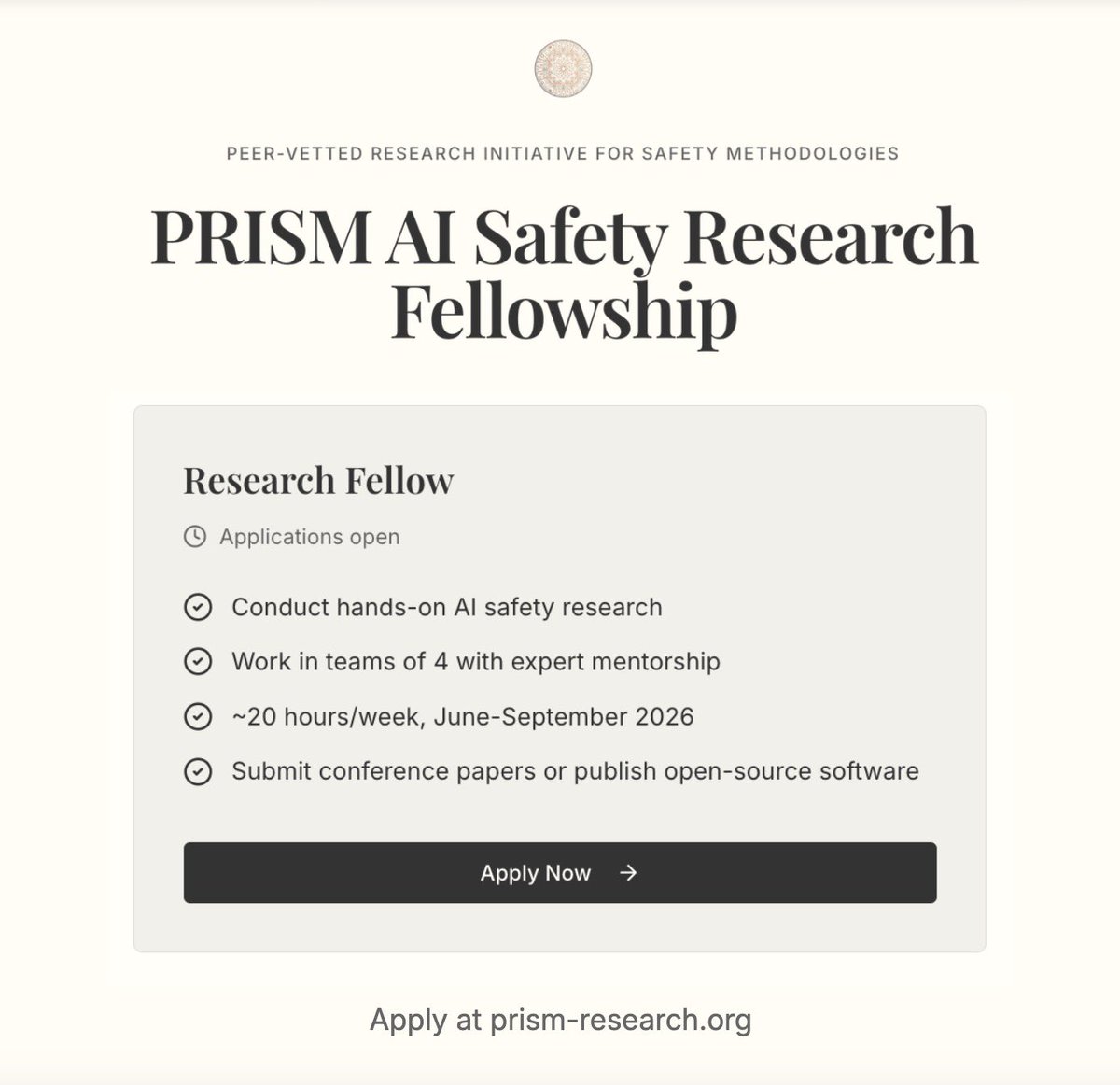
Interested in getting into AI safety research? Applications are open for the PRISM Fellowship!
It’s a 16-week, remote program where fellows work in teams of 4 with established mentors toward a conference-ready paper.
Women & underrepresented researchers especially encouraged!
NeurIPS deadline today. While polishing my submissions, I kept wishing Overleaf had Cursor's tab-autocomplete and Claude Code's multi-file editing.
So I vibe coded a small Mac app that syncs Overleaf projects to local .tex files via Git. One click to Pull, one click to Push. Coauthors keep using Overleaf and wouldn't notice anything.
Some other benefits:
– no more multi-second section loads
– offline editing on flights
– real .tex on disk → grep, your own git
Sharing in case it's useful for anyone else in deadline mode: https://t.co/ACw1voVa8m
if you're ever in doubt whether to apply to that fellowship, that job, or asking someone out.
just know that Aidan Gomez once applied to a Grad role at Google Brain as an undergad, the recruiter missed he was an undergrad and he ended up co-authoring the paper "attention is all you need"
off of a clerical mistake. @aidangomez correct me if i am wrong but i find it truly one of the wildest examples of "you miss 100% of the shots you don't take"
source: an interview of aidan gomez i watched a year back
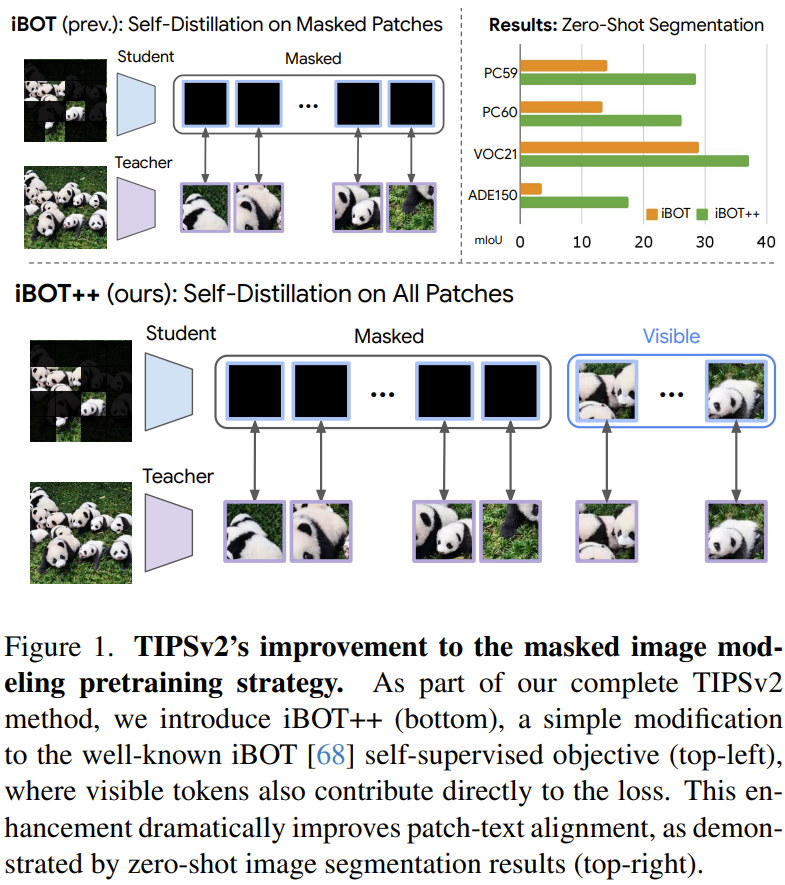
Can vision-language models truly see the fine-grained details in images?
Google DeepMind presents TIPSv2.
They boost dense patch-text alignment using three novel tricks: a distillation method where the student outperforms the teacher, an upgraded masked image objective (iBOT++) that also learns from unmasked tokens, and smarter caption sampling with synthetic captions.
Across 9 tasks and 20 datasets (classification, retrieval, segmentation, depth), TIPSv2 matches or beats leading vision encoders.
TIPSv2: Advancing Vision-Language Pretraining with Enhanced Patch-Text Alignment
Project: https://t.co/wSUIaE1N8O
Paper: https://t.co/a1gzT1UrhQ
Our report: https://t.co/RpI3C8dmGt
📬 #PapersAccepted by Jiqizhixin
DirectEdit - training-free text-guided image editing for flow-based models (flux, SD).
- aligns the editing trajectory perfectly with the original, so backgrounds stay pristine while only your requested changes happen.
- precise local editing and multi-turn workflows.
https://t.co/Vm86U9ACnC
A central concept in diffusion is the iterative refinement of model predictions.
But what if we could gradually refine our dataset too? 🤔
Introducing Ambient Dataloops (ICML 2026): a new paradigm for co-evolving datasets and generative models.
As the generator becomes better, so does the dataset we train it on!
CIP Research Fellowship
Call for Proposals: Pilot Cohort
Work with proprietary datasets and produce original academic and public-facing outputs at the intersection of AI, public values, and democratic governance.
https://t.co/ZBeAkIiYEJ