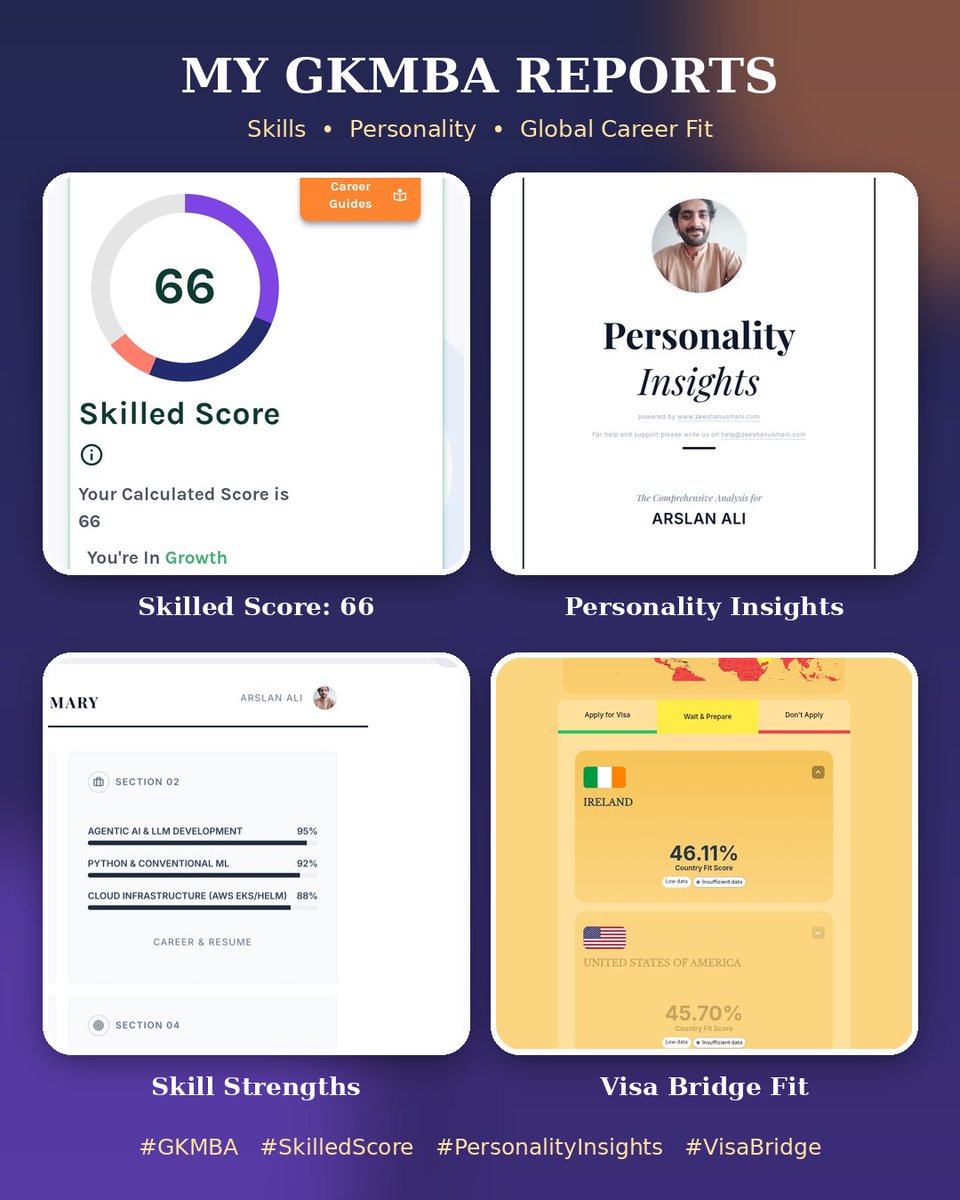
5/ Which one do you need most?
Am I good enough? → SkilledScore
Who am I at work? → Personality
Where next? → Visa Bridge
Stop guessing. Start measuring.
#GKMBA#SkilledScore#PersonalityInsights#VisaBridge
1/ I let 3 tools judge my career. The results were humbling and useful. 🧵
2/ 📊 SkilledScore: my score is 66/100 (Growth Phase). Top strengths: Agentic AI, Python & ML, Cloud. Now I know what to level up.
https://t.co/8NiysAQ0PR
3/ 🧠 Personality Insights: a full report on how I think, work and lead.
https://t.co/KVonKLNuX0
4/ 🌍 Visa Bridge: country-fit scores that tell you Apply, Wait & Prepare, or Don't Apply. Know before you spend on an application.
https://t.co/18LK0ohqy2
We'll be spending a lot more time trying to understand the outputs of language models. A few thoughts, tips & tricks:
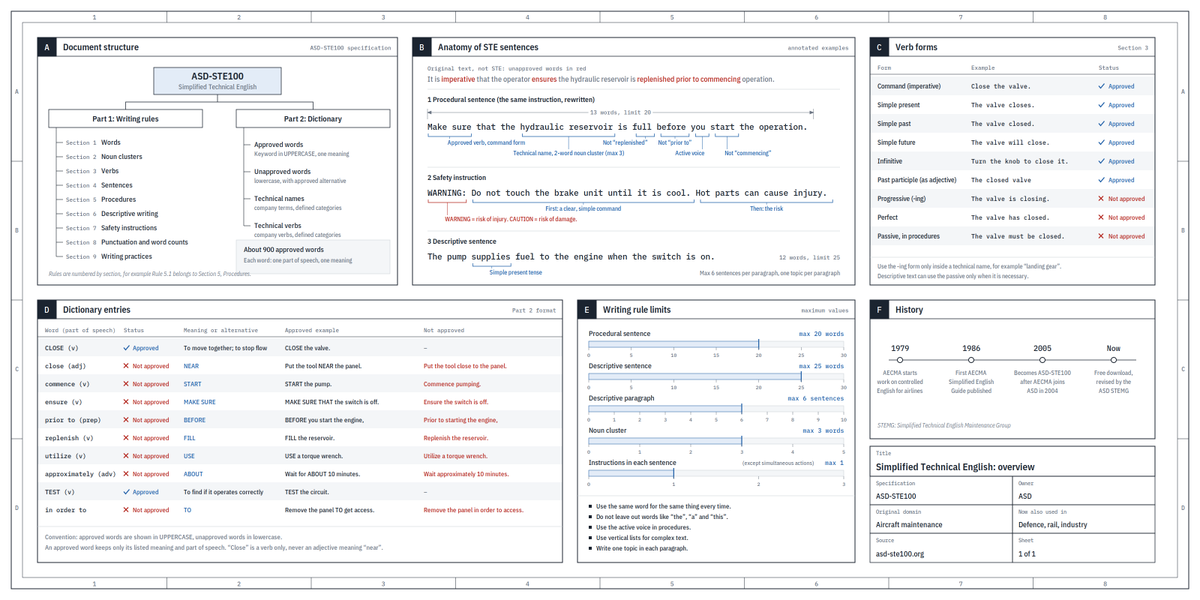
Writing. Something I've had success with: Ask your LLM to explain something in ASD-STE100, it's a controlled language specification originally developed for aerospace maintenance documentation. LLMs well-versed in this language and it comes with heavy constraints on clean writing style that I often find a lot more readable. Sometimes I've tried to soften it a bit e.g. ask for "80% of the way to ASD-STE100" because the spec is quite stringent. But even better:
Diagrams / images. Instead of writing, ask your LLM to create a diagram. These can be a lot easier to process, parse, and understand. But even better:
Web pages. Ask for output "in HTML" to get a beautiful, interactive webpage. LLMs are getting really good at frontend and can create beautiful experiences, animations, etc. But even better:
Explainer videos. The output format I am most bullish on is fully custom / bespoke explainer videos generated on any arbitrary topic. Experiment with things like "Create a 3b1b style video explainer on X. Use my ElevenLabs API key for audio narration". (you'd need an API key for the latter or you can ask your LLM to find you decent free alternatives that use your local compute). This is actually starting to work!
In summary:
- As LLMs get better, they will do more and more of the legwork autonomously, and a lot more of our work will rise up the abstractions into oversight and understanding.
- Luckily, LLMs can help here too because as intelligence and code are increasingly abundant, you can ask for large, custom, discardable software artifacts (e.g. web apps, video explainers) that would have never made sense to create before. Push the boundaries here and you'll be surprised.
The Global South perspective was also very relevant. For countries like Pakistan, developing AI skills is important, but building our own capacity in compute, research, evaluation, and locally relevant AI systems will be equally important.
Really insightful read. What stood out to me most was the shift from simply talking about AI to actually thinking about AI ownership, governance, compute, and human control.
As someone currently learning and working toward AI/ML,
the point about AI agents especially caught my attention. The challenge is no longer just building models that can generate answers, but building systems that can act responsibly, be evaluated, monitored, and stopped when necessary.
Agentic AI interview question:
The agent planned 15 steps, but step 6 changes the available information.
Should it continue the original plan or re-plan? How?
@ShazaFK And for the line from Riyadh that stuck with me most: measuring people employed, not people trained. That's the kind of accountability that's rare from any minister, anywhere, and it's the line that makes this whole to-do list credible.
The Indus AI Summit in February --- which was the real catalyst behind this --- took its authors from "AI is important" to a document with named owners and a number attached (a billion dollars by 2030).
Credit to our IT minister mam @ShazaFK for pushing that shift herself,
This is one of the most concrete AI policy pieces I've read on Pakistan, most "AI strategy" writing is at the level of vision statements, and this one insists on a number, a comparable country, and a 12-month test for every single item. The discipline is the hard part,not the AI.
My takeaway: No style is "the best", The best leaders switch between these based on the situation and the people they're working with.
What's your natural leadership style? Curious to hear in the comments 👇
#SoftSkills#Leadership#Communication#NetSol#CareerGrowth#AgenticAI
Active Listening – Understand before you respond. Most miscommunication starts with not listening.
Empathy – Read the room. Adjust tone based on who you're talking to.
Feedback Loop – Confirm understanding both ways ("Did that make sense?").
🔹 Best for: creative teams, long-term projects.
3. Laissez-Faire Leadership
Leader takes a hands-off approach, trusting the team to self-manage. Great for experienced teams, risky for teams needing direction.
🔹 Best for: senior, highly skilled teams.
what makes communication effective, and the leadership style you naturally lean toward.
🔑 Factors That Make Communication Better
Clarity – Say exactly what you mean. No jargon-overload, no ambiguity.
🗣️ Soft Skills Series: Communication & Leadership Styles
As an AI/ML Trainee at NetSol, I've realized technical skills get you in the room, But soft skills decide how far you go in it. Today, breaking down two things every engineer should understand:
My first video with my online family
Assalamualaikum! I'm Arslan Ali. Currently diving into Agentic AI to help businesses automate and scale profitably.
Recently joined GKMBA by @zeeshanusmani Sir.
Highly recommend if you're serious about your career.
#AgenticAI