When you're going through a tough time or feel like you're getting all the bad breaks, don't ask, "Why is this happening to me?"
Ask, "What can this do for me?"
What can I learn from this? What opportunity might this create? What door could this be opening that I just can't see yet?
And if it feels like every door is closing, then ask yourself one last question: What's the lesson?
There's always a lesson. If you learn from it, the setback wasn't a waste. It was a gift.
Stop being ungrateful when you get gifts in disguise. Say, thank you teacher.
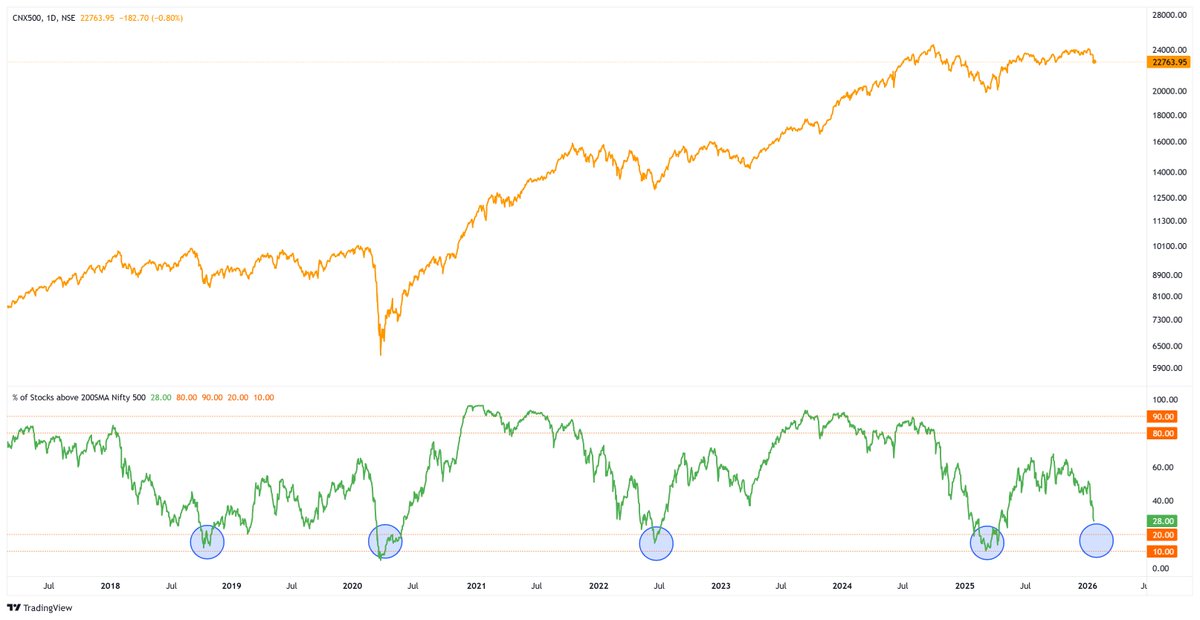
In the past 8 years, there have been only 4 instances when the % of Nifty 500 stocks above the 200 MA has dropped below 20%.
Those phases have marked a long-term bottom.
Every time - you will hear this time it is different, but no.
I'll be a mad buyer in ETFs in tranches as soon as we reach that range, and I will switch off the Noise.
I draw a line, and I sell a few % below the line.
I have nothing much or nothing extra on the charts.
What is to be bought is picked up by the scans.
Winning horses don't come back to the gates - Dan Zanger
No matter how smart you are, how high your IQ, how advanced your education, how good your information, or how sound your analysis, you are simply not going to be right all the time.
In fact, you will probably be right less than half the time.
- How to make money in stocks
if u wish to hv a long career as a profitable trader, trade management like a pro is a must
-hv a plan before placing a trade
-While in the trade, make appropriate tweaks to the plan but do that outside of mkt-hours
-execute the plan during mkt hrs (ignore news/opinions)
Many people ask me why I use a quarter-on-quarter earnings scan instead of looking for a year-on-year jump.
My answer is that I have read about many past multi-baggers, and they always have earnings on the table. They typically start their move after one quarter of earnings surprise and the second quarter of earnings acceleration.
When I delved deeper to understand what made them move, many X - the answer was that they always surprised the market in one quarter, and then they accelerated. During their first quarter of surprise, they may not experience the year-on-year spike.
To understand, imagine a car traveling at 60 km/h on a highway, whereas the speed limit is 80 km/h.
When do you want to nab the driver if he decides to drive rashly? Do you want to catch the car at 140 kilometres per hour or 80 kilometres per hour?
You want to catch that vehicle at 80, and that is why we have speed cameras installed.
Similarly, I am looking for a winner that has just started accelerating, and that is why I am using either one or two quarters of earnings data to spot the earnings surprise.
If you want consistency and long- lasting success trading, you must learn discipline, and you must refrain from chasing stocks just because the "market" is up and you're afraid to miss out. If you succumb to FOMO, you are doomed! It's that simple. Stocks either meet your criteria, or they don't. The rest is noise!
A study was done on 77,000 accounts at a large discount broker from 1990 to 1996. The findings revealed:
1. Investors are more likely to allow a stock to reach a large loss than they are to allow a stock to attain a large gain; they hold losers too long and sell winners too quickly.
2. The probability of buying additional shares is greater for shares that have lost value than it is for shares that have gained value. Investors may readily double down their bets when stocks decline in value.
3. Investors are more likely to take a small gain than a small loss.
The results would be no different 50 years ago, or 50 years from now.
I'm never really bullish or bearish; only by default. I simply buy stocks that meet my criteria and sell them when they don't work (which is often). When my trades are working, I add exposure... if not, I reduce until I'm in cash (by default). If there are no stocks that meet my criteria, I stay in cash. NEVER do I add to a loser. And never do I get bold when running cold. When I do get aggressive, I get very aggressive, but always with a stop loss and never risking more than 1-2% of total equity per trade.
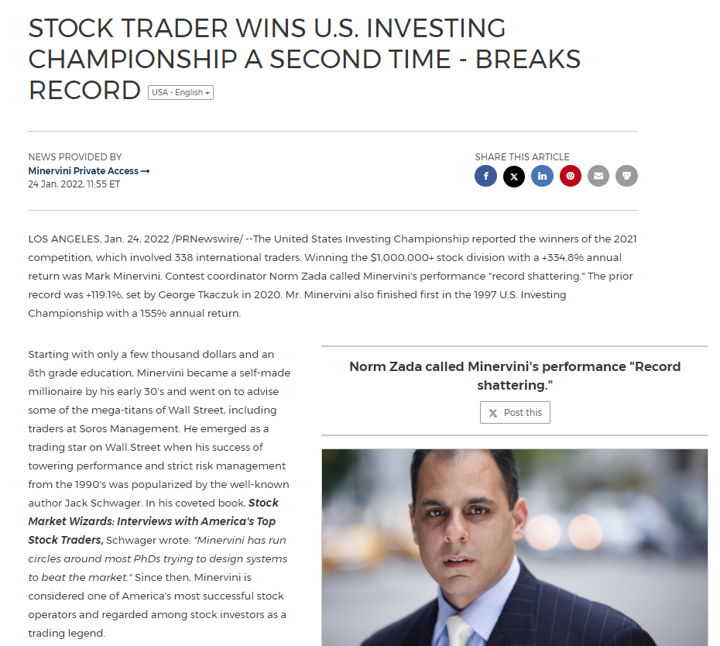
There you have it! The strategy that made me rich and a two-time US investing Champion.
Best wishes and happy trading my friends. 😇🙏🤑👊
Some complain 'breakouts aren't working, I'm getting cut to ribbons." Then stop playing them until you see breakouts working! But no, you want action!!
The problem is never the market, the problem and the solution is always your response to the market.
7 trading rules that changed my life
1. Always use a stop loss
2. Keep losses small in relation to gains
3. Never add to a loser
4. Sit out as long as it takes for stocks to meet my buy criteria
5. Never let a good size gain turn into a loss
6. Never get bold when running cold
7. Don't fight the trend
https://t.co/JXzFFTmMtn
Quote of the Day:
If you want to know everything about the market, go to the beach. Push & pull your hands through the waves. Some are bigger, some are smaller. But if you try to push the wave out when it’s coming in, it’ll never happen. The market is always right. — Ed Seykota
You will never get huge returns with any real consistency holding a diversified portfolio of stocks through thick and thin. Big performance with little drawdown requires:
1. Timing
2. Turnover
3. Aggressive position sizing when trades are working
4. Cash or light positioning during bear markets
If you want to make great returns consistently, you must get off the idea of being right or wrong and instead learn how to lose much less when you're wrong than you make when you're right. I'm wrong just as much as I'm right. That's why I use stops.
During my 41 years trading stocks, what I learned about bottom fishing and holding losses is simple: it will seduce you and then abuse you. The abuse part is just a matter of time.
This rally has the look and feel of nothing more than a technical bounce. Before a reliable bottom can be established, we are likely to experience more volatility and a test or undercut of the recent lows. With that said, my focus (as always) is on individual stocks. Until stocks meet my strict buy criteria, I'm on the sidelines in the safety of cash.
https://t.co/JXzFFTmMtn
Stop making excuses for your poor performance. The stock market is not rigged! To the contrary, the stock market offers unlimited opportunity. It's like they say in poker "all you need is a chip and a chair." It's an environment where those who win get rewarded instantly, and those who have skill and discipline get rewarded consistently. I started with a few thousand dollars and built my fortune in the stock market... and you can too. But not until you shed ALL your excuses. First and foremost, the number one ingredient for success is personal responsibility. If you don't have that, then you're not going to make it. And yes, it will feel rigged... because you suck.
When you truly make a commitment to a strategy, you free yourself from the chains and noise of the indexes, opinions and temptations driven by hindsight. You could care less if the Dow rallies 30%, or if Paul Tudor Jones is buying while you are in 100% cash. You understand the value of uncorrelated returns, uncorrelated volatility, and most of all... uncorrelated thinking. It's your uncorrelated approach that drives your alpha and your independence, and it confounds the conventional thinkers.