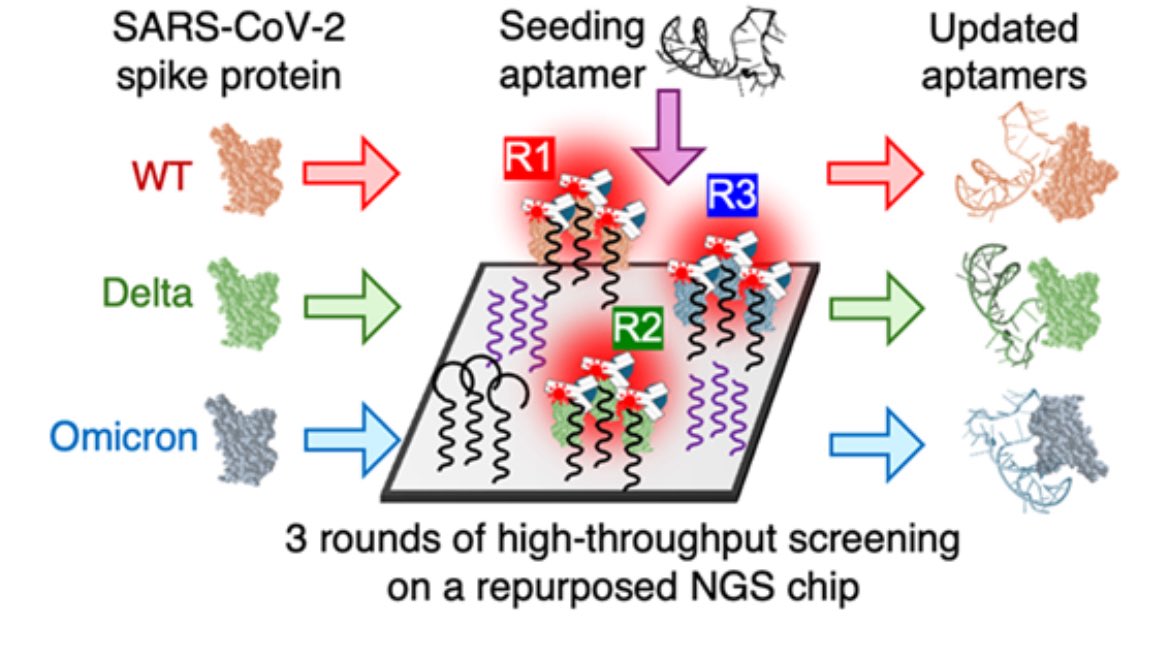
Our work is now out in @acsnano ! 🧬 We developed a high-throughput platform combining rational-random library design with NGS-chip screening to rapidly adapt DNA aptamers to evolving SARS-CoV-2 variants. >11,000 sequences were screened simultaneously.
https://t.co/VMFFGC12kM
Something more: the screening data also revealed that the upper stem is also essential for binding the proteins. MD simulations suggested that among all point mutation at G11, only G11A preserved the binding; G11T and G11C’a binding was disrupted for different reasons.
What we found: a double mutant with improved Delta binding, a triple mutant with improved WT selectivity, and a double mutant with altered binding to Omicron. All of these mutants have been validated in solution.
The approach: we started with an existing SARS-CoV-2 aptamer and designed a hybrid library combining rationally selected mutations, insertions/deletions, and doped mutants. The library was screened directly on an Illumina MiSeq chip against multiple spike variants.
The challenge: aptamers can be powerful molecular recognition tools for viruses, but viral evolution can quickly compromise their binding. How can we efficiently adapt an existing aptamer to a newly emerging variant without starting SELEX from scratch?
It's still under development. More features on the way. I mostly built it for my own figures, but I'd genuinely love to know whether it's useful to other nucleic acid researchers too. Feedback and suggestions are very welcome!
AptaRender, a browser-based tool that separates DNA/RNA 2D structure drawing from prediction. You paste a DNA/RNA sequence and its dot-bracket structure, and it gives you a fully editable 2D layout. Make figures look the way you want. Try it: https://t.co/RYHZUdCPai
#aptamer
Currently, AptaRender is able to do per-base and per-basepairing coloring, adjustable fonts, structure rotation with upright text, customizable base circles, flexible 5′/3′ tail layouts, and clean SVG/PNG export ready for publications.
I'm preparing figures for presentations, and I kept hitting the same wall. Tools like mfold or UNAfold predict DNA/RNA 2D structures beautifully, but they're rigid on the aesthetic side.
Thrilled to share that the first project from my PhD is now published in Science (@ScienceMagazine)! 🎉
We studied the genetic architecture of and evolutionary constraints on the human pelvic form.
Read more:
https://t.co/KjN3Vqp2wI
The obstetrical dilemma - a 60yr old hypothesis in evolutionary theory, suggests that a narrow pelvis aids bipedal locomotion but complicates childbirth. But how does it stand up to modern empirical evidence? Read our preprint to find out!
https://t.co/Ga8TynAj6G