The world's largest sovereign wealth fund just placed a $243 million bet on the quantum future.
Norway's Norges Bank has disclosed substantial positions across the industry, allocating $200 million to IonQ, $39 million to Rigetti Computing, and $4 million to D-Wave Quantum.
This marks a maturing of the market structure. While quantum stocks have largely been the province of retail investors and passive flows, the entry of a $2 trillion institutional heavyweight brings a different tier of validation.
The split across companies is the most telling detail. By diversifying across hardware modalities, the fund is betting that different technical approaches will find success in different applications. It is a tacit acknowledgment that the industry is likely big enough for multiple architectures to thrive.
For a sector that lives and dies by deep R&D, the arrival of patient, long-term capital signals that the commercial timeline is coming into focus
#QuantumComputing
Quantum computing is often explained as trying every answer at once. The reality is far more elegant: it is about choreographing probabilities so the right answers amplify while the wrong ones cancel out.
That process relies on counterintuitive physics. Qubits use superposition to represent complex states, entanglement to link information, and interference to orchestrate the solution. The result is a system that thrives exactly where classical processors hit a wall.
Where it matters most right now: simulating molecular behavior, optimizing logistics across millions of variables, and stress-testing modern encryption. These are not hypothetical use cases. Early quantum systems are already tackling proof-of-concept versions of each.
The catch is decoherence. Qubits are extraordinarily fragile, requiring temperatures colder than deep space and near-perfect isolation from environmental noise. Error correction remains the defining engineering challenge of the field, making practical large-scale advantage a milestone that is still years away.
But progress is real. Cloud platforms have made quantum hardware accessible globally, hybrid classical-quantum approaches are bridging the current hardware gap, and the race to scale fault-tolerant qubits is advancing steadily.
Even if you never program a quantum circuit directly, its impact will reach you through faster drug development, stronger cybersecurity, and advanced materials design. The foundation of the digital world is quietly being rewritten
#QuantumComputing
Quantum computing is sitting exactly where AI was in 2021—poised on the edge of a capability explosion.
Global investment has crossed $55 billion, with governments shouldering 70% of the load. The private capital trailing behind signals a realization that commercial pathways are finally crystallizing.
But the market dynamics are nuanced. This isn't a standard software play. The investment profile mirrors biotechnology: long development timelines, sporadic breakthroughs, and valuations driven by technical milestones rather than quarterly revenue. Investors are purchasing strategic options on a fundamental shift in physics.
We have moved from pure research to tradable progress. Volatility has turned quantum from an academic pursuit into an active investment theme where roadmaps and government contracts act as pricing events.
Current projections peg the market at $200-250 billion by 2035. This likely underestimates the reality. Just as early AI forecasts missed the downstream application boom, we are likely blind to the use cases that will emerge once utility is achieved.
While hardware architectures continue to compete for dominance, the software layer capable of bridging these distinct approaches remains the critical variable to watch #QuantumComputing
Transformative technology rarely follows a straight line. The current volatility in the quantum sector isn't chaos—it's a necessary sorting process.
As hardware companies compete for research contracts, the field is separating into tiers. These programs serve as de facto benchmarks, helping the market distinguish between theoretical roadmaps and engineering reality. This consolidation is a hallmark of industry maturation.
We are effectively in the "picks and shovels" era of a market projected to exceed $100 billion by 2035. The fluctuation we see is the market digesting technical progress to determine who is building the foundation for commercial viability #QuantumComputing
Quantum today feels a lot like AI in 2020. The parallels in trajectory are becoming impossible to ignore.
We are seeing a convergence of error correction advances and hybrid architectures that suggests a genuine inflection point. The shift from theoretical physics to engineering scalability is underway.
However, a reality check is essential. The physics remain difficult and the timeline is uncertain. If someone promises you near-term miracles, check their math.
For the enterprise, the strategy shouldn't be to bet the farm today, but to understand exactly where this technology will fit when it matures. Broad deployment is still years away, but the foundation is being laid right now #QuantumComputing
We combined GenAI and designing quantum circuits using the best LLMs available: Claude 3.7 Sonnet, Gemini 2.0 Pro and o3-mini (with reasoning set to high) and released it as a SaaS "QubitVerse".
In Jan 2021 when we registered qubitverse-domain the idea was to focus on online learning, but after the rapid development in the field of AI there is no reason to stop there. It will be the AI doing the circuit design and development in the future.
Vuodesta 2025 tulee tekoälyn läpimurtovuosi, sanoo tekoälyasiantuntija @immon Salo. Chambercast-podcastin uudessa jaksossa Salo keskustelee Kauppakamarin tuottajan @tainaparviainen kanssa siitä, mitkä ovat vuoden 2025 johtavat tekoälyteemat.
Kuunnellaan!
https://t.co/2zR5wKCRP4
Muutama viikko sitten olin Vaasassa kuuntelemassa, kun tekoälyasiantuntija Immo Salo @immon vihitytti @oajpohjanmaa yleisöluennolla meidät tekoälyn koko kirjoon. 👏 https://t.co/SydRga5yL2
Tänään juhlitaan @immon kirjaa, kuullaan esitys ja haastattelu maksuttomassa tapahtumassa. Ilmoittaudu mukaan: https://t.co/7lR6YLyD01
@K2HEL#luovatekoäly
We noticed some of you were hitting rate limits, so we decided to scale up (by up to 50x). For tts-1, tts-1-hd, whisper-1, dall-e-2, and dall-e-3, requests per minute have been increased to:
Tier 1: 500
Tier 2: 2,500
Tier 3: 5,000
Tier 4: 7,500
Tier 5: 10,000
https://t.co/hvt2XJ1t6J
Millaisia mahdollisuuksia tekoäly tarjoaa järjestöille ja taloushallinnolle?
Tästä puhuu Talous- ja hallintopäivillä toimitusjohtaja @immon@BonairoFi!
Tutustu Helsingissä 18.–19.11. pidettävän tapahtuman ohjelmaan ja ilmoittaudu mukaan vaikka heti 👉 https://t.co/XVDMrIpc0k
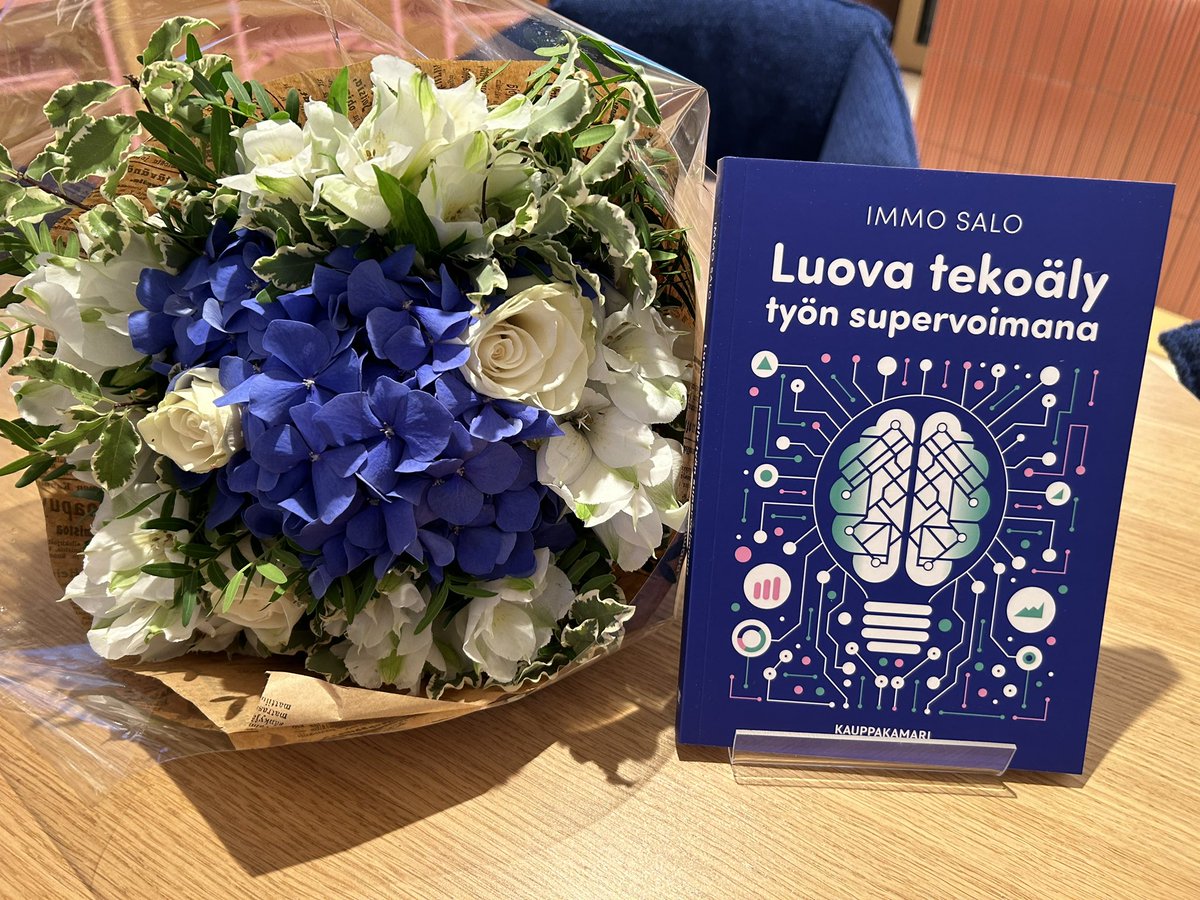
Uusin kirjani kaupoissa 09/2024 🎉🎉🎉
Esittelyssä tekoälyn läpimurron keskeiset palvelut ja niiden käyttökohteet. Oman työelämäni tekoäly muutti jo pysyvästi ja tätä ilmiötä on innostavaa seurata lähietäisyydeltä 😊
https://t.co/xPckTMlZQa
Kiitos Immo Salo @BonairoFi herättelystä tekoälyn maailmaan tänä aamuna @K2HEL Itä-Uudenmaan elinkeinoaamussa @Taidetehdas
10 vuoden päästä tekoäly on yhtä tavallinen kuin älypuhelin, vai onko? Löytyykö tästä apu osaajapulaan yrityksissä?
#tekoäly#elinkeinoelämä#ItäUusimaa
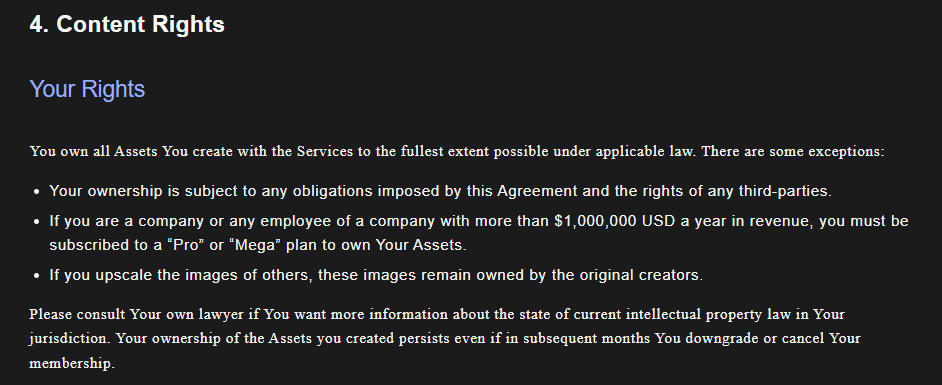
Olettaen, että liikevaihto jää alle tuon 1 milj. $ 🙂 (jos käyttäjänä yritys tai yrityksen työntekijä), niin kuvan omistusoikeudet Midjourney luovuttaa käyttäjälle. Mitä lakien ja asetusten tulkinta Suomessa sanovat tekijänoikeuksiin liittyen eli ovatko tekijänoikeudet käyttäjällä, kun kuva on luotu Midjourney-palvelulla vai ovatko Midjourney-tuotokset tekijänoikeudettomia Suomessa, niin sitä en uskalla sanoa.