@FurlencoSupport Can you please get in touch with me ASAP. i had requested for a delivery and we are not able to align the timing for delivery? There is no way we are able to get in touch with you. I am DMing details @NJain61
For whatever it is worth
TCS now trades at a valuation last seen in Jun 2009.
ITC now trades at a valuation last seen in Feb 2020 to Nov 2020.
HDFC Bank now trades at valuations we have never seen in 20 yrs.
This reminds me of the quote from William O'Neil:
"It is one of the great paradoxes of the stock market that what seems too high usually goes higher and what seems too low usually goes lower."
Amid a searing 46°C heatwave in Bundelkhand’s Hamirpur, a bat collapsed from a tree inside the district court complex, apparently unable to survive the extreme temperatures. Lawyers gathered around the exhausted animal and tried to revive it with water.
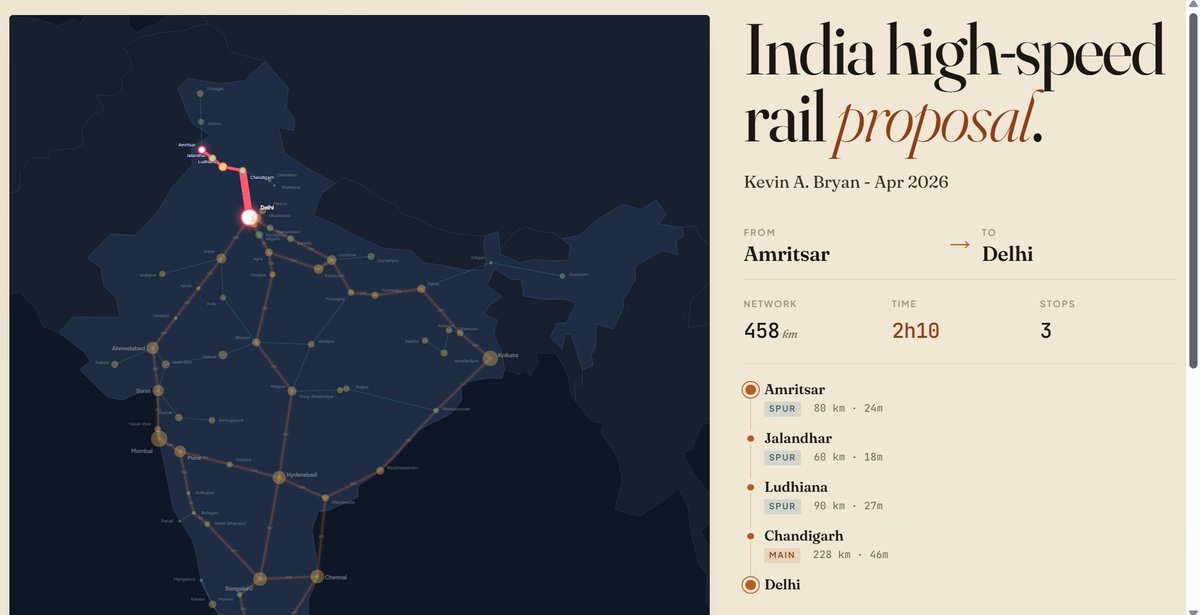
Friday fun: any higher-value infra project in the world than Indian HSR? Let's code it up, use AI to grab 60 biggest cities + distances, then Dijkstra's algo. Result: 1/3 the rail of China, and even at France/Spain speeds, all major cities connected at flight-competitive time 1/2
This analysis has 3 flaws - (i) 9% inflation permanently, (ii) 0% real returns (iii) ignores the fact that consumption drastically goes down with age after 60. More realistic figure is 15 Cr (with buffer 20 Cr).
If the 40 crore retirement number I shared shocked you, this post is for you.
Here is what I said. If you are 40 today, spending 2 lakh rupees a month, with no EMIs to service, and you want to retire at 60, you will need 40 crore rupees.
The comments had a lot of pushback. The number feels impossible. It is not. Let me show you why.
Two assumptions drive this number. Inflation and life expectancy. Both are higher than what regular retirement calculators assume. Both are right.
Start with inflation. Retail CPI in India is 5 to 6%. That is the inflation of atta, dal, and bus fare. It is not the inflation of an affluent household.
Private healthcare in India runs at 12 to 14% every year. Domestic staff wages in metros are growing at 10 to 12%. Premium school fees, international travel, club memberships. All of these inflate between 8 and 10%. Blend them and you get 9%. That is the real inflation rate of an HNI lifestyle.
Now life expectancy. Most Indians plan their retirement assuming they will live to 75 or 80. That is what national averages suggest. But national averages are pulled down by infant mortality and rural data. They have nothing to do with how long a healthy, affluent Indian actually lives. For a couple aged 65 today, there is a 71% probability that one partner reaches 85. A 44% probability that one reaches 90.
Now the math.
2 lakh rupees a month at 9% inflation becomes 11 lakh 20 thousand rupees a month at age 60. That is an annual spend of 1.34 crore.
Plan for 30 years of retirement. Your retirement portfolio which is focused on capital preservation (60% fixed income: 40% equity) earns 9%. Your Inflation is also 9%. Your real return is zero.
So corpus needed equals 30 multiplied by 1.34 crore. That is 40 crore.
Here is the good news. This number is not as far away as it looks. At 12% returns before retirement, 40 crore at age 60 translates to roughly 4 crore today for a 40 year old.
The point of this message is not to scare you. It is to make sure you understand the silent erosion of purchasing power that inflation causes.
Jevons paradox is happening in real time. Companies, especially outside of tech, are realizing that they can now afford to take on software projects that they wouldn’t have been able to tackle before because now AI lets them do so.
We’re going to start to use software for all new things in the economy because it’s incrementally cheaper to produce. Marketing teams at big companies will have engineers helping to automate workflows. Engineers in life sciences and healthcare will automate research. Small businesses will hire engineers for the first to build better digital experiences.
And as long as AI agents still require a human who understands what to prompt, how to review when an agent goes off the rails, how it guide back, how to maintain the system that was built, how to fix the ongoing bugs, and more, we will still have humans managing these agents.
This is why all the advice you get of not going into engineering is wrong. The world is going to increasingly be made up of software, and the people that understand it best will be in a strong economic position. This will happen in other roles as well where output goes up and demand increases.
Dhurandhar The Revenge does 1000 cr in 7 days worldwide.
This is the AI moment in Indian Film industry. Focus shifting to content, strong characters and team based approach over superstar culture & the use of music.. in fact music is a character
Kudos for a global blockbuster!