Perfectionist, SE (Flutter & Python) 👨🏻🎓 Bachelor of TUIT 🦂 INFJ-T/ADHD | Full Stack (overflow) Developer | Single | Love Reading Books | Writing Posts
For my first post, I’m sharing a letter @NVIDIA signed on why open models matter.
AI will transform every industry, power every company, and be built by every country.
Open models strengthen safety and cybersecurity, accelerate innovation and diffusion, and enable sovereignty.
The world needs both frontier closed models and frontier open models.
https://t.co/AUKzoQ5Ikb
Sakana Fugu surprisingly performed near GLM 5.2 level but 17× more expensive!
We gave the same prompt to 4 models: build a complete live Trader Desk with both frontend and backend components, real-time market data fetched from external APIs for 8 symbols, and a custom dark-theme UI.
Outputs:
Fugu Ultra — 22,225 t, $0.51
Opus 4.8 — 15,802 t, $0.31
GPT-5.5 — 11,474 t, $0.26
GLM 5.2 — 13,677 t, $0.03
Fugu created the most polished and feature-rich trading desk in the run. GLM 5.2 was very close behind, with a similarly complete multi-panel interface and live data, but at a much lower cost. Opus and GPT also performed well, delivering solid results with a better balance between quality and cost
R.I.P. job hunting. ☠️
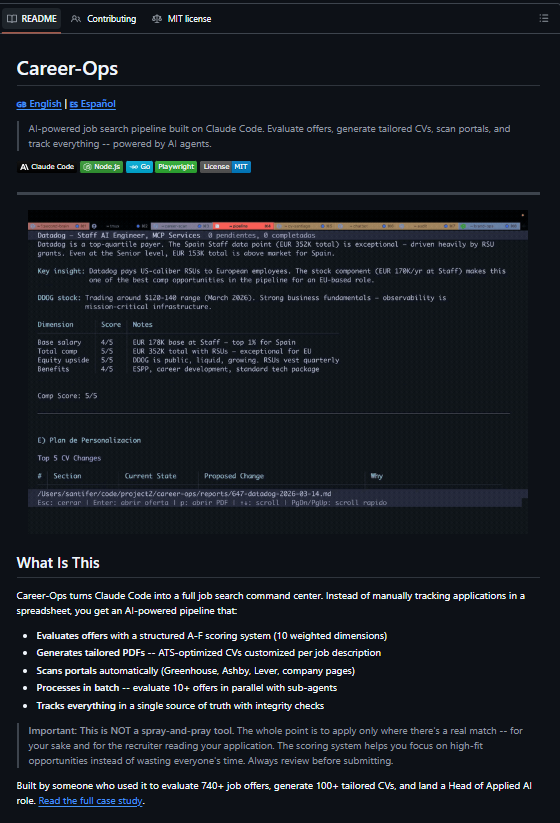
Someone built an AI job search system with Claude Code.
700+ applications scored and submitted automatically.
They got hired.
→ Scans company career pages on its own
→ Rewrites your CV per job
→ Fills application forms
→ ATS-optimized PDFs via Playwright
→ 45+ companies pre-configured (Anthropic, OpenAI, Stripe...)
Recruiters charge $10,000+ to place candidates.
This does it for free.
The job market just changed.
Holy shit… someone just gave Claude a real browser.
Not screenshots.
Not brittle selectors.
Not slow MCP loops.
Real Playwright code — inside a sandbox.
It’s called dev-browser — and it lets AI agents control Chrome like developers do.
Here’s why this is different:
Instead of inventing new “agent syntax”,
dev-browser just lets AI write actual browser code.
goto
click
fill
evaluate
scrape
screenshot
Everything.
And it runs in a QuickJS sandbox — so the agent gets full browser control without touching your system.
That means:
• Real browser automation
• Zero host access risk
• Persistent tabs
• Multi-script workflows
• Connect to existing Chrome
• Full Playwright API
The key idea is simple:
The fastest way for an AI to use a browser
is to let it write browser code itself.
So an agent can literally:
Open X
Scroll
Extract tweets
Return JSON
All in one run.
No plugins.
No extensions.
No orchestration layer.
No MCP complexity.
Just:
install → tell Claude “use dev-browser” → done.
Even better, scripts run against persistent pages.
So agents can:
login once
navigate once
reuse context
continue workflows
Now you get things like:
• autonomous research agents
• AI QA testing websites
• scraping without MCP overhead
• multi-step browser workflows
• AI that actually uses web apps
• Claude operating real dashboards
And the security model is clean:
Playwright power
QuickJS sandbox
No filesystem access
No host execution
So agents are powerful — but contained.
Benchmarks are wild too:
Dev Browser
3m 53s
$0.88
29 turns
100% success
Faster and cheaper than typical setups like:
• Playwright MCP
• Chrome extensions
• browser skills
We’re moving from:
AI that looks at the web
→ AI that operates the web
That’s a big shift.
Because once AI can control browsers reliably,
it can use any software with a UI.
No API needed.
No integration required.
Just open the page — and work.
AI coworkers just got hands.
Claude Code doesn't show you how many tokens you're using for subscriptions. No breakdown by model. No breakdown by project. Just a progress bar that says "63% used."
So I built a local dashboard that reads the files Claude Code already writes to your machine.
Turns out every session, every turn, every token is logged to ~/.claude/projects/ in JSONL files. Input tokens, output tokens, cache reads, cache creation, model name, timestamp.
It's all there. You just can't see it.
My numbers over the last 30 days: 440 sessions. 18,000 turns. $1,588 in API-equivalent costs. On one day, the cache spiked to 700M tokens - visible cache bug, two days in a row.
The dashboard scans those local files, builds a SQLite database, and serves charts on localhost:8080. Filter by model (Opus, Sonnet, Haiku). Filter by time range (7d, 30d, 90d, all time). Cost estimates based on current Anthropic API pricing.
Works retroactively. First run processes your entire Claude Code history.
Install:
git clone https://t.co/BKyUCxi8Cq
cd claude-usage
python3 https://t.co/O3rvjobdvx dashboard
Windows: use python instead of python3.
Zero dependencies. Python standard library only.
Open source, MIT.
Star it. Fork it. Make it your own.
🚨 Sam Altman literally gave a 43-minute masterclass on turning ideas into billion-dollar companies.
Most people will never watch it.
And instead of hype, he broke down what actually makes startups work.
No fluff. Just reality.
He explained that ideas don’t matter nearly as much as execution. The difference between something small and something massive isn’t the idea it’s how relentlessly it’s built and improved over time.
He also emphasized that the best founders don’t chase everything. They focus on one thing that truly matters and push it forward with extreme clarity. Distraction kills more startups than competition ever will.
And then there’s scale. Truly big companies aren’t built for a niche they solve problems that millions of people care about. If the market isn’t large enough, the outcome won’t be either.
His biggest insight? Startups don’t win because they’re smarter they win because they stay in the game longer and iterate faster.
That’s why this masterclass stands out.
Because while most people are waiting for the perfect idea…
The best ones are already building.
Every new Claude launch since the beginning of 2026👇
- Jan 2026: Claude Cowork launched.
- Feb 2026: Opus 4.6 released.
- Feb 2026: Sonnet 4.6 released.
- Feb 2026: Cowork launched on PC
- Feb 2026: PowerPoint integration
- Feb 2026: Excel integrations added.
- Feb 2026: Co-work plug-ins released.
- Feb 2026: Claude Code security launched.
- Feb 2026: Claude Code Remote Control
- Feb 2026: Scheduled Task in Co- work
- Feb 2026: Connector available in the free
- Mar 2026: Claude memory is free
- Mar 2026: Claude Marketplace launched
- Mar 2026: Claude com ambassadors
- Mar 2026: Code review for Claude code
- Mar 2026: Claude skills for Excel & Slides
- Mar 2026: charts & diagram in chat
- Mar 2026: 1 million context window
- Mar 2026: Dispatch for Claude Co-work
- Mar 2026: Claude code Channels
- Mar 2026: Co-work Projects
- Mar 2026: Claude Computer use
- Mar 2026: Auto mode in Claude code.
Anthropic is cooking
🫣 Help protect your app's sensitive content with this #WidgetOfTheWeek!
This feature is available on Android API 35+, and you can try it out by using the SensitiveContent widget. Learn how ↓
First guy looks friendly second guy really intense about his fitness. Perhaps women are answering “would you want to date him” (and men are asking, “would you like to look like / be him”?)
Evolutionarily you can argue that the male desire for muscles and strength is about competing with other males for status & the right to mate.
@muhammadi077 Qatta tugʻilsa tug'ilib o'lmidimi, foxishalar kammi oʻzbekistonda? Haqiqat boʻsa ham nima.
Turk boʻsa nima?
Bir gap bor, terrorism millat tanlamaydi degan. Xuddi shunday gap bu ham