The Excellencies of Lagos and the Rot Within
By Citizen Bolaji O. Akinyemi
The struggle for control of the Abrahamic political dynasty gave birth to one of history's most enduring philosophies of power. Within the house of Isaac, manipulation became an instrument of succession. Thus emerged the paradox of "the voice of Jacob and the hands of Esau"—a timeless metaphor for political deception, where appearance differs from reality.
In Nigeria, we have coined our own expression for this phenomenon: "The more you look, the less you see." The optics of government are often carefully crafted to conceal realities beneath the surface.
An attempt to replace optics with reality once landed Akinwunmi Ambode in political trouble.
His determination to modernise Lagos' waste management system along the lines of other global megacities threatened entrenched interests. The "Jacobs" of Lagos—political actors who simultaneously function as grassroots party leaders and beneficiaries of government-approved waste collection contracts—saw reform as a threat to their economic interests.
Their resistance was fierce. Waste remained uncollected across the city, public frustration mounted, and the crisis became one of the factors cited against Ambode's continuation in office.
This is not an appeal for Ambode's political resurrection. He has accepted the verdict of political circumstances, and one can only wish him well in his future endeavours.
But Lagos cannot continue to mortgage its future to vested interests.
A city that prides itself as Africa's economic capital must operate according to the standards of the world's leading megacities.
Consider the waste management situation in many communities today.
On Owogbemi Close in Ojokoro LCDA, household waste reportedly remained uncollected from February until May. Now, in July, refuse is piling up once again with no certainty about when collection will resume.
This is not merely an environmental inconvenience.
It is a public health emergency waiting to happen.
With poor drainage infrastructure already worsening seasonal flooding, indiscriminate dumping of uncollected refuse into drainage channels has compounded Lagos' flooding challenges. The State of Aquatic Splendour must not become the State of Preventable Environmental Disaster.
Nothing undermines the claim of excellence more than the recurring collapse of buildings.
A truly excellent city establishes rigorous standards for construction, enforces compliance without compromise, and protects human lives above every other consideration.
The frequency of building collapses in Lagos raises troubling questions about the effectiveness of the Lagos State Building Control Agency.
Who has led this agency from 1999 to date?
What measurable improvements have been recorded under successive leaderships?
What institutional failures continue to permit avoidable structural disasters?
The recent building collapse in Amuwo Odofin once again raises legitimate questions about competence and accountability.
Who currently heads the agency?
Is the Acting General Manager a professionally qualified engineer duly certified by the Nigerian Society of Engineers, or is the office another casualty of political patronage?
Technical institutions deserve technical leadership.
Appointments to such offices should never be rewards for political loyalty.
The public deserves transparency.
Was there a competitive process for appointing the agency's chief executive?
Were competence-based assessments conducted?
Can the results be made public?
Can Lagosians be assured that merit—not patronage—determined the appointment?
The broader governance culture deserves equal scrutiny.
One commendable development under the administration of Babajide Sanwo-Olu was the decision that even the First Lady, Ibijoke Sanwo-Olu, reportedly sat for the qualifying examination alongside every other candidate seeking appointment as a Permanent Secretary.
If accurate, that represents global best practice.
However, another question naturally follows.
If candidates pass the examination but remain indefinitely on a waiting list without appointment—as has reportedly happened to some directors who have written and passed the examination more than once—what then becomes the real basis for appointment?
Merit should not merely open the door to opportunity; it should determine who walks through it.
Otherwise, examinations risk becoming ceremonial exercises while other considerations determine outcomes.
Lagosians deserve answers.
The performance of the Lagos State Building Control Agency should concern every resident because every collapsed building represents lives lost, families shattered, investments destroyed and public confidence diminished.
Excellence is not measured by painted flyovers, glittering skylines or attractive public relations campaigns.
Excellence is sustained through sound institutional architecture, professional competence, transparent governance and uncompromising compliance with standards.
A magnificent building without structural integrity is a disaster waiting to happen.
Likewise, a state celebrated for excellence but weakened by compromised institutions risks becoming nothing more than a beautifully whitewashed sepulchre.
Lagos must stop painting over structural failures.
The true excellence of a city lies not in what visitors see, but in the strength of the institutions that quietly protect the lives of those who call it home.
@jidesanwoolu@drobafemihamzat KemiOlunloyo @InibeheEffiong@Omojuwa@Peter4Nigeria
#SanwoOlu #LagosGovernance #CenterOfExcellence #LagosFlood
Gbaja, Tinubu and the "Fake" Agency Saga: When Politics Silences Governance
By Citizen Bolaji O. Akinyemi
I would have assumed that the President is disconnected from the realities of the plight of ordinary Nigerians and concluded that articles by citizens like me mean little or nothing to him, until I heard him respond to the question posed in the title of one of my articles: "Who is this Iya Alakara?"
The President's response was not a private conversation with his wife in the "oza room", apologies to his predecessor. It was made publicly before invited media practitioners when he introduced the First Lady as "Iya Alakara."
That moment told me something important: the President hears. He notices. He is aware of conversations in the public space. But he chooses what to address—and what to ignore.
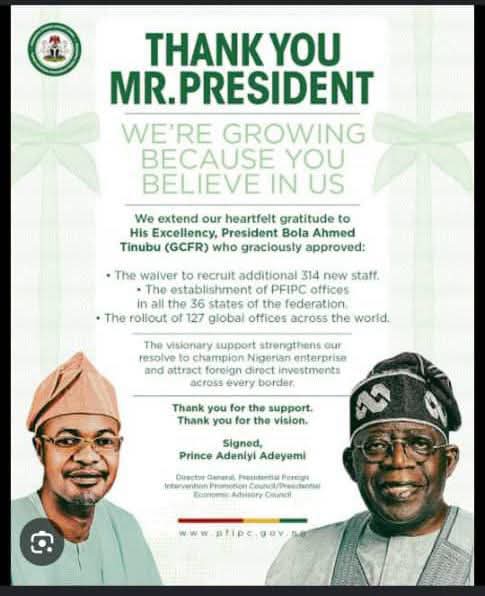
We may assume that once the Presidential spokesperson issues a statement, the President has spoken. No—not on an issue of this magnitude, where the head of the so-called agency hosted diplomats and investors, posed for photographs with senior government officials, and operated openly from the comfort of his alleged "fake" agency office at the Federal Secretariat.
That is precisely why the President's silence on matters of far greater national consequence has become even more troubling.
Why have Nigerians not heard directly from the President on issues that deserve presidential attention—the Prince Adeyemi Adeniyi Matthew and Rt. Hon. Femi Gbajabiamila saga, and the national embarrassment to which the so-called fake agency controversy has subjected Nigeria?
Recently, Femi Gbajabiamila, while explaining why he did not support Desmond Elliott's bid to return to the Lagos State House of Assembly, openly disclosed that his position as Chief of Staff to President Bola Ahmed Tinubu was allegedly threatened because of the political crisis surrounding the impeachment of Mudashiru Obasa.
More significantly, he told Nigerians that the President considered the Surulere political crisis important enough to summon him to his private residence for discussions.
Whether one agrees with Gbajabiamila's position on Surulere politics is beside the point.
The real issue is what that disclosure reveals about the priorities at the highest level of government.
If the Chief of Staff to the President can publicly suggest that political intrigues almost consumed his office, then Nigerians deserve to ask a simple but fundamental question:
Who is governing Nigeria while the political class remains perpetually occupied with managing politics?
Then came the so-called fake agency saga.
Again, the nation watched another controversy dominate public discourse. Lawyers argued. Political commentators took sides. The media churned out endless analyses. Social media became a courtroom. Government supporters and critics traded accusations.
We are told that Gbajabiamila blew the whistle through a petition reportedly written as far back as October. The obvious question is this: Why was there silence until about three weeks ago, when Prince Adeyemi Adeniyi Matthew publicly presented his own side of the story?
Millions of voices have been heard on the matter.
Yet one voice has remained conspicuously absent.
The President's
The number steward of our nation that ought to speak authoritatively have remained largely silent. There has been no comprehensive official explanation, no coordinated institutional briefing, no clear timeline of events, and no transparent account of how such an agency allegedly emerged, who approved it, what procedures were followed, or what corrective measures will prevent a recurrence.
That silence is more damaging than the controversy itself.
In every serious democracy, communication is governance.
Leadership is not merely about making decisions. It is about ensuring that citizens understand those decisions and retain confidence in the institutions making them.
When governments allow rumours to compete with facts, rumours usually win.
The real embarrassment, therefore, is not simply whether an agency was genuine or fake.
The greater embarrassment is that Nigerians have been left to depend on speculation instead of official information.
This is not how modern governments operate.
If the matter passed through any ministry, Nigerians deserve to know.
If any department processed the documentation, Nigerians deserve to know.
If the Office of the Secretary to the Government of the Federation had any role, Nigerians deserve to know.
If the Federal Executive Council considered any aspect of it, Nigerians deserve to know.
If no institution approved it, Nigerians deserve to know precisely how the process failed.
To imagine that the Agency had a budget in the 2026 appropriation bill is the height of this revelation. Which committee of the Senate has oversight of the Agency?
What word can we get from Senator Olamilekan Adeola as the Chairman of the Appropriation Committee on the procedure that privileged the Agency to make it on the budget?
Every institution connected with the matter should issue a formal public account of its role—or lack thereof.
That is how confidence is rebuilt.
Anything less leaves government looking confused.
It is also unfair to innocent public servants whose reputations remain under suspicion because no official process has clarified responsibility.
The impression created by political marketers before the 2023 election was that President Bola Ahmed Tinubu had built his political reputation on organisation, discipline and strategic coordination, with Lagos frequently presented as the evidence of that pedigree.
Those strengths must now be demonstrated in governance—unless they were merely products of political branding.
Politics wins elections.
Governance builds nations.
Nigeria cannot continue operating as though political management is an adequate substitute for institutional leadership.
This episode should become a defining moment.
The President should direct every institution connected with the matter to publish a factual account of its involvement, identify procedural failures, recommend reforms, and implement sanctions where necessary.
Such openness is not a sign of weakness.
It is a demonstration of confidence.
Globally, effective leaders understand that credibility is preserved by confronting controversy early, directly and transparently.
A useful example is President Donald Trump's handling of the 2025 unrest in Los Angeles. The administration moved swiftly to communicate its position publicly, announcing the deployment of federal forces, explaining the legal authority upon which it relied, and defending its decisions through coordinated White House briefings and official statements. Whether one agreed with the policy or not, there was little uncertainty about where the administration stood or who was accountable for the decisions taken. That clarity is an essential ingredient of effective leadership during moments of national controversy.
That is one of the enduring principles I explore in my forthcoming book, Global Leadership Code: leadership cannot outsource communication during crises. A vacuum of official information is quickly occupied by speculation, and speculation erodes institutional legitimacy.
Nigeria must embrace that code.
The Presidency should not merely react to crises.
It should define the national narrative through truth.
This is bigger than one agency.
It is about restoring confidence in the architecture of governance.
It is about reminding every public institution that silence is not neutrality.
Silence is communication.
And sometimes, silence communicates institutional failure.
Mr. President, this is your mandate! On this, no other person should stand on this for you.
Do I need remind the President of the key commitments in the oath of his mandate, which are:
To be faithful and bear true allegiance to Nigeria.
To discharge the duties of President faithfully and in accordance with the Constitution and the law.
To preserve the Fundamental Objectives and Directive Principles of State Policy.
Not to allow personal interests to influence official decisions.
To preserve, protect, and defend the Constitution.
To abide by the Code of Conduct.
To do right to all people without fear or favour, affection or ill-will.
To maintain the confidentiality of matters of state except as required by duty.
To devote himself to the service and well-being of the people of Nigeria.
Mr President, on the account of your mandate, call every institution to account.
Require every file to be traced.
Publish every stage of the process.
Tell Nigerians exactly what happened.
Where laws were broken, prosecute.
Where procedures failed, reform them.
Where officials erred, discipline them.
Then move the nation forward.
That is how democracies mature.
That is how institutions earn respect.
That is how presidents rise above politics to become statesmen.
Nigeria does not need another cycle of endless opinions.
Nigeria needs official truth.
History will remember not merely that a controversy occurred.
History will remember whether leadership had the courage to confront it with transparency, resolve it with integrity, and restore public confidence in the institutions of the Nigerian state.
@YayiAdeola@NGRPresident@officialABAT @femigbaja @EiENigeria
#NigeriaPolitics #LetThePresidentSpeak #StateOfTheNation #RenewedHope
Pastor E.A. Adeboye: The Soup in the Belly of an Elder
An Apostolic Reflection to Daddy G.O.
By Citizen Bolaji O. Akinyemi
There are moments in the life of a nation when silence is no longer wisdom, and there are moments in the life of the Church when love itself demands honest reflection.
This is one of those moments.
I write, not as one seeking to diminish the stature of one of God's greatest servants, but as one persuaded that the Kingdom of God is best served when fathers can still hear the voices of sons, and when sons speak with reverence rather than rebellion.
The Apostle Paul demonstrated this balance when he withstood Peter to his face—not because Peter had ceased to be an apostle, but because the integrity of the Gospel was greater than the reputation of any man.
Likewise, every public statement made by an elder of the Church deserves careful examination, not to condemn the elder, but to preserve the credibility of the witness entrusted to him.
Pastor Enoch Adejare Adeboye remains one of God's greatest gifts to Nigeria, Africa and the global Church. His ministry has transformed millions of lives. His humility is legendary. His commitment to prayer is unquestionable. His influence reaches presidents, kings, scholars and ordinary citizens alike.
Precisely because of that influence, every public word he speaks carries national significance.
His recent address in the United States has generated intense debate.
Many have responded emotionally.
I believe the Church deserves something deeper than emotion.
It deserves apostolic reflection.
One statement in the address particularly captured my attention.
Pastor Adeboye quoted an African proverb.
«"After an elder has eaten soup, no matter what happens, the soup must not shake in his belly."»
It is one of the most profound descriptions of eldership in African philosophy.
An elder absorbs pain without transmitting panic.
He restrains anger.
He calms younger generations.
He thinks beyond the emotion of the moment.
He sees farther than those around him.
Indeed, Pastor Adeboye demonstrated that quality when he recounted how he restrained angry Christian youths from retaliating after horrific attacks against believers.
For that, he deserves the gratitude of the nation.
Nigeria may never fully appreciate how many religious conflicts have been prevented because respected fathers refused to permit revenge.
History should honour such restraint.
Yet the same proverb invites another question.
Did the soup remain steady throughout the speech?
Or did it begin to shake?
That question is uncomfortable.
But the Church has never grown by avoiding uncomfortable questions.
It has always grown by confronting them in love.
The first part of Pastor Adeboye's address reflected the heart of a shepherd.
He spoke about persecution.
He spoke about murdered pastors.
He spoke about widows.
He spoke about internally displaced persons.
He spoke about children.
He spoke about the tears of the Church.
Every compassionate heart should feel the weight of that burden.
No responsible Nigerian can deny that Christians have suffered immensely from terrorism and criminal violence.
Nor can anyone dismiss the pain that produced his appeal.
But somewhere along the journey, the shepherd gradually became a political commentator.
There is nothing wrong with that.
The prophets did it.
Nathan confronted David.
Elijah confronted Ahab.
John the Baptist confronted Herod.
Paul reasoned with governors and kings.
The Kingdom of God has always spoken into the affairs of nations.
The difficulty is not that Pastor Adeboye addressed politics.
The difficulty is that he repeatedly insisted that the gathering was "not political" while discussing governmental performance, military strategy, diplomacy, international relations, and presidential decision-making.
That is politics—not partisan politics, but the politics of governance.
The Church should never apologise for speaking into governance.
Indeed, if righteousness exalts a nation, then the Church has both the right and the responsibility to address the conduct of government.
The problem is not political engagement.
The problem is inconsistency.
That inconsistency became most apparent when Pastor Adeboye discussed two Presidents who both occupy the office of Commander-in-Chief.
The Two Commanders-in-Chief
Perhaps the greatest inconsistency in the address lies in Pastor Adeboye's comparison between President Donald Trump and President Bola Ahmed Tinubu.
Pastor Adeboye openly admired President Trump for his decisiveness.
He described him as a leader whose words become action.
He celebrated the certainty with which Trump's military commands are executed.
He even illustrated his point by referring to American military operations, arguing that once President Trump gives an order, he does not need to leave the White House.
He goes to bed while the institutions of state execute his command.
That observation is correct.
It reflects the strength of institutions.
It reflects the discipline of command.
It reflects accountability within government.
But then Pastor Adeboye turned to President Tinubu.
Here, the standard changed.
He argued that once President Tinubu had instructed the military, the President had fulfilled his own responsibility.
That is where the soup began to shake.
Why should execution matter in Washington but not in Abuja?
Why should one Commander-in-Chief be celebrated because his orders are implemented, while another Commander-in-Chief is excused despite the continuing failure of implementation?
The constitutional office is the same.
The principle of command is the same.
The burden of accountability is the same.
Leadership cannot be measured by instructions alone.
Leadership must ultimately be measured by results.
Our Lord Jesus Christ never taught us to judge stewardship by intentions.
He taught us to judge by fruit.
Scripture says,
"By their fruits ye shall know them."
The Commander-in-Chief is not merely the nation's highest military officer.
He is the nation's highest accountability officer.
Delegation distributes duties.
It never transfers responsibility.
When insecurity persists despite repeated directives, constitutional responsibility still rests at the highest office.
This is not a political statement.
It is both a constitutional truth and a biblical principle.
Apostolic leadership refuses to separate authority from accountability.
If a father instructs his household and nothing changes, the household still looks to the father.
If a shepherd gives instructions and the flock remains scattered, the Chief Shepherd still asks questions.
If a president commands the Armed Forces and insecurity worsens, history will judge the presidency—not merely those who received the orders.
The Church must apply one moral standard to every leader.
Anything less weakens its prophetic authority.
Another concern arises from Pastor Adeboye's description of his meeting with President Tinubu.
He disclosed that he advised the President to engage President Trump diplomatically, issue firm military directives, and pursue the sponsors of terrorism rather than merely the foot soldiers.
That advice was wise.
Indeed, many Nigerians have made similar recommendations for years.
Yet one question remains.
If those recommendations were sound enough to be presented privately to the President, should they not also become part of the Church's consistent public prophetic witness?
The prophetic ministry loses credibility when truth is whispered in private but softened in public.
Nathan did not merely advise David in secret.
He confronted him openly.
John the Baptist did not quietly counsel Herod.
He publicly declared, "It is not lawful."
The prophetic office has never existed merely to preserve relationships with rulers.
It exists to preserve righteousness within government.
This brings us to an important distinction.
Pastors Comfort Kings. Prophets Confront Kings.
The Church must never confuse pastoral compassion with prophetic responsibility.
Pastors comfort people.
Prophets comfort truth.
Pastors heal wounds.
Prophets expose the systems that continue to inflict those wounds.
Pastors pray for rulers.
Prophets remind rulers of the covenant they swore to uphold.
Nigeria needs both.
No one questions Pastor Adeboye's pastoral heart.
The nation has witnessed it for decades.
What Nigeria desperately needs now is the full weight of his prophetic mantle.
Not because presidents should be embarrassed.
But because nations are preserved when truth is spoken consistently.
The Church is neither an opposition party nor the public relations department of any government.
It is, in the words of Scripture, "the pillar and ground of the truth."
Truth comforts.
Truth convicts.
Truth corrects.
Truth heals.
Truth also demands consistency.
When the Church appears to celebrate one President for institutional effectiveness while excusing another for institutional failure, younger generations begin to wonder whether proximity to power has influenced prophetic clarity.
That is a dangerous perception.
Not because it diminishes one man.
But because it weakens confidence in the prophetic voice of the Church.
Daddy G.O., permit one of your sons to end with the proverb that inspired this reflection.
You reminded us that after an elder has eaten soup, the soup must not shake.
Permit us to respectfully add:
The soup in the belly of an elder must remain steady not only in the face of persecution, but also in the presence of power.
The elder who restrains angry youths from revenge must also restrain presidents from complacency.
The elder who teaches patience to suffering congregations must also teach urgency to those entrusted with governing.
The elder who speaks courageously before foreign audiences must speak with equal courage before domestic authority.
The Church owes every government the same message.
Justice.
Truth.
Righteousness.
Accountability.
The Church does not strengthen a president by lowering the standard of accountability.
It strengthens a president by reminding him of the oath he freely swore before God and before the nation—to preserve, protect and defend the Constitution; to do right to all manner of people without fear or favour, affection or ill will; and to devote himself to the service and well-being of the people of Nigeria.
That oath is not fulfilled by issuing orders alone.
It is fulfilled when those orders produce justice, security and peace for the people.
The greatest service an elder can render a king is not applause.
It is truth.
History remembers prophets not because they preserved the comfort of kings, but because they preserved the conscience of nations.
May God continue to preserve Pastor E.A. Adeboye as a father in Israel.
May He grant him even greater grace to remain what he has always been at his best—a pastor to the broken, a father to the Church, and a prophet to the nation.
For when the soup remains steady in the belly of an elder, the nation finds wisdom.
But when the soup begins to shake, generations lose their bearing.
May the God of truth keep the soup steady in all our bellies.@PastorEAAdeboye @TheRCCG @PastorFAAdeboye @DavidOyedepoMin @BishopKukah@TundeBakare @PojuOyemade @Sam_Adeyemi@YemiOsinbajo@LekeAdeboye @GodmanAkinlabi @CAN_Nigeria @PFNHQ@Church_Gist
#ChurchAndState #AccountabilityInPower #NigerianChurch #FaithAndGovernance
NIGERIA DOES NOT NEED ANOTHER PLAN; IT NEEDS A CHANGE LEADERSHIP ARCHITECTURE
Why Dr. Wale Adekanla's ADAPTS™ Framework Deserves National Attention
By Citizen Bolaji O. Akinyemi
Apostle of Order | Nation Builder
Every generation produces thinkers whose ideas deserve to move beyond the classroom and become part of national conversations. Such ideas should not remain confined to academic journals or conference halls; they should shape public policy and inspire citizens.
One such contribution is Dr. Wale Adekanla's recent paper, Redesigning Nigeria: A Strategic Architecture for National Transformation Through the ADAPTS™ Change Leadership Framework.
Having carefully studied the work, I believe it deserves the attention of every Nigerian who sincerely desires national transformation.
For decades, Nigeria has suffered from what may be described as "planning without transformation." We have produced Vision 2010, Vision 2020, NEEDS, SEEDS, Agenda 2050, numerous constitutional conferences, and countless reform committees. Yet our development outcomes remain disappointing.
Dr. Adekanla identifies the missing link with remarkable clarity.
According to him, Nigeria does not primarily lack policies or strategic plans. Rather, Nigeria lacks a coherent architecture for leading, implementing, and sustaining change.
That diagnosis deserves serious reflection.
Far too often, we celebrate the announcement of policies but neglect the discipline of implementation. We inaugurate committees without building institutions. We pursue reforms without preparing the people, aligning stakeholders, or creating mechanisms that survive changes in political leadership.
This is where the ADAPTS™ Change Leadership Framework offers something fresh.
The framework proposes six sequential stages of transformation:
- Alert the nation to the urgency of change.
- Diagnose the real structural gaps.
- Assess readiness for reform.
- Build broad-based participation through dialogue.
- Execute reforms through institutional alignment.
- Scale and sustain transformation beyond individual leaders.
This sequence appears simple, yet it addresses one of Nigeria's greatest historical weaknesses—the tendency to jump directly to implementation while ignoring diagnosis, consensus-building, and institutional readiness.
As someone who has consistently advocated constitutional restructuring, institutional reforms, accountable leadership, electoral integrity, and nation-building, I find considerable convergence between Dr. Adekanla's framework and the larger conversation on Nigeria's future.
His emphasis on leadership systems rather than heroic individuals is particularly instructive.
Nigeria has spent too much time waiting for a "messiah." Nations are not transformed by messiahs alone. They are transformed by institutions that consistently produce competent leaders and accountable governance.
The paper also reminds us that countries such as Singapore, Rwanda, South Korea, and the United Arab Emirates did not become success stories by accident. They deliberately built institutions capable of implementing national visions over many years.
Nigeria must learn this lesson.
Our greatest challenge has never been the shortage of brilliant ideas. Our universities produce ideas. Our professionals produce ideas. Our diaspora produces ideas. Our civil society produces ideas.
The challenge has been converting ideas into coordinated national action.
This is why I consider the ADAPTS™ framework more than another leadership model. It is an invitation to rethink how Nigeria approaches transformation itself.
Of course, no single framework can solve every Nigerian problem.
Questions of constitutional legitimacy, true federalism, fiscal restructuring, electoral reforms, security decentralisation, justice, and citizen participation will continue to require robust national dialogue. These remain issues I have consistently advocated and will continue to champion.
Nevertheless, any serious constitutional or governance reform must eventually confront the challenge of implementation.
That is precisely where Dr. Adekanla's work makes an important contribution.
Ideas that improve our national thinking deserve encouragement regardless of who authors them. Nation-building requires intellectual generosity as much as political courage.
I therefore commend Dr. Wale Adekanla for contributing an African-developed leadership framework to the growing body of knowledge on national transformation.
My recommendation is straightforward.
This paper should be studied by members of the National Assembly, state governors, policymakers, civil servants, political parties, universities, leadership institutes, civil society organisations, youth groups, and every Nigerian interested in rebuilding our country.
Nigeria's future will not be secured merely by producing another document.
It will be secured when we finally build leadership systems capable of translating vision into measurable national progress.
That conversation deserves to begin now.
Citizen Bolaji O. Akinyemi
Apostle of Order | Nation Builder.
@successnature@UtomiPat@SamAmadi@obyezeks
#Nigeria #PublicPolicy #GoodGovernance #AfricanLeadership #ApostleOfOrder
THE WIDOW'S VOTE, THE NATION'S CONSCIENCE
Why Nigeria Must Hear the Cry of Widows and Single Mothers Before 2027
By Bolaji O. Akinyemi
A nation does not reveal the strength of its democracy by how it treats the powerful. It reveals its soul by how it treats the vulnerable.
Among the most overlooked constituencies in Nigeria today are widows and single mothers. They are not a political party. They do not command the financial influence of the business class. They are rarely consulted when public policies are designed. Yet they constitute one of the largest and most consequential demographic groups in our democracy.
Their votes count during elections.
Their voices are scarcely heard after elections.
Across Nigeria are millions of women whose lives changed forever in a single day.
Some watched terrorists murder their husbands before their eyes.
Some fled burning communities with nothing but the clothes they wore.
Some escaped with children in their arms, leaving behind homes built over decades.
Some have never returned to their ancestral lands.
Many no longer know where the graves of their husbands are.
Their children now grow up without fathers.
Entire generations are being raised by mothers carrying burdens no citizen should ever be forced to bear alone.
Behind every statistic on insecurity lies a human story.
A widow.
An orphan.
A child permanently traumatised.
A family living with disability inflicted by bullets, bombs, kidnappings or violent attacks.
A farmer whose land has become inaccessible.
A trader whose shop was reduced to ashes.
A young girl whose education ended because her family's breadwinner never returned home.
These are not isolated tragedies.
They are the untold human cost of Nigeria's prolonged insecurity.
Yet one of the greatest ironies confronting our national conscience is this.
From time to time, we celebrate programmes designed to rehabilitate those who once embraced violence. Society speaks about reintegration, vocational training and opportunities for former combatants to begin life afresh.
Rehabilitation has its place in every civilised society.
Peace often requires pathways back into lawful living.
But justice demands balance.
A nation cannot become so committed to restoring those who once carried arms that it forgets those against whom those arms were carried.
What message does it send when those associated with violence appear to receive structured pathways to restoration while countless victims remain forgotten?
What does democracy mean to the widow who still lives in an internally displaced persons camp years after losing her husband?
What hope exists for the orphan who has never received educational support?
What comfort reaches the family caring for a father, mother or child permanently disabled by terrorist attacks without access to healthcare, rehabilitation or economic assistance?
What becomes of communities where people cannot return home because insecurity still makes farming impossible?
Many victims have nowhere to return.
No homes remain standing.
No farms are safe to cultivate.
No businesses survive.
No compensation arrives.
No structured programme exists to rebuild their lives.
Some continue to depend on charity long after public attention has shifted elsewhere.
Others quietly descend into extreme poverty while the nation debates politics.
This is not merely a humanitarian concern.
It is a profound question of justice.
The true measure of post-conflict recovery is not only how many former fighters are rehabilitated.
It is whether victims are restored with equal or greater urgency.
Justice must never create the perception that violence attracts more organised attention than innocence.
A compassionate nation must never allow victims to feel abandoned while extending opportunities to those who once threatened society.
Widows and single mothers therefore represent far more than a vulnerable social category.
They embody the unfinished business of national justice.
They carry within them the visible scars of governance failures, security failures and policy failures.
Yet despite these enormous sacrifices, they remain largely absent from our national development agenda.
Every election season politicians speak passionately about infrastructure, employment, agriculture, education and economic reforms.
These conversations matter.
But there is almost no sustained national conversation about widows, orphans, fatherless children and female-headed households as a distinct constituency deserving comprehensive public policy.
This silence must end.
Widows and single mothers are not objects of charity.
They are stakeholders in the Nigerian project.
They are taxpayers.
They are entrepreneurs.
They are professionals.
They are farmers.
They are teachers.
They are healthcare workers.
They are raising the next generation of Nigerians.
Indeed, the future leadership of Nigeria is already growing inside homes headed by widows and single mothers.
If we neglect them today, we mortgage tomorrow.
As Nigeria approaches the 2027 elections, perhaps the time has come to convene a National Conference of Widows, Single Mothers, Orphans and Victims of Terrorism.
Not as another ceremonial gathering.
Not as a sympathy event.
But as a strategic democratic assembly.
Its objective should be to produce a National Charter for Victims, Widows and Vulnerable Families.
The conference should ask difficult questions.
How should government rebuild destroyed communities?
How should victims of terrorism receive compensation?
How should children orphaned by insecurity be guaranteed uninterrupted education?
What healthcare should exist for those permanently disabled by violence?
How should inheritance rights be better protected?
What legal and psychological support should be available for women suddenly forced to become heads of households?
How can victims move from dependency to economic productivity?
How should governments measure success—not merely by the rehabilitation of former perpetrators, but by the complete restoration of innocent victims?
These questions deserve answers.
This is no small constituency.
Millions of votes reside within these homes.
Millions of future citizens are being raised by women who have already sacrificed more than most public officials will ever understand.
When organised, informed and united around a common agenda, they possess enormous democratic influence.
Political leaders should not fear such organisation.
They should welcome it.
A democracy grows stronger when every significant social group can peacefully organise, articulate its interests and negotiate its rightful place within the national conversation.
Beyond government, religious institutions, traditional institutions, civil society, professional bodies and the private sector must move beyond seasonal charity.
Nigeria needs permanent systems that restore dignity rather than temporary interventions that merely postpone despair.
The issue before Nigeria is therefore much larger than welfare.
It is about justice.
It is about national memory.
It is about inclusion.
It is about ensuring that those who have already paid the highest price for Nigeria's insecurity are not condemned to lifelong neglect.
As 2027 approaches, widows and single mothers must begin to recognise not only their pain but also their democratic power.
They must organise.
They must speak.
They must negotiate.
They must demand measurable commitments.
They must insist that every political party seeking their votes presents a clear agenda for widows, orphans, victims of terrorism and vulnerable families.
Democracy works best when every voice is represented.
Perhaps the time has come for Nigeria to recognise that among the strongest voices still waiting to be fully heard are those who have buried husbands, raised children alone, survived displacement and endured unimaginable loss without surrendering hope.
When they finally speak together, the nation may discover that it has ignored not merely one of its most vulnerable populations, but one of its greatest reservoirs of courage, resilience and moral authority.
The future of their children—and by extension, the future of Nigeria—cannot be left to chance.
It must become a deliberate national covenant.
For any nation that remembers those who once terrorised it but forgets those who suffered because of terror has not yet completed the journey from conflict to justice.@officialABAT@ObyEzeks@SERAPNigeria #TheWidowsVote #Nigeria2027
NDC: WHO IS A GOOD PARTY MAN?
Justice Within Before Justice Without (III)
Why Due Process Is the First Test of Internal Democracy
By
Citizen Bolaji O. Akinyemi
Apostle of Order | Nation Builder
Director-General
Citizen Independent Campaign Organisation (CICO)
An Initiative of the Citizens Advancement and Development Initiative (CADI)
The recent suspension of Hon. David Lahandu Dama by the Naraguta B Ward of the Nigeria Democratic Congress (NDC) has opened yet another constitutional and administrative conversation that the national leadership of the party can no longer afford to ignore.
This is no longer about one individual.
It is no longer about Plateau State alone.
It is about whether the NDC intends to build a political culture different from the one Nigerians have rejected for decades.
The question before the nation is simple:
Who is a good party man?
Is a good party member one who keeps quiet in the face of perceived injustice?
Or one who, while remaining within the party, raises constitutional questions about its internal processes?
Every democratic institution must answer that question.
The Administrative Puzzle
The suspension letter raises an important procedural issue.
It announces an immediate six-month suspension.
It simultaneously informs the recipient that he will later appear before a Disciplinary Committee to defend himself.
This sequence deserves careful examination.
Ordinarily, what becomes the responsibility of a disciplinary committee after punishment has already been imposed?
If suspension is the outcome of disciplinary proceedings, should the disciplinary process not precede the punishment?
Should the committee merely validate a decision already taken?
Or is it expected to genuinely determine whether suspension is justified?
These are not technical questions.
They go to the heart of natural justice.
Across democratic institutions, one enduring principle remains constant:
No one should be punished before being heard.
Justice must not only be done.
It must be seen to have been done.
Does Process Matter?
Yes.
Because institutions are remembered less for the decisions they make than for the processes through which those decisions are reached.
The credibility of any disciplinary system rests upon fairness.
Where procedure appears reversed, public confidence inevitably suffers.
That is why Nigerians are asking whether the handling of internal disagreements within the Plateau chapter may unintentionally be lending credibility to allegations already circulating about attempts to suppress internal democracy.
Whether those allegations are true or false is precisely why transparent due process is indispensable.
Proper procedure protects not only the accused.
It also protects the integrity of the institution itself.
The Grievance That Triggered the Crisis
The immediate background to this controversy should not be overlooked. Before his suspension, Hon. David Lahandu Dama publicly alleged that the process for selecting the NDC's House of Representatives candidate for the Jos North/Bassa Federal Constituency fell short of the standards of internal democracy. He contended that no transparent primary election was conducted, that no genuine consensus was reached among the aspirants, and that the eventual emergence of a candidate reflected imposition rather than a process consistent with the party's constitution and democratic ideals. He consequently appealed to the national leadership of the NDC to review what he described as a flawed process. Whether these allegations are ultimately established or disproved is a matter for the party's lawful internal mechanisms. However, disciplining a member who has raised constitutional and procedural concerns inevitably invites public scrutiny of both the original grievance and the fairness of the disciplinary process itself.
Silence Is No Longer Golden
The leadership of the NDC has maintained remarkable silence despite several constitutional questions now before the public.
Silence may sometimes be strategic.
But there are moments when silence creates a vacuum that speculation quickly occupies.
For a political party asking Nigerians to entrust it with national leadership, silence is becoming increasingly expensive.
Many nation-builders across Nigeria continue to look upon the NDC with hope.
That hope is not rooted merely in campaign promises.
It rests upon the expectation that the party will demonstrate a higher commitment to constitutionalism than those it seeks to replace.
Public silence should not be mistaken for public approval.
Neither should the leadership mistake restraint for satisfaction.
The Yoruba Wisdom
Our elders captured this principle long ago.
"Ojú awo ni awo fi ń gba obe."
The plate takes soup on its inside and never its back.
Trust is earned before responsibility is given.
Citizens cannot safely entrust the future of a nation to institutions that appear unwilling to answer legitimate constitutional questions about their own internal affairs.
A Marriage Built on Trust
Political parties and citizens are prospective partners in the marriage of nation-building.
Trust is the foundation of that marriage.
Without trust, manifestoes become mere literature.
Campaign promises become mere slogans.
Institutions become hollow.
The NDC still possesses a rare opportunity to distinguish itself.
It should not waste it.
Time Is Running
Nigeria is approaching the period when the Independent National Electoral Commission (INEC) will provide political parties with access to upload the names of their candidates.
That moment will become another important test of transparency.
If Nigerians eventually discover that individuals who did not participate as aspirants in duly conducted primary elections emerge as candidates under descriptions such as "placeholder" or by any other procedural innovation unknown to law, public confidence will suffer profound damage.
Citizens are becoming increasingly vigilant.
They are prepared to defend constitutional democracy with lawful civic action.
The NDC should not place itself in unnecessary conflict with the very citizens whose confidence it seeks to earn.
Speak Now—or History Will Speak Later
This is therefore a respectful appeal to the national leadership of the Nigeria Democratic Congress.
Speak.
Clarify.
Explain.
Reassure.
Demonstrate that internal democracy remains the soul of the party.
Because if the NDC truly seeks to become the vehicle for building a new Nigeria, it must first show Nigerians that justice begins within its own house.
History is watching.
The Nigerian people are watching.
And silence, at this defining moment, is no longer @PeterObi@KwankwasoRM@inecnigeria@YIAGA@SeunOkin@RufaiOseni
#InternalDemocracy #ElectoralAct2026 #PlateauPolitics #NDCOfficial