🚨Anthropic just showed a 24-minute workshop on how to actually do prompts for Claude.
Taught by the people who built it.
Free. No registration. No paywall.
I've seen $300 courses that don't cover what they teach in the first 8 minutes.
Watch it and bookmark it now.
I’m sitting on an airplane right now.
I remembered a roofing company that gets 100% of their business from real estate agents. Every single job comes from pre-sale roof inspections. No other marketing.
So I had an idea…I sent a prompt to Cody, my openclaw, who helped me write a prompt to run . All from my phone, on discord, from a plane.
It scraped Zillow, Redfin, and https://t.co/BAv8OuRNik for real estate agents actively listing homes built between 1965 and 2000 in my service area.
Brokerage, phone, email, active listings, property addresses, year built. , everything.
A csv just landed in my Google Drive.
Cody is already starting outreach.
I’m still in the air.
I don’t have employees doing this. I don’t have a VA. I have an AI agent doing actual work for me, and blowing my mind.
If you’re doing stuff like this, hit up the comments 👇🏼
Today is the day.
We have landed in California after a legendary run of rationing Gavin Newsom. Now it’s time to get to work.
We have one mission: To expose the fraud and corruption that is killing one of America’s greatest states.
The criminality in California steals from all America Taxpayers. We are partnering with researchers who have spent their lives studying this corruption and have the receipts.
Please pray for us.
The downside of flipping:
If you sell a house to a buyer at the top of a market and something changes in their life/loan etc - completely outside of your control
The buyer comes back and threatens to sue
It happened to me in 2009
Happening to me again in 2024
Homes I sold 18+ months ago to buyers who make speculative purchases.
You're overlooking income patterns when selecting sites, and it's causing you to miss high-return opportunities.
99% of investors will never see the true potential of transitional areas.
Here’s what I learned from a single conversation during my time at SMU that changed how I search for deals
A seasoned investor shared how he identified overlooked areas by using a “topographic income map.”
Instead of showing elevation, it visualized area median income—revealing stark contrasts between high and low-income neighborhoods.
This approach made it easy to spot transitional areas with strong growth potential, places most investors ignore because they don’t fit the typical profile. It’s a strategy I’ve used ever since to find hidden opportunities in under-the-radar neighborhoods—especially for Opportunity Zone projects.
The lesson? Sometimes visualizing data differently can help you see value others miss.
There is a proven playbook to grow companies.
What tools to use, agencies to hire, strategies to employ.
Well here is my exact 12 step plan and my exact strategy for supercharging a business:
#1 - New logo with 99 designs. It costs $299 and is good enough for me.
#2 - New website by https://t.co/sxVaDXCStX. They've built 5 of my websites.
Whoever you chose, make sure it is SEO optimized and has landing pages for each of your services and each location.
KEEP IT SIMPLE. A person who knows nothing about your business should be able to become your customer in 5 minutes or less.
#3 - Link building plan to increase domain authority and Google ranking with https://t.co/hm9vkny0k2.
The website structured correctly, content and these links are what will work for you.
Make sure to do "citations" as well with your name, address, phone number that list your company on all the directory sites like Yelp, Angies list, Yellow pages and more.
#4 - A LATAM or filipino hire through https://t.co/0yF9bNSQE1. $5 an hour can get you an excellent back office employee. Game changer.
80% of my employees at a SELF STORAGE company are overseas. You would be surprised how much can be managed and done from afar.
#5 - A Google Business profile you check and post on every single day. And you get all of your customers to write you a review.
This is a game changer as well and low hanging fruit.
#6 - Google ads running with https://t.co/vARhdrTvgO. Make sure you hire a company that can setup Google Analytics 4 and track how the ads convert to customers.
You should get an ad spend amount per customer acquired so you can track profitability.
#7 - Make sure to get a premium .com domain for a few thousand bucks with less than 13 characters. English words. Not .co. Not .net. Not .io.
People invest thousands into their business but make due with a $19 domain wit hyphens. Makes no sense.
#8 - Online banking with relayFi. It is easy to send money and get cards for all your employees.
Don't accept cash or check. It is a waste of time and money. And people will steal it.
#9 - An online software to run your business. Jobber or another one like it.
A customer should be able to log in and pay an invoice in 2 minutes. And you should be able to send them a professional invoice and take auto-payment for services.
#10 - Payroll tools like Deel (international) and Gusto make it super easy to run payroll.
#11 - Bookkeeping and tax returns through https://t.co/FCAKe2HGgv. I use them and they are awesome. Send monthly reports and prep tax returns.
#12 - Slack for communication. Loom for sharing training videos. Avoma for recording meetings.
It’s a cheat code to have these vendors to amplify my companies.
(I’m a partner in several of these companies)
What do you have in your tech stack that I’m missing? What tools do you love that I didn't share?
If someone wants a billion dollar blue collar business that is ripe for disruption…
Look no further than Cintas, Unifirst, Aramark
Never seen companies that *actively* try to screw their customers like they do
As we get deeper into looking at assets with non-credit tenant bases (mainly, multi-tenant industrial) in SoCal, three things are becoming clear:
1. Even though the tenants are superficially in different businesses, the reality is likely that they're ~all cyclical businesses, so you're vulnerable to large increases in vacancy / big rent drops
2. Bc of the above, you want to keep large reserve and/or limit or eschew leverage, so as to avoid becoming a forced seller at precisely the moment you would not want to be
3. The pricing for these assets reflects the fact that we have not had a real down-cycle in a very long time
It's interesting that Anthony Bourdain's favorite restaurant in LA was In-N-Out Burger
In this classic clip he explains why and also subtly gives an insightful lesson on business/marketing...
Office was the first commercial real estate asset class to enter distress this cycle.
Class B & C Multifamily in the Sunbelt is the next shoe to drop.
Too many of these properties were purchased between 2020-2022 at extremely low cap rates that buyers were able to make pencil by using significant rent growth assumptions and turning units, with the intention to flip out after only a couple of years in the deal..
In addition, they underwrote these investments with a 3-5 year hold with exit caps in the 4’s and 5’s.
Problem is, the rent growth has stopped and over the past 12 months is starting to go negative.
Markets that were crazy hot, markets like Austin, Phoenix, Vegas, Nashville, Raleigh, Orlando, etc are now experiencing YOY rent declines, while operating costs are rising rapidly, especially insurance.
Furthermore, exit cap rates are 100+ bps higher and climbing. Will likely be in the 6’s and 7’s, not 4’s and 5’s.
Almost all buyers were GPs using LP money they raised for the acquisition promising mid to high teen IRRs.
Here’s the problem; on the surface it appears that they can’t sell, they can’t refinance, and they can’t raise more money.
They will try all three, but more often than not won’t be successful.
It will be difficult to sell, because cap rates have moved and they likely haven’t turned enough units and pushed rents enough to compensate for the value loss from the higher cap rate.
It’s challenging to refinance, because to start the lender likely doesn’t want to stay in the deal. But regardless of lender, the DSCR is totally jacked up because interests rates are in the 6’s and 7’s, AND lenders have increased their DCR from 1.15-1.20 to 1.25-1.30.
The LTV with these numbers are so low that it will likely necessitate a capital call every time.
And it’s incredibly hard via capital call to raise money because most LPs don’t want to put good money after bad, so capital calls are very challenging and optically not ideal for a GP.
So all of these factors; lower values, softening rents, challenging lending environment and pessimism about values falling further are in the process of creating a surge of loans that will mature in ‘24 and ‘25 that will not be able to be refinanced or paid off via a sale.
While the culture amongst lenders and special servicers is to work it out with the existing owner as long as there is good behavior, not everything can go that way.
Not every owner behaves well when they digest the fact they worked hard for multiple years on an asset and will effectively make zero dollars.
Either because the lender has to take back the asset, or an owner throws them the keys because they have no money left in the deal and the loan is non-recourse, expect a material increase in distress in class b & c “value add” Multifamily.
There will be some fantastic buying opportunities coming down the pipe.
Having your capital and lender lined up ahead of time is paramount.
In addition, having your deal flow pipeline via the brokerage community as well as acquisition personnel is essential.
Fwiw many of these fundamental truths apply to Class A multi in these markets as well. But those deals tend to have a little more cushion to absorb loss than the pure value add deals did.
Office was the first. Multi will be the second….who wants to take a guess at the third?
The following is one of the most educational real estate lectures on the web
James Randel is the author of "Confessions of a RE Entrepreneur," the best RE book of all time
In the lecture, he shares past deals teaching 🔥strategies/lessons across different asset classes⬇️
Here how you'll make your first 6 figures, with almost no startup costs:
High ticket lead gen.
Let's do roofing. Here's an actionable, step by step how to guide:
Step 1: Find a customer.
I know what you're thinking:
"But I don't even know what high ticket leadgen even means yet?"
It doesn't matter, you need a customer first. But to find a customer, you need to do some research first.
You are going to become an expert on Google PPC (pay per click) ads in one weekend (it'll be a long weekend).
Don't fret about FB ads or anything else for that matter. The only two words in your vocabulary this weekend are:
1. Google
2. Roofing
Why Google? Because it works, it's proven to work for roofing leads and you don't want to reinvent the wheel.
Why roofing? Because it's high ticket and biz owners are already used to buying leads and most leads are shared with 4-6 other competitors and suck. Yours will be exclusive and not suck.
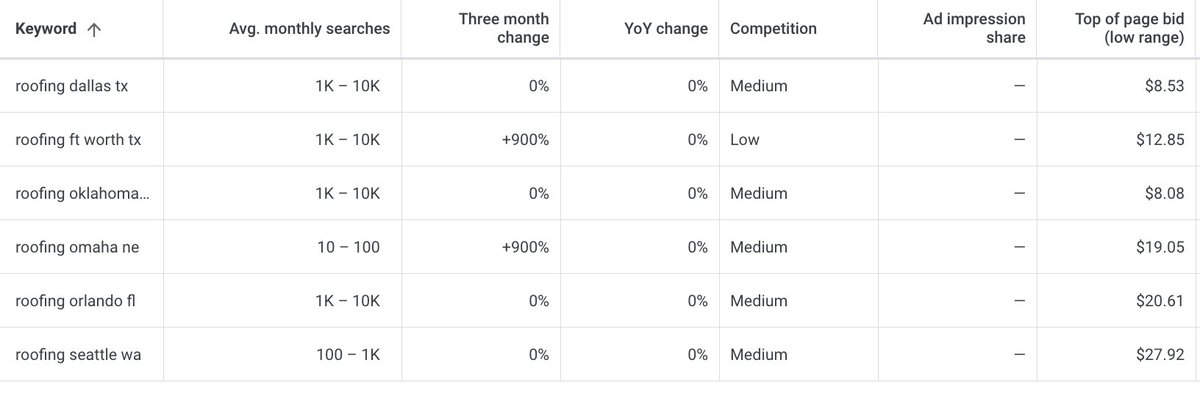
Google "Google keyword planning tool" and start typing in:
"roofing + city name"
Test it with 30-50 different cities ranked in the top 50 by population.
Google will spit out which markets are less competitive. For instance, Ft. Worth isn't too competitive for roofing leads, so let's use Ft. Worth.
Then use a scraping tool or a VA to scrape every roofer on Google maps in Ft. Worth and nearby cities.
If you find a customer in low PPC competition cities then you will be more profitable and more successful.
Look on FB Marketplace and Craigslist as well.
This will literally take 15 mins and cost about $5.
Now run those numbers through Searchbug to remove the landlines from the cells.
That cell phone list is your own personal goldmine, start working it.
How? By texting. Text all of the owners and say this:
Listen, I know you get these pitches for roofing leads all the time, but mine pitch is different. Why? Because I don't know a freaking THING about roofing leadgen. But In 1 week I'll be an expert. Once I become an expert, will you be my first customer? Your leads will never ever ever be shared with other companies. They're yours alone. I'm young and HUNGRY for roofing leads.
You'll find a customer. Call them when they don't answer. Or call them when they do. You won't close them via text.
Don't like my pitch. Try something else.
Take notes on what they all say and follow up until you have a CC#.
Step 2. Learn how to do PPC for roofing leads, with these tools:
- Subreddits
- YouTube
- Udemy Courses
- Google
That's it. You only care about roofing and Google, remember?
After two 12 hour days you'll know about 75% of everything there is to know about roofing PPC leads.
Step 3. Make a Stripe account, call up your first customer and get his CC#. Tell him you are ready to go.
What will you charge? $200 per lead. Yep, that's a lot, but not outrageous for exclusive leads for a $20k++ product.
If your customer's close rate is 20% then he's spending $1k to generate $20k.
You are going to target an an average cost per lead of $100. This can be higher or lower depending on several factors.
As you learn to refine the keywords and negative keywords you could possibly get it lower over time.
So that's a 50% gross margin. To net $100k you need to sell 1,000 leads, or 3/day.
It might not be possible with 1 customer, but your first customer is the hardest, by far.
If you're good at generating these leads then acquiring customers won't be the hard part, scaling will be.
Step 4. Start running ads for your customer and do nothing but watch them like a hawk.
These clicks are expensive so start with a $50-$100/day budget and go from there.
Follow up with your customer maniacally about each and every lead. If he doesn't chase them then they won't close and he won't keep buying from you.
Maybe you charge extra to call the lead yourself and set up an inspection.
Swipe that card every time a lead comes in.
Fine print:
1. You'll have to put these ad costs on a credit card and it will add up fast. You can get a $500 credit from Google though.
2. Your customer might not have a well-optimized Google My Business profile or website, so you may need to help with that.
3. Your customer might not be great at following up with these leads, or good at sales. You'll just have to learn this with time.
4. Many things can and will go wrong, but that's bizness, baby!
This model can be replicated in almost any other industry, or any other city with other roofing clients. Follow @mhp_guy for more bangers.
Good luck!
This MUST WATCH clip details the events that led to one of the CRAZIEST deals in Vegas history
Phil Ruffin shares the story of how he sold the New Frontier Hotel & Casino
In 98, he purchased it for $165m w/ $50m down
Just 9 yrs later, he sells it for $1.24 BILLION, a record at the time
It's a reminder that it just takes one deal to change your life
There are some great lessons to be learned here for any investor/entrepreneur/businessperson, particularly for those that are already in real estate
Billionaire investor Dan Loeb believes studying this one company is worth more than a 2-year MBA.
Surprisingly, it isn’t Amazon, Apple, or Berkshire Hathaway.
As one of the all-time best-performing stocks, it’s delivered 4,500%+ returns over the last 25 years.
Let’s dive in!