Cash Crude Oil
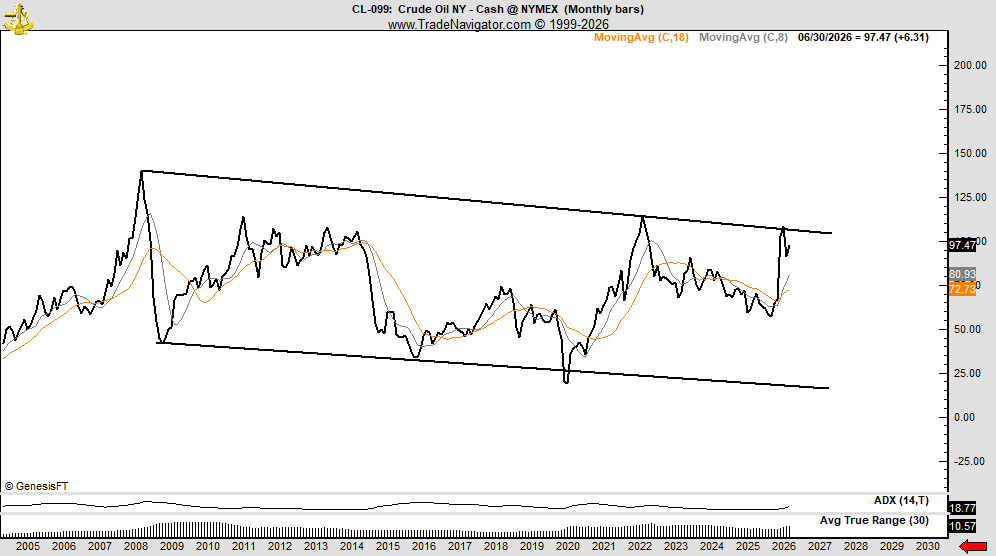
If we look at the monthly closing price chart we see a massive multi year channel
This would be a monster if completed above the 2022 high projecting price toward $200
The daily chart is coiling in a sym triangle
For the record.
In Canada, It Matters How the Economy Dies.
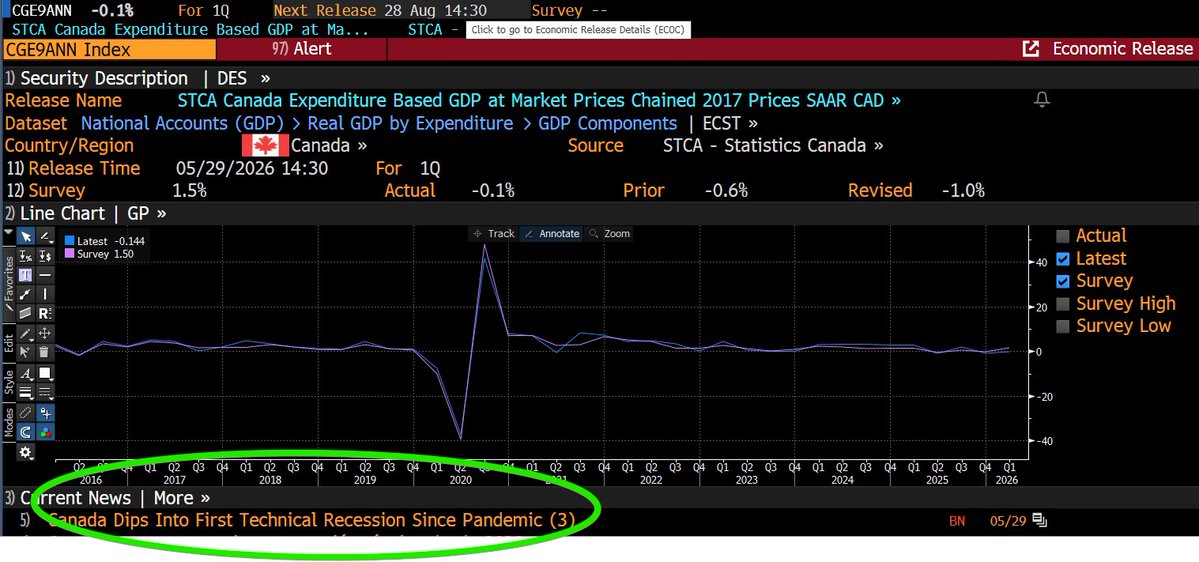
The Canadian economy is dead. It just didn’t die with a crash big enough to satisfy the models. No Lehman moment, no Covid‑style cliff, just two negative quarters of GDP, years of falling output per person, negative productivity, and a private sector slowly strangled by rates and regulation while the establishment insists the patient is “resting.”
On the facts, this isn’t ambiguous. Real GDP has contracted for two consecutive quarters on an annualized basis. Labour productivity has been flat or negative since 2021. Real GDP per capita is below its pre‑pandemic level. Ontario has logged its worst non‑pandemic quarterly job losses since the mid‑1970s. The only consistent growth is in government payrolls and compliance, not in private enterprise and investment. If that isn’t recessionary, the word is meaningless.
And yes Macklem threatens rate hikes through all of this insanity.
Yet Canada’s official guardians insist nothing fundamental has broken. The C.D. Howe recession‑dating committee says the downturn is not “pronounced, persistent, and pervasive” enough. The central bank warns against overreacting to “technical” weakness. Bay Street talks about “soft landings” and “resilience.” In some quarters, the answer to this slow‑motion collapse is not relief, but further rate hikes. Ignore the body on the table, we are told, the vital signs aren’t quite bad enough yet to fill out the certificate.
Their rulebook was built for heart attacks, not cancers. It excels at spotting sudden collapses in aggregate GDP and jobs. It barely registers slow organ failure: a few tenths off real GDP per capita each year, productivity edging down, ugly quarters for private‑sector employment and capex offset by public hiring. None of that triggers the old alarms until the damage is permanent.
Meanwhile, Canada has been busy throwing away the advantages that once justified its prosperity. Energy and resource projects are stalled or strangled. Business investment per worker trails peers. A country rich in capital, talent, and geography behaves as if it can live forever off inherited endowments while making it harder to build anything new. That is not “resilience.” It is delusion.
Canada’s economic establishment needs to wake up.
Two negative quarters of GDP, negative productivity, falling GDP per person, historic job losses in the core province, a suffocated private sector and calls for more tightening on top, are not signs of an economy “cooling toward trend.” They are signs of an economy that has already crossed the line from stagnation into decay.
The Canadian economy is dead in the way that matters: as an engine of rising living standards and a place where private capital is rewarded for building the future. It just didn’t die loudly enough for the old definitions. The real question now is not what we call it, but how long our institutions will keep pretending the corpse is “resilient.”
⚡️The middle class is where the system hides its extraction because the middle class still believes obedience will be rewarded.
The poor are visibly dependent.
The rich are structurally insulated.
The middle class is trapped inside the moral contract of responsibility.
Work hard. Pay taxes. Buy insurance. Save for retirement. Don’t cheat. Don’t default. Don’t complain. Don’t take too much. Don’t fall behind. Keep your credit clean. Keep your kids on track. Keep your career moving. Keep the mortgage paid. Keep smiling.
Then the system taxes that obedience.
The middle class is easy to extract from because its income is visible, its behavior is predictable, and its fear of falling is powerful.
W-2 income can be captured before it ever reaches the bank account.
Property taxes attach to shelter. Healthcare attaches to employment. College aid disappears once income crosses thresholds. Tax credits phase out. Professional licensing, insurance, childcare, commuting, housing, and retirement all become toll booths.
The rich escape through structure.
The poor survive through assistance.
The middle pays retail.
That is why it feels like the most expensive place to live. It is the zone where you make enough to be denied help and not enough to buy freedom. You are too “successful” for sympathy and too exposed for security.
This is also why the middle-class anger is going to grow. These people are the stabilizing class. They follow rules, raise kids, pay bills, fund municipalities, staff companies, buy homes, carry insurance pools, and keep institutions functioning. When they start realizing the bargain no longer compounds, political trust breaks hard.
The deepest betrayal is that income stopped being the path to safety. Asset ownership became the path to safety. The middle class earns income to buy assets, but asset prices keep moving away because monetary policy, debt, housing restriction, financialization, and investor demand pushed the ladder higher. So the worker runs faster while the asset-owner floats.
That is the hidden class split.
The middle class is not poor enough to receive the system’s mercy and not rich enough to command its architecture. It is the payer class. The compliance class. The full-price class.
Bottom line:
The middle class is expensive because it is where responsibility gets monetized.
The system extracts most efficiently from people who still believe playing by the rules will save them.
⚡️California is what happens when a ruling class confuses moral language with operational competence.
That is the whole signal.
California has the money, the universities, the tech companies, the foundations, the experts, the climate rhetoric, the DEI language, the credentialed bureaucracy, the consultants, the nonprofits, the elite media support, and the cultural prestige.
It should dominate education, infrastructure, housing, energy, and public administration.
Instead, it often produces paralysis.
That is why Maher’s point is so damaging.
Mississippi beating California on fourth-grade reading and math does not merely embarrass California.
It exposes the failure of an entire governance religion.
California’s system spent years telling itself that equity language, funding, administrative sensitivity, and elite moral intention could substitute for standards, discipline, curriculum coherence, teacher accountability, and basic execution.
Reality disagreed.
Texas beating California in energy is the same pattern from another angle. California talks like the climate capital. Texas builds like the energy capital. California moralizes energy. Texas produces it. California adds process. Texas adds capacity. California creates commissions, reviews, lawsuits, hearings, equity analyses, environmental bottlenecks, and interconnection delays. Texas lets capital build.
Execution beats sermon.
The deeper regime crack is that blue-state governance has become addicted to veto power. Every stakeholder gets a procedural weapon. Every bureaucracy gets moral cover. Every delay becomes “community input,” “environmental review,” “safety,” “equity,” “inclusion,” or “process.” The machine can always explain why nothing moved. It cannot explain why the outcomes keep getting worse.
That is the real rot.
The professional-managerial class became very good at producing language around problems and very bad at removing the constraints that keep the problems alive. Housing unaffordable? Add process. Schools failing? Add consultants. Energy delayed? Add review. Homelessness exploding? Add coordination. Crime rising? Add frameworks. Infrastructure stalled? Add another layer of approval.
The system rewards people for occupying the problem, not solving it.
The big lesson is brutal:
The future belongs to builders, not managers of moral language.
The age of prestige governance is ending because reality is grading outcomes again.
The public keeps waiting for prices to “normalize,” but normalization itself is over. Governments accumulated unimaginable debts during the era of cheap energy, cheap labor, and global stability. Now the geopolitical order is fragmenting at the exact moment sovereign debt has reached unsustainable levels. That combination is deadly because governments can no longer solve crises with unlimited stimulus without fueling another inflation wave.
⚡️This is the formal burial of the old free-trade consensus.
This is not normal Republican economic messaging.
This is a regime statement.
Bessent is saying the prior model treated cheap goods as victory while ignoring fragility, dependency, supply-chain captivity, industrial decay, and national-security exposure.
That is a huge admission.
For decades, the establishment bargain was: offshore production, lower consumer prices, expand imports, let finance and software dominate, tell people consumption equals prosperity, and assume the global system will stay stable enough for efficiency to substitute for resilience.
That bargain is now being repudiated from inside Treasury.
The key phrase is “efficiency as a substitute for resilience.” That is the entire post-1990 economic order getting judged. The old system optimized for price. The new system is optimizing for control. Domestic production, energy capacity, semiconductors, defense supply chains, shipbuilding, pharmaceuticals, rare earths, AI infrastructure, grid equipment, steel, copper, industrial machinery. These are no longer “sectors.” They are sovereignty layers.
Bessent is also saying trade policy is no longer separate from national security. That means tariffs, incentives, capital controls, procurement, tax policy, financing, and industrial strategy become part of one integrated state-capital project. America is not going back to neutral globalization. The state is openly choosing strategic production over abstract efficiency.
That fits the entire Trump-Bessent regime arc.
Treasury is being repositioned from debt manager into industrial-financial architect. The goal is to rebuild domestic capacity while maintaining dollar dominance, controlling inflation pressure, funding the state, and forcing capital back into strategically useful channels. That is why this matters for markets. The government is telling you where the new policy premium goes: domestic production, energy, defense, AI infrastructure, metals, grid, power, manufacturing, and hard-asset supply chains.
The uncomfortable part: this is inflationary in the short run and necessary in the long run.
Resilience costs more than efficiency. Domestic production costs more than offshore dependency. Redundant supply chains cost more than fragile just-in-time chains. Strategic stockpiles cost money. The old system gave consumers cheap goods by hiding geopolitical risk. The new system makes that risk visible in prices.
So the tradeoff is real: higher cost today for less strategic vulnerability tomorrow.
The deeper read:
America is shifting from consumer empire to production-security empire.
Consumption will no longer be treated as enough. Owning the factory, the grid, the chips, the energy, the minerals, the weapons, the compute, and the logistics matters again.
That is the regime shift.
⚡️Canada is a rich-country warning flare.
The country did not suddenly break.
It spent years converting future capacity into present comfort through housing, leverage, population growth, and state-managed consumption.
Now the bill is showing up.
Canada has enormous natural advantages: land, energy, minerals, water, agriculture, institutional stability, proximity to the U.S., educated labor, and strategic geography.
A country with that asset base should be one of the great productive powers of the 21st century. Instead, much of the national growth model became a loop of importing people, inflating housing, expanding household debt, taxing/redistributing around the pressure, and calling the aggregate number progress.
That model creates GDP, but it does not necessarily create prosperity.
The core sickness is per-capita stagnation hidden by headline scale. A country can grow on paper while the median person feels poorer, more crowded, more indebted, less housed, and less hopeful. That is Canada’s fracture. The macro story and the lived story diverged for too long.
Housing became the false god. It absorbed savings, distorted politics, rewarded incumbents, punished young families, and redirected capital away from productive enterprise. When a country’s main wealth engine is bidding up shelter, it eventually starts consuming its own future. Young people lose formation. Families delay. Businesses struggle. Talent leaves. Politics curdles.
The recession print is the surface crack. The deeper fracture is that Canada’s old growth engine has stopped producing legitimacy.
Tariffs and weak jobs matter, but they are accelerants. The deeper problem is strategic drift. Canada did not build enough future-facing industrial strength relative to its potential. Energy could have been a sovereign superpower. Minerals could have been a strategic weapon. AI power infrastructure could be a national moonshot. Instead, the country over-indexed toward housing, bureaucracy, compliance, redistribution, and moral-managerial politics.
The U.S. has plenty of dysfunction, but it still creates monsters: Nvidia, OpenAI, SpaceX, Palantir, Anduril, hyperscalers, shale, venture capital networks, deep markets. Canada produces capable people and then often loses them into stronger systems. That is the brutal asymmetry.
The policy path ahead probably becomes rate cuts, fiscal support, more housing intervention, immigration recalibration, and attempts to cushion households. Some of that may stabilize the surface. It will not fix the core unless Canada shifts from asset inflation toward productive power.
The real question is whether Canada chooses productivity or keeps protecting the old model.
Productivity means energy development, industrial strategy, permitting reform, housing supply, capital formation, defense/AI/minerals infrastructure, and a political culture that rewards building. The current model means more debt, more transfers, more housing distortion, more young-person despair, and more dependence on U.S. demand.
Final compression:
Canada is not poor.
Canada is misallocated.
The recession is the signal that the housing-population-debt model has reached exhaustion.
A country with immense real assets forgot to build enough real power.
This Pearson Airport story somehow keeps getting worse.
W5 literally walked in from the street into the baggage pickup area and showed how easy it would allegedly be to grab a “drug bag” and leave.
They also observed workers entering without pass scans and random people using exit doors.
And this is at Canada’s busiest airport.
I always wished we had a Canadian version of @truflation, so I vibe-coded a "real" inflation tracker and calculator at https://t.co/2tNB2JVWWm
Scrapes & tracks goods pricing in real time starting today, so the real-time tracking should get a bit better with time. I modelled it out over the last 40 years as well and backtested.
This is v0 and literally just a random thing I wanted to pump out... so, feedback welcome.
The oil sector statements coming in now.
1. Oilsands Alliance
"The announced industrial carbon tax, while lower than the current industrial carbon tax, still maintains uncompetitive costs on the Canadian oil sands industry. No other major oil producing nation faces a similar tax.
The MOU states an objective to reduce the carbon emissions intensity of Canadian heavy oil production to best in class in terms of the average for heavy oil by 2050. As set out in Canada’s 2025 budget, the Canadian oil industry has a carbon emissions intensity that is already below the global average.
“Oil Sands Alliance is committed to advancing the Pathways carbon capture and storage project provided the necessary regulatory and fiscal terms are in place, to support the project and new oil sands growth in Canada,” said Oil Sands Alliance President Kendall Dilling. “An industrial carbon tax only adds uncompetitive costs to industry on top of the costs of a carbon capture project.”
https://t.co/hJugQv95G3
C-22 is looking like a huge mistake. It worries me a great deal. There is so much nonsense in there that It may well end up dealing a death blow to Canadian tech viability.
The Grand Ransom™️has now been signed: a reduced & deferred carbon tax to $140/t by 2040, and the promise of a new pipeline that "is tied to Pathways", a $30BN project that is irrelevant and enormously expensive. No other country in the world is doing this to themselves, just 🇨🇦.
Great move, in 30 years your $800k will have the purchasing power of $200k today and your rent will go up every year meaning you can afford less of a place over time. Top notch plan.
No one should take this claim by Lewis at face value. Journalists must ask him what evidence he has that streamlining project permitting processes as proposed by the Carney government will result in “ecological disaster”. He will not have a rational answer.
⚡️America has converted essentials into extraction rails.
Food, housing, healthcare, insurance, transportation, childcare, and debt service are no longer background costs. They are the core toll system of daily life. The household does the work, receives the paycheck, and then watches the paycheck pass through a chain of mandatory gates before any real freedom begins.
That is the deeper break.
A society can tolerate inequality when the basics remain reachable. It can tolerate rich people, asset booms, luxury spending, and status gaps as long as ordinary life still clears. Once essentials become unstable, the psychological contract snaps. People stop feeling poor relative to billionaires and start feeling hunted by life itself.
That is why the affordability data matters more than normal sentiment data. Difficulty affording essentials means the pressure has moved from discretionary life into survival infrastructure. People can skip vacations. They can delay upgrades. They can trade down brands. They cannot opt out of rent, food, medicine, transport, or insurance without their life structure degrading.
The machine still reports strength because aggregate spending continues. But the spending is increasingly financed by exhaustion. Credit cards. BNPL. Longer auto loans. Smaller homes. More roommates. Delayed medical care. Fewer children. Less saving. More dependence on family. More people locked into jobs they hate because one missed paycheck can detonate the household.
That is the invisible recession. No clean crash. No single event. A slow confiscation of margin.
The wealth chart underneath the reply points to the same regime. Asset owners absorbed the inflationary era as nominal wealth expansion. Wage earners absorbed it as cost-of-life expansion. The same monetary system lifted portfolios while raising the price of breathing room. That is why the top can feel fine while the middle feels betrayed.
The most important word here is essentials.
When luxuries inflate, people grumble.
When essentials inflate, legitimacy decays.
Deep down, America’s problem is no longer simple inflation. It is tribute economics. Every basic function of life has a gatekeeper. Shelter has landlords, zoning, rates, insurance, taxes. Health has insurers, hospitals, PBMs, administrators, deductibles. Mobility has auto debt, repairs, gas, insurance. Food has supply chains, grocers, shrinkflation, margin pressure. Education has credential debt. Even risk itself has become a subscription through insurance.
The household is surrounded.
That produces a darker political phase because people eventually stop believing better messaging can fix a broken ledger. They do not need an economist to tell them the economy is strong when their own life no longer balances. The household balance sheet becomes the truth source.
The real signal is brutal:
The American economy still creates enormous wealth.
The conversion rate from wealth creation to ordinary human security is collapsing.