.@RobertskMiles is spitting fire:
“People are starting from a prior in which ‘[AIs] are safe until you give me an airtight case for why they're dangerous.’
This framing is exhausting. You explain one of the 10,000 ways that AIs could be dangerous, then they explain why they don't think that specific thing would happen. Then you have to change tack, and then they say, 'your story keeps changing'...
"If you're building an AGI, it's like building a Saturn V rocket [but with every human on it]. It's a complex, difficult engineering task, and you're going to try and make it aligned, which means it's going to deliver people to the moon and home again.
People ask “why assume they won't just land on the Moon and return home safely?"
And I'm like, because you don't know what you're doing!
If you try to send people to the moon and you don't know what you're doing, your astronauts will die.
[Unlike the telephone, or electricity, where you can assume it’s probably going to work out okay] I contend that ASI is more like the moon rocket.
"The moon is small compared with the rest of the sky, so you don't get to the moon by default - you hit some part of the sky that isn't the moon. So, show me the plan by which you predict to specifically hit the moon."
And then people say, “how do you predict that [AIs] will want bad things?”
There's more bad things than good things! It's not actually a complicated argument...
I'm not going to predict specifically where it off into random space your astronauts are going, but you're not going to hit the moon unless you have a really good, technically clear plan for how you do it. And if you ask these people for their plan, they don't have one. What's Yann Lecun’s plan?”
"I think that if you're building an enormously powerful technology and you have a lot of uncertainty about what's going to happen, this is bad. Like, this is default unsafe.
If you've got something that's going to do enormously influential things in the world, and you don't know what enormously influential things it's going to do, this thing is unsafe until you can convince me that it's safe."
HOST: “That’s a good way of thinking about it - with some technologies you can assume that the default will be good or at least neutral, or that the capacity of a person to use this in a very bad way is bounded somehow. There's just only so many people you could electrocute one by one."
Update: It works!!!
We’re able to see a 2mm wide plastic ball at 30 centimeters, with only 1/1300th of our planned transmitting power.
This validates our SNR budget and gets us closer to our final goal: tracking and killing mosquitoes at a 3meters range
Hominids were trained by evolution to chip handaxes. Humans went to the moon.
You don't only get what you trained for, when the thing you end up training is intelligence.
Side note but stuff like this is why it always bugs me to see those “film majors just want a black and white film in Swedish about a raisin” type gags because they always operate off the presumption that films didn’t know how to be crowd pleasing and funny until 1986 blockbusters
And to go on beating the same drum: this is yet another case in point of how you need a prediction market on which results will replicate; and until you have those markets, your planet does not have Science except by goodwill and luck.
The thing is, Artificial General Intelligence, by definition, will be able to do _any_ cognitive task that humans can do -- meaning any jobs that humans can do -- including jobs that haven't been invented yet.
That's the problem. All previous tech eliminate some jobs but created some new jobs. AGI won't create any new jobs that can't be done better by AGI than by humans. It's guaranteed mass unemployment.
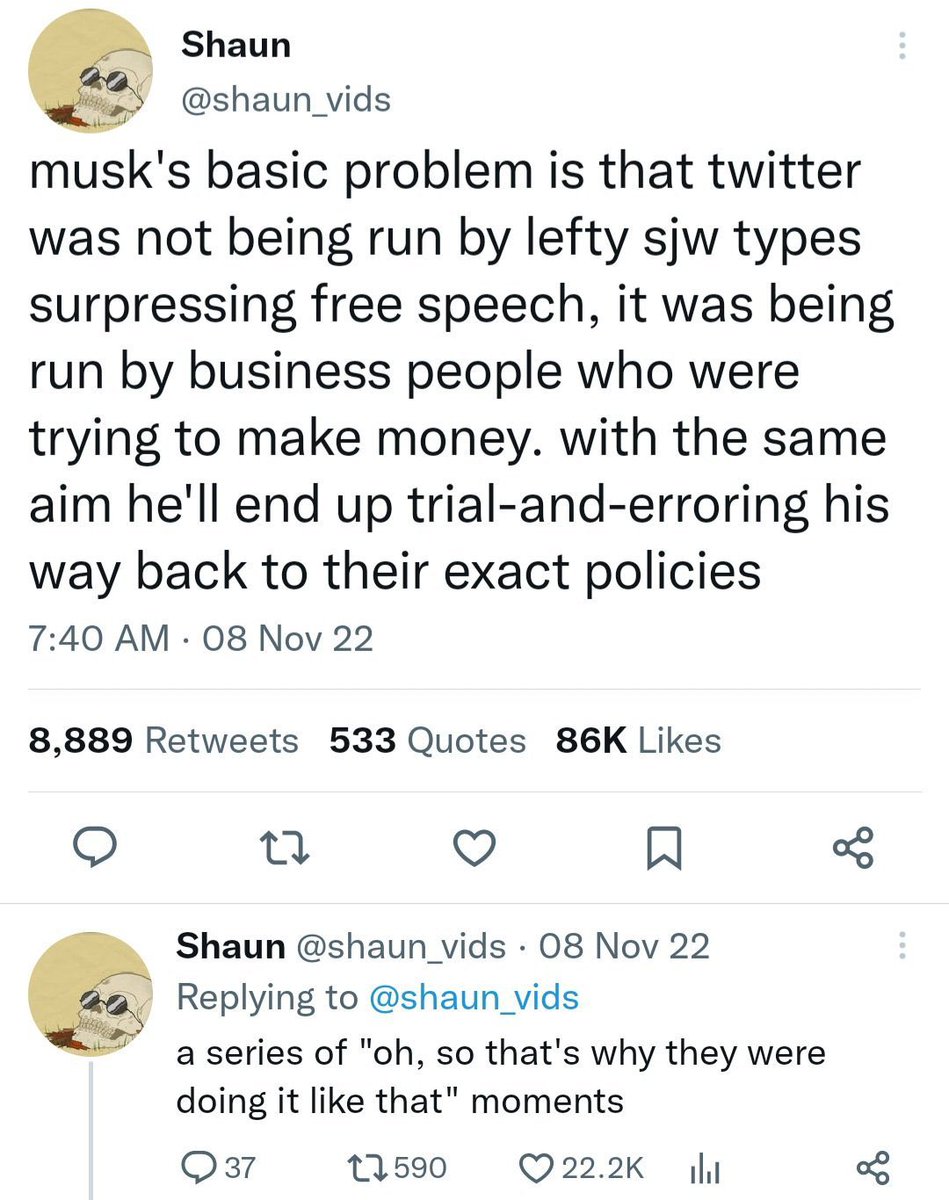
Apparently Elon Musk permanently suspended the user below for the tweet below, and did so on the grounds that comedy is not legal on Twitter when the butt of the joke is Musk himself.
So I propose a minor act of harmless Twitter disobedience: RETWEET the hell out of this image.
Conrad puts it well. I will elaborate excessively anyways because I am bored:
Normal people have a lot of good intuitions around certain things. Lots of bad intuitions around other things, of course.
You correctly point out that it actually is a strike against people like me and Eliezer that we pattern match to previous (wrong) techno-pessimists. (surface level match of course, if you dig even slightly into our pasts you would find we are/were both avid techno-optimists otherwise, which is not how historical techno-pessimists came about)
But this is a reasonable intuition and signal to have and you should not dismiss it out of hand.
But you also have more intuitions and signal than that. (eventually, if you want to make good decisions, you actually have to reason yourself. alas...)
If your civilization always plays "wait until a disaster happens" with new tech, you are predictably ngmi. Russian Roulette is a great way to make a lot of money, until it very suddenly isn't. You might be right 5/6 of the time, which is more right than the "bullet-pessimist", but so what?
1. The Core Intuition is not stupid
"Creating something smarter (whatever that means) than us, with literally no oversight or even a plan for how to control it, that is supposed to automate/replace all labor - by some of the least responsible people/companies that have hurt me and my family in the past with their products (e.g. facebook), and even despite many experts saying it could be literally the most dangerous thing ever, and even shitting on those experts that are concerned, seems bad" is, in fact, a good intuition.
If you applied this intuition to other situations in the past (and future), you would have been more right than wrong.
2. There is no plan, not even a bad one, for the risks we know will come sooner or later
It's not like there are some expansive, widely discussed plans for how to handle AGI (not just technically, but also how to handle complete collapse of all jobs, how to distribute resources in an automatic economy, how democracy works with digital minds, how to prevent AGI automated giga-war etc etc etc) and we are just quibbling about the technical details.
There is no plan, no one has a plan, not even a bad one.
The intuition that this is concerning is a good intuition.
3. Technology is not a magic paste that makes things better the more of it you apply
Some technologies are actually different from other ones. Nukes are not the same as airplanes, which are not the same as cars, which are not the same as coffee, which is not the same as tissue papers.
You may not be an expert, but I quite trust that your intuitions around the difference between nukes and cars are probably pretty reasonable.
If you treat all of these things exactly the same, your civilization is just ngmi, it's really that simple. It's actually sometimes not that deep.
As we build more and more powerful technology, handling technology carefully and beneficial gets harder, not easier.
Eventually, you have tech so powerful, it can blow up everything. Then what? Continue to refine it until it's mass marketable and accessible? (decentralized maybe???) You may like this aesthetically if you are a libertarian, but ask your intuitions: "Then what happens? What happens if anyone can buy planet busters for 9.99$ on amazon?"
I suspect your intuitions agree that that civilization is ngmi.
And eventually we will have the tech to build 9.99$ planet busters.
Anyone that is trying to sell you that airplanes, coffee and nuclear weapons are in the same reference class is selling you snake oil.
The true embodiment of patriarchy: I wish to go off and commit violence with no restriction for the glory of it and when I get back I want every women to be my mom.