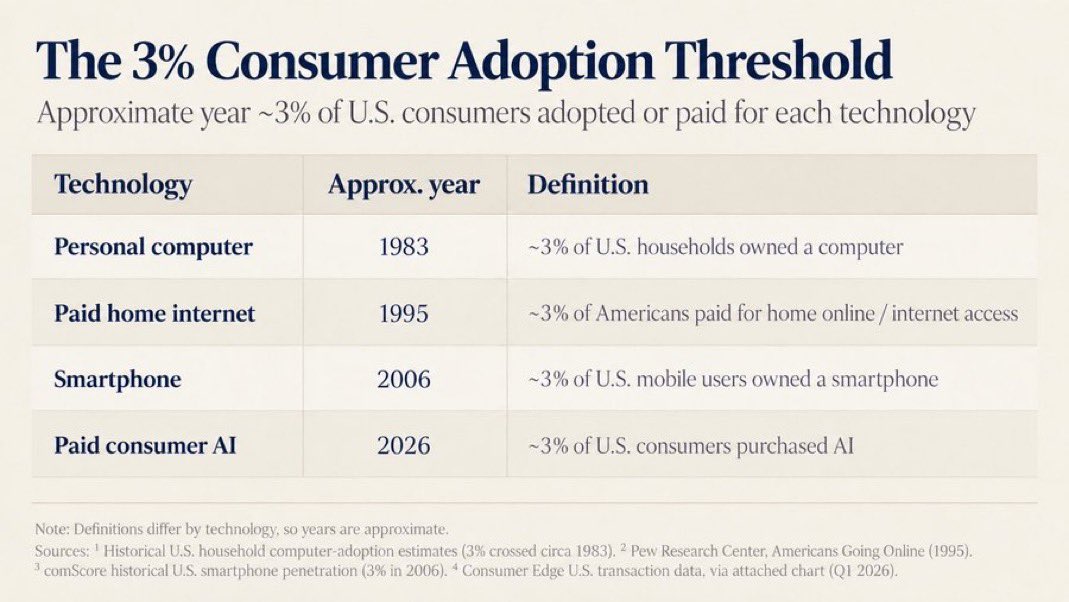
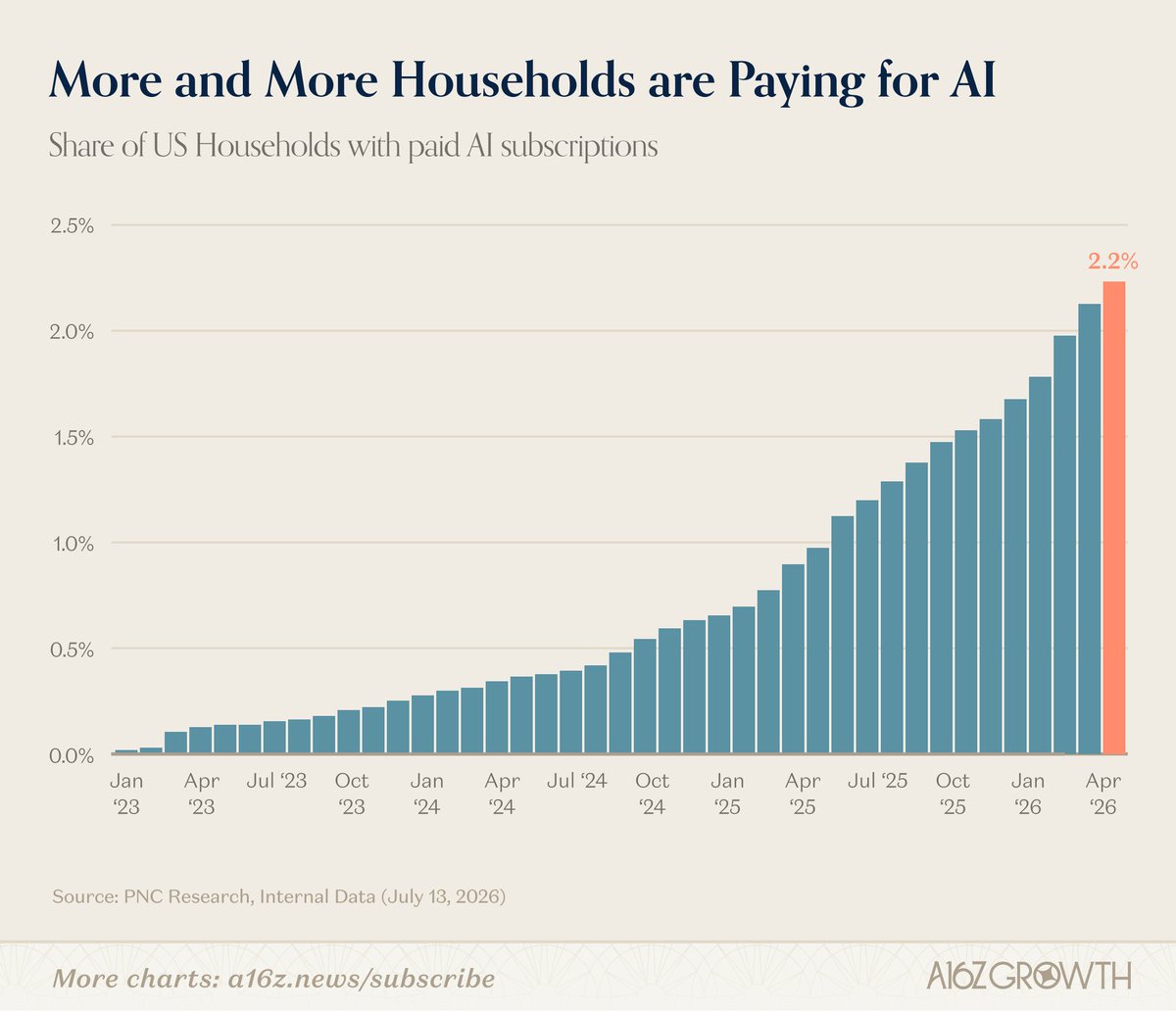
Are we still early?
Personal computer: 4 more years
Paid home internet: 5 more years
Smartphones: 2 more years(less important)
The bigger question is if lost market share and cap in leading frontier labs is enough to stop this market or if the consumer adoption, automations, agentic AI and alike will be able to make up for it.
AI will continue growing, however given the circular nature of funding that has been abused over the past few years might lead to contagion risk should one of the major players fail.
Model: @CryptoCX1
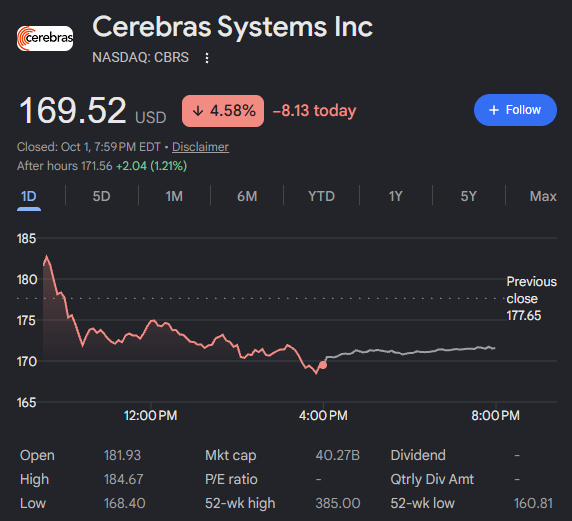
If you hold $CBRS you have to be very upset right now.
OpenAI's new ultrafast model runs on NVIDIA. Not Cerebras. The entire pitch was inference speed and the biggest customer in the world just picked $NVDA for exactly that.
Same week, the COO sells $78 million of stock and walks away with zero shares.
Two things you never want to see at once. The customer you built for passing on you, and the insider who knows the most heading for the exit.
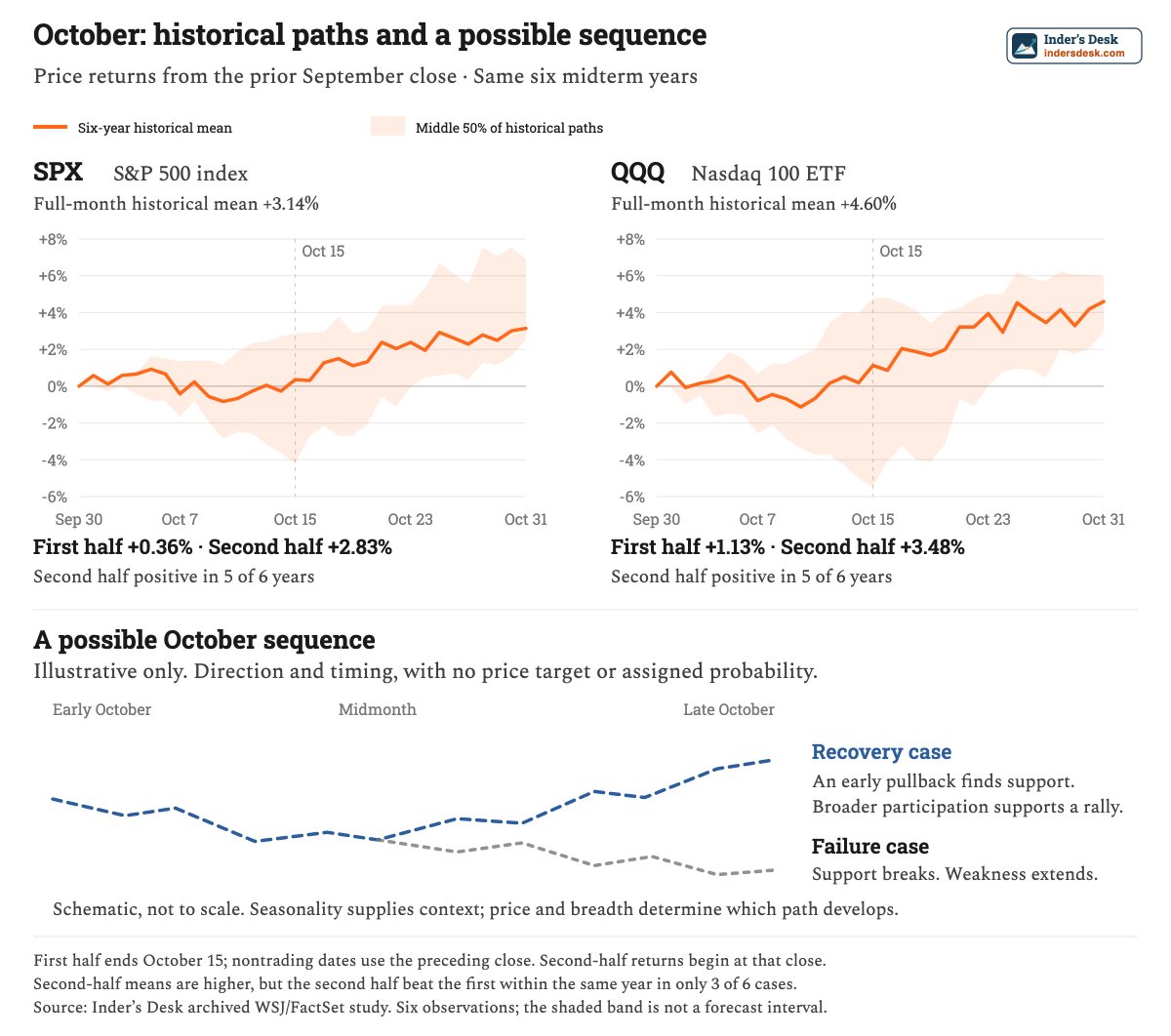
October historical seasonality. The first part of October may offer some consolidation before finishing strong in the second half of the month. $SPY $QQQ
https://t.co/2q2tbhpW5g
Jefferies' satellite check on US data center buildout (via SynMax data):
• ~11 GW in 2025 → 16-18 GW in 2026, 2027 capped in the low 20s, well short of 80GW of commitments
• ~80% of the 2028 pipeline hasn't broken ground
$MU: more than 75% of CY27 output is already committed, across SCA and non-SCA customers. Non-SCA customers are already placing 2027 purchase orders. SCA coverage is still targeted at ~50% of revenue through 2030, keeping the rest flexible. — CEO Sanjay Mehrotra (Q: Harlan Sur, JPMorgan)
https://t.co/fCWyyK9jts
$MU CFO Mark Murphy, asked whether equipment shortages cap capex (Q: Krish Sankar, TD Cowen): no. The construction-heavy mix reflects the supply-demand imbalance and "the lead time it takes to get greenfield capacity in place." SCAs give the visibility to build the shells now (ID1, ID2, Japan, Singapore, Tongluo), "and then we will equip those fabs as appropriate given our most current views on demand."
https://t.co/fCWyyK9jts
$MU CEO Sanjay Mehrotra, asked by BofA's Vivek Arya whether 2027 is the cycle peak: "the supply demand environment is only getting tighter." He sees tighter conditions in CY27 and CY28 than in CY26, even with new clean rooms, because they "take a long while to build" and ramp gradually. Moving to HBM4/4E costs more wafers per bit, and new nodes give less gain per wafer. Customers trimming memory per server are doing it "to enable them to ship more units."
https://t.co/fCWyyK9jts
$MU CEO Sanjay Mehrotra, asked by BofA's Vivek Arya whether 2027 is the cycle peak: "the supply demand environment is only getting tighter." He sees tighter conditions in CY27 and CY28 than in CY26, even with new clean rooms, because they "take a long while to build" and ramp gradually. Moving to HBM4/4E costs more wafers per bit, and new nodes give less gain per wafer. Customers trimming memory per server are doing it "to enable them to ship more units."
https://t.co/fCWyyK9jts
$MU's capex mix matters as much as its size. CFO Mark Murphy: construction capex grows "meaningfully" faster than equipment capex in FY27. Shells add no bits until equipment goes in, and new clean-room output starts late CY28 or later. Read: near-term supply stays tight (bullish for memory pricing into 2027), and less of the headline capex flows to equipment vendors in FY27 than it seems.
https://t.co/fCWyyK9jts
$MU's capex mix matters as much as its size. CFO Mark Murphy: construction capex grows "meaningfully" faster than equipment capex in FY27. Shells add no bits until equipment goes in, and new clean-room output starts late CY28 or later. Read: near-term supply stays tight (bullish for memory pricing into 2027), and less of the headline capex flows to equipment vendors in FY27 than it seems.
https://t.co/fCWyyK9jts
$MU CFO Mark Murphy, asked by UBS's Tim Arcuri about capital return:
- FQ1 free cash flow will be "significantly higher" than FQ4's $33B.
- Cash reaches its target level by the end of FQ1.
- Excess cash goes back "primarily" through buybacks, starting Dec 9.
- The current $2.2B authorization is small, and "you can assume that we will seek additional authorization in the near term."
https://t.co/fCWyyK9jts
$MU CFO Mark Murphy, asked by UBS's Tim Arcuri about capital return:
- FQ1 free cash flow will be "significantly higher" than FQ4's $33B.
- Cash reaches its target level by the end of FQ1.
- Excess cash goes back "primarily" through buybacks, starting Dec 9.
- The current $2.2B authorization is small, and "you can assume that we will seek additional authorization in the near term."
https://t.co/fCWyyK9jts
$MU capex: ~$11.5B in FQ1, ~$25B in 1H FY27, and "higher in the second half", which puts FY27 above $50B vs $27.4B in FY26. — CFO Mark Murphy
https://t.co/P5bPYTAEhi
$MU capex: ~$11.5B in FQ1, ~$25B in 1H FY27, and "higher in the second half", which puts FY27 above $50B vs $27.4B in FY26. — CFO Mark Murphy
https://t.co/P5bPYTAEhi
$MU guides FQ1-27 revenue to a record $61.5B ± $1.5B (EPS $38.15 ± $1, GM ~86.25%), and expects FY27 to be "another record year with sequential revenue growth each quarter." — CFO Mark Murphy
https://t.co/P5bPYTAEhi
$MU guides FQ1-27 revenue to a record $61.5B ± $1.5B (EPS $38.15 ± $1, GM ~86.25%), and expects FY27 to be "another record year with sequential revenue growth each quarter." — CFO Mark Murphy
https://t.co/P5bPYTAEhi
$MU: "over time we expect to return 100% of our excess cash to shareholders," with the step-up starting Dec 9, 2026. — CFO Mark Murphy (net cash $68.3B at quarter end)
https://t.co/P5bPYTAEhi
$MU: "over time we expect to return 100% of our excess cash to shareholders," with the step-up starting Dec 9, 2026. — CFO Mark Murphy (net cash $68.3B at quarter end)
https://t.co/P5bPYTAEhi
$MU is raising FY27 capex above prior plans. Most of the increase is construction, to pull in DRAM clean-room space for late CY28 and beyond. It's backed by the "greater visibility" the SCAs give into demand "through the end of the decade and beyond." — CEO Sanjay Mehrotra
https://t.co/fCWyyK9jts
$MU is raising FY27 capex above prior plans. Most of the increase is construction, to pull in DRAM clean-room space for late CY28 and beyond. It's backed by the "greater visibility" the SCAs give into demand "through the end of the decade and beyond." — CEO Sanjay Mehrotra
https://t.co/fCWyyK9jts
$MU: NAND industry bits to grow ~mid-20s % in both CY27 and CY28, with the industry "supply constrained in both years." Micron's own NAND supply grows slower than the industry's in CY26. — CEO Sanjay Mehrotra
https://t.co/P5bPYTAEhi
$MU CEO Sanjay Mehrotra: "we do not have line of sight to when supply and demand will return to balance" in DRAM, even with the industry's planned clean-room additions, as customers keep sending "new upside requests."
https://t.co/P5bPYTAEhi
$MU: NAND industry bits to grow ~mid-20s % in both CY27 and CY28, with the industry "supply constrained in both years." Micron's own NAND supply grows slower than the industry's in CY26. — CEO Sanjay Mehrotra
https://t.co/P5bPYTAEhi