My car insurance expires on January 17, 2027.
But I have already received more than 15–20 reminders since last 1 month.
SMS, WhatsApp messages, emails, and even AI-generated calls.
And the interesting part?
My insurance still has nearly 2 months left.
I understand why these companies want me to renew early.
But why should I pay nearly 2 months in advance when I can keep that money in my bank account and renew closer to the expiry date?
This experience made me realise something interesting.
Companies are extremely good at reminding us to spend money.
But who reminds us to make better decisions with our money?
When was the last time someone reminded you to review your mutual funds?
Check whether your insurance coverage is sufficient?
Or calculate whether you are saving enough for retirement?
These decisions could have a much bigger impact on your financial future than renewing a car insurance policy 2 months early.
That's why I believe financial guidance is important.
Platforms like Zomint, which help people connect with financial experts, can be useful for reviewing financial decisions instead of making them blindly.
We don't need more reminders to spend money. We need more reminders to manage it wisely.
You can use this link to get FREE Consultation call with Zomint team.
https://t.co/7PFxWOoy5r
(paid collab)
Imagine you run a business where your biggest customers love to take risks.
Then, one by one, the rules make it harder for them to take those risks.
That is the difficult situation many Indian stock brokers are facing now.
SEBI is reportedly considering limits on buying shares with borrowed money. Margin-funded stock purchases have reached a record ₹1.53 lakh crore.
Through Margin Trading Facility, or MTF, an investor can buy shares by paying only part of the money. The broker funds the balance and charges interest, usually between 9% and 18%.
Some brokers offer up to 4 times leverage.
For example, with ₹1 lakh, an investor may buy shares worth ₹4 lakh.
This can increase profits when the stock goes up. But it can also create huge losses when the stock falls.
Nearly two-thirds of this borrowed-money exposure is in small-cap and mid-cap shares.
These stocks can fall quickly during panic selling.
That is why SEBI is considering restrictions on fresh MTF buying when borrowed positions in a stock become too large compared to its freely available shares.
This is not the first challenge for brokers.
SEBI has already reduced weekly F&O expiries, increased contract sizes, raised margin requirements, and removed calendar-spread benefits on expiry day.
Also a big hike in STT charges on F&O trades by the government.
All these actions can reduce trading activity. Lower trading activity can mean lower brokerage income, lower interest income from MTF, and slower growth for brokerages.
The goal is to protect retail investors.
But for stock brokers, more safety rules may mean a tougher road ahead.
Huge growth in revenue, but negative or lower growth in profits is the current trend 😁
But there is a company that has shown the reverse of this trend 😱
Deepak Fertilisers’ profit jumped 85%, while revenue rose only 11%.
In the September 2026 quarter, Deepak Fertilisers reported a profit of around ₹394 crore, compared to ₹214 crore (YoY) in the same quarter last year.
But its revenue increased only from around ₹3,006 crore to ₹3,334 crore.
So, how did profit grow much faster than sales?
The answer is simple: better operating margins (OPM is 22% compared to 15% last sep quarter)
A company does not always need massive revenue growth to create massive profit growth.
Sometimes, it can earn more from the same products by reducing costs, improving efficiency, getting better raw-material prices, or selling more high-margin products.
Deepak Fertilisers benefited from a stronger product mix, better efficiency, and the advantage of its long-term energy arrangements.
This is an important lesson for investors.
Do not get impressed only when a company says, “Our revenue grew 30%.”
Ask one more question:
Did its profit grow faster than revenue?
If revenue grows 30% but profit grows only 5%, it may mean costs are rising or margins are under pressure.
But if revenue grows 11% and profit grows 85%, it shows the business is becoming more efficient and profitable.
In the stock market, sales create attention. But margins and profits create long-term wealth.
Disclaimer - This is not a BUY/SELL suggestion. It is just an observation about revenue and profits.
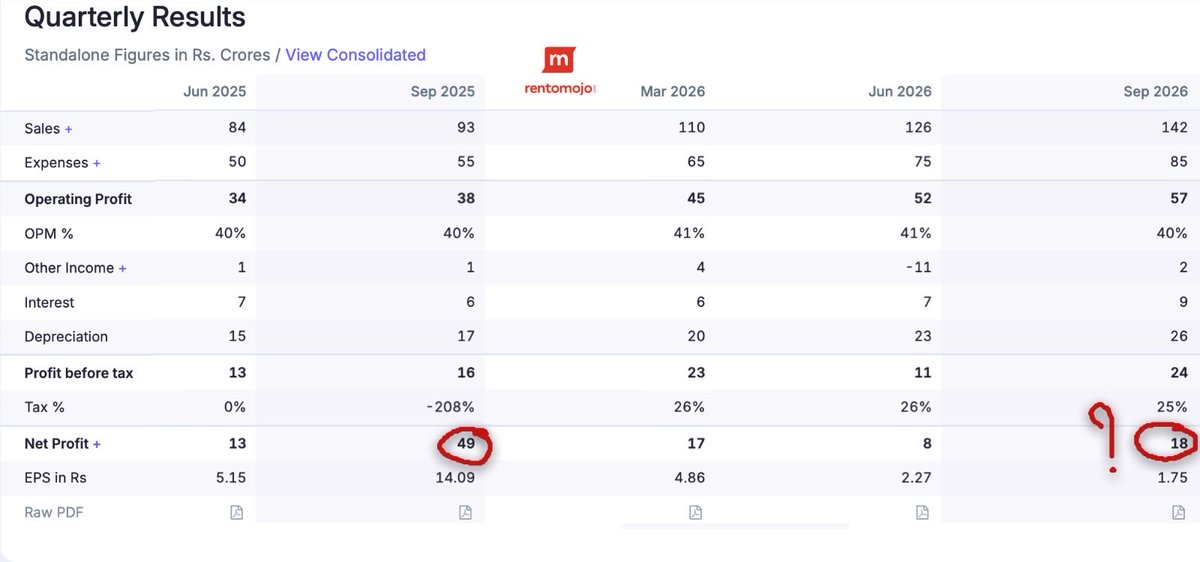
“Rentomojo Q2 Profit Falls 63%”
I saw this headline in a news portal.
But when I looked at its financial results, I found something surprising.
The business was actually making more money before tax!
Recently, Rentomojo, a company that rents furniture and home appliances, announced its quarterly results.
Its revenue increased by 53% to ₹142 crore.
But its reported profit fell by 63% to just ₹18 crore.
At first, these numbers look worrying.
How can a company grow its sales so quickly and still report such a big fall in profit?
The answer is hidden in something called deferred tax.
Last year, Rentomojo recorded a tax benefit of nearly ₹33 crore in its accounts.
This year, instead of that benefit, the company recorded a tax expense of around ₹6 crore.
So, when we compare the two years, the profit looks much worse than the actual performance of the business.
Before tax, Rentomojo's profit actually increased from about ₹16 crore to ₹24 crore. That's nearly 55% growth!
Another interesting number is its occupancy rate of 85.9%.
In simple terms, out of every 100 rental items available, roughly 86 were with customers.
This tells us that most of its rental stock was being used to earn revenue.
Does this mean Rentomojo is automatically a good investment?
May be or may be not!
We still need to study its valuation, debt, cash flow and future growth.
But there is an important lesson here.
A falling profit number does not always mean a business is performing badly.
Before reacting to any quarterly result, understand why the numbers changed.
How often do we judge a company's performance by reading just one headline?
@Seshu66920863@velumania I didn’t say they don’t spoke Tamil bro, every person speaks fluent Tamil there.
But if a person speaks in Hindi, they would speak in Hindi.
If your salary is delayed by just 2–3 days, you start worrying about your expenses.
But after retirement, your salary stops completely, while your expenses continue for another 20–30 years.
That's why retirement planning is not just about saving money, but building enough wealth to support your lifestyle without a regular salary.
Free Zomint Consultation Link:
https://t.co/7PFxWOoy5r
(paid collab)
The opposite of “exceptional” isn’t “bad.” It’s “very good.”
Ideas that are exceptional are far more likely to spread than ideas that are merely good.
Businesses that do something exceptional are more likely to attract attention, win customers, and earn higher profits.
The lesson? Being good is no longer enough. You need to give people a reason to talk about you.
Some examples are:
1. CRED – Turned the boring activity of paying credit card bills into a rewards-driven experience, supported by unusual advertising that people talked about.
2. Zomato – Made food delivery memorable through witty notifications, relatable social media posts, and creative marketing.
3. Virat Kohli – India has thousands of excellent cricketers. But Kohli became exceptional through his consistency, fitness, discipline, and performances under pressure.
4. A. R. Rahman – India has thousands of talented music composers. Rahman stood out by creating a distinctive sound that people could recognise and remember.
Being good helps you compete. Being exceptional helps you stand out.
And when you stand out, people notice you, remember you, and talk about you.
There is a strange CEO.
He takes charge of a company on Monday.
His first order on Tuesday is to cut most of the company's products.
He rejects all pending new business opportunities and decides to focus on just a handful of products.
A few years later, his company becomes dramatically more successful.
Sounds strange?
This is a common strategy used by many successful CEOs.
One of the best examples is Steve Jobs.
When he returned to Apple in 1997, the company was struggling financially and selling dozens of different products.
Instead of launching more products to increase sales, Jobs did something extraordinary.
He eliminated nearly 70% of Apple's product lineup.
He decided to focus the company's money, talent, and energy on just four main product categories.
The result?
Apple went from losing over $1 billion in fiscal 1997 to earning $309 million in fiscal 1998.
Jobs understood something that separates great CEOs from ordinary CEOs.
The game is all about Capital Allocation.
The same principle applies to our lives as well.
We all have three valuable forms of capital: Money, Time and Focus.
And how we allocate these resources can make a huge difference to our future.
A great CEO doesn't just focus on making profits.
Where the company invests those profits, how much it invests, and what it chooses to avoid are equally important.
Because even a profitable company can destroy wealth through poor capital allocation.
The same logic applies to our personal finances.
How much money we earn is important.
But how much we save, where we invest, and what percentage we allocate to different assets are equally important for building long-term wealth.
Two people with similar incomes and opportunities can end up with completely different financial futures.
And one major reason is how they allocate their resources.
Remember, earning money creates capital. Allocating it wisely creates wealth.
If you are not sure how to allocate your investments to achieve your financial goals, you can speak to the experts at Zomint for a free consultation.
https://t.co/7PFxWOoy5r
(paid collab with @ZomintNow)
You wake up in the morning.
The news says an entire country has stopped all flights from taking off!
That’s exactly what reportedly happened in the United States on November 13.
The Federal Aviation Administration, or FAA, ordered a nationwide ground stop after a major communications failure affected all 22 air traffic control centres.
Thousands of passengers faced disruptions.
Planes already in the air could continue flying and land safely, but departing flights were ordered to remain on the ground.
But here’s where the story gets even more interesting.
Just three days earlier, on November 10, the FAA reportedly introduced a new AI-powered air traffic management system across all 22 centres.
And suddenly, three days later, a massive communications failure!
Was AI responsible?
Nobody knows yet. There is no confirmed evidence connecting the AI system to the outage.
Some people also suspected Microsoft’s recent outage, but officials found no confirmed connection.
Interestingly, this isn’t the first time America has faced such a crisis.
In January 2023, a computer system failure grounded flights nationwide, causing over 9,500 delays and 1,300 cancellations.
Investigators later found that contractors had accidentally deleted important files.
Here’s the biggest lesson.
AI can make our lives faster, easier and more efficient.
But when it comes to critical systems like aviation, healthcare, defence and banking, even one mistake can affect millions of people.
Before introducing AI into such important areas, we must study it thoroughly, test it repeatedly and ensure strong human oversight and backup systems.
Because when millions of lives depend on technology, reliability matters more than speed.
What do you think?
Just a few weeks ago, many investors were worried about the Indian stock market.
FIIs were selling, global uncertainty was increasing, and many people believed Nifty would touch 20,000 levels.
But something unexpected happened.
Nifty rallied nearly 10% in November and closed at 25,255 on November 11, reaching its highest closing level in nearly 9 months.
So, what changed so suddenly?
Here are 3 important reasons behind this powerful rally.
1. Foreign Investors Suddenly Started Buying Indian Stocks
This is probably the biggest immediate reason.
For months, Foreign Institutional Investors (FIIs) were selling Indian stocks.
But in November, they completely changed their behaviour.
Foreign investors invested approximately ₹53,739 crore in Indian equities in just 6 trading sessions!
One interesting reason is the changing global AI investment story.
Global investors had invested heavily in American technology and AI companies.
As concerns about expensive AI valuations increased, some investors started reconsidering where to invest their money.
India became attractive again, encouraging foreign investment.
2. Indian Companies Reported Better Profits Than Expected
This is perhaps the most important fundamental reason.
Stock markets cannot rise sustainably just because investors are buying.
Companies must eventually justify their valuations through earnings.
And that's exactly where India delivered a positive surprise.
Out of 47 Nifty companies that had reported September-quarter results by November 10:
27 companies reported better-than-expected earnings.
17 companies reported results broadly in line with expectations.
Only 3 companies disappointed.
Better profits improved confidence in Indian businesses and made stock valuations look more reasonable.
3. Falling Crude Oil Prices Reduced India's Economic Worries
India imports most of its crude oil requirements.
When oil prices increase, India's import bill rises, inflation risks increase, and businesses face higher costs.
But recently, crude oil prices corrected from their highs.
Brent crude was trading near $91-92 per barrel on today.
Expectations of easing US-Iran tensions also improved market sentiment.
Lower oil prices can benefit India's economy, company profitability and inflation outlook.
My Take
Stock markets will always have ups and downs. That's how markets work.
When markets fall, most investors become fearful. When markets rise, the same investors rush to buy.
But successful long-term investors look at these situations differently.
Market corrections can provide excellent investment opportunities, especially when good companies become available at attractive valuations.
Instead of worrying about what Nifty will do tomorrow or next week, focus on where Indian businesses and the economy could be in the next 5–10 years.
Remember, real wealth is built by thinking long-term, not by reacting to every short-term market movement.
You may have added your wife as the nominee for your bank accounts, mutual funds and other investments.
But did you know that being a nominee doesn't always make her the legal owner of your money?
A nominee generally receives the assets, but the final ownership may depend on succession laws, a valid Will and the type of asset.
Don't just add a nominee. Make sure your family's financial future is legally protected.
Zomint Free Consultation - https://t.co/7PFxWOo0fT
(paid collab)
In just 4 months, China’s STAR 50 index, which includes major technology companies, crashed nearly 44%!
Almost $500 billion in investor wealth wiped out in just 4 months.
Over the last two years, China has been trying to revive its economy and reduce its dependence on American technology.
So, government-backed funds started investing heavily in Chinese chipmakers, robotics companies and AI businesses.
Seeing government support, millions of small investors rushed to buy AI stocks.
Soon, AI stocks made up 42% of China's stock market value and 57% of its trading volume.
At one point, companies in China's STAR 50 index were trading at nearly 250 times their annual profits!
That means investors were paying ₹250 for every ₹1 of annual profit.
And when valuations become this expensive, even small disappointments can trigger a massive fall.
Take Unitree, a Chinese robotics company.
Its IPO was reportedly oversubscribed 8,000 times!
But when its profits fell 17%, investors started losing confidence. Its share price eventually fell by nearly 50%.
However, China has an even bigger problem.
Too many companies are competing for the same customers.
Just like China's electric vehicle and solar industries, government support encouraged many companies to enter the AI business.
Now, to attract customers, these companies may have to cut prices, hurting their profits.
And this could be a warning for the entire global AI industry.
But remember one important lesson.
A technology can change the world, while many companies building that technology can still lose money.
The internet changed our lives forever. But many internet companies went bankrupt.
AI could follow the same path.
So, don't confuse a great technology with a great investment. Valuation and profits matter!
I shared this chart on my Telegram and WhatsApp channels on October 26.
Only 3–4 people appreciated it. Most people didn't like the idea.
Some even responded with comments like:
"How can you say this?"
"India is in deep trouble."
"FIIs are exiting India."
"You are completely wrong!"
In fact, many people were behaving as if it was the end of the world for Indian stock markets.
But unfortunately, this is how stock markets behave.
Markets often overreact to every situation.
Positive news? Stock prices shoot up to the sky.
Negative news? Stock prices fall much more than they should.
This is both good and bad.
It's bad because it creates fear, panic and pain for investors.
But it's also good because market overreactions can create excellent investment opportunities for those who are prepared.
That's why you should always be prepared for such situations.
Keep some cash available, study good businesses, understand their valuations and have the courage to act when opportunities arrive.
Because the best opportunities often come when most people are afraid to invest.
As Warren Buffett famously said:
"Be fearful when others are greedy, and greedy when others are fearful."