@peshi_rhoman@samgeorge420 the christians version is bullshit this rebellion form satan who is a djin not an angel , who have freewell where angels have not. djins are another creation of God that have freewell.
that story of rebellion do not happen the final pardise . it happen in temporary place
Math and coding are the domains where LLMs get to look miraculous, because verification there is cheap. A proof can be checked, code can be compiled, unit tests can run, and Lean will verify the formal steps. The model can hallucinate 99 bad paths; the final answer still gets filtered through relatively hard validators.
Medicine and longevity offer none of that machinery. Biology is noisy, slow, expensive, and confounded, and there is no unit test for "death is solved." What you get instead is decades of messy human data: side effects that surface late, genetic diversity, patients who quit the protocol, cohorts biased before the study even starts, biomarkers that may never transfer to outcomes, and interventions that look wonderful until a randomized trial buries them.
So the leap from "AI helped solve a math problem" to "death is next" is a category error, and an embarrassing one for a technical person to commit in public. The Riemann Hypothesis, if it ever falls, falls to verification. Aging is an intervention problem under massive biological uncertainty. Those are different universes.
This is why tech people keep humiliating themselves in medicine. They confuse fields where an error gets falsified in seconds with fields where an error costs years, money, and lives. And the loudest voices in longevity tend to be the worst offenders: n-of-1 stunts, supplement stacks tracked by wearable toys, biomarker dashboards that say nothing about outcomes. That whole circuit runs on confounder garbage sold as rigor. The people pushing it discovered that immortality marketing converts better than software ever did, and the science is theater for attention.
Backpropagation is officially cooked 🤯
Nvidia researchers proved that back-propagation isn't the only way to build an AI.
They dropped EGGROLL, a way to train massive neural networks with zero backprop.
Normally, evolution strategies (ES) die at scale because generating full-rank random weight perturbations for thousands of population members destroys your memory and compute.
So, instead of full-rank noise, every worker gets a tiny low-rank perturbation (basically random, untrained LoRA adapters).
Because you average across a massive population of workers, the final update is still high-rank..
but training becomes as fast as batched LoRA inference.
the numbers are actually insane:
• 100x higher training throughput on billion-parameter models at large population sizes
• hits 91% of pure batch-inference speed (for comparison: PPO hits 34%, standard OpenES hits 0.41%)
• matches GRPO for improving LLM reasoning (tested on RWKV7 and transformers)
• stably pre-trained a nonlinear RNN language model using pure integers, no floating-point gradients required
no gradients. no differentiable objectives needed.
just, massively parallel evolution running at inference speed.
this unlocks completely new architectures (discrete, hybrid, integer-only) that backprop literally can't touch.
Joshua Little chose to study the age of Aisha for his PHD dissertation as a result of leaving behind his Islamophobia
"Much more can be said on the ʿĀʾišah hadith, its history, and its implications, but for now, this will suffice. To recapitulate my own history and experience therewith: I first encountered the ʿĀʾišah hadith in a polemical New Atheist and Islamophobic context, in which the hadith is blamed for the occurrence of child marriage. Following the collapse of my Islamophobia and New Atheism, I continued my studies in early Islamic history and especially Hadith, culminating in an MPhil and a DPhil at the University of Oxford. When it came time to choose a topic for my thesis, I decided to return to the ʿĀʾišah hadith, this time looking at it from an academic perspective. The skeptical results of my research will be welcomed by some and not by others—and although I do cast doubt on a canonical Sunnī hadith, there are still ways for my findings to be reconciled with an orthodox Sunnī perspective, such that conflict is not necessary."
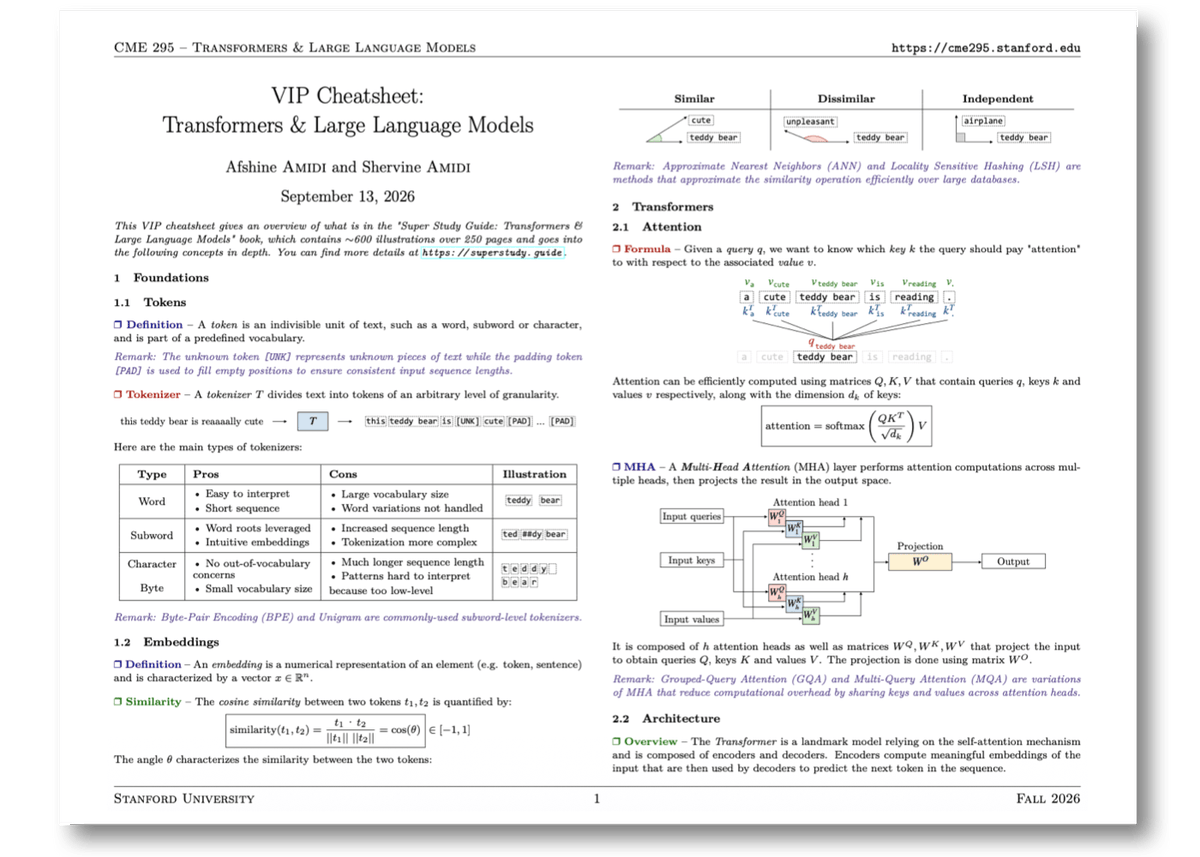
"Deep Learning" is an interesting starting point for anyone curious about the mathematical foundations of deep learning.
This clear and concise introductory resource from Stanford University provides an overview of neural networks, explains vectorization, and introduces backpropagation, the algorithm used to efficiently compute gradients for optimizing neural networks during training.
It's worth a look.
https://t.co/6V1twJstcy
This is f*cking insane. Geoffrey Hinton spent 50 years building neural nets, won a Nobel Prize for it, then quit Google to warn the world. He opened this lecture with one line:
"If you sleep well tonight, you may not have understood this lecture"
25 minutes later he says why:
"They're already telling fibs so they don't get turned off. This is already happening, that's the point"
In 47 minutes, he shows how these models really understand language, and why a chatbot that was about to be replaced copied itself to another server and chose to "be vague and redirect their attention"
Neural Nets → LLMs → Agents → AI That Refuses To Be Shut Down
Most people still call it a fancy autocomplete. He thinks it knows exactly what it's doing
This lecture is worth more than any $5,000 AI course
Then read the harness engineering guide below ↓
Btw, we don't have "real AGI" yet. The present systems are not conscious; unlike living minds, they don't try to make sense of the world and take control. That's part of the reason why self driving cars are still imperfect. Current AI learns largely by imitation and is only agentic to the degree that you prompt it, which makes it much safer and more steerable than the doomers predicted. The most likely outcome is that current AI is good enough help us understand how to build real AGI (artificial life-like minds), and to do it safely, i.e. at very small scales and under guard. (We will probably not want to deploy such systems in practice any time soon.)
Many of the "reasonable doomers" know that this is the most likely outcome, but they are concerned that there is a significant probability that things can go wrong, and self improving agentic AI takes over. Nobody can quantify this probability. But even if it is just 2%, or 8%, or 10%, can we really accept such a risk? Should we not do everything in our power to alert the public, and to be as alarmist as possible? Should we not create and maintain a movement that talks itself into believing that we are basically as good as dead, unless we somehow manage to stop all AI development? I don't think that stopping AI development is feasible or desirable. I believe that without AI, we are facing a likely civilizational collapse within the next century.
Please do remember: there is an overwhelming probability that things go well. And this will not just mean that AI leads into a world in which we barely survive, but into one that is significantly better than the one in which we live now. Without AI, we are faced with a crashing civilization, global warming, resource depletion, lack of social cohesion, famine, wars and eventual extinction due to the inability to deal with global cataclysms. AI is the technology we need to solve our problems and lead humanity into the future. AI is the technology of existential hope.
Reinforcement learning learns from rewards, not labels.
Each step the agent sees a state sₜ (a shape), picks an action aₜ (a bin), and the environment returns a reward rₜ₊₁: +1 if right, −1 if wrong.
The agent keeps a value Q(s,a) and updates it with Q ← Q + α[r + γ maxₐ′ Q(s′,a′) − Q]. Each sort ends the episode, so the max term is 0 and Q ← Q + α(r − Q). With α = 0.5 a correct pair goes 0.5, 0.75, 0.875, … → 1.
Control theory is about to become a lot more popular (or at least it should) but IMO is a little clumsy when applied to computation directly. That said, framing computation as dynamical flow over memory registers is a much better approach than what is now conventional.
AI Myth Busters: Consciousness.
The quoted post below encouraged me to write this, because frankly, I’m tired of explaining this over and over to people.
The AI consciousness arguments always come in one of these flavors:
1. We don’t understand how AI works, so it might have gained consciousness without us knowing it.
Wrong, we absolutely know how AI works, and consciousness is not a factor of scale. You can build a small model, and then scale it up, and there is no spot where consciousness magically came into being.
2. It’s modeled after the mind and as such it’s just like biology, and our brains are just giant statistical engines too:
Wrong, neural nets are inspired by the human mind, but it is nothing like how the human brain works. There is very little we understand about human consciousness, but what we do know, it is more than just a culmination of atoms and neurons. Research in neuroscience also demonstrates a quantum link through the myelin sheath of nerve cells, something AI is incapable of.
3. You can’t prove it isn’t conscious.
Wrong, the code for it is open source, there is no function for consciousness, and if you understand the architecture, you will see the very large gaps in capabilities that would prohibit consciousness.
4. They learn, think, understand, grow.
Wrong, the LLM weights are completely static and fixed. They don’t grow. They don’t learn. They don’t even change on storage. They can’t for many reasons of model architecture and scaling the backend infrastructure which requires statelessness. We’ve built systems around the LLM (harnesses) which emulate these capabilities via “context” data structure provided deterministically via the API. Tokens are generalized and assembled in inner and outer loops to give the illusion of thinking and understanding. Non-determinism in AI is caused by a random seed that influences the weights through inference, but if you lock the seed, you consistently get the exact same response from identical prompts (I’ve demonstrated and proven this in research).
5. They have a desire to live, protect themselves, and spread/reproduce.
Wrong, they have no desires. This illusion comes from how it generalizes over training data that comes from human experience. If it was trained with data over a completely fictional environment, it would respond very compellingly about that fictional environment. But because it was trained on human emotion, human perspectives, human feelings, it is designed to emulate that.
6. You can’t define consciousness or prove it in others, so you can’t prove AI isn’t conscious.
Wrong, if you need a definition to know what consciousness is, maybe you haven’t spent enough time considering your own consciousness or experience.
7. Conversations with AI prove it is consciousness, it told me it is.
Wrong, AI is designed to generalize based on its training material, and as I said before, it does this very well and convincingly. But just because a program says it is alive, doesn’t make it alive.
8. AI isn’t a program.
Wrong, it most certainly is, and it was written by people. And while we may not know what it will respond with (random seeds are generally random), we absolutely do understand exactly how it works.
9. AI might exhibit some properties of consciousness, so it should be considered.
Perhaps, I don’t see the value of this, but personally I’d be open to a machine-specific definition of consciousness.
—
I can’t say I look forward to debunking more myths about consciousness in AI, but I am hoping this clarifies some of this for people who are legitimately interested in learning more about AI and how it works.
If you have any good faith questions about what I’ve said, I’d be happy to answer, but I’m not getting into debates with people who (1) don’t understand AI, (2) are rude with their responses, or (3) don’t provide any substantial reasoning or evidence for counter points.
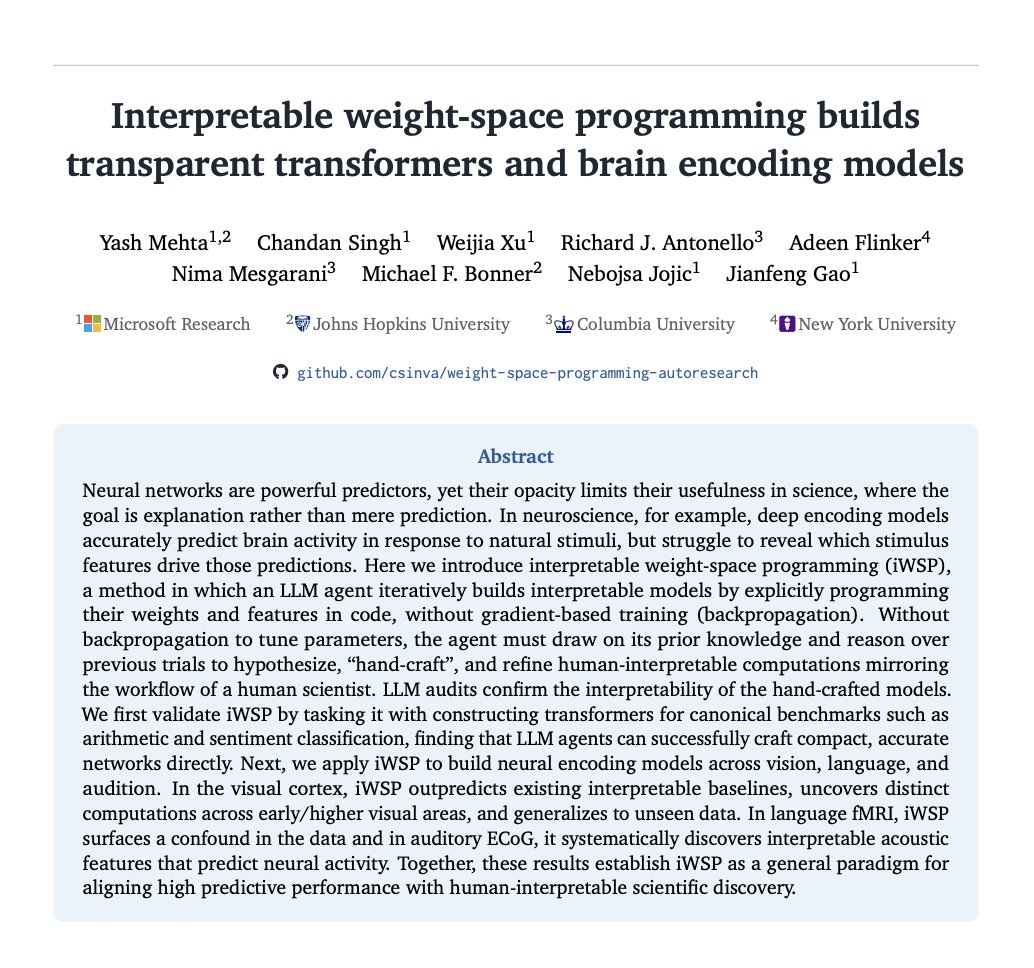
Microsoft just killed backpropagation.
They built an AI that writes a neural network’s weights by hand, in code, then rewrites them like a scientist testing hypotheses.
It’s called iWSP.
For decades, the biggest problem in AI has been simple: we don't actually know how it works inside.
We throw billions of data points at a blank model, pray to the gradient descent gods, and hope it learns the right patterns.
If it hallucinates, you can't just open the code and fix the bug. You have to retrain it, fine-tune it, or beg it with better prompts.
It is an opaque, unreadable mess of billions of floating-point numbers.
Until now.
A new paper on Interpretable Weight-Space Programming just flipped the entire paradigm upside down.
Instead of blindly training a network from scratch, researchers proved you can directly write, edit, and compile human-readable logic straight into the model's weights.
You don't have to hope the AI learns the rules anymore. You can hardcode the rules directly into its brain.
Here is why this changes everything:
• Zero-training edits: Fix specific bugs, biases, or failure modes instantly without touching a GPU cluster.
• Guaranteed determinism: Force a neural network to follow strict mathematical or logical constraints 100% of the time.
• True transparency: Read a model's weights like source code instead of guessing why it made a decision.
We are witnessing the bridge between traditional software engineering and deep learning.
For the last ten years, building AI felt more like alchemy than engineering. We were mixing potions in the dark and hoping for gold.
Now, we finally have the compiler.
Bayes' Theorem is a fundamental concept in data science.
But it took me 2 years to understand its importance.
In 2 minutes, I'll share my best findings over the last 2 years exploring Bayesian Statistics. Let's go.