🎉Congratulations to Cara-lin Lonetree & Grant Hickok of the @IngunnStromnes lab on receiving NCI F31 Fellowships to advance innovative research in T cell-based immunotherapies for pancreatic cancer. We are proud to celebrate this outstanding achievement! https://t.co/MlzFAxpIFD
New #JITC article: "Sleeping Beauty mutagenesis identifies BACH2 and other regulators of CD8+ T-cell exhaustion, persistence in vivo, and CAR-T cell function under tumor-associated chronic antigen stimulation" https://t.co/9uB80ZgBIM
A breakthrough in pancreatic cancer research!
Researchers from the UMN Medical School identified why pancreatic cancer is difficult for the immune system to recognize and attack, paving the way for a new approach to improve immunotherapy.
Read more: https://t.co/ctCUxnhNhG.
It was great to be interviewed about our recent Science Immuno. publication. Thanks to ACIR for featuring our work and writing up a "Meet the researchers" section!
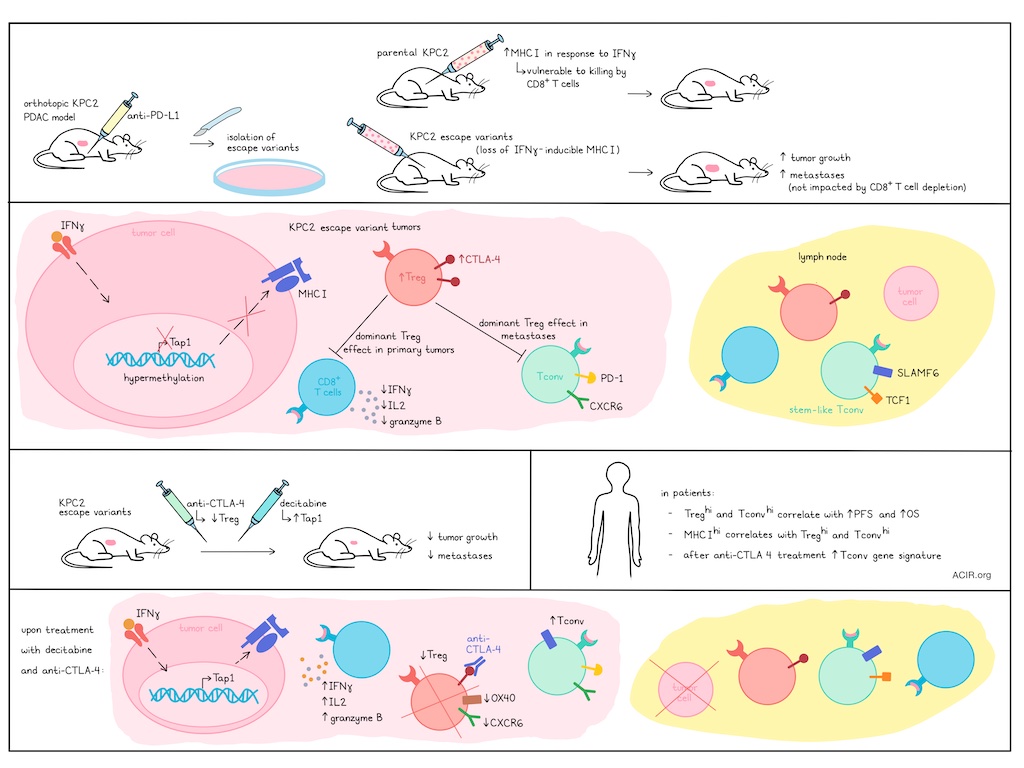
Schmiechen et al. recently unraveled a complex web of escape mechanisms and immune interactions in pancreatic ductal adenocarcinoma. https://t.co/8dp5Ts6ary
@umnmedschool@IngunnStromnes
Schmiechen et al. found that variants of PDAC that escaped following PD-L1 blockade showed epigenetic silencing of Tap1 expression, which induced loss of IFNγ-inducible MHC-I and reduced tumor cell killing mediated by CD8+ T cell. Escape variants also had an increased capacity for metastasis, which was promoted by Tregs and their suppressive effect on conventional CD4+ T cells. Combination strategies involving restoring IFNγ-inducible MHC-I, targeting Tregs, and enhancing Tconv enabled more effective cancer immunotherapy, suggesting potentially targetable mechanisms to enhance immunotherapy in PDAC.
A new Science #Immunology study shows that PD-L1 blockade can inhibit MHC-I presentation on tumor cells, enabling immune evasion and #metastasis in mouse models of #pancreatic cancer. @IngunnStromnes https://t.co/CGeW2vgG1K
We were able to make treatment-resistant PDA sensitive to CTLA-4 blockade through genetic or pharmacological restoration of MHC-I, highlighting how a simple defect in antigen presentation can impact the efficacy of immunotherapy. Worth a read!
Huge congrats to the team for all their hard work on our latest publication in @SciImmunology !
We show pancreatic cancer evades the immune system by losing MCH-I and with the help of CD4+ Tregs.
https://t.co/RP09SWuNNZ
Grant gave an awesome fourth year talk today!
Super interesting results on how CD8 T cell receptor affinity are associated with T cell response to pancreatic cancer.
DEADLINE TODAY! AAI RESTORE Grants applications close today. If your federal immunology grant was impacted, apply now! Don't miss this opportunity for up to $100K.
🔗 https://t.co/XRyxtXfVoE.
#ScienceFundingCrisis#SupportResearchers#AAIRESTORE#Immunology
🎉 Congratulations to Dr. Carla Rothlin, incoming Director of CFI, on her election as Vice-President of the International Union of Immunological Societies (IUIS)! A tremendous honor and a testament to her leadership in the global immunology community. 🌍🧪
3 groups use generative AI to design high-specificity pMHC-binding “artificial TCRs” for more precise targeting of tumor antigen @ScienceMagazine intro by @IngunnStromnes
https://t.co/dSTHZy9UEr
🧬 Wondering what the future holds for T cell cancer therapies? We wrote an editorial for @ScienceMagazine about how AI—like AlphaFold—is accelerating the design of T cell receptors (TCR), powering the next-generation of anti-tumor therapies. Read here!
https://t.co/XnwUxFVC1g
Our lab at the Center for Genome Engineering isn’t just for scientists—it’s a state resource for discovery, education, and innovation.
Proud to partner with Doors Open Minneapolis to share our work with the community.
👀 Want a tour? Reach out!
#GenomeEngineering#UMNResearch
📰New paper from the lab! Using our transgenic TCR model we reveal that T cell beta-selection can be bypassed via a γδ TCR alternative path that allows T cell maturation to continue. This path appears highly dependent on IL-7 signaling. Read here!
https://t.co/uZVFAO6uJY
We’re proud to support future scientific leaders through trainee travel scholarships!
Eduardo Cruz presented his pancreatic cancer immunology research at AAI in Hawaii—and even won this awesome shirt in a conference raffle!
@IngunnStromnes#GenomeEngineering#Immunology
In today’s tough budget climate, restoring funding to FY24 levels is a major win – and a direct result of thousands of advocates who have contacted Congress in support of #pancreaticcancer research funding over the past few months. ���
This is a huge step forward – but it’s not over yet.
Next, the bill heads to the full House for a vote. Additionally, the Senate still needs to propose and pass their version of the FY26 Defense Appropriations bill and then both chambers need to agree on the final version of the bill. Through all of that, the job of the PanCAN community is to make sure Congress knows how important it is to keep this funding in until the bill becomes law. We’ll need your continued support in the coming months to make that happen.
Take action today to thank House members who have supported the restoration of the dedicated Pancreatic Cancer Research Program in FY26 and remind all members that you’re counting on their support of this vital funding! ➡️ https://t.co/CQVLrP63Lb
Thank you for raising your voice, pushing for change and helping to deliver hope for everyone affected by this devastating disease. 💜
We had a great time at this year's @CSHL Pancreatic Cancer Course! Ingunn gave a fantastic overview of pancreatic cancer immunology and Grant has had a weekend full of deep learning from faculty all around the country. Hope to do it again next year!