A positive thinker, result oriented, goal getter, and focus driven.
FMR NATIONAL VICE CHAIRMAN SOUTHEAST, LABOUR PARTY NIGERIA.
NOW DEPUTY NATIONAL SECRETARY.
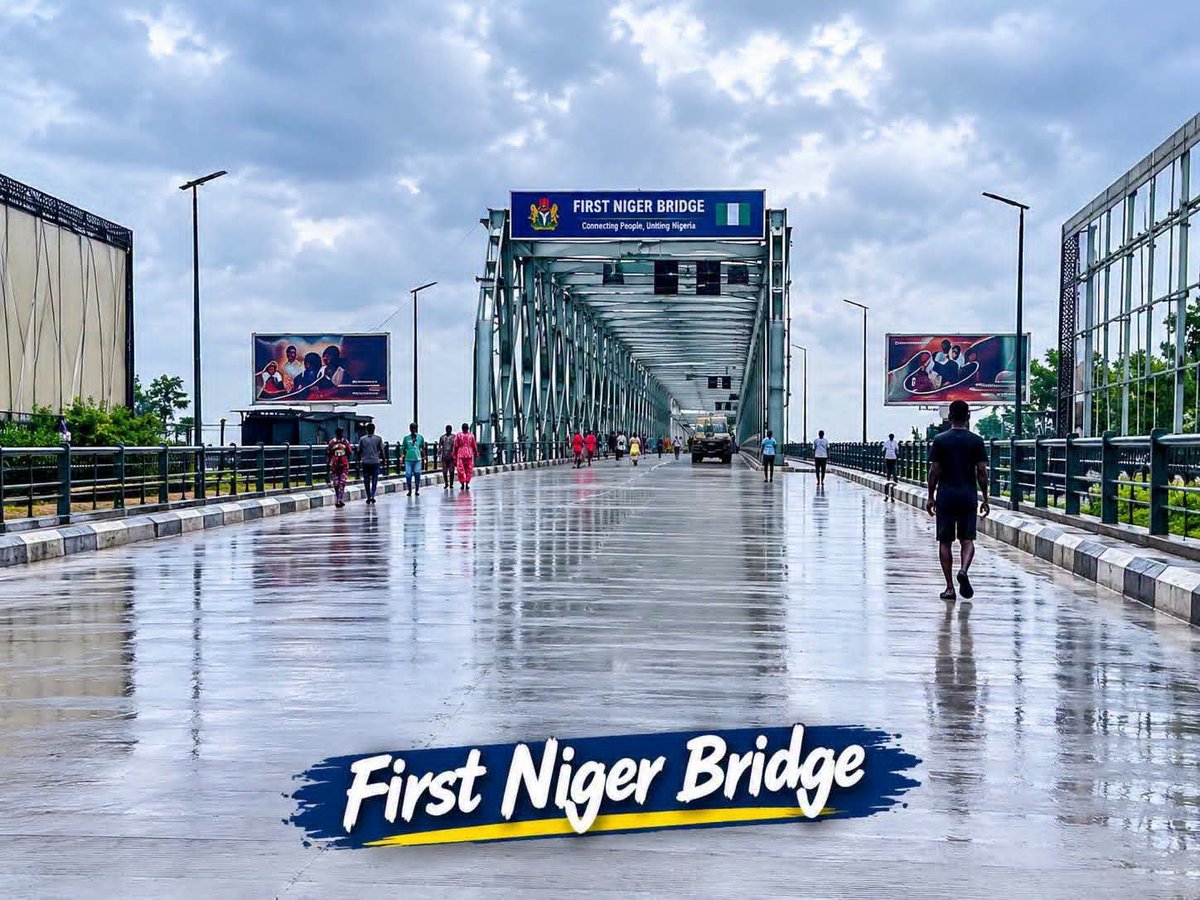
The Repainted 1st Niger Bridge and the Insult Behind the Celebration
By Innocent Okeke, Duru Agumba
There is nothing wrong with re-electing President Bola Ahmed Tinubu for a second term, if he earns it. If he justifies his first mandate and treats all Nigerians fairly, he deserves to ask for another chance.
What is wrong is how it is being done - with intimidation, harassment, and false propaganda. And what we saw with the reopening of the First Niger Bridge is a clear example of that. It is an insult to the intelligent and hardworking people of the Southeast.
A Minor Repair Turned Into a Big Ceremony.
The First Niger Bridge was built in the 1960s by Prime Minister Tafawa Balewa. Since after the civil war, it has not received any major attention.
What was just done on the bridge was not a major reconstruction. It was only a small remedial work - three weeks of resurfacing and repainting. There is nothing special about it to call for a minister to come and cut ribbon with full media coverage.
The Third Mainland Bridge in Lagos, built in the 70s and 80s by Gowon and Babangida, has been repaired many times without any fanfare. The Carter Bridge in Lagos is currently undergoing total overhauling and replacement without noise. Other bridges are being built and repaired across Nigeria quietly.
So why should a simple repainting in the Southeast be turned into a national celebration?
What the Celebration Really Reveals
The noise and energy put into this small repair has exposed the truth. The ribbon-cutting by the Minister of Works, Engr. Dave Umahi, has shown that this repainted bridge may be the only visible project started and completed by the Tinubu administration under supervision of David Umahi for the Southeast since 2023.
Ask yourself: how many major projects has Minister Umahi commissioned in the Southeast with this kind of public ceremony? If there were real, big projects - new roads, new rail-line, new bridges, new federal presence - there would be no need to celebrate a painted job.
The fact that they are celebrating resurfacing and painting shows there is nothing substantial on ground to show.
Sycophancy and Politics
This also shows the level of sycophancy and the pressure on Southeast ministers to keep their jobs. To remain in office, they must play the script and praise even the nothing or smallest thing.
It is clear why the APC in the Southeast and the minister were quick to rush to this bridge. The bridge is strategic. It is visible. It is good for campaign adverts. That is why shortly after reopening it, they reportedly barred other parties from placing campaign adverts on it. The intention is clear - use the bridge for political show.
Nigerians should understand why people of the Southeast complain of marginalization. When you give a region almost nothing, then paint a small part of it and call the whole world to come and clap, that is not service. It is mockery.
Let the Southeast Breathe
The Southeast is not asking for too much. They are only asking for fairness. The same way other regions are treated quietly and respectfully when projects are done, that is how the Southeast should be treated.
Government should slow down on the harassment, intimidation, deprivation, and ethnic profiling of the people of the Southeast.
Development is not measured by how much paint you put on an old bridge. It is measured by real projects that improve people's lives. You cannot humiliate a people and at the same time expect them to praise you.
Let the Southeast breathe. #BolaAhmedTinubu #FemiGbajabiamila #DavidUmahi #PeterObi #soludo #HopeUzodimma #PeterMbah #AlexOtti #Wike #southeast #SouthEastNigeria #southsouthnigeria #GodswillAkpabio @all.
The Path Forward: Reversal Through Truth
What the Nigerian governing class has achieved over these years through divide and rule in the Eastern Region can be reversed not through antagonism, but through understanding and well-articulated historical engagement.
Historical Truth-Telling:
We must return to honest history. Anioma and Ikwerre are not strangers to Ndigbo; they are Ndigbo. Their history must be taught, not edited.
Deconstruction of Sub-labels: We must reject political labels that weaken us. An Igbo man in Asaba is as Igbo as an Igbo man in Aba. Unity does not erase dialect; it strengthens destiny.
Economic Blueprint for the Old East: Just as the Western Region is developing unhindered today with a clear economic blueprint and political coherence, the old Eastern Region needs a common economic council that transcends state boundaries. Shared infrastructure, shared seaport access, and shared industrialization will do more to restore oneness than any slogan.
Nigeria at 66 cannot afford to continue the war by other means against a third of its population. True federalism, which the East fought for, remains the only pathway to quality life and even development for all.
The question is no longer whether Ndigbo are broken. The question is whether Nigeria is ready to be whole.
NIGERIA AT 66: The Igbo Question, Inclusiveness and the Crisis of Identity in the Southeast
By Innocent Sunday Okeke, Duru Agumba
At 66, Nigeria is still wrestling with its most fundamental question: how to build a true federation of equals from a tripod of dominant nationalities.
The architecture is well known. One language, Hausa, dominates the entire North; two dominate the South — Yoruba in the West and Igbo in the East. While the North and West have largely retained their cultural and political coherence since independence, the East has experienced a systematic fracturing. This is the heart of the Igbo Question at 66.
The Oneness That Was
Before the Nigeria-Biafra Civil War (1967-1970), the old Eastern Region possessed a remarkable degree of Igbo solidarity. From Arochukwu to Anioma, from Nsukka to Ikwerre, there was a shared sense of ancestry, language continuum, and destiny. The war was fought, in its deepest political meaning, to force Nigeria to embrace true federalism, a Nigeria where no group would be economically strangled, politically excluded, or made to feel like a stranger in its own country.
The East lost the war, but the consequences were not evenly distributed.
How The Identity Crisis Was Engineered
The identity crisis you see today in parts of the old Eastern Region did not happen by accident. It was born of two forces: trauma and statecraft.
First, political trauma. After the defeat of Biafra in 1970, being identified as Igbo carried severe political, social, and economic consequences. For communities on the fringes of the former Eastern Region, survival dictated self-preservation. To disavow the Igbo label was to escape suspicion, persecution, and economic punishment.
This is why we see the phenomenon in places like Anioma in present-day Delta State and Ikwerre in present-day Rivers State, communities whose language, names, culture and cosmology are unmistakably Igbo, but who were compelled by circumstance to forge a new public identity.
Second, administrative statecraft. The creation of Rivers State in 1967 on the eve of the war, and the subsequent proliferation of states, was not merely administrative convenience. It was a deliberate strategy of divide and rule, to fracture the solidarity of the old Eastern Region, isolate the core Igbo heartland, and create minority identities with a vested interest in separating from their kith and kin.
Geographic sub-labeling was introduced to complete this work: "Delta Igbo," "Rivers Igbo," "Edo Igbo." On the surface, these sound like harmless descriptions. In reality, they fracture the collective political power of a single ethnic nationality. A people divided into sub-labels cannot negotiate as one.
Fifty Years of Indoctrination
A policy sustained for five decades becomes culture. Those who were born and fed with this narrative of separation in the 1970s are now over 50 years old. They have children and grandchildren who have been indoctrinated with the same corruption of history. That is why this crisis may last even longer if we do not consciously confront it.
The consequences are visible today. As Governor Hope Uzodimma of Imo State recently observed, federal positions and appointments that should naturally accrue to Ndigbo as a bloc are often given to those who have publicly denied their Igbo ancestry. The minorities carved out from the old East have been blessed with access, while the core Igbo continue to face economic strangulation, developmental denial, government un-inclusiveness, unequal service opportunities, ethnic profiling, and orchestrated security lapses in the Southeast.
Yet, with all this, the Igbo man is still standing and striving to live. His resilience is enterprise, his protest is progress.
The Path Forward: Reversal Through Truth
What the Nigerian governing class has achieved over these years through divide and rule in the Eastern Region can be reversed not through antagonism, but through understanding and well-articulated historical engagement.
Historical Truth-Telling:
We must return to honest history. Anioma and Ikwerre are not strangers to Ndigbo; they are Ndigbo. Their history must be taught, not edited.
Deconstruction of Sub-labels: We must reject political labels that weaken us. An Igbo man in Asaba is as Igbo as an Igbo man in Aba. Unity does not erase dialect; it strengthens destiny.
Economic Blueprint for the Old East: Just as the Western Region is developing unhindered today with a clear economic blueprint and political coherence, the old Eastern Region needs a common economic council that transcends state boundaries. Shared infrastructure, shared seaport access, and shared industrialization will do more to restore oneness than any slogan.
Nigeria at 66 cannot afford to continue the war by other means against a third of its population. True federalism, which the East fought for, remains the only pathway to quality life and even development for all.
The question is no longer whether Ndigbo are broken. The question is whether Nigeria is ready to be whole.
THE POWER OF THE MESSAGE: How The Pulpit Transforms Society
What is preached is more important to the hearer than we think.
The message from the pulpit does not just end in the church or Mosque. It first transforms the adherent, and then it transforms the society.
History proves it.
The message that was consistently preached on the pulpits of Europe and America is what dramatically transformed them and gave birth to strong institutions, democracy, innovation, and productivity. It separated them from other civilizations.
If the gospel is preached correctly, it creates renewed, regenerated men and women. That is why the Bible warned: "Take heed what ye hear." Because whatever is preached - good or bad - is powerful enough to shape a destiny.
When The Pulpit Preaches Laziness
If your preaching centers only on miracles, and your interpretation of miracles is:
Lock yourself up for days praying, abandon positive thinking, abandon creative thinking, place little emphasis on going to your daily work, believe only in miracle money, wait for someone to bless you with a heavy gift, claim another person's wealth as "wealth of the gentiles" and all sorts of beliefs that make you lazy and unproductive...
Then you are receiving the wrong teaching.
It means the teacher himself was a lazy fellow. A man who could not add up in business, who could not create value, abandoned it and ran to the pulpit to earn a living, claiming he was "called." He may come as a very eloquent and fine preacher, but in reality, he is a destroyer of destiny, transferring his lazy attitude to his listeners.
Why Nigeria Prays So Much, Yet Remains Underdeveloped
Why does Nigeria remain a prayer nation, yet underdeveloped and plagued with criminal vices?
It is the result of many wrong preachers. For the love of God, many became gullible to their antics.
The Bible said we should test every spirit and know which is of God.
We preach love, forgiveness, dignity, and righteousness every day, but they are far from our reality in Nigeria. We easily attribute our failure to the devil, but I want us to examine the preachers - what they preach, the attitudes they display, and more importantly, their private lives. Then we will understand why we are not meeting up with the rest of the world.
Every man is supposed to have a personal relationship with God, not through representation. If God is our Father, you do not meet your biological father through an intermediary.
The Real Miracle
We must emancipate ourselves from the mental slavery of wrong preachers.
We must understand this truth: The first set of people God uses to perform miracles on earth are not pastors or imams. It is the government of the people, the present day government.
When you hold government accountable and they build roads, housing, hospitals, schools, electricity, water, social welfare and insurance - my brother, miracles have finished. You do not need disturb God anymore for miracles.
That is why some countries are called ADVANCED countries. Because these basic life-supporting amenities are at their beck and call.
We can achieve the same in a few years as a nation if we do a 360-degree turnaround and pick up our senses where we have mortgaged them.
Innocent Sunday Okeke, Duru Agumba.@everone
I am disturbed by the way Chief Engineer Dave Umahi carries himself and runs his ministry, especially how he intimidates Ndigbo in the Southeast.
President Tinubu has several Yoruba ministers handling critical positions, and you hardly hear them harassing their own people:
Wale Edun - Finance and Economy, Olubunmi Tunji-Ojo - Interior, Adebayo Adelabu - Power, Dele Alake - Solid Minerals, Bosun Tijani - Communications and Digital Economy.
Others are Adegboyega Oyetola - Marine and Blue Economy, Jumoke Oduwole - Industry, Trade and Investment, Ayodele Olawande - Youth Development, Lateef Fagbemi - Justice and Attorney General, Moruf Olalekan Adebayo - State, Environment, and Iziaq Adekunle Salako - State, Health and Environment.
You never hear them taunting their people while carrying out their duties. Why is Dave Umahi so loud everyday in the Southeast? Is it inferiority complex or job security?
Dave is reducing Ndigbo to a laughing stock and he needs to change.
When You Think You've Seen It All — Another Uniformed Bigot Appears
By Innocent Sunday Okeke, Duru Agumba
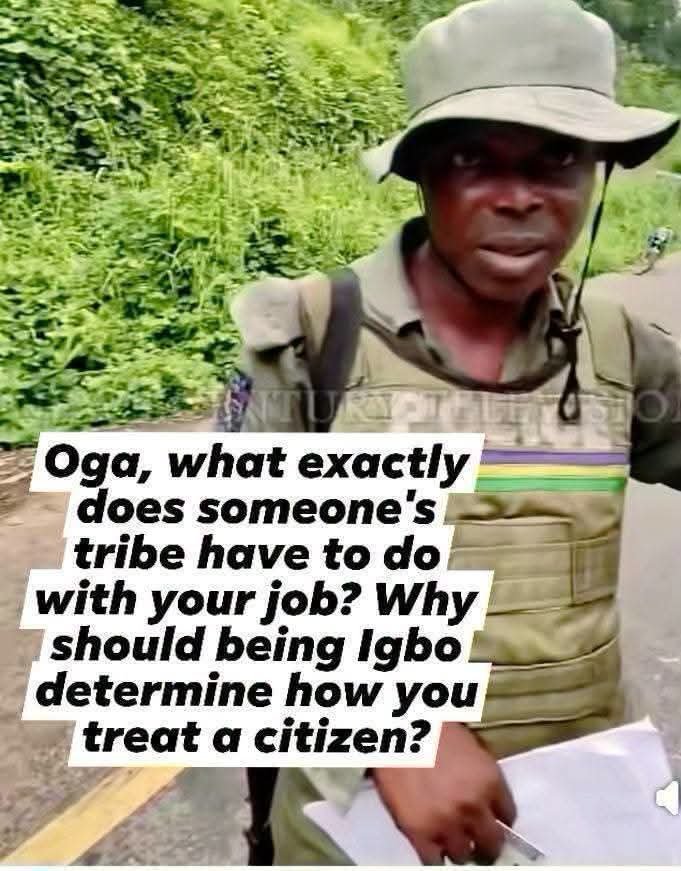
Just when you think you have seen it all in Nigeria, boom! Another one appears. Another uniformed man, paid and armed by the Nigerian state, goes on camera to profile an entire race with rage and reckless abandon.
This time, it is the Igbo race again.
A Dangerous Pattern That Has Become Normal
Profiling the Igbo by personnel of the Nigerian security outfits is no longer an aberration. It has become a routine, unbecoming, and dangerously unpunished culture.
Watch the elements involved. They do it with a confidence that suggests they were contracted to do so. They speak with venom, with bitterness, with a sense of immunity — as if ethnic hatred was part of their basic training orientation.
We must ask the uncomfortable question: How can a Nigerian uniformed officer, sworn to protect all Nigerians irrespective of tribe, tongue or creed, openly voice such disrespect against a particular tribe and still walk free? How can a man full of such open hate speech against the very people he was trained to protect be allowed to keep his uniform and his weapon?
A man who can publicly profile the Igbo with such rage, if given operational cover, is capable of a pogrom. A man who dehumanizes a tribe on camera will not hesitate to pull the trigger on its sons and daughters off camera.
Why They Keep Doing It: Because Nothing Happens
This police officer who recently went viral profiling the Igbo race did not act in a vacuum. He has watched his colleagues — his tribesmen in uniform — do the same in the past. He saw that nothing happened to them. No arrest. No dismissal. No public reprimand. No compulsory retraining.
So he decided to also come public, confident that nothing is going to happen.
This is the real tragedy. The system has taught its worst elements that insulting the Igbo is a risk-free sport. The silence of the authorities has become approval. The lack of punishment has become permission.
This has been a daily occurrence in the Nigerian security architecture, yet there has never been a clear, standing warning from the Inspector General of Police, the Chief of Army Staff, the Chief of Defence Staff, or the heads of paramilitary outfits that ethnic profiling and hate speech in uniform will not be tolerated.
In a Sane Country, This Is a Felony
In any sane, developed country, this would not be treated as "banter" or freedom of expression. It would amount to a felony — hate speech, professional misconduct, and a breach of constitutional oath.
The culprit would be taken in, stripped of his operational privileges, investigated, and prosecuted. The institution he represents would immediately dissociate itself from his comments and reassure the targeted community.
But in Nigeria, society appears to enjoy it, as long as it is the Igbo that is being insulted. The videos are shared, liked, and laughed at. The comments sections are filled with more bile. And the leadership fitters — it fizzles out as if nothing happened.
This selective outrage is a cancer.
The Heads Must Take Responsibility
The police high command and the leadership of all military and paramilitary outfits must accept responsibility for producing such defamatory characters and sending them into public space to represent them unchecked.
You cannot recruit, train, arm, and deploy a man and then claim you are not responsible for what he says and does in your uniform. The uniform is not his personal cloth. It is the symbol of the Nigerian state. When he speaks hate in it, Nigeria is speaking hate.
What message are we sending to young Igbo officers serving in the same outfits? That their colleagues see them as enemies? What message are we sending to Igbo citizens who run to these same officers for protection?
It pains the heart to see this constantly happening.
What Must Be Done Now
If Nigeria is serious about being one nation, this must stop.
STOP TAUNTING NDIGBO WITH TOKENISM
To: Chief Engr. David Umahi,
Honourable Minister, Federal Ministry of Works
Sir,
It is painful to watch you become an instrument for mocking the sensibility of the Igbo race — playing politics with the dignity of Ndigbo for personal aggrandizement.
For over three years you have served as Minister of Works. Yet the 1st Niger Bridge — the gateway linking the entire Southeast and South-South, begging for comprehensive attention since the end of the civil war — has only received a makeshift repair and resurfacing. You then turned that minor palliative work into a campaign tool to humiliate your own people.
You repeatedly lay claim to President Bola Ahmed Tinubu’s “monumental projects in the Southeast” that cannot be seen on the ground, and you cite the resurfacing of the old Niger Bridge as one of them.
We welcome any genuine development in the Southeast with an open heart. And we look up to you, as a son of Igbo land, to attract meaningful projects to the region. But please, do not taunt us with minor works as if they are a free gift to the undeserving.
Let us face the facts:
The 2nd Niger Bridge has not advanced 20% beyond where the Buhari administration left it.
Every federal road leading into the Southeast from other parts of Nigeria is a nightmare to travel. The Benin Bypass to Asaba experience is one you would not wish on your worst enemy.
Yet you boast of monumental projects in the Southeast.
We have watched you hire a retinue of paid image-makers to sing your praises and that of President Tinubu. We tolerated it because you are a son of the soil. But it is unacceptable to now destroy the image and reputation of other Igbo sons just to promote yourself.
Stop making Ndigbo look like second-class citizens in a country where we are major contributors to economic growth. What is done in the East should not be presented as a privileged gift.
Real bridges and monumental roads are built in other zones of Nigeria, and you never campaign with them as vigorously as you do with token projects in the Southeast.
Free us from this mental torture you call representation. Resurfacing the old Niger Bridge is not a monumental project to warrant the deafening publicity you and your aides are currently orchestrating. It is the cheapest campaign strategy.
If you want us to celebrate you, do the real work:
Do the Owerri-Onitsha road. Do the Ihiala-Orlu-Umuahia road. Complete the Enugu-Onitsha road that has been under construction for 24 years. Fix the Ore-Benin-Asaba corridor to ease movement for your people. Fix the other collapsed federal roads.
Do these, and we — your people — will be the ones to trumpet your achievements, not you or your paid agents.
Innocent Okeke
Duru Agumba
#daveumahi #FederalGovernment #SouthEastNigeria #NDIGBO #DavidUmahi #PeterObi #anambra #anambrastate #alaigbo #ohanezendigbo @all
Public Alert No. 042/2026.
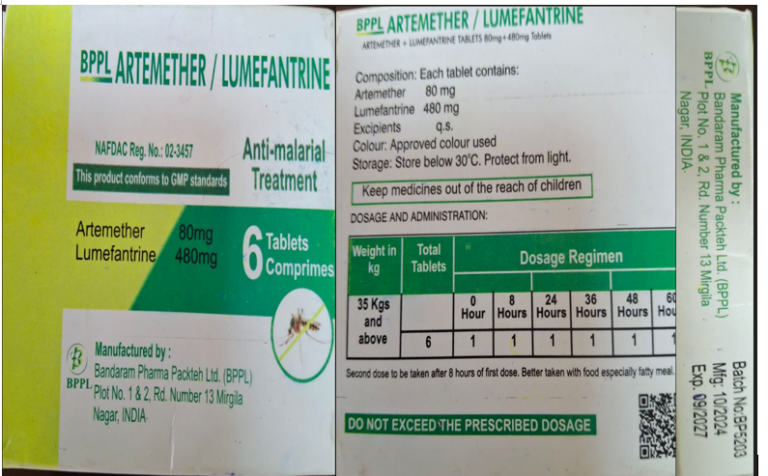
Alert on the seizure of suspected substandard and falsified BPPL Artemether/Lumefantrine 80mg/480mg
https://t.co/kKdm83q4AW
#NAFDACAlerts
EASTERN ROADS: THE UNSPEAKABLE NIGHTMARE TRAVELERS ENDURE DAILY
By Duru Agumba
Traveling to the eastern part of Nigeria from the West and North has become worse than a nightmare. What travelers go through daily is unspeakable, excruciating, and dehumanizing.
All the noise about governance and project delivery is nothing but self-hype by government officials.
The Minister of Works, Engr. Dave Umahi recently boasted about how many roads and bridges his ministry has constructed in every state of the federation. The honest questions every Nigerian road user should ask are: Where are these roads? Which of these roads are on the priority list of the federal government? Are they roads that impact the economy and daily lives of Nigerians?
You can not tell Nigerians that you are developing thousands of roads inside bushes that can not be reached or verified, while the strategic economic corridors that carry millions of people and goods every day are left in total ruins
THE JOURNEY OF PAIN
1. Ore to Benin:
The stretch from Ore to Benin City is an experience you can not imagine until you are trapped in it. What should be a 2-hour journey now takes 6 to 10 hours. Trailers fall, small cars sink inside craters, and armed robbery and kidnapping thrive because vehicles are forced to crawl at 5km/h through failed portions. Passengers sleep on the road. Businesses lose perishable goods worth millions.
2. Benin Bypass - Agbor - Asaba:
This is hell on earth. From the Benin bypass through Agbor to Asaba, the road has completely collapsed. There is no word to describe it. Potholes have become ditches. Ditches have become ponds. Travelers spend a whole day on a stretch that should take less than 90 minutes. It is an experience you will never wish even your enemy to have.
3. Asaba - Onitsha - Further East:
Getting to the Niger Bridge is another battle. The Asaba-Onitsha corridor is choked, broken, and dangerous. And once you cross into the East, it continues. Whether you are heading to Owerri, Enugu, Aba, or Port Harcourt, the story is the same - abandoned construction sites, no contractors on ground, but billions claimed to have been budgeted.
A MINISTER FROM THE EAST WHO DOES NOT USE THE ROAD
The irony is painful. The Minister of Works, Engr. Dave Umahi is from this very Southeast region. Even though he flies and does not ply these roads, he hears daily the wailing and cries of his own people. He can not claim ignorance.
This is the greatest undoing of governments in Nigeria: employing barefaced liars as aides and assistants. People who can not tell their principal the truth about the real state of development. Their only job is praise-singing, bootlicking, and unnecessary hyping of failure. They feed the President with Photoshop pictures and fictitious reports of roads constructed in the bush.
This problem has lasted for nearly 10 years. Every government comes, re-awards the same road, cuts ribbon on the same road, and abandons it. Yet functionaries will appear on television to claim they have delivered infrastructure.
MR. PRESIDENT, VERIFY YOURSELF
President Bola Ahmed Tinubu, sir, I appeal to you: Please do not depend only on reports pushed to you by your ministers and aides.
Use third-party, independent verifiers. Send people without convoy to travel from Lagos to Onitsha by road, incognito. Let them feel what ordinary Nigerians feel. Let them record what they see. That is the only way you will know if you are truly impressing Nigerians or if your officials are simply telling you what you want to hear.
The economy of the East is bleeding because of these roads. The people are suffering. Governance must be seen on the roads that people use every day, not on paper.
Innocent Sunday Okeke,
Duru Agumba. @highlight
WHO WILL DEFEND NDIGBO, WHO DO WE COMPLAIN TO?
They have all gone silent.
Our so-called leaders are afraid to speak for their own people even in the face of terror, humiliation and inhumanity.
To them, politics is not about Ndigbo. It is about themselves, their immediate families, their comfort and their stomach. Once they get what they want, the rest of ndigbo are meaningless.
Ndigbo are the giant in the East, supposed be the voice in defending even the minority neighbours.
While our people die daily and are dehumanized on Eastern roads, they are busy singing praises to Abuja. They are busy positioning for 2027 and 2031. Vice President, President, and what have you.
They know our political class is weak and timid, so they throw them empty promises and use them to make a mockery of the entire Southeast.
Where is our voice?
Deputy Speaker Benjamin Kalu - silent.
Senator Enyinnaya Abaribe, once our loudest voice - now silent.
Senator Orji Uzor Kalu - never stood for us, now leading the praise-singers.
And the rest? Onyewuchi, Izunaso, Umeh, Tony Nwoye, Kelvin Chukwu, Akobundu, Osita Ngwu and all House members from the Southeast - TOTAL SILENCE.
And the Governors - Nwifuru, Otti, Uzodimma, Soludo, Mbah - all competing to praise the President while their own children are slaughtered and humiliated at home.
You are playing politics with the blood of your own kinsmen!
What a tragic, terrible fate to be Ndigbo today. Who will liberate our leaders from this shackle of cowardice? Who will free them from this paralysis of will?
We are watching. History is watching. And Ndigbo will not forget this betrayal.
ENOUGH IS ENOUGH. SPEAK NOW OR NEVER CLAIM TO REPRESENT US AGAIN.
@highlight
DO SOMETHING GOOD AND GO!
The Two Constitutions of Nigeria: A Roadside Encounter on the Lagos-Benin Expressway
"If you are someone else, park over there. If you are Igbo, I will say park over there."(Detained)
Those were the words of a Nigerian police officer on the Lagos-Benin road to a motorist.
That single sentence is not an isolated incident. It is the daily creed. It is the excruciating, lived experience of the average Igbo man on Nigerian roads.
For Ndigbo, travelling from any part of Nigeria to their ancestral home in the Southeast is no longer a journey. It is a gauntlet.
From Ore to Asaba, from Asaba to Onitsha, and deep into the heartland of Igboland, we have army checkpoints, police checkpoints, custom checkpoints, NDLEA checkpoints, road safety, VIO, etc, each checkpoints sighting the other one ahead, every checkpoint becomes a courtroom where your tribe is already judged guilty.
Torture. Harassment. Humiliation. Extortion. Blackmail. Coercion.
Not because you broke the law. Not because your papers are not complete. Simply because you are Igbo.
And the agents on the road no longer hide it. They announce their mission with pride, as if it were official duty. The uniform that should symbolize protection has become a tool for ethnic profiling. It has become normalized.
One Country, Two Constitutions
We are told Nigeria operates one constitution. That is a lie we have lived with for 56 years.
In reality, there are two constitutions operating simultaneously in this country.
One constitution for other Nigerians.
And another constitution, unwritten but brutally enforced, for Ndigbo.
This second constitution was written in the aftermath of the civil war, 56 years ago, and it is still counting. It says an Igbo man must be reminded, at every opportunity, that he is hated, that he is a second-class citizen, that he must pay for being Igbo.
The authorities in Abuja play lip service to "equal rights" and "One Nigeria." They chant it on Independence Day. But they know, as we know, that it is not true. One Nigeria cannot exist where one tribe is deliberately targeted on its own roads within the same country.
The Weapon That Wounded Its Maker
For 56 years, Nigeria has fashioned a weapon against the Igbo man. But here is the irony they refuse to see: that weapon is now tormenting them.
The policy of exclusion, the deliberate attempt to humiliate and frustrate Ndigbo, has not only failed to break the Igbo spirit - it has brought ruin upon the entire nation. It has brought Nigeria to its knees.
This is why Nigeria, which gained independence alongside countries like Malaysia, Indonesia, and South Korea, cannot catch up with them. While others were building nations, Nigeria was busy perfecting the art of humiliating Ndigbo. The energy, the resources, the intellect that should have built roads, hospitals, and industries was diverted to sustain inequality.
The quest to keep Ndigbo down has produced hardship and underdevelopment for the whole of Nigeria. And they know it.
But here is the secret they don't understand: The Igbo man has accustomed himself to this hostility and is prospering in spite of it. He has turned every roadblock into a business lesson, every extortion into motivation to build again. While his predators think they are punishing him, they are wallowing in abject hardship, because a nation that hates its most industrious people can never prosper.
So I ask a simple question:
If Nigeria cannot accommodate Ndigbo and prosper, why not allow them freedom and prosper? Why not allow confederation and let everyone prosper in their own way?
You cannot hold a man down in a well without staying down in the well with him. Nigeria has held Ndigbo in that well for 56 years, and look at us - all of us are still in darkness.
It is time to end the two constitutions. It is time for justice, equity, and true federalism. Or it is time to allow those who want to leave, to leave in peace.
NIGERIA, WE MUST HEAL!
Harboring animosity for too long is a sickness that does nobody good. It damages your health, and when irreparable damage has already been done, all you can do is build an atmosphere to overcome it.
I followed with keen interest in the recent interview of Thomas Aguiyi-Ironsi, son of General J.T.U Aguiyi-Ironsi.
What struck me was not just what he said, but how he said it, his careful choice of words, his deliberate refusal to inflame an already painful history. Watching him, I concluded that if Nigeria would ever heal, the time is now or never.
Thomas was just 12 years old on the eve of those tragic events of 1966. He understands what happened. He has every reason to be bitter if he replays the horror of his father’s murder. But he chose not to be bitter. He understands that some damage can not be repaired; you can only move forward.
That is the lesson.
Most of those still carrying the animosity of 1966 in the North were infants at the time or were born twenty years after. They were only fed a one-sided story — that it was an "Igbo coup. Or igbo agenda".
They were never told that the man tagged as the leader of that military junta, Major Chukwuma Kaduna Nzeogwu, could barely speak Igbo. He was born and raised in Kaduna, in the North, and had little connection to his place of origin. They were never told that his collaborators in that regrettable coup were officers from other tribes, including the North itself.
Yet the Igbos have carried this blemish for 60 long years and have suffered irreparable damage for it.
General Aguiyi-Ironsi, Chukwuemeka Odumegwu Ojukwu, and many other senior officers of core Igbo extraction did not plan and did not take part in that first coup that created the animosity. Yet they suffered death, humiliation, and deprivation. Their entire tribe has endured constant profiling ever since.
If the son of Aguiyi-Ironsi can let go of the cruelty of his father’s murder, if he can humbly admit where his father was slow to act, and still address fellow Nigerians with respect and dignity, then every other aggrieved person should learn from him and follow suit and let go every bitterness.
We can not carry this animosity for sixty long years and still expect to move forward. We can not keep curing a madness that is older than most of us and expect quick results.
The generation that caused these events is remaining very few now. We should allow them to go with the troubles they caused and together build a new, prosperous, and rewarding future for Nigeria.
The very sad incident of Saduana and Tafawa Belewa, holding onto these regrettable events, has not made us better as individuals. It has not improved our economy. It has not built Nigeria.
It is time to reject those old stories of tribal hate, division, and enmity. It is time to build a new generation on the foundation of love, equity, and truth.
Innocent Sunday Okeke,
Duru Agumba
Passionate crusader for equal rights and justice.#nigeria @highlight #TheNation #punchnewspapers #thesun #AriseAgenda
RE: URGENT APPEAL TO PREVENT THE HIJACK OF THE COORDINATED WHOLESALE CENTER POLICY AND AVERT IMMINENT CRISIS IN IDUMOTA DRUG MARKET RELOCATION
To:
His Excellency, President Bola Ahmed Tinubu, GCFR
The Honourable Minister of Health
The Director-General, NAFDAC
The Registrar, Pharmacists Council of Nigeria (PCN)
The Permanent Secretary, Federal Ministry of Health
From: Concerned Stakeholders and Aggrieved members of Lagos State Medicine Dealers, Idumota Drug Market, Lagos
Date: July 9, 2026
Your Excellency, Honourable Minister, and Heads of Agencies,
We write as over 5,000 medicine traders in Idumota Drug Market, Lagos, to alert the Federal Government of the hijack of the Coordinated Wholesale Centre (CWC) policy a noble initiative designed to end chaotic open drug markets by a powerful few, thereby endangering the planned relocation of Idumota Drug Market by 2029 and threatening national security.
The Federal Government, through the Federal Ministry of Health, designed the Coordinated Wholesale Centre policy as a practical solution to the unregulated and chaotic distribution of medicines in Idumota. The policy envisioned a registered, regulated hub to accommodate traders in a clean, monitored environment, enabling regulatory agencies to oversee daily operations and restore order to the drug supply chain.
This policy was widely welcomed by Idumota medicine dealers who have long sought an end to friction with regulatory authorities. To actualize this government initiative, traders made personal sacrifices:
From 2011 to 2018, we collectively contributed funds to purchase land from the Ojora Family in the Iganmu area of Lagos State.
We further processed and secured the Certificate of Occupancy and building plan approval from the Lagos State Government through our appointed agents and leaders.
Our actions demonstrated full commitment to the Federal Government’s relocation plan, which aimed to safely resettle over 5,000 traders and avoid the security risks of forced displacement.
The land we purchased and secured has been forcefully taken from us. This was executed by a group of powerful, well-financed importers and manufacturers, allegedly with the support of certain officials within the Pharmacists Council of Nigeria (PCN), NAFDAC, and relevant ministries.
We, the original contributors and intended beneficiaries, have now been labelled “unfit” for the approved Coordinated Wholesale Centre we funded.
Should this injustice continue, the consequences by 2029 will be severe:
This complaint has been formally lodged with the Federal Ministry of Health, NAFDAC, PCN, and other relevant authorities. In January 2026, the Federal Ministry of Health directed the PCN and the Food and Drug Department to investigate and report back for immediate action.
As of today, July 9, 2026, no action has been taken. The agencies have failed to act, thereby enabling the ongoing dispossession.
Halt the takeover of the Iganmu CWC land by the aforementioned importers/manufacturers and restore rightful access to the Idumota traders who funded and secured it
Order an independent probe into the roles played by officials of PCN, NAFDAC, and the Ministry in this hijack.
Enforce the original CWC policy that the Center must accommodate existing Idumota traders first, as intended, before consideration of new entrants.
Provide a clear timeline for the relocation process and stakeholder engagement to prevent the 2029 deadline from triggering a crisis.
Conclusion
The over 5,000 traders affected are Nigerians with families and dependents. Stripping them of their means of livelihood without alternative will create a humanitarian and security disaster the government may struggle to contain.
We call on the President, the Honorable Minister of Health, and all responsible agencies to act now. The CWC policy was designed to solve a problem, not create a bigger one. #nigeriapresidency #femigbajabiamila #fmhn
Re: Plateau Governor, Caleb Mutfwang's Apology to Ndi Igbo - Sincerity or Strategy?
The Plateau State Governor's recent apology to Ndi Igbo resident in the state over the civil war experience deserves critical examination.
While any gesture of reconciliation is welcome, its timing, venue and immediate aftermath raise concerns. Coming in mid-2026 on the eve of the 2027 elections, and delivered not at a formal reconciliation forum but at an interactive session in Government House, its sincerity is questionable.
Furthermore, the instant transmutation of the apology session into an endorsement rally for 2027 by some Igbo leaders present undermines its moral weight. It conflates historical justice with political patronage.
Ndi Igbo constitute a vital economic force in Plateau, dominating commerce in Jos Main Market, Terminus and other key markets. Are we being apologized to as citizens deserving of healing, or courted as a voting bloc?
If this is an official position of Plateau State, let it be gazetted and followed by concrete policies of inclusion and remembrance. Until then, it remains what it looks like: the politicization of Igbo pain.
Agumba Innocent Sunday Okeke (Duru Agumba)#igbo #ohanaezendiigbo #ndiigboindiaspora