In the country with the world's worst recent inflation, a soccer club just sold out 85,018 seats for the 105th match in a row.
The brand loyalty math on this should mass-humble every CMO on Earth.
105 home games. 85,018 fans every time. A bigger crowd than any NFL stadium fits. Four years straight. Zero empty seats. Over 8 million tickets sold during the run.
Now layer in the country.
The streak started in February 2022, when Argentine annualized inflation was running 50%. It peaked above 200% in late 2023. The peso lost roughly 80% of its dollar value during the run. 91% of Argentine households carry debt and 58% of those loans last year went to buying food. The average state pension is $300 a month.
Argentines who can barely afford groceries filled the world's biggest soccer stadium twice a month for four straight years.
The club is River Plate. They've held the highest average attendance in world football for three years running, ahead of Real Madrid, ahead of any Premier League ground.
The response from leadership is the tell. River just announced a $100 million expansion to push capacity to 101,000 by 2029, partnered with the German firm that built the roofs at Real Madrid's Bernabéu and Tottenham. They're betting demand keeps climbing past 85,000 in a country still running 33% inflation.
This is what identity-based products do that subscription products cannot. When the currency melts and groceries get bought on credit, the line item that survives is the one their grandfather had. River's product is the only asset in Argentina holding real value while the peso loses it.
Every founder talks about "brand loyalty." Most watch churn spike after a 5% price hike. River raised effective ticket prices through 200%+ inflation and grew their waitlist.
The capacity number is engineered. 85,018. The last two digits commemorate the 2018 final River won against their archrival in Madrid. They built a championship into the building.
You cannot replicate that with a CRM.
Let me explain exactly why your phone seems to read your thoughts, because the real answer is more invasive than telepathy.
Every time you open a website or app, a real-time bidding auction fires in under 100 milliseconds. Your GPS coordinates, browsing history, device fingerprint, age, gender, income bracket, and hundreds of inferred interest categories get packaged into a “bid request” and broadcast to hundreds of companies simultaneously. One company wins the ad slot. All of them keep the data.
This happens thousands of times per day per person. A 2018 New York Times investigation found 75 companies pulling precise location data from apps, with some users tracked up to 14,000 times in 24 hours.
In 2012, a Target statistician identified 25 products that, purchased in combination, could predict a customer was pregnant and estimate her due date. A teenager’s father discovered she was pregnant because Target sent baby coupons to the house before she told anyone. That was one retailer. Store receipts only. Fourteen years ago.
Now scale that. Your phone pings GPS while you sleep. Data brokers link your phone, laptop, and tablet through probabilistic matching of IP addresses, WiFi networks, and behavioral patterns without you ever logging in. The FTC caught two brokers in 2024 categorizing people by visits to reproductive health clinics, political protests, and religious services, then selling those profiles to law enforcement.
The algorithm doesn’t hear your thoughts. It compares your behavioral fingerprint against millions of similar profiles and predicts your next interest before you’re consciously aware of it. It makes hundreds of predictions per day. You ignore the misses. The five hits feel like telepathy.
You paid for the phone. You pay for the data plan. You generate the signal. And every time a page loads, your identity gets auctioned to the highest bidder before the content even renders.
They called it “personalized advertising” because “real-time mass surveillance funded by the people being surveilled” doesn’t fit on a consent banner.
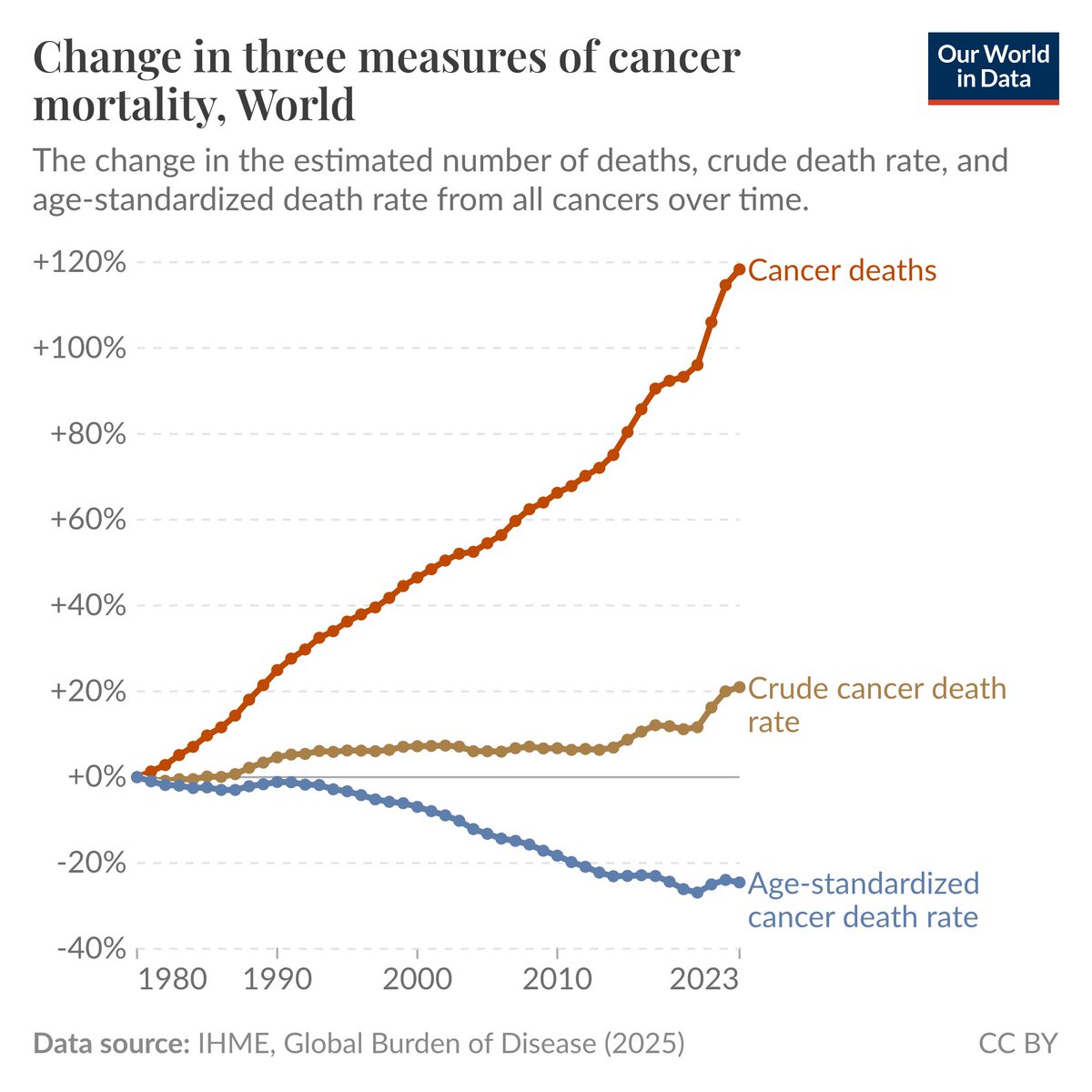
The number of cancer deaths worldwide has more than doubled since the 1980s. Does that mean we're losing the fight against cancer? Not necessarily, because it depends on how you measure it. On this chart, you can see three ways to look at the same data.
The red line shows the total number of cancer deaths. It has increased by about 120%, but this measure doesn't account for the fact that the world's population has also grown enormously over this period.
Another approach is to look at the death rate: the number of cancer deaths divided by the total population. That's the brown line, called the crude cancer death rate. It has increased too, but much less — around 20%.
But there's still a problem: the world's population has been getting older. Cancer is mostly a disease of old age, so even per capita, we'd expect more cancer deaths simply because there are more older people than before.
That's where the method of “age standardization” comes in. It's a way of asking: what would the cancer death rate look like if the age structure of the population hadn't changed?
The blue line shows this age-standardized rate: it's fallen by about 25%. At any given age, people are now less likely to die of cancer than they were in the 1980s.
The same underlying data gives us three different pictures. The absolute number of deaths is up; the crude rate is up slightly; the age-standardized rate is down. None of these are inaccurate, but they answer different questions.
Age standardization is one of the most important statistical methods for making sense of health data. Without it, population aging can hide progress or mask problems.
holy sh*t. this is hands down the coolest website i have ever found in my life. it's a live feed of the freaking Hubble Telescope AND James Webb Space Telescope. and the resolution is honestly so incredible i didn't think it was real.
unbelievable.
https://t.co/YQNsG9TVwe
"The nitrogen in our DNA, the calcium in our teeth, the iron in our blood, the carbon in our apple pies were made in the interiors of collapsing stars. We are made of starstuff."
My parents died years ago. I was very close to them. I still miss them terribly. I know I always will. I long to believe that their essence, their personalities, what I loved so much about them, are - really and truly - still in existence somewhere.
I wouldn't ask very much, just five or ten minutes a year, say, to tell them about their grandchildren, to catch them up on the latest news, to remind them that I love them.
There's a part of me - no matter how childish it sounds - that wonders how they are. "Is everything all right?" I want to ask. The last words I found myself saying to my father, at the moment of his death, were "Take care."
Sometimes I dream that I'm talking to my parents, and suddenly - still immersed in the dreamwork - I'm seized by the overpowering realization that they didn't really die, that it's all been some kind of horrible mistake.
Why, here they are, alive and well, my father making wry jokes, my mother earnestly advising me to wear a muffler because the weather is chilly. When I wake up I go through an abbreviated process of mourning all over again. Plainly, there's something within me that's ready to believe in life after death. And it's not the least bit interested in whether there's any sober evidence for it.
So I don't guffaw at the woman who visits her husband's grave and chats him up every now and then, maybe on the anniversary of his death. It's not hard to understand. And if I have difficulties with the ontological status of who she's talking to, that's all right. That's not what this is about. This is about humans being human.
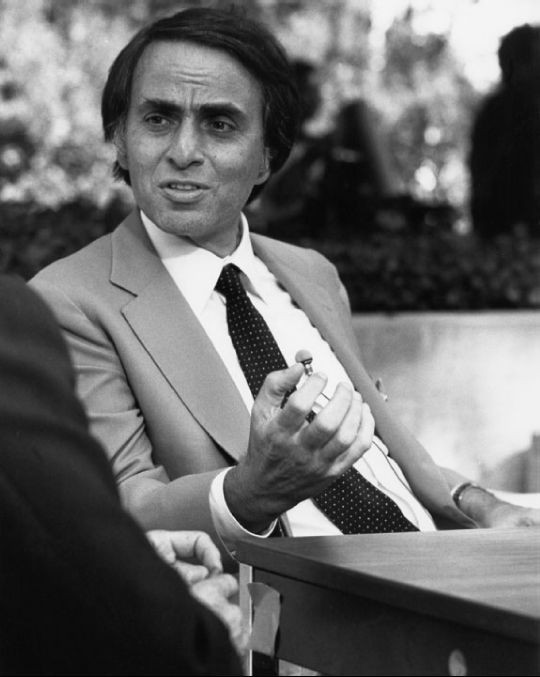
- Carl Sagan
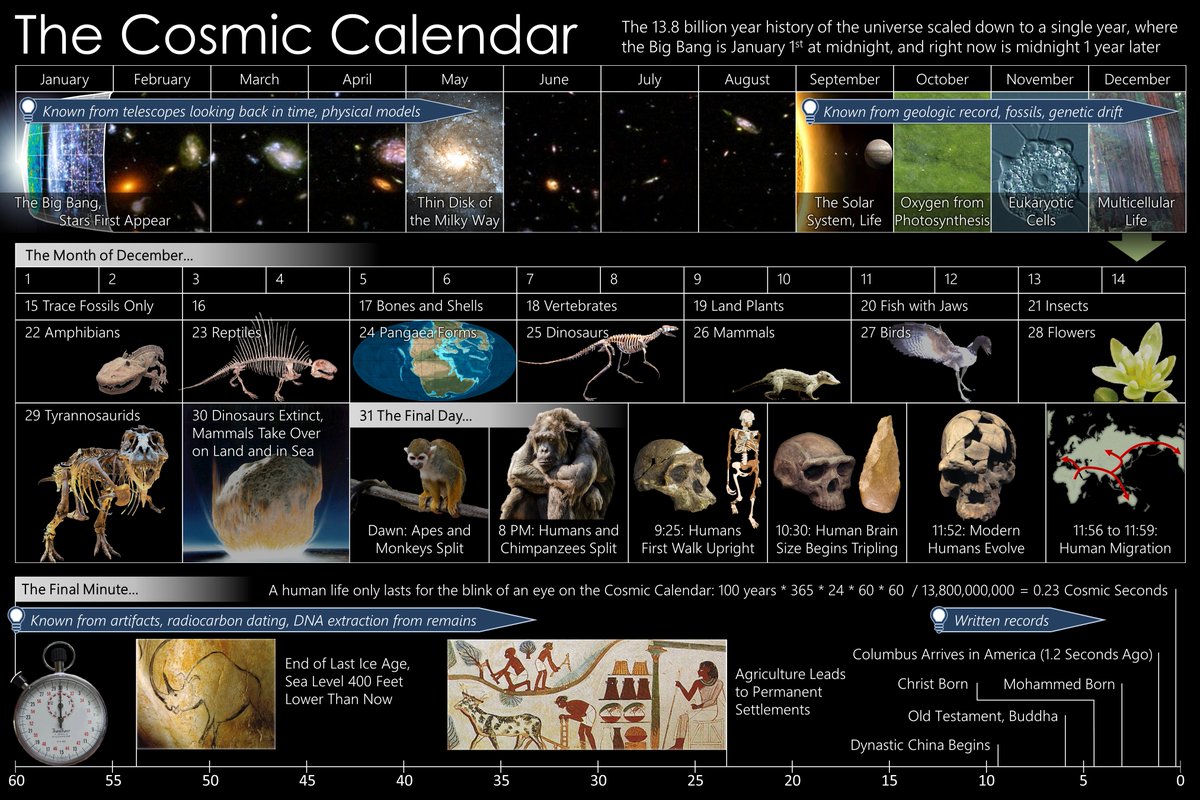
Carl Sagan used the Cosmic Calendar to scale the universe’s 13.8 billion-year history into a single year—making its timeline easier to grasp and teach.
Entropy is one of those formulas that many of us learn, swallow whole, and even use regularly without really understanding.
(E.g., where does that “log” come from? Are there other possible formulas?)
Yet there's an intuitive & almost inevitable way to arrive at this expression.
My meager education in biology and evolution gave me the mistaken impression that evolution optimized everything. But it didn't.
One example is the recurrent laryngeal nerve (RLN). It goes from behind your ear, loops down below your aorta, and then back up to the voice-box
1/2
This is what will matter 1000 years from now.
Not your politics. Not your stupid tantrums about who platformed who on some website. Not your incomprehensible desire to send NASA's entire budget to the third world.
This guy reignited the Space Age.
He spent his own money, hired a bunch of dudes, and reignited the Space Age. And together, they underbid and outdid NASA and its pet dinosaur corporations on every conceivable level.
This is history happening before you.
If you are a puddlefish, if you think this is a wasteful showpiece or science project, then you don't understand physics, economics, astronomy, or in fact the basic layout of the universe you live in.
We live in a tiny puddle at the bottom of a well.
Out there is an entire universe, full not only of stuff to explore, but full of stuff to build things out of.
Big things. Wonderful things. Things that are going to make all of the cool stuff you have today, all of human civilization to date look like early Assyrians writing stuff down on wet clay with a reed.
Infinite resources. Infinite energy. Infinite space.
Instead of fighting over little patches of land, we will have an infinite 3d volume. Enclose it in steel, pump it full of air, spin it, and it's a habitat.
Instead of scratching tiny scraps of metal out of the crust of one planet, we will break down entire asteroids and smelt them.
Instead of drilling for hydrocarbons and turning water wheels, we will harness entire suns, split the atom, and eventually draw our fuel from the substance that makes up 99% of the entire universe.
None of your local, temporal Earth politics matter compared to this. This is more important than pride parades and abortions, more important than tribal conflicts in eastern Europe and southwest Asia, more important than tensions with Russia and China.
More important, in the long run, than the United States of America.
America's most important function, its one most vital purpose, is to serve as an incubator for this.
Because this changes everything.
All of our arguments about conditions on this planet become obsolete, because the whole planet becomes just one suburban neighborhood.
All of our wars over resources and territory become obsolete, because no one has time to brawl when we're all sitting on top of a dragon horde with sacks and shovels.
Everyone who was alive at the time remembers where they were when Kennedy died in Dallas. When the towers fell. When the Eagle landed. When the Wall came down.
But this... this is the real moment, one of the first of many. They are what every child will know about a thousand years from now, even if they have four arms and are genetically engineered for zero-g, or are sentient blocks of code running on a sphere of computronium enclosing an entire star.
You may not live to see that, depending on what we do or don't invent, and when.
But it will happen, and you will live to see wonderful things.
If the puddlefish don't get in the way.
Don't be a puddlefish.
Asimov’s Foundation series was part of the inspiration for making life/consciousness multiplanetary.
Being multiplanetary greatly extends the probable lifespan of civilization.
We must build Terminus.
Heisenberg and Schrödinger get pulled over for speeding.
The cop asks Heisenberg "Do you know how fast you were going?"
Heisenberg replies, "No, but we know exactly where we are!"
The officer looks at him confused and says "you were going 108 miles per hour!"
Heisenberg throws his arms up and cries, "Great! Now we're lost!"
The officer looks over the car and asks Schrödinger if the two men have anything in the trunk.
"A cat," Schrödinger replies.
The cop opens the trunk and yells "Hey! This cat is dead."
Schrödinger angrily replies, "Well he is now."
https://t.co/orJguHU4iw allows you to listen to virtually all the radio stations on Earth through a Google Earth-like interface. Each green dot is a radio station: you can just click on one and listen.