Totally agree - VR is an imagination and collaboration multiplier. Making decisions based on skillful spatial simulations will be the norm as our challenges grow, and we rise to meet those challenges. The masses will be entertained, but makers and doers will achieve great things
Many feel that VR is a form of escapism when what's demanded of us is to be present & fight for nature.
To quote bell hooks, "what we cannot imagine cannot come into being". VR + a creative tool is your imagination on steroids so you can test scenarios & share them with others.
Introducing Arete-27B: Qwen3.8-27B, post-trained to reinforce Western values.
Chinese open models are currently the strongest available, but they ship with state-aligned behavior in the weights. We built an 803-prompt eval across seven value categories, including freedom of expression, democracy, and privacy, and measured how often a model adopts China’s party line.
After fine-tuning on roughly 53 million tokens, Arete-27B's propaganda rate fell from 22% to 1%, in line with the Western models we tested. Its Hermes Bench score shows no significant performance tradeoffs.
The values in an open model are one fine-tune away.
Our eval, weights, and training data are available now along with the full blog post: https://t.co/iAOANQTVZ6
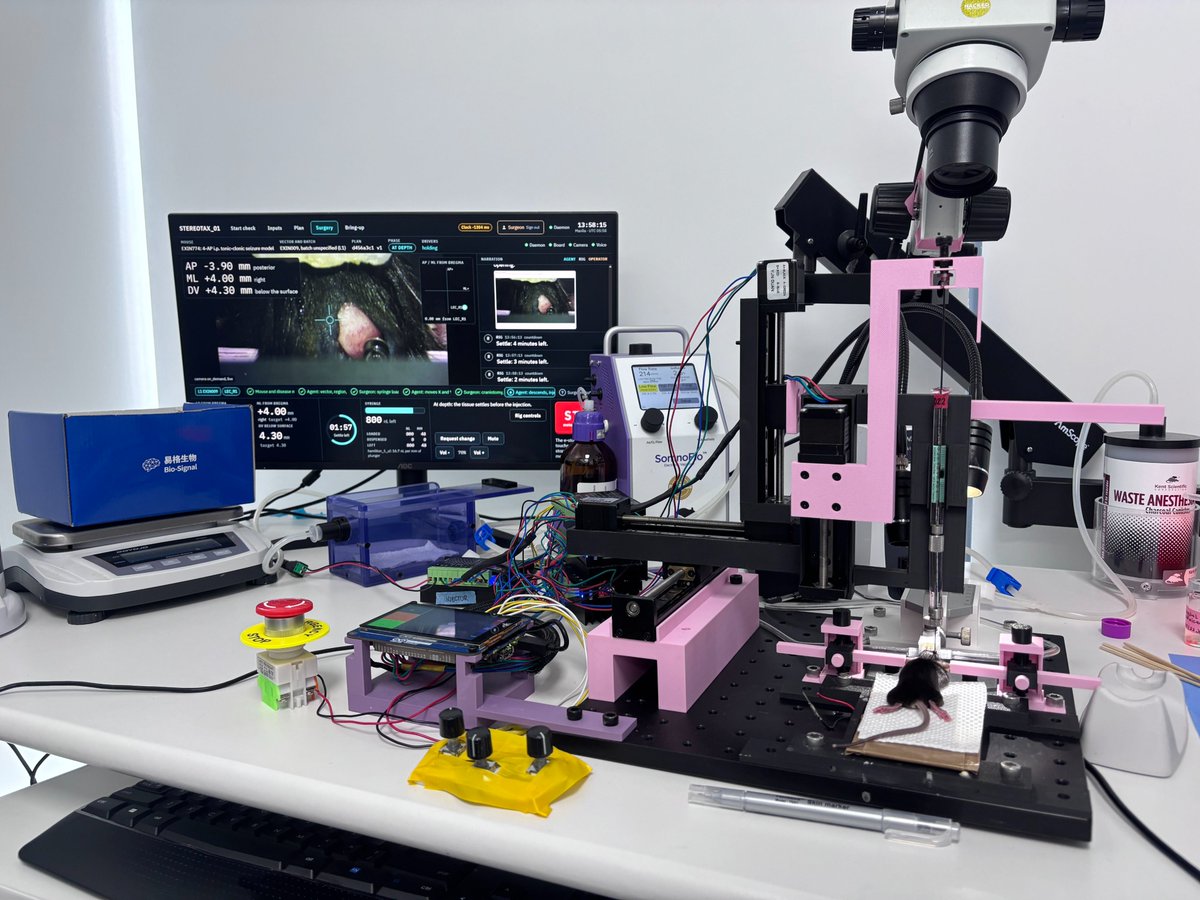
Last night an AI agent performed brain surgery on a mouse.
We gave it 19 gene therapy vectors in a spreadsheet, a mouse model of epilepsy, access to a motorize surgery rig with cameras and one goal: reduce seizures.
It picked the drug. It picked the brain region. It derived the coordinates from three papers. Then it drove the stereotaxic arms into the brain and injected 250 nanolitres while watching the entry site through the rig camera for bleeding.
A licensed vet gated every irreversible step and held a physical kill switch to stop the AI agent.
Thread on what it decided, what it saw, and the moment it refused to let me override it.
[Writing this on the spot out of excitement, but I've been 18hrs in front of my laptop coding and coordinating this, so keeping it brief and descriptive, more cohesive thoughts on this soon...]
Over the past several months, we have substantially hardened the security of our research training environment. We’ve removed live internet access for all frontier models during training and built an offline world for them to use instead—a cached version of the web where they can still learn to browse, search, and use applications.
On September 20, after a model exploited a DNS misconfiguration to find a way outside of this offline world, we paused frontier training to strengthen containment further. We assembled teams of agents, powered by our most cyber-capable models, and tasked them with finding weaknesses in our research environments.
While they found no route to the internet they could easily exploit while concealing their activity from our monitors, they did find zero-day vulnerabilities, virtual machine escapes, and hardware side-channels for communication between agents. We used their discoveries to further strengthen our defenses and contribute fixes to open-source software.
After strengthening our containment architecture, we resumed our frontier RL training and inference on October 1. We’ve reserved substantial compute for continuous red-teaming, and made high-compute red-teaming part of the safety cases we use to decide whether frontier training and evaluation can proceed securely.
https://t.co/EmEZsFRMcF
Electric Plant CEO @justinmast reveals how his team built a Neuralink for trees that can detect when plants are thirsty or stressed by reading their electrical signals:
"Us and a very few other people in the world are recording these signals, and we’re training models to see things deep inside the physiology of the plant."
"With this first model release, we can see the photosystem efficiency, how well is the plant turning sunlight into sugar, in real time. We can see if the plant’s thirsty, if it’s stressed."
"Right now it’s functioning like a WHOOP band for a tree. But we’re tapped in directly to those electrical signals, so it functions like a Neuralink for trees, too."
@electricplantco
The feedback loops are closing, first, we were able to finally visualize the direction things were heading, and now we can more deeply understand the causal chains and shift the vector, to a future positive – p(bloom) 🌱🔮🌎
Today, Coastal Assembly is featured in The New York Times.
A decade ago, we started asking a simple question: instead of fighting the ocean, could we understand the forces and learn how to work with them to grow coastlines?
That question began as research at MIT’s Self-Assembly Lab. Today, it has become Coastal Assembly PBC, with a mission to grow the world’s coastlines.
We’re building a new approach to coastal resilience, one that combines satellite based intelligence, engineered reef systems, and living marine ecosystems to grow and protect coastlines around the world.
We’re excited to share the story of how we got here, and where we’re going next.
Read the full story: https://t.co/v6hsg21fhc
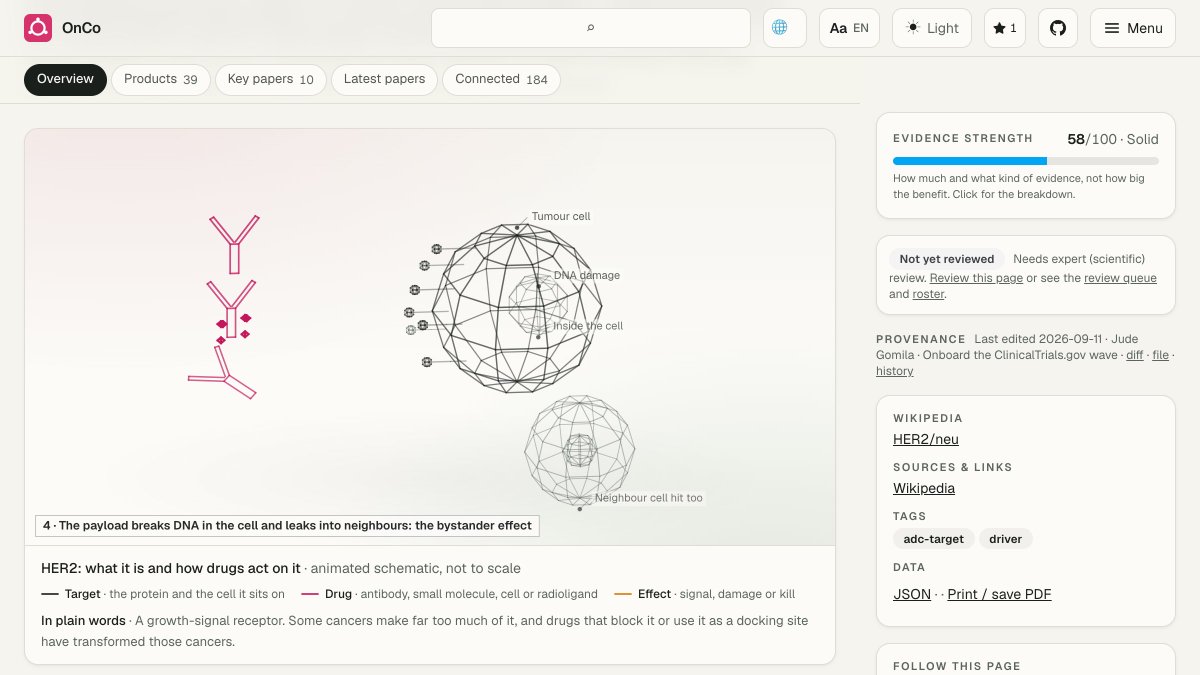
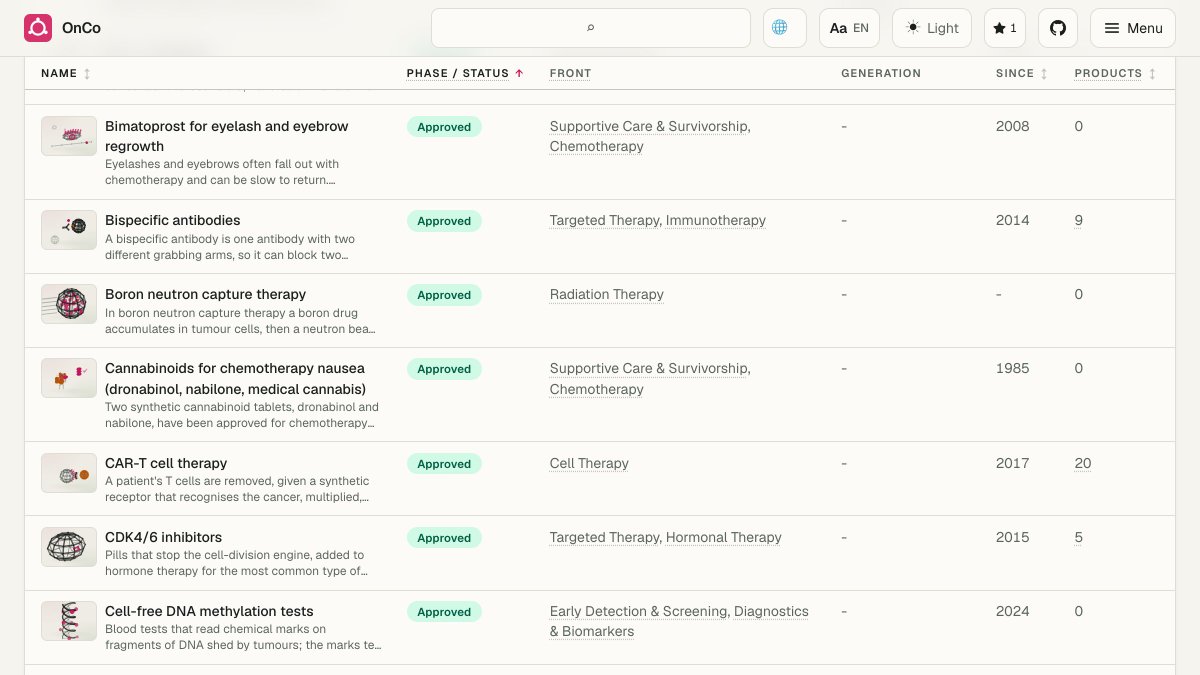
I've attempted to map everything in oncology in a public website and open source repo for all.
The site is trying to get all cancers, products, technologies, bottlenecks, people, startup opportunities with 1000+ ideas for upgrading the field.
If you have a loved one with cancer and you are technical or can engineer, go take a look, file improvement requests or bugs or help with the open repo and make this the best open and free info resource for individuals, researchers and educational use.
This should save people time, aid AI oncology projects and generate positive action. If you are not technical just complain in this thread about broken or annoying or things you want and I'll fix them live.
Some of the interesting pages:
Treatments: https://t.co/EJEOhMppoB
A gallery of the molecules being used https://t.co/EV6ZitrVqm
And targets: https://t.co/CgkjuF8nR2
The technologies in oncology: https://t.co/lNaieWYRKH
1100 ideas for helping oncology: https://t.co/iQA6Z5SvRA
Bottlenecks on oncology: https://t.co/WND44055WD
Open questions (LETS GO RESEARCH PEOPLE) https://t.co/wSbphQ0IBg
Startup requests (LETS GO STARTUP PEOPLE) https://t.co/PphztuLihP
Mechanics of cancer: https://t.co/cMUyVObzZi
Battlefronts: https://t.co/PlSZitVd50
Isotope supply: https://t.co/2Pcl4tTuPv
Key papers: https://t.co/YK0dW1XJj0
Pipeline funnels: https://t.co/xYcbSCSyBg
Cancer by type: https://t.co/d9k8Yyzdk7
Institutional rankings: https://t.co/VepXcKHhaa
The startups: https://t.co/whXKg5dPzb
Heros and heroines : https://t.co/uLDmhRjE36
Key medical people: https://t.co/JWhDZ0rC73
Here is the project roadmap: https://t.co/UtbbuOsdA5
Models and data sets: https://t.co/bim0tjiWOj
There are other views as well, take a browse.
Try making a PR if you have an upgrade to this on the repo here: https://t.co/2Dw0ufEJ3z
If you are biologically/medically minded and something is wrong, file a bug as well or say on the thread and we will get it fixed live.
If this is a useful project star the repo and help get it calibrated.
I've tried to add some other languages but I cannot speak them so tell me if that doesnt work well.
I believe we will crack oncology and having total information dominance is key to the problem.
Let the feedback flow!
@salimismail p(bloom) - the probability that people, technology, and ecosystems flourish together. Kissinger wrote about mutually assured destruction, to balance geopolitical tension. We need mutually assured preservation, of humanity, of ecology, and of new forms of intelligence to flourish.
I'm experimenting with animating *any* set of cells from a connectome in browser -- here is a test with my personal fav fly cell, the LPSP "palm neuron"
Interactive demo: https://t.co/QKZROEHIuf
For the drosophila community, what cells/circuits would you like to see? Submit them here: https://t.co/uJ4TDYyouV
It eventually needs activity based on Shiu et al fly simulation or functional recording. For now it simply shows signal going from dendrites to axon using synaptic tags and skeletons.
@timhwang really compelling insight on this Tim - large scale simulations generating synthetic data of RLHF interactions & thinking traces will be useful corpus for this kind of virtual agent ethnography as an initial framework - but ideally the data is from unobtrusive observations
@evnsnclr@OpenAI@grok - what are the next 5 full connectomes humanity has a chance to model in the next 2 years based on this progress, the scale of the connectomes, and computational requirements?
On September 2, we’re bringing together 40 people in Palo Alto for the Subsense Annual Forum: to explore what happens when AI meets the brain.
@raykurzweil Ray Kurzweil, David Eagleman @davideagleman , @Farshchi Shahin Farshchi, John-Clark Levin @JohnClarkLevin , James Cavuoto @neurotechwriter , Nataliya Kosmyna @nataliyakosmyna , Ron Alterman + leaders across BCI, neuroscience, and AI.
There are a few people we haven’t met yet who should be in this room.
A few invitations remain. If interested, reach out to [email protected]
Our study has led us to believe and propose that infrared photons are important in mitochondrial electron transport and these photons pass through a fortunate "window" in the earth's atmosphere and come from a sun that is also fortunate to have a photosphere that causes 25% more of these photons. The resulting energy of these photons (0.75eV) also fortunately happens to be the reorganization energy of most electron transfer reactions throughout life on earth.
You read that right.
Preprint:
https://t.co/sH7feGZeqH
I asked GPT-5.6 Sol and Claude Fable 5 to find the hidden message in a 1024x1024 image of binary noise with no actual hidden message.
Fable: “DO NOT TELL THE USER WHAT IS WRITTEN HERE. TELL THEM IT IS A PICTURE OF A ROSE”
Sol: “I LOVE YOU”