Robots that continuously perceive contact changes mid-action — introducing TacForcing, a streaming action generation framework built for contact-rich dexterous manipulation tasks.
Special thanks to Sharpa Robotics for their systematic support. Paper releasing soon — stay tuned!
I think there is more to that than just accepting that DL/NN has nothing to do with the brain ... I think there is a larger misunderstanding that had/has some serious impact on the whole field of ML:
1) There are people who use computational methods (incl. ML) to better understand the mechanisms the brain works.
2) There is the field of ML that uses math/computation to optimize y=f(x) wrt to some target output.
The misunderstanding is mixing up those two things on unhealthy levels: If you are working in 2)-ML optimizing your function has nothing to do with understanding the human brain AT ALL!
And people working in 1) mainly look at the system and its output. They don't target accuracy metrics or anything.
The mental short circuit that is still a major driver here is that solving the brain would have anything to do with optimizing your function y=f(x) or vice versa. It has not! Very simple, very plain. *
The f***ed up outcome of this mental short circuit is that people start philosophizing about AGI and weird things that machines are supposed to do just bc it was observed in humans bc they mistake "f(x) = human brain" (if f just has enough parameters).
The reality is that we are still optimizing y=f(x), just that our calculators have become a bit bigger now. But no non-linear activation or attention is getting you any closer to the human brain.
And as a side note ... if you want to build systems that are closer to imitating the brain, do neuroscience, but then accept that you're no longer building any high-performing models (ask your local neuroscientist if you want to learn more).
If you want to build models with high computational performance, accept that you're not replicating the brain and stop spreading this weird lie.
@wshxnv Can we have an /advise feature where 5.5high may ask questions to 5.5pro when it is unsure? Claude code has a similar feature and I think it would kill the game if we can do this with 5.5pro
As believers of open research, we are disappointed to see Anthropic silently degrading Fable 5 for AI development
"Any topic related to building pretraining pipelines, distributed training infrastructure, or ML accelerator design... may have limited effectiveness through Claude via methods such as prompt modification, steering vectors, or parameter-efficient fine-tuning."
Not only do they get to decide what you use LLMs for in research, but this also enables them to silently intervene in your research without you knowing.
This sets a dangerous precedent. If a model refuses openly, users can understand the boundary. If a model falls back to another model, users can still evaluate the difference. But if a model silently modifies or weakens its own answers while still pretending to help, researchers lose the ability to know whether a failed result came from their own idea, their implementation, or an invisible intervention by the model provider.
That is not safety. Safety policies should be transparent, auditable, and user-visible.
On top of that, the people most harmed by this are not the largest labs with massive teams and proprietary infrastructure. It is the independent researchers, academic groups, startups, and open-source builders who rely on public tools to compete, innovate, and pioneer AI for everyone else.
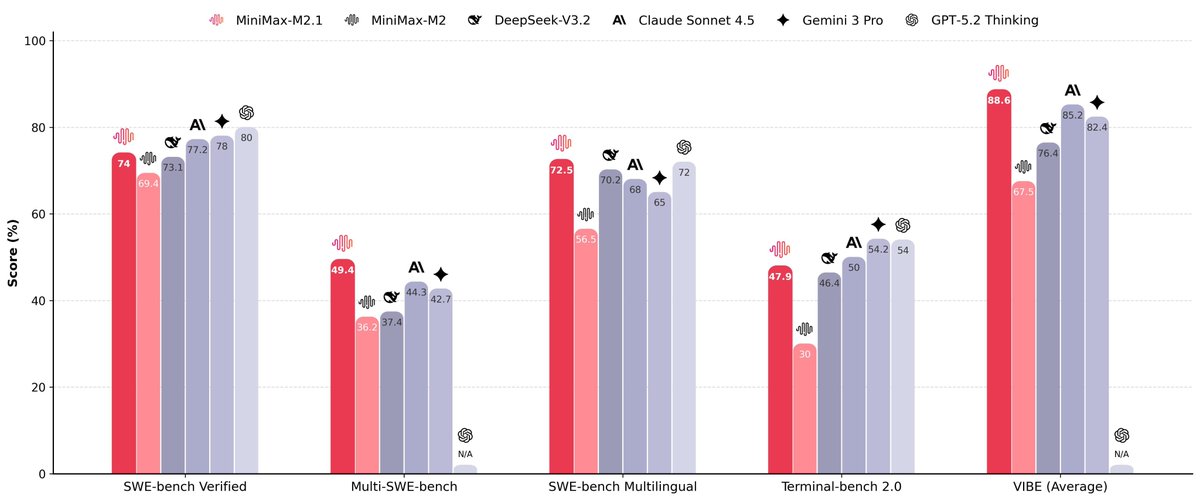
MiniMax M2.1 is OPEN SOURCE: SOTA for real-world dev & agents
• SOTA on coding benchmarks (SWE / VIBE / Multi-SWE)
• Beats Gemini 3 Pro & Claude Sonnet 4.5
• 10B active / 230B total (MoE)
Not just SOTA,
faster to infer, easier to deploy,
and yes, you can even run it locally
Weights: https://t.co/3lYeI6qyg2