Academic publisher of high-level pure and applied math research, with 28 peer-reviewed journals and a range of monographs, textbooks, and long-running series.
International Press of Boston (IP) is home to 28+ peer-reviewed mathematics journals and dozens of books & series on current pure & applied math research. Follow us for research highlights and calls for papers.
Sign up for our mailing list at: https://t.co/xKEXcZQhb4!
We are excited to announce the new Journal of AI-Assisted Mathematics! Check out this Gold OA journal at https://t.co/yJ2l2DqM9S. We at IPB decided it was necessary to open a rigorous, peer-reviewed journal for this new and emerging field, esp after the Navier-Stokes solution.
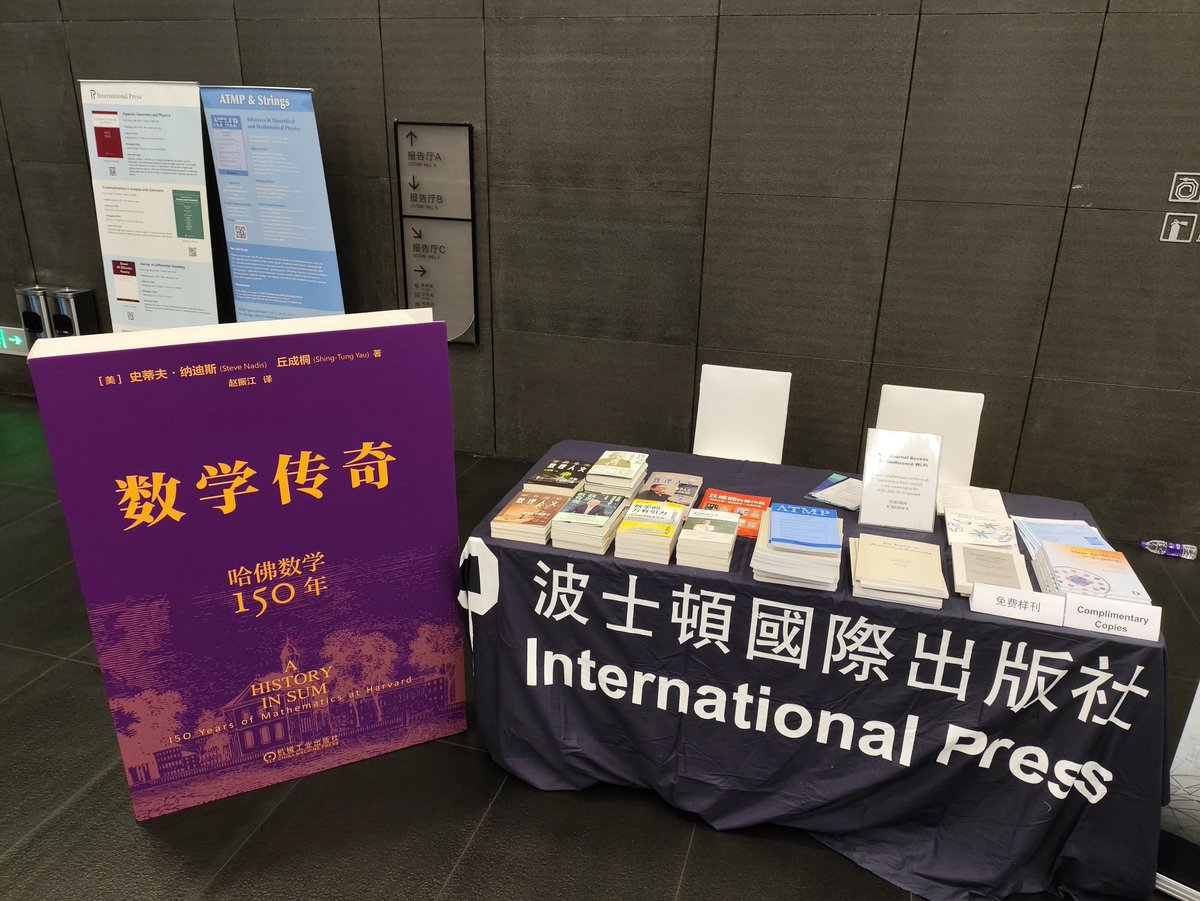
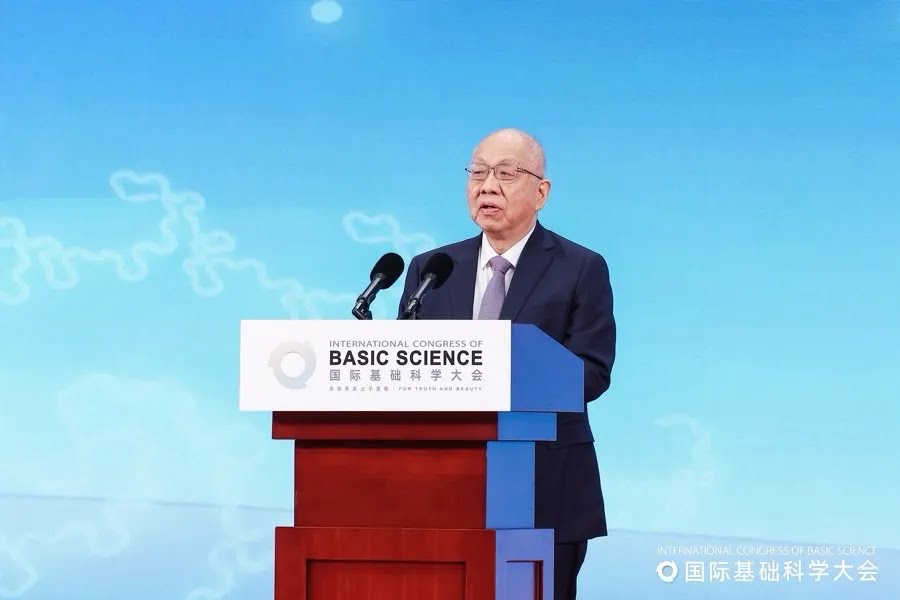
We love getting to see everyone at the 2026 International Congress of Basic Science! Come visit our table! In addition to I.P. journals and books, we will feature a special selection of Professor Shing-Tung Yau’s popular science and humanities titles published in China!
#icbs #icbs2026 #math #bookspotlight
Congratulations to Professor Zhenan Bao from Stanford University for receiving the 2026 ICBS Chien-Shiung Wu Engineering Medal. Shing-Tung Yau has gifted her his poetry collection to honor her achievement!
#stem#icbs#icbs2026#poetry#steam#WomenInSTEM#math
We at IPB honor Prof. Horng-Tzer Yau, an editor of our Cambridge Journal of Mathematics, for his ICM plenary talk. An #ICM one-hour plenary talk is the most prestigious invited lecture at the International Congress of Mathematicians! Being selected to deliver a plenary lecture is one of the highest honors in math, second only to major international awards like the Fields Medal.
The @intlpressboston journal Advances in Theoretical and Mathematical Physics accepts “C-R-T Fractionalisation, Fermions, and Mod 8 Periodicity” by our Ben Delo Fellow Juven Wang and co-authors. https://t.co/0tBsORymrX
A mathematician who won the Fields Medal, the Abel Prize, and the Wolf Prize spends an hour on the equals sign.
This is Pierre Deligne at the Institute for Advanced Study, September 2018, speaking at the memorial conference for Vladimir Voevodsky. The title is a question: what do we mean by equal.
Deligne proved the last of the Weil conjectures. He holds every major honour mathematics gives. He chose to talk about the symbol every schoolchild learns first.
The problem is real. Two objects can be the same in a way that carries information about how they are the same, and set theory throws that information away. Voevodsky spent his last years rebuilding foundations around exactly this.
Watch the board. Set theory's definition of equality on one line, homotopy groups underneath, and the gap between them opening as he writes.
A research engineer I know rewatched the setup twice and said type systems stopped feeling like an implementation detail.
Free on YouTube from the Institute for Advanced Study, chalk only.
Equality looked settled for 2,000 years. It was a placeholder.
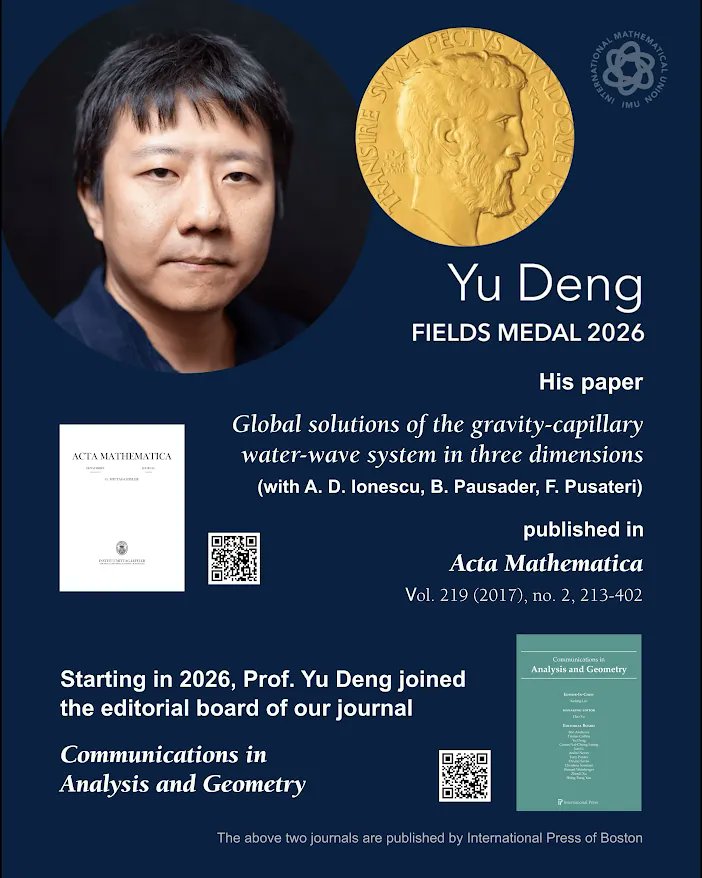
Check out this paper by newly minted Fields Medalist Yu Deng in Acta Mathematica on our website https://t.co/I3RO73ouaY! Congratulations again to one of IPB's own editors of Communication in Analysis and Geometry!
#dengyu#yudeng#fieldsmedalist#fieldsmedal#acta#cag#ipb #math #stem
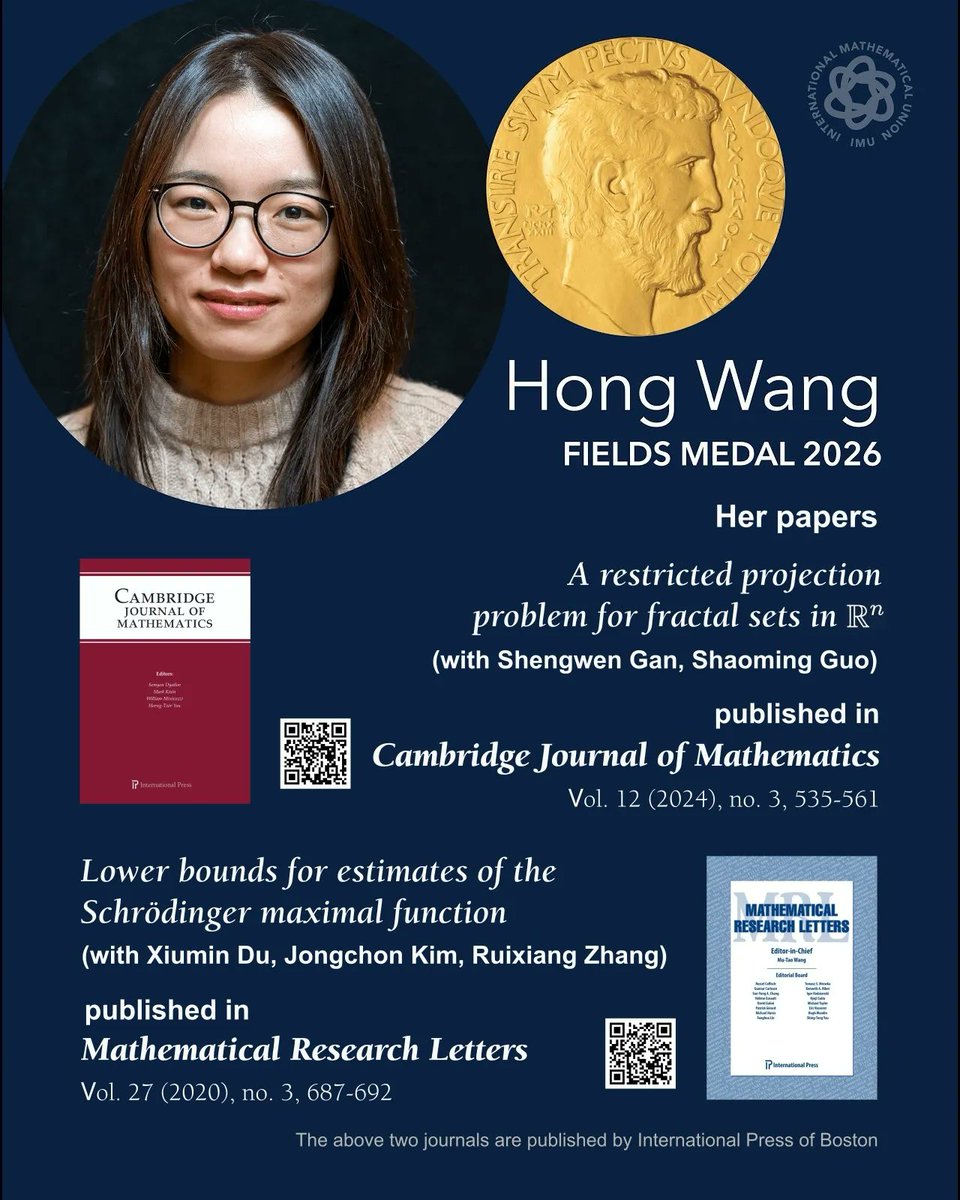
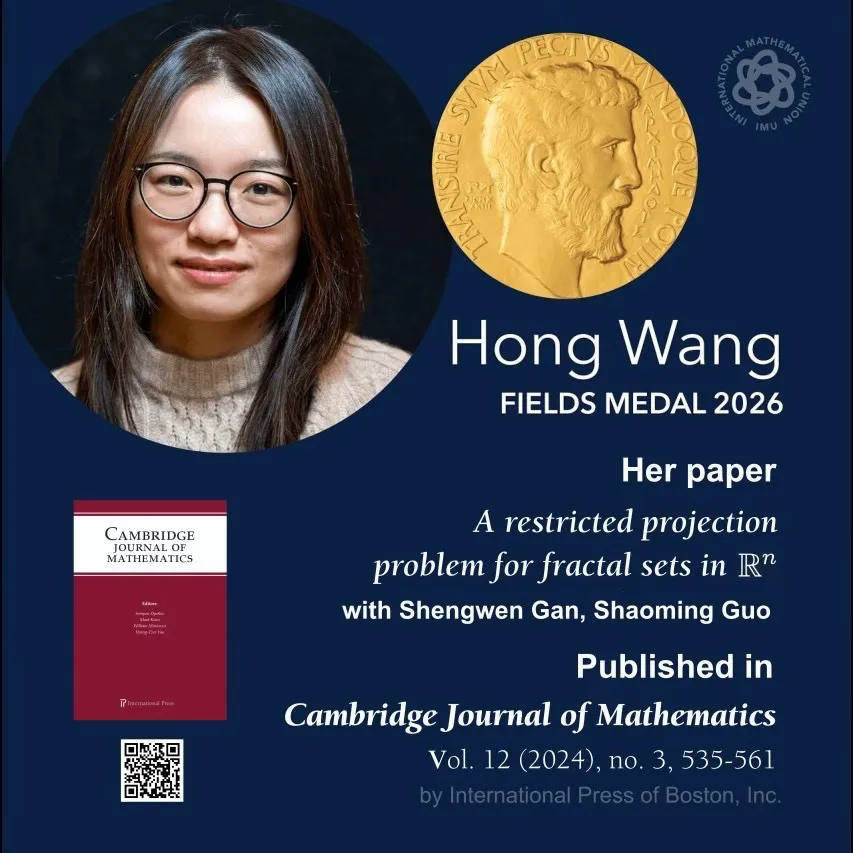
Check out these papers by newly minted Fields Medalist Hong Wang in the Cambridge Journal of Mathematics and Mathematical Research Letters on our website https://t.co/I3RO73p20w! Congratulations again to the first female Chinese Fields Medalist!
#hongwang#fieldsmedalist #fieldsmedal #cjm #mrl #ipb #math #stem
Terence Tao on AI in Math.
AI can synthesize a million papers and brute-test ideas. Humans can check just 5 examples and see the pattern.
But as systems move toward world models, causal reasoning, and active learning, this efficiency gap will narrow.
Congratulations to former Harvard math Junior Fellow, Jacob Tsimerman, currently professor of mathematics at the University of Toronto, for receiving one of the four 2026 Fields Medals! https://t.co/43uqMuG4nz
#CNRSnews 📰 Hong Wang, a mathematician at the IHES Institute for Advanced Scientific Studies, has been awarded the prestigious Fields Medal for solving the Kakeya conjecture in three dimensions, in collaboration with Joshua Zahl. 🏅📚 https://t.co/083tsdpQJd
To IMU Abacus Medal winner Shayan Oveis Gharan, working on a proof feels like building a house one brick at a time. “You put these bricks on top of each other,” he said. “You never know if you're doing it the right way.” https://t.co/ohL2dgT4wx
Fields Medal Winner 2026 Jacob Tsimerman:
"I do not do mathematics only to find truth. I do it largely because I enjoy it and I am good at it."
A part of his tweet on the joy of problem solving:
"I’ve seen some people say that they only do mathematics to find truth and others valourize that as the only virtuous way to be. I do not do mathematics only to find truth. I do it largely because I enjoy it and I am good at it. I also find it beautiful and am grateful I get to spend my days understanding beautiful things. But I enjoy the challenge, the process, resolving confusions, finding strategies, grappling with problems. I would like to push for this being de-stigmatized. Mathematicians are people who need money, housing, food, love, exercise, and a great deal of other stuff including various forms of meaning. There are many people whose primary enjoyment of math comes through problem solving in one of its incarnations. If that disappears, that is not a trivial issue and many of them might not want to do it anymore (even if there were some way to proceed)."
Opinion: I think this is how most of us feel in some form but havent yet internalized well given how fast things are changing. Please read his full tweet below for a bigger picture.
Wang Hong has won the 2026 Fields Medal, becoming the third woman in history to receive mathematics’ highest honor.
“If you spend enough time thinking, even the hardest problems will eventually become simple and elegant.”
Her journey shows the power of patient mentors, supportive collaborators, and refusing to give up when the answer may be just one step away.
Some researchers seek to map the limits of computation, by identifying problems that are too hard for even the cleverest algorithms. IMU Abacus Medal winner Shayan Oveis Gharan is more of an optimist: “I like to say things are possible.” https://t.co/ohL2dgT4wx
During the ICM coffee break, I had the opportunity to talk with Professor Edward Witten, who had just returned from the Strings 2026 Conference in Shanghai. He remains the only physicist ever to have received the Fields Medal.
Many thanks to Professor Witten for submitting his Strings 2026 paper last week to the forthcoming Proceedings of Strings 2026, to be published by International Press.
#icm #icm2026 #strings #strings2026 #fieldsmedal