📌 CPU가 더 팔리면, $MRVL도 더 버는가?
AI 에이전트 시대, 어제 CPU 관련주가 뛰는 걸 보며 마벨 보유자로서 이 연결고리를 다시 생각했다. CPU 수요가 늘었다는 기대가 마벨의 매출 증가로 이어지려면 중간에 확인할 것이 있다.
1️⃣ 서버가 실제로 더 많이 설치되는가?
2️⃣ 서버 사이에서 오가는 데이터도 늘어나는가?
3️⃣ 고객이 더 빠른 네트워크에 투자하는가?
4️⃣ 그 설계에 마벨 제품이 채택되는가?
마벨은 9월 20일 발표에서 3.2T 연결을 겨냥한 레인당 400G 광기술 데모를 공개했다. 회사 설명에는 CPU·가속기·메모리 사이의 연결도 포함된다.
기술적으로 대응할 준비를 한다는 근거는 있다. 다만 CPU 관련주가 올랐다는 사실만으로 마벨의 추가 주문까지 확인된 것은 아니다.
나는 CPU 강세를 보면서 마벨의 다음 차례를 기다리기보다, 고객의 네트워크 투자와 제품 채택을 확인하려 한다.
여기서 가장 궁금한 건 이것이다.
에이전트 AI가 늘리는 작업 중 얼마나 많은 부분이 서버 내부에서 처리되고, 얼마나 많은 부분이 서버 사이의 통신을 늘릴까?
이 비중에 따라 CPU와 광연결 기업이 받는 수혜도 달라질 수 있다고 본다.
출처: 마벨 ECOC 기술 발표
📌 CPU가 강해지는 시장, $HPE에는 얼마나 좋은 일일까?
CPU 관련주가 급등하니 내 포트에서 4번째 비중이 있는 서버를 파는 HPE도 자연스럽게 떠오른다.
다만 보유자로서 나는 주문과 원가를 같이 보려고 한다.
CPU 강세의 배경이 실제 서버 증설이라면 HPE의 판매 기회가 커질 수 있다.
반대로 부품 공급이 빠듯해지고 가격까지 오른다면, HPE가 그 비용을 고객에게 얼마나 전가할 수 있는지도 중요해진다.
"부품이 잘 팔리는 것과 완제품 업체의 이익이 늘어나는 것은 따로 확인해야 한다."
HPE의 FY2026 3분기 발표에서 눈에 들어온 숫자는:
• 서버 매출 전년 대비 +35.3%
• Cloud & AI 부문 영업이익률 17.0%
• 분기 잉여현금흐름 약 10억 달러
이미 나온 실적이다.
앞으로도 유지되는지는 다음 주문과 마진에서 확인해야 한다.
그래서 다음 실적에서 보고 싶은 것은 세 가지다.
1️⃣ 주문이 실제 매출로 얼마나 전환됐는지
2️⃣ 제품 구성과 부품 비용이 마진을 어떻게 바꿨는지
3️⃣ 이익 증가가 현금 회수로 이어졌는지
서버 수요가 강한 구간에서 더 큰 이익을 가져가는 쪽은 부품 업체일까, 네트워킹까지 묶어 공급하는 시스템 업체일까?
나는 HPE가 후자의 강점을 숫자로 보여주는지 지켜보려 한다.
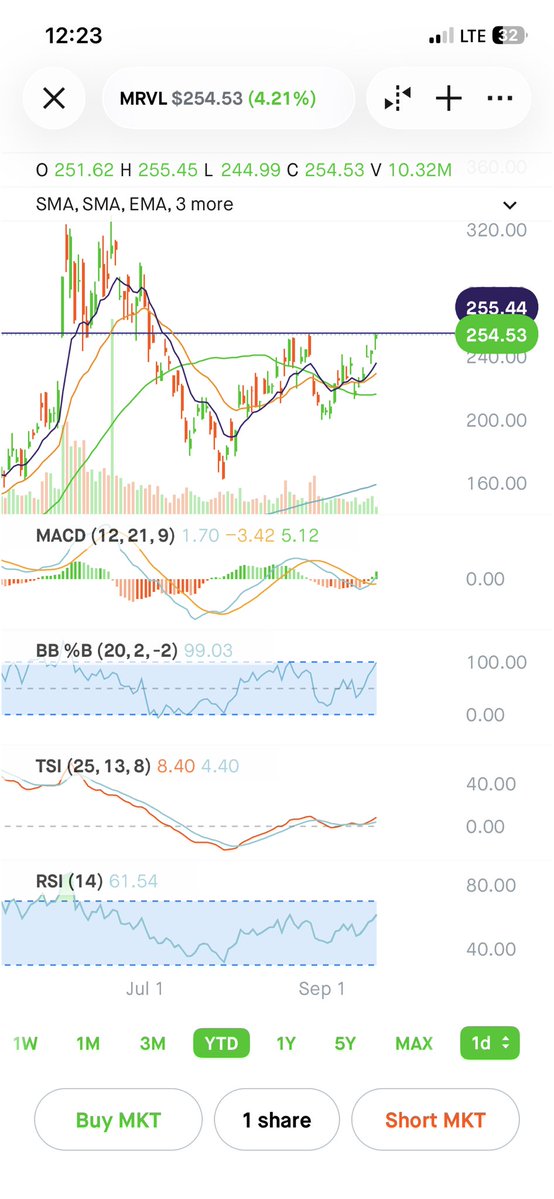
MRVL
let her rip. 😴
This in fact was the bottom, you’re welcome. We tapped 165$ previous resistance and have been ripping.
This thing is coiled. Higher lows, moving averages catching up underneath, and price pressing into the multi-month downtrend as we make a new September high.
Investor Day is October 6. I’m watching $255 as the flip level, with $280–$300 next.
The bigger story is the optical stack: 2nm 400G/lane PAM4, 800G ZR/ZR+, 1.6T ZR and a 102.4T CPO platform as AI networks move toward 3.2T. Copper is running into distance and power limits, putting optics front and center.
Rip salad time. Don’t blink 300 comes fast.
📌 Same AI optics theme. Different ways to make money.
$LITE, $COHR, $MRVL and $TER often get grouped into the same AI optics trade. But that label hides where each company actually earns its revenue.
A simplified map of their optical exposure:
1️⃣ $LITE → Lasers, light sources, optical transceivers and optical switches.
2️⃣ $COHR → Optical components through complete transceivers.
3️⃣ $MRVL → DSPs and interconnect chips that process and move data.
4️⃣ $TER → Equipment that tests optical and electrical signals.
Their businesses overlap, but the metrics to watch differ. For components and modules: shipments, yields and pricing. For DSPs: customer adoption and transitions to higher speeds. For test equipment: customer equipment spending and production ramps.
“AI optics demand is strong” is only the starting point. Whose orders grow—and how much of that revenue becomes profit?
Owning several names in the same theme doesn’t automatically diversify the risk. I’d rather map how they make money—and how much they depend on the same customers.
- The most immediate catalyst for $AXTI is its addition to the S&P SmallCap 600, which became effective before the market opened on September 21.
- The inclusion has created buying demand from passive and benchmark-tracking funds, contributing to the stock's recent momentum.
- Fundamentally, AXT reported Q2 revenue of $47.6M and net income of $11.1M, while management highlighted record indium phosphide revenue, reinforcing expectations for InP substrate demand tied to AI datacenter optical connectivity.
- The broader market is also in a risk-on environment today, with AI and semiconductor stocks leading, providing an additional tailwind for a high-beta optical materials name like $AXTI.
> The key driver today looks more like S&P SmallCap 600 inclusion and index-related flows than a newly announced major contract.
> What makes $AXTI more than just an index-addition trade, however, is the underlying narrative: InP wafers → high-speed optical transceivers / silicon photonics → AI datacenter connectivity.
> With optical component names such as $COHR and $LITE already benefiting from AI optical infrastructure demand, $AXTI sits one layer further upstream as an InP substrate supplier, giving it materials-level leverage to the same buildout.
> The cleanest framing is therefore: S&P inclusion is the trigger, while InP and AI optics are the fundamental narrative. Index-related buying can normalize after inclusion, so today's entire move should not be interpreted as a corresponding change in fundamentals.
📌 $COHR PhotonLink 출시!!
코히런트가 통합 광학 플랫폼 ‘PhotonLink’를 출시했습니다. CPO와 NPO, 칩 간 광연결까지 하나의 플랫폼으로 대응하겠다는 겁니다.
CPO와 NPO에서 각각 10건 이상, 칩 간 연결에서 5건 이상의 고객 협력이 진행 중
광부품을 따로 파는 것보다 고객 한 곳에서 가져오는 매출과 관계를 함께 키울 수 있는 그림이죠.
매출은 2026년 4분기부터 늘어날 전망입니다.
다만 ‘고객 협력’이 곧 양산 수주를 의미하진 않습니다. 이제 볼 것은 실제 설계 채택과 매출 증가, 그리고 증설비까지 감당하고 남는 현금입니다.
📌 $MRVL, 1.6T는 끝이 아니다. 3.2T 연결을 겨냥했다
마벨이 ECOC에서 선보일 광기술 데모를 발표했습니다. 레인당 400G부터 800G, 1.6T ZR·coherent-lite까지...
특히 레인당 400G 기술은 3.2T로 넘어가기 위한 준비입니다.
제가 보는 포인트는 다음 속도에서도 마벨의 칩이 필요한 자리를 이어갈 수 있느냐입니다. 데이터센터가 더 많은 데이터를 옮기려면 속도를 높이면서 전력 부담도 줄여야 하니까요. 이번 발표는 마벨이 그 다음 세대에도 제품을 공급하려고 준비 중이라는 근거입니다.
다만 데모가 곧 수주는 아닙니다. 기술의 다음 단계는 보여줬고, 투자자가 기다릴 다음 소식은 고객 채택과 양산 일정입니다. 신제품 이름보다 그 두 가지가 매출 전망을 바꿉니다.
@MelvinInvests The real bottleneck isn’t GPUs.
It’s time + megawatts.
Hyperscalers can print money. They can’t print substations and interconnection queues overnight.
That’s why this middle layer keeps winning even when their biggest customers are also their competitors.