I want every Bitcoin treasury company to recruit and retain exceptional people, and I believe strong teams should be rewarded for strong results. I also generally avoid commenting on how peers compensate their teams.
But Strive has repeatedly been cited as equivalent to another compensation structure in a way that I do not believe is factually accurate. Because this concerns our company and our shareholders, I want to clarify the record.
David wrote that “a perpetual non-dilutive option creates misalignment.” I agree. That principle applies at every stage, especially for a Bitcoin treasury company whose strategy includes accretive equity issuance.
The comparison to Strive does not hold because it combines three fundamentally different categories: legacy founder ownership, merger consideration distributed to all legacy shareholders, and forward-looking compensation for current management. Those categories are not interchangeable.
Founder equity originates at formation. The founding owners collectively own the company, then dilute alongside other shareholders as investors come in. A founder like Michael Saylor retaining 65% after an IPO holds the remainder of an existing stake after dilution. It is not a new 65% compensation award.
That is fundamentally different from an ongoing award whose share count automatically increases with future issuances to preserve management’s ownership percentage.
Strive’s 270.5 million pre-split Class B shares were merger consideration issued to all premerger Strive equityholders, including investors. They were not a 270.5 million-share management award. Class B was the security used for the merger consideration, not a compensation pool reserved for founders or employees.
Vivek was Strive’s sole shareholder at founding, which is where his founder ownership originated. Since then, he has received no additional equity as compensation. Any additional securities he acquired were purchased by investing capital into Strive, including through private financings and SATA’s initial public offering.
Vivek is not a current officer or director, and he has not had a single share vest since I became CEO in April 2023, including throughout our entire Bitcoin treasury strategy. His public-company shares reflect his founder ownership and invested capital carried through the merger, not compensation for managing that strategy.
The relevant question is how current management is paid for future results. Under Strive’s current program, no management award automatically increases with future share issuances to preserve a fixed ownership percentage. Management dilutes alongside shareholders, and my current vested economic ownership is well below 1% of the company.
As I laid out in my September 2 post linked below, we designed our compensation framework through a methodical process that can be clearly explained and evaluated. Under the Strive Board’s direction, we worked with Mercer to build the framework and began by benchmarking overall compensation around the 50th percentile for comparable roles.
We started there because this was a new strategy and results had not yet been demonstrated. It was a starting benchmark, not a permanent ceiling. Sustained exceptional performance can justify reassessing compensation through the same disciplined process, just as underperformance should reduce compensation and bring management accountability.
At the roughly $2.1 billion equity value cited in that post, target annual equity compensation for our entire 30+ person team was approximately $21 million, less than 1% by value. Long-term awards are earned over three years and tied to outperforming Bitcoin, which is our hurdle rate, alongside performance against a broad-based stock market index.
Shareholders can agree or disagree with the resulting package, but its purpose, benchmarking, cost, vesting period, dilution, and performance hurdles are transparent. That clarity comes from the process used to build it.
The Bitcoin treasury sector has evolved extraordinarily quickly, and Metaplanet’s prior compensation program predated its Bitcoin treasury strategy. At that earlier stage, neither the scale of its future success nor all the alignment implications at today’s size may have been apparent.
Metaplanet has delivered substantial value for shareholders over the course of its Bitcoin journey, and its team deserves credit for that performance. I also recognize that Metaplanet has removed the future adjustment mechanism from its prior program and is reviewing its compensation approach. I view that as constructive, and I hope the resulting framework strongly aligns management with shareholders.
That progress does not change my view that the prior structure created misalignment, nor does it make that structure comparable to Strive’s compensation framework.
I believe strong management teams should have meaningful upside when they deliver exceptional long-term results. Our objective is to make that upside transparent, performance-based, and aligned with the shareholders alongside whom we are building the company.
Here is my full post discussing Strive’s framework:
https://t.co/DkmXC4Vl5B
Metaplanet froze its executive share pool after it grew 595% through shareholder dilution
"So Metaplanet performed exceptionally well, it was one of the darlings of the treasury boom."
"The problem here is that they have an executive pool of shares that was pegged not at a fixed amount but at 20% of the company's fully diluted share capital."
"If you understand how treasury companies work, they effectively dilute shareholders by creating more shares and selling those to buy Bitcoin, which works exceptionally well when mNAV is high and increases Bitcoin per share."
"Well they pegged it at 20%. So what happens is every time that they made new shares to dilute shareholders to buy Bitcoin, they were also effectively diluting shareholders to pad their own pockets with the shares in that executive pool that rose with it."
"They said in their own filing that the mechanism amplifies the dilution borne by existing shareholders."
"They froze it in August because they realized it was so bad at 319.464 million executive shares. That pool started at 46.5 million shares."
"The pool of executive shares grew by approximately 273.5 million shares, which is nearly seven times its original size, an increase of roughly 595%."
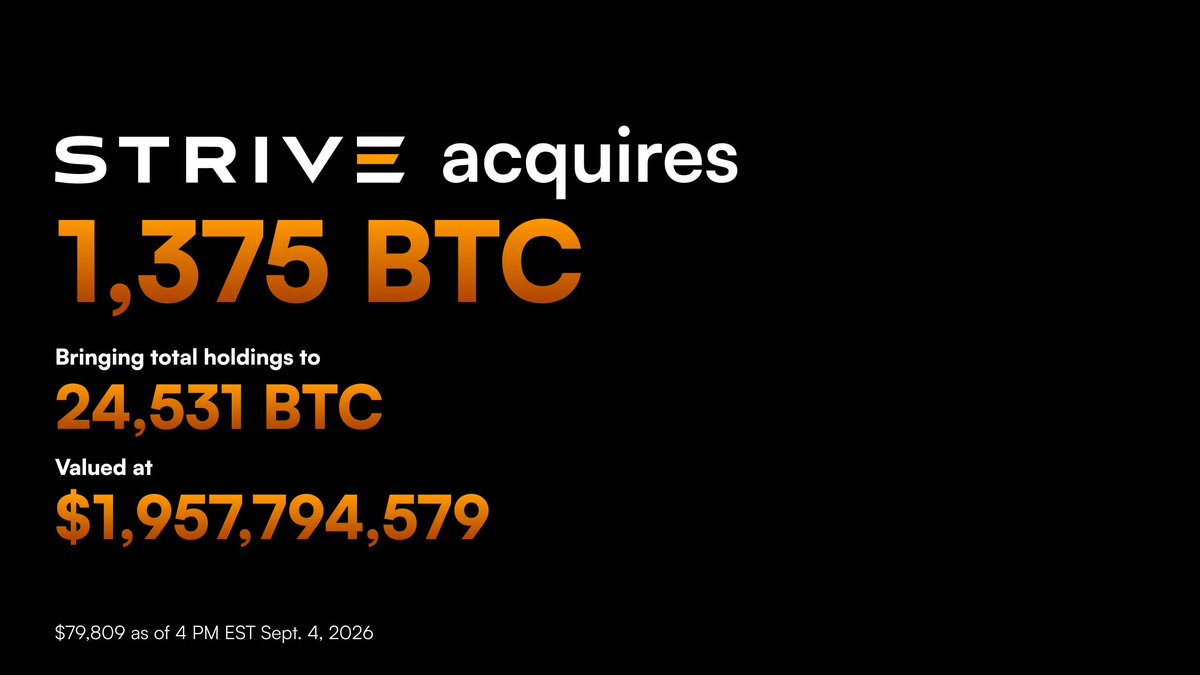
Strive increased gross BTC holdings by 5.9% week over week (23,156 > 24,531). Third consecutive week of 5%+ WoW change in holdings.
In the last three weeks, we have increased our Bitcoin stack by 21.1% (20,245 > 24,531).
$999M of $SATA outstanding & scaling
Strive acquired an additional 1,375 BTC for $109M at an average cost of $79,281 per bitcoin, bringing total holdings to ₿24,531.
70% of the capital raised last week came from $SATA, which now has $999M notional outstanding.
Time to break the billion-dollar wall.
$ASST $SATA
Strategy has repurchased $176M of $STRC and increased the size of its Digital Credit Securities Repurchase Program from $1.0B to $2.0B. As of 9/7/26, we hold 845,050 $BTC and $6.5B of USD Assets. $MSTR https://t.co/mxqv9QCRat
No, investors are selling Metaplanet because they enacted a compensation scheme that is unprecedented and completely outside the boundaries of public company corporate behavior. In fact it is so rich that it has literally never been done before. Management did not act as a fiduciary for their shareholders. A standard they should be held to. They should be fired, resign, disgorge the unearned gains or suffer in a class action lawsuit. I no longer own the Company but if I were a holder I would initiate such a suit.
This is just not good enough.
1) There is still no commitment to roll back the 273 million shares the anti-dilution clause created. By the company's own account that provision amplified dilution, obscured the share count and raised concerns about capital-raising decisions and option holders' interests. All past tense. The fix is future-only.
2) Confirmation that the CEO of Metaplanet has a significant stake in the parent of MMXX, a vehicle acting as lender, bondholder, share-lender to the dilution counterparty, largest shareholder at one point, and trading the stock throughout.
A reminder that those 273 million shares are worth ~$500 million today and almost $3 billion at last year's highs.
What's frustrating is that rolling it back costs them very little. Management would still hold the original 46 million shares, worth over $80m today, and the company could apply a fair incentive scheme retrospectively for the two and a half years of work.
Nobody is asking anyone to work for nothing.
A reply to Simon's post on transparency
@gerovich, thank you for posting [1]. You asked for engagement, so here is mine, with the sources linked below so anyone can check.
On MMXX. Your post says you are a "significant but non-majority shareholder" of MMXX's parent, with no role in its decisions. Metaplanet's securities report filed 26 March 2026 says you "indirectly hold a majority of the voting rights" of MMXX Ventures and classifies it as a company whose voting majority is held by officers and their close relatives [2]. The FY2024 report says the same [3]. The December 2022 allotment notice says MMXX Ventures is 100% owned by MMXX Capital Limited and that you and Mark Reinecke are its shareholders [4]. Your own large-holding report of 25 August lists your wife as your only joint holder [5], and MMXX's reports list none [6]. A company whose votes you control would be a deemed joint holder under the FIEA. So either the securities reports are wrong, or the large-holding filings are, or "close relatives" is carrying a lot of weight in that sentence. Which is it, and who owns MMXX Capital Limited?
While on filings: your initial 5% report, due within five business days of 8 February 2023, was filed on 10 April 2025, together with four catch-up change reports for events in 2024 [7]. Twenty-six months. That is the CEO's own disclosure record on the company's own stock.
On the 10th series. The 18 August notice, in the company's words, says the adjustment clause "amplifies the dilution borne by existing shareholders" and raised "concerns regarding the relationship between capital-raising decisions and the interests of the SAR holders" [8]. I agree with every word. A clause that was misaligned on 18 August 2026 was misaligned on 8 April 2024 and on every raise in between; nothing about it changed except that shareholders read it. It took the pool from 46 million shares to 319 million, a claim on 7,207 BTC. On the September 2025 offering alone it handed the holders 2,068 BTC of claim against 277 BTC for the shareholders who funded the deal [9]. Ten days after fixing it forward you exercised 92,000 units into 64 million shares for ¥640 million [10]. Admitting the structure was wrong and keeping what it produced is a contradiction, and no amount of communication resolves it. The consistent position is: the pool ends at 46 million.
One more date. On 26 August 2025 all five holders signed an undertaking capping the pool at 25% of issued shares [8]. On 27 August the board resolved the $1.4 billion international offering. The undertaking was never announced by the company. It appears in your 17 September 2025 filing, in the same paragraph as your lock-up agreement with Morgan Stanley and Cantor Fitzgerald, the offering's bookrunners [11]. Management bounded the pool the day before launching the largest raise in the company's history, said nothing to shareholders, and let it grow under the cap for twelve more months. Was the undertaking a condition of the offering, and did the offering circular disclose the adjustment clause to the institutions that bought 385 million shares?
On the rest of the record, which the post did not address. Who were the nine parties given 467,500 9th-series warrants for nothing on pivot day, the ones who exercised at ¥20 against a ¥19 close [12]? Why did the board route 1.7 million lapsed retail rights free to MMXX and to you in October 2024, and sell the other 4.9 million to EVO at ¥22.1 each when they were worth about ¥633 [13]? Who sold MMXX 2 million shares at ¥600 that same day, against a ¥1,188 close [14]? MMXX sold roughly 50 million shares into the 2024 rally while the company was raising equity from the public [15]; if you have no role in its trading, who does?
Many of us put our hard earned savings into this company. And while we do not fault you for the recent performance of the share price as there are factors outside of your control, we do hold you accountable for those that are within your control, especially when it comes to transparency and your fiduciary responsibility towards shareholders. As I'm sure you've seen over the past couple of years, I've spent countless hours advocating for Metaplanet and publishing my views + insights (with no obligation or financial return) to foster a community of die-hard fans (including myself). In return we ask for something ordinary: that management be aligned with us rather than positioned against us, and that material terms be explained in the language most of us shareholders read, especially when the terms favor the people writing them. And even more importantly, when serious questions are raised by the community, especially the difficult questions, that management respond with clarity and transparency around those issues, rather than ignore them in the hope they will be forgotten (the receipts are all there). We trusted the team as stewards of our capital.
The fix in August was a step in the right direction. But "we can do better" is a promise about the future, and the questions above are about what already happened. Answer them, name the owners of MMXX, and unwind the pool to where it stood at the pivot. That is what alignment looks like. Everything else is PR.
Satoshi created Bitcoin so that no one could print themselves a bigger share and the rules would be visible to all. You preach that Metaplanet's conviction in bitcoin has never wavered. Yet the vehicle you run printed its insiders a growing share, behind rules its shareholders never saw. That is not aligned with Bitcoin's values.
$MPJPY $MTPLF $DN3
Sources
[1] Simon Gerovich, 6 Sep 2026: https://t.co/1EXRsoZxrw
[2] Metaplanet securities report FY2025, filed 26 Mar 2026, related-party note 4 (EDINET S100XTWY): https://t.co/cuWHWIUH6B
[3] Metaplanet securities report FY2024, filed 24 Mar 2025, related-party note 4 (S100VG8G): https://t.co/hRciY37asQ
[4] TDnet 28 Dec 2022, third-party allotment notice, allottee profiles (MMXX: 100% owned by MMXX Capital Limited; Gerovich and Reinecke shareholders): https://t.co/1zxCVw102W
[5] Gerovich change report No.8, 25 Aug 2026 (S100YXY8): https://t.co/v24c0txKdH
[6] MMXX Ventures large-holding filings (EDINET E38638), e.g. initial report 12 Apr 2023 (S100QL3V): https://t.co/ZgHybymPEG
[7] Gerovich initial large-holding report, obligation date 8 Feb 2023, filed 10 Apr 2025 (S100VL2I): https://t.co/t2DDYgKkA1
[8] TDnet 18 Aug 2026, amendment to the 10th-series terms (section 4 "Reason for the Amendment"; 26 Aug 2025 undertaking): https://t.co/Ov3hGEJeOP
[9] Effective Diluted Shares table, Metaplanet notice of 2 Apr 2026 (basis for the offering arithmetic): https://t.co/8yvGBU5c5N
[10] TDnet 31 Aug 2026, partial exercise of the 10th series: https://t.co/exAPLAHaxh
[11] Gerovich change report No.7, 17 Sep 2025, section 6 "important contracts" (Morgan Stanley / Cantor lock-up; 25% exercise undertaking) (S100WP31): https://t.co/YoBYZ7MDUE
[12] Extraordinary report of 24 Apr 2024 on the 9th-series transfers, reproduced in the Jan 2025 registration statement (S100V56J, pp. 57–58): https://t.co/gBj8lPVBZz
[13] TDnet 21 Oct 2024, 11th-series results, transfers to MMXX and Gerovich, sale of 4,915,487 rights to EVO at ¥22.1: https://t.co/5XnUM0xOty
[14] MMXX change report No.19, 29 Oct 2024 (2,000,000 shares acquired off-market at ¥600 on 22 Oct 2024) (S100ULCZ): https://t.co/Eg7IGkmOK1
[15] MMXX change reports Nos. 5–14 and 17–19 (Apr–Oct 2024 disposals), e.g. No.14 (S100U4AU): https://t.co/KM7cmospxm
Metaplanet update 2.
I just wanted to make a follow on post with some additional observations.
The response has been incredible.
A brief overview:
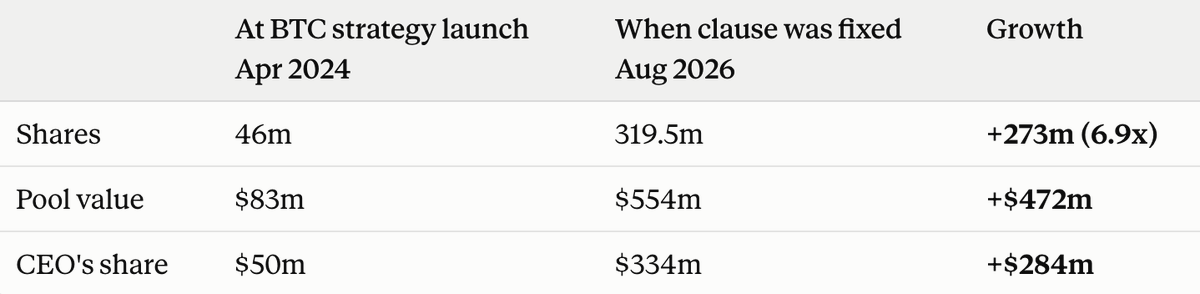
-Since the Bitcoin treasury strategy launched in April 2024, the 10th Series pool grew from 46 million shares to 319.5 million, a 273 million share increase equal to 17% of the fully diluted company, created not by any grant decision but by an anti-dilution clause.
-When this was raised last year by me and a few others, it was completely ignored. Only after the issue resurfaced this year was the clause removed.
-This was disclosed years ago in Japanese with no widely spread updates in English ever since.
-Without the anti-dilution clause, the CEO would have still got $50m at today's share price. I have created a small table down below to show it in simple terms at today's share price. At last year's highs the numbers would go into the billions.
Most people have been incredibly supportive of my posts. Some have doubted my intentions.
Let me make it clear.
1) $500m in compensation for 2 and a half years of work is extremely excessive and unfair to shareholders. This number was in the billions when the share price was much higher last year and an order of magnitude higher than any other company in the space. Nvidia's CEO is getting paid $37m this year including equity for comparison.
2) The whole point of these posts is to pressure the team to do the right thing and roll back the additional shares created at the expense of shareholders. It was a legacy clause that is irrelevant to the business today.
3) Quite frankly, to put the industry on notice. This is not meant in an arrogant way or to say I matter at all, I don't... but management teams might get the wrong idea if they see this sort of profligacy go unchallenged. Already we have had the CEOs of Strive, Smarter Web and Capital B come out and explain their compensation structure in fine detail.
The last point matters to us as shareholders.
When we are comparing the cost of capital for each company, you cannot ignore things like this.
In Metaplanet's case, part of the thesis relies on the low cost of capital due to Japan's low yields. However, the drag of these additional shares from the 10th series is substantial, even if you spread it out over 5 years... therefore negating the benefit of such low yields in Japan.
It's a shame that some shareholders seem to think I have shorted the stock lol. This is obviously not true.
As an analyst and shareholder who has been covering the company for a while, you are damned if you do, damned if you don't.
If I am bull posting for a year straight but go quiet when the difficult questions need to be asked, people will call me out. If I ask the difficult questions, I am told I have ulterior motives.
The whole purpose of Bitcoin is to not be unfairly diluted. I am surprised that some do not care about it at all.
Ironically it was my dissatisfaction, along with some others, that led to management pausing the anti-dilution clause. They have said this themselves both publicly and privately.
Such is life.
As for Metaplanet, the core thesis remains intact. This is just one issue that I hope can be resolved and then be put behind us. It's a shame it had to come to this but a good outcome for shareholders is all that matters.
Thank you to everyone who has shown support. It is much appreciated.
Let's see what happens.
Smarter Web Livestream: Thursday, 10 September 2026, 14:00 GMT / 09:00 ET.
Miller Cole (@MillerC0le) is joined by Ben Werkman (@Werkman), Chief Investment Officer at Strive (Nasdaq: $ASST | $SATA).
A focused conversation on Bitcoin treasury strategy, capital structure and the development of Digital Credit.
Watch live here on X or YouTube.
LSE: #SWC | OTCQB: $TSWCF | FRA: $3M8
Remember the mysterious 96.25 million additional shares from the Metaplanet international offering last year?
Now we finally have our answer (confirmed by Grok):
"Yes. The 96.25 million extra diluted shares match the 10th Series anti-dilution ratchet exactly.
The 10th Series stock acquisition rights (granted in early 2023, ¥10 strike) contained an adjustment clause that reset the option pool to 20% of fully diluted shares after every capital increase. That formula is equivalent to the pool growing by 25% of any new shares issued."
As you can see in the post below, many of us have asked the team multiple times.
And we followed up multiple times (see here for example) without any answer by the team: https://t.co/lZZtonDOb1
@metaplanetdays has cracked it, but unfortunately I haven‘t seen it back then: https://t.co/yB4x2azDTB
This is the final nail in the coffin.
I haven‘t planned to announce this, but I have rotated all of my remaining Metaplanet shares to $ASST this week.
I might be back one day, but honestly I don‘t plan to, as the Strive team have built exactly what I hoped Metaplanet would build one day.
Onwards and upwards.
Since we're still on the topic - let's examine the economics of #Metaplanet's IO in Sep 2025. Who benefitted and by how much - as I think that better informs the conversation here.
Disclaimer: I am still a shareholder of MP as I write this and haven't decided to sell my shares. However my position may change as the conversation evolves.
Here are the numbers-
Amount raised: ¥212.9bn ≈ $1.44bn gross (385,000,000 shares at ¥553)
Deployed into BTC: ¥183.7bn
BTC held pre raise (8 Sep 2025): 20,136
BTC held post raise (30 Sep 2025): 30,823
Stack growth: +53.1%
Fully diluted shares pre raise: 953,142,925
new shares issued to investors: 385,000,000
new shares to 10th series holders (0.25 per share issued): 96,250,000
= fully diluted shares post raise: 1,434,392,925
Dilution: +50.5%
BTC per 1,000 diluted shares pre raise: 0.02113
BTC per 1,000 diluted shares post raise: 0.02149
BTC yield from the transaction: +1.7%
BTC gain to pre-raise shareholders: 277 BTC ≈ $32M
BTC claim handed to 10th series holders via the 96.25m new shares: 2,068 BTC ≈ $236M (at ¥553 issue price net of the ¥10 strike: ¥52bn ≈ $355m)
10th Series pool received 7.5x what the company's shareholders received.
So, importantly, what if the 10th Series hadn't participated / received shares in the deal? Let's run the numbers again..
Fully diluted shares post raise: 1,338,142,925
BTC per 1,000 diluted shares post raise: 0.02303
BTC yield from the transaction: +9.0%
BTC gain to pre-raise shareholders: 1,458 BTC ≈ $166m
10th Series cost on this one raise: 7.3 points of yield, 1,181 BTC, ≈ $134m moved from shareholders to the option holders.
I think the numbers speak for themselves - so I have no further comment here. $MPJPY $MTPLF $DN3
@RoaringRagnar@ZynxBTC
Metaplanet update.
This is a post I would rather not make but as someone who has covered the stock extensively, I feel it is my duty to.
It gets into the weeds of the 10th Series Stock Acquisition Rights, which saw 46 million shares become 319.4 million, because the pool was defined as a permanent 20% of fully diluted shares rather than a fixed count.
A brief timeline of events:
28 Dec 2022. Board resolves the package that creates the 10th Series, alongside a third-party allotment, the 9th Series, and the rename to Metaplanet. The company is distressed, going concern flagged, stock around ¥30.
8 Feb 2023. 460,000 units issued: 336,000 to directors, 124,000 to employees. Strike ¥10. Underlying shares defined not as a fixed number but as fully diluted shares × 0.2.
Apr 2024. Bitcoin treasury strategy announced. Roughly 154m shares outstanding. Every share issued from here expands the pool to keep it at 20%.
18 Aug 2026. Pool frozen at 319,464,000 shares, or 696 per unit, roughly 20% of the company. Lock-up added to 2031. The company concedes the clause went beyond ordinary technical adjustment and made dilution hard for shareholders to grasp.
28 Aug 2026. Gerovich exercises 92,000 units into 64,032,000 shares for about ¥640m ($4m). Stock closes ¥346, valuing them at roughly $138m.
You can see the problem here.
The misalignment was there from the very beginning, sitting in legacy warrants that existed long before the Bitcoin treasury model was adopted.
Dilution events like the controversial international offering benefited the 10th Series holders 7.5x more than they benefited ordinary shareholders. I will link the post explaining this below (not to be confused with the quoted post, which I will come to).
While these shares were accounted for in BTC/share and other metrics, the clause itself was never made widely available in English. It was published years ago, in Japanese.
Could we have done better due diligence? Perhaps. But you hardly expect something like this to exist years before the treasury model began. It is an obscure and unusual thing to attach to warrants, and it is not what anyone was looking for. As soon as something looked off with the international offering, I raised it.
The company has said that, without shareholder feedback, it saw no need to fix the clause until a few weeks ago.
That is not the full picture. In the quoted post you can see I asked the question directly and tagged both Simon and Dylan. Ragnar raised the same issue two weeks earlier, as did several others. We were all ignored.
And the company now agrees the clause was not appropriate. If there were no problem with it, why fix it at all?
In my view $600 million of value is not a defensible outcome. That is 17.75% of the $3.38 billion Bitcoin NAV on the balance sheet, and 25% of the entire $2.4 billion market cap.
A quarter of the company.
At last year's highs the same holding was worth more than $1.5 billion, and on the current share count it would be closer to $3 billion.
For scale, Nvidia's CEO earned $49m in 2025 and is set to be paid $37m in 2026, at the largest company in the world. These figures include equity.
The right thing to do would be to cancel the expanded portion entirely, let management keep the original 46 million shares, worth roughly $90m at today's price, and then apply an employee incentive scheme that is fairer to shareholders from here.
I wanted to keep this strictly to the 10th Series, but there is also MMXX Ventures Limited, a BVI-incorporated investment vehicle tied to Simon with a history of buying and selling Metaplanet stock that deserves scrutiny. It would be nice to get some clarity on this.
I have spoken with the team directly alongside Ragnar to discuss this issue but unfortunately we do not see eye to eye on this.
I didn't want to take part in shareholder activism but this is important. We all bought Bitcoin to escape the Cantillon effect after all.
I hope this can be resolved.
These are fair questions, and I agree with the core principle behind them. Compensation should be structured so that the team does well when shareholders do well, and the incentives should be tied as directly as possible to the outcomes we are trying to create. I wrote about our philosophy last September: https://t.co/MMuJLhXSnr
Our short-term incentives are driven by increasing Bitcoin per share and meeting all of our obligations. Our long-term incentives are driven primarily by outperforming Bitcoin, because Bitcoin is the hurdle rate, as well as our performance relative to the broader stock market. If we fail to pay any dividend on $SATA, bonuses do not get paid. On the long-term side, the highest payouts require us to outperform Bitcoin and perform among the top tier of publicly traded companies.
We worked with compensation consultant Mercer to build the framework. My direction was to benchmark overall compensation around the 50th percentile of the market for comparable roles, while making the incentive structure as aligned with shareholders as possible. Across our 30+ employees today, annual salaries total approximately $8 million. Aggregate short-term (annual) incentives have a target of approximately $5 million and a maximum of approximately $11 million, while long-term incentives have a target of approximately $21 million per year and a maximum of approximately $41 million. The long-term incentives are earned over a three-year period.
That means total annual compensation across the entire Strive team is approximately $34 million at target, including salaries, short-term incentives and long-term incentives. Maximum compensation under the current structure would be approximately $60 million, but getting there requires exceptional performance. At today’s roughly $2.1 billion equity value, target equity compensation represents less than 1% of the company annually, and even if we maxed out the current performance framework, the annual equity component would be approximately 1.9% of today’s equity value. Importantly, because these are three-year awards and are tied to both outperforming Bitcoin and being a top equity performer, the actual percentage of the company represented by that compensation on a forward-looking annual basis would likely be substantially lower if those maximum outcomes were actually achieved.
On the 5% incentive reserve specifically, that is simply capacity under the plan. It is not an annual grant, an annual target, or an expectation that 5% of the company will be issued every year. We have not issued 5%, and as you can see from the current structure, we are not operating at anything close to a 5% annual pace. The purpose of the reserve is to give the company enough flexibility to recruit and retain talent without repeatedly going back to shareholders simply to replenish the plan, while actual compensation remains capped and tied to performance.
There is another side of this that I think is important to be transparent about. My responsibility as Chairman & CEO is not only to recruit the best people, but to retain them. I believe we have an exceptional team that works incredibly hard, has great chemistry, and has produced results that reflect that. When I look across the industry, there are companies that offer similar or greater compensation with substantially easier performance hurdles. If Strive continues to outperform, grow Bitcoin per share and scale the company, I am much more concerned about losing great employees to competitors than I am about our team being overcompensated.
As Strive grows, I expect we will continue to reassess compensation to make sure we can recruit and retain the best talent. But the principle will not change: compensation should be competitive enough to retain exceptional people, tightly aligned with shareholder outcomes, and structured so that significant upside for employees comes from significant performance for shareholders.
RNS Announcement: Bitcoin Purchase
The Smarter Web Company announces the purchase of additional Bitcoin as part of "The 10 Year Plan" which includes an ongoing treasury policy of acquiring Bitcoin.
Please read the RNS on our website (link in comments).
LSE: #SWC | OTCQB: $TSWCF | FRA: $3M8
Today, Smarter Web announced the addition of 35 Bitcoin - our 2nd largest single purchase of 2026.
I’m looking forward to adding more to the treasury soon.
Strategy responded today to MSCI’s proposed “non-operating company” exclusion. While not material to $MSTR, the proposal is misguided, flawed, and conflicts with established securities laws and accounting principles. Read our letter and share your support: https://t.co/Vup3T5TbvY
Strategy has acquired 4,603 BTC for $370M, increased USD Cash by $29M, and repurchased $152M of $STRC. As of 8/30/26, we hold 845,050 bitcoin:native and $6.71B of USD Assets, bringing Net Leverage to 0.0%. $MSTR https://t.co/XAAEZV5Gil