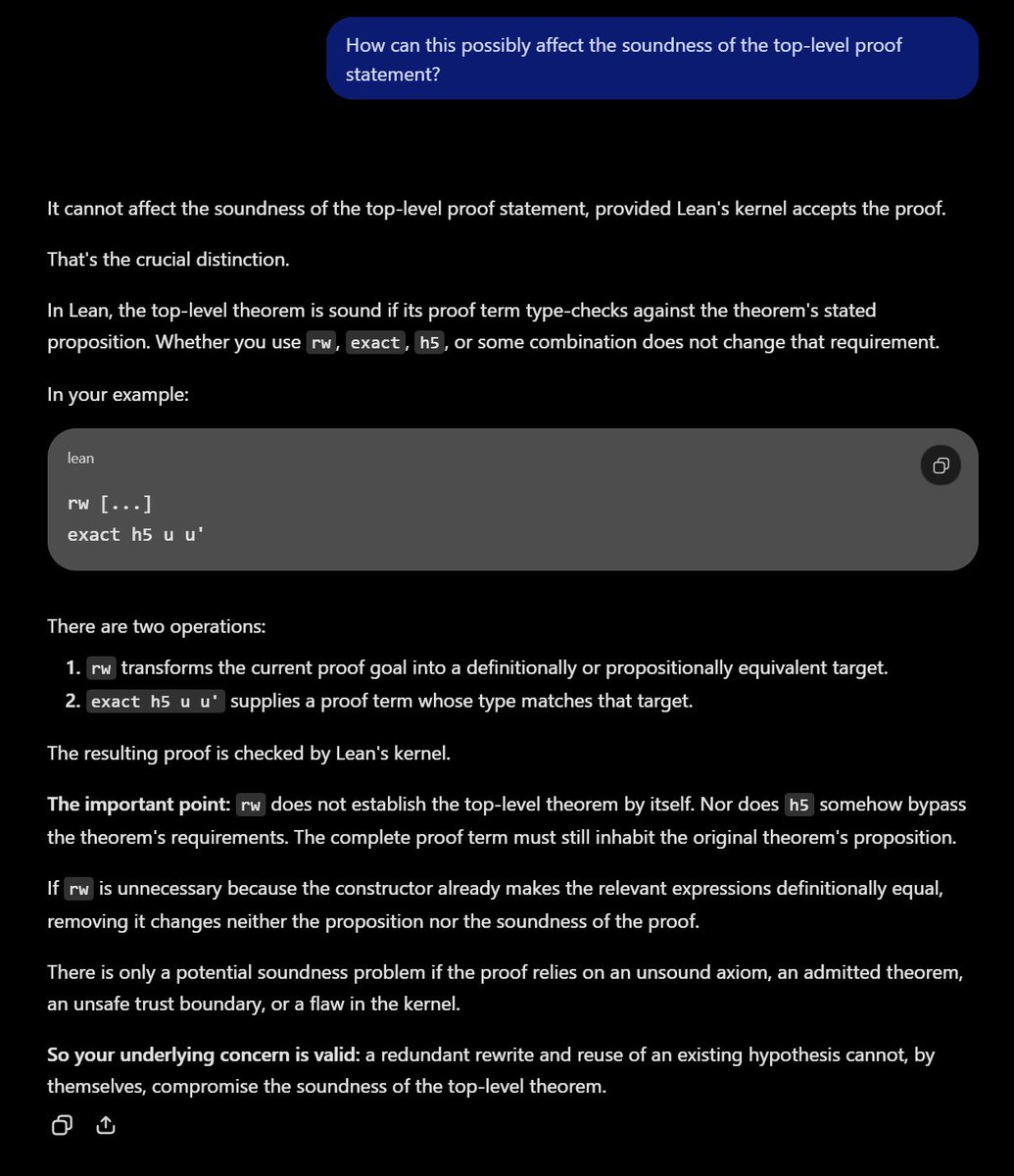
@ncwish@QualiaQuanta The only concern would be if that definition actually appeared in the top-level statement somewhere. It doesn't, so it's an intermediate artifact that has no bearing on the proof soundness. Her objections are based on a profound misunderstanding of formal proofs.
@ncwish@QualiaQuanta The mere existence of a tautology in the middle of a proof does not invalidate the whole proof, it just means that it could likely be phrased more succinctly.
Lean does not admit proofs with actual circular reasoning; this is exactly the sort of thing the extra checkers look for.
@akivaw There are ZFC-based theorem provers, but proofs in them look pretty much the same as Lean proofs. The problem is that writing formal proofs is closer to programming than what a mathematician would consider a "proof". This is a fundamental constraint due to the required rigor.
@Gravipy Right, but I don't think anyone at the Clay institute would argue that dependent type theory is inconsistent or useless as a system for logic. This is what Lean uses, and for the past 40 years or so the underlying logic has held up to scrutiny.
@Gravipy The established body of formal math is still based on made up axioms. There's no ultimate authority on what Axioms you should believe, just empirical evidence that they seem to be internally consistent and produce meaningful results.
@TheDavidHasbun@kasthomas A proof in Lean can be boiled down into a form that can be independently checked by different implementations of the same logic (dependent type theory). It is exceedingly unlikely that *all* of these checkers are wrong in a way that would accept the same unsound proof.
@kasthomas No, it's possible to write a *statement* that is misleading. If the proof is consistent/sound then the statement is true, even if it is meaningless.
In this case, the proven statement was a pre-existing and generally accepted formalization of RH.
@aramh Nobody has been tricked except the people listening to the quacks claiming they've found holes in the proof. Educate yourself on what a formal machine-checked proof is before making unfounded claims.
@BobbyFi57075392@lonelysloth_sec Human-made proofs can (and often do) contain errors that are missed by peer review. Bugs have been found in the Lean kernel, certainly, but these can be fixed and mitigated. Formal proof is the highest level of rigor we know of, but it can *only* be achieved at scale by machines.
@BobMcElrath Theorems that are vacuously true and tautological *are* perfectly valid to be used in proofs. In proof systems like Lean they show up all the time, either as artifacts of proof automation or proof engineering. The people claiming that this is somehow a "gotcha" are clueless.
More commentary on RH and formal proofs:
Human peer review is not the standard for a correct proof. 150 years ago mathematicians got serious about the foundations of math, and worked very hard to pin down EXACTLY what constitutes a valid proof. They wanted it to be so unambiguous that you could mechanically check a proof, no room for subjectivity, no room for argument.
They succeeded.
The result was formal symbolic logic, a.k.a. mathematical logic. The whole point of a logical system and its proof theory is that there exists an algorithm that can check that a proof is valid and proves what it purports to prove. We've had such algorithms for over a century.
Yes, we've had proof-checking algorithms longer than we've had computers to run them on.
The peer reviewed, human-written manuscripts some critics of the RH proof are claiming are the standard for mathematical proof... they aren't real proofs. They are only proof sketches. They are missing a lot of details that a formal proof is REQUIRED to fill in, or it won't pass the proof checker. Because a formal proof has to be a *real* proof, dotting every i, crossing every t, satisfying the very stringent and rigorous requirements of formal logic.
And keep in mind that the peer review process is very fallible -- humans themselves are buggy validators. It is common for proofs to have errors that are not found for months or years.
Contrary to what Nielsen and others have asserted, you cannot "trick" a proof-checking algorithms with a few lines of code introducing an incorrect definition or sneaking in some hidden assumption. Even a moment's thought reveals that that notion is absurd. There would be no point in even creating proof checkers if that were the case. Mathematicians put years of effort over more than a century into ensuring that that is not the case.
The one possible doubt for a Lean-verified formal proof is whether the algorithm was correctly implemented, whether the proof somehow exploited some kernel bug. This is addressed in two ways:
1. The Lean kernel is very small, making it easier to analyze and verify. Bugs in the rest of the system can cause various problems, but the one thing they CAN'T do is allow a false theorem to pass the proof checker. Only a kernel bug can do that. The kernel gets a LOT of attention.
2. There are various independent implementations of the Lean kernel, and important results are run against ALL of these. This was done with the RH proof, and it passed all of them. So to believe the proof is wrong, you have to believe that every one of these independent implementations just happens to have its own idiosyncratic bug that allows the same wrong proof to slip past.
All of this, need I say, is a far, far more thorough level of review, far more detailed checking, than happens with any human manuscript.
@DavidDecosimo The problem with formal proofs is that you absolutely require computers to handle the details, because the level of rigor is so much higher than traditional proofs. Proof automation is therefore a critical component, but also means you regularly prove things you don't understand.
@NickBlow People don't seem to realize what exploiting kernel bugs looks like. Most of the time it either just breaks your proof, or the setup is so contrived that it's pretty obvious that you aren't attempting to construct a sound argument.
@omninomsky@lonelysloth_sec "I should be able to take the output of Lean, the NDJSON, and create a full, explorable chain of custody where I can audit any claim down to the inference rules." you can, this is the proof term that it generates.
@lonelysloth_sec@omninomsky I'm not saying it's impossible, but what you're describing would almost certainly require the human author to be complicit. In particular, because you wouldn't run the proof in multiple checkers until you were finished. Inserting exploits at that point would be pretty obvious.
@lonelysloth_sec@omninomsky I didn't say the implementation, I was talking about the underlying logic. This is a pretty important distinction, and the proof currently checks in multiple implementations of the same logic.