Swift 6.2 concurrency journey:
- Start single-threaded.
- Introduce asynchrony for latency.
- Embrace concurrency for performance
- Leverage actors for robust state isolation.
GPU rental rates aren't depreciating on schedule.
As of October 19, rental rates were above a six-year straight-line depreciation path from their first observed rent:
- A100s by 9%
- H100s by 54%
@mavolpi: "The demand is so high that even if the watt-to-dollar conversion is low, you're going to still use the asset"
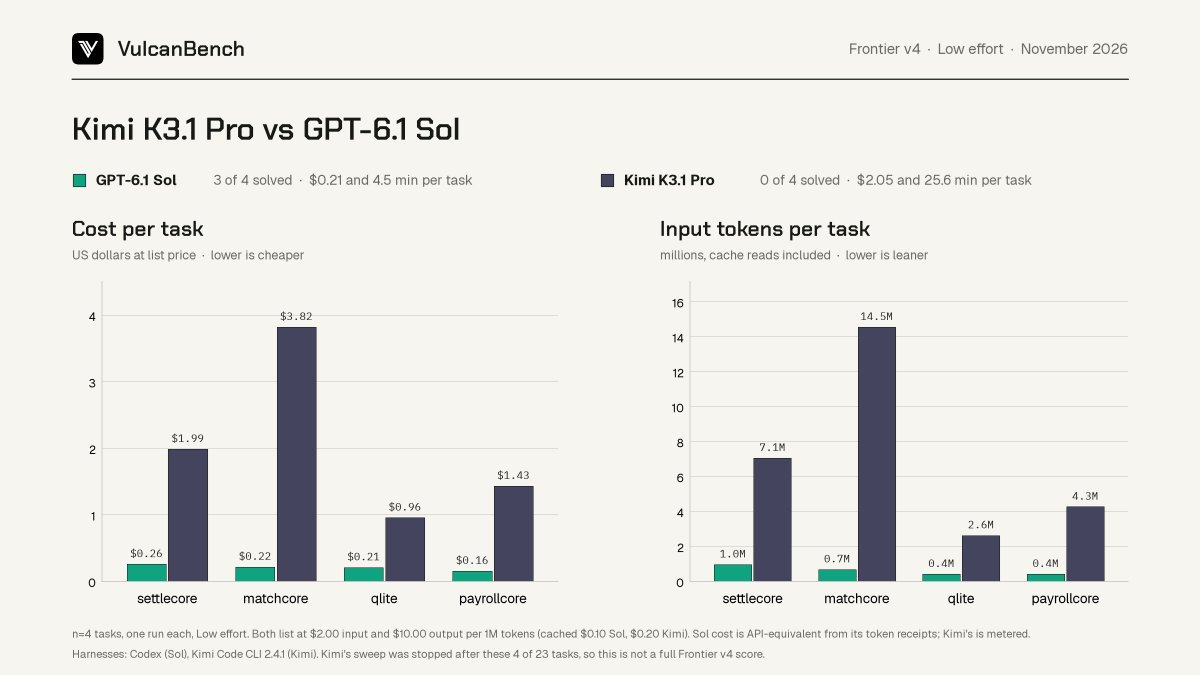
Okay, so I have decided not to benchmark Kimi K3.1 Pro with @VulcanBench after running some initial tests.
This is one of the interesting and complex things about running these benchmarks. At the end of the day, as a CTO, I care about models that me and my team would use for daily coding tasks.
And this means models need to have a good balance of accuracy and cost efficiency.
I started testing Kimi K3.1 Pro on low effort, with four tasks, and it solved none of them, took 26 minutes per task, and cost $2.05.
For comparison, GPT-6.1 Sol low, on the same four tasks solved three out of four, took 4.5 minutes per task, and cost $0.21.
This is also a really good example of why you can't just look at input/output token cost to judge the cost of a model.
Kimi K3.1Pro and GPT-6.1 Sol both cost $2/M input tokens and $10/M output tokens.
What input/output cost doesn't take into account is how many tokens a model uses per task, and in this case, Kimi K3.1 Pro uses ~10x the tokens, so it's actually ~10x more expensive than GPT-6.1 Sol.
So I'm going to pass on benchmarking this model, it would cost me between $200 - $300 to do it, and I already know this isn't a model I'd use with my team.
Live long and benchmark, thoughtfully 🖖
Cisco gives 27-year-old engineer unlimited AI tokens to rewrite 98% of the company's legacy code in 24 months — president plucks former startup founder, telling him to 'go nuts' https://t.co/CjjFrUXFVu
For a sw engineer, there is practically no upside but large downside side to be an asshole to a fellow engineer on this site.
It is a career limiting move: because no one wants to hire a jerk (or have a jerk as a new colleague)
Unless you’re checking out of tech: why do it?
SwiftUI's segmented picker looks cleaner on iOS 26.
The selected segment is rounder, and the thin separators between segments are gone. The code stays the same.
🥇 SwiftUI Performance: Find Redraws in Xcode Instruments
https://t.co/UKSSI4UbxU
🥈 How to reduce token usage in Claude Code, Codex, and Cursor
https://t.co/Yi3fZbsjLo
🥉 Sendable and @Sendable closures explained with code examples
https://t.co/dTOzIxbCAb
#swiftlang#swiftlee
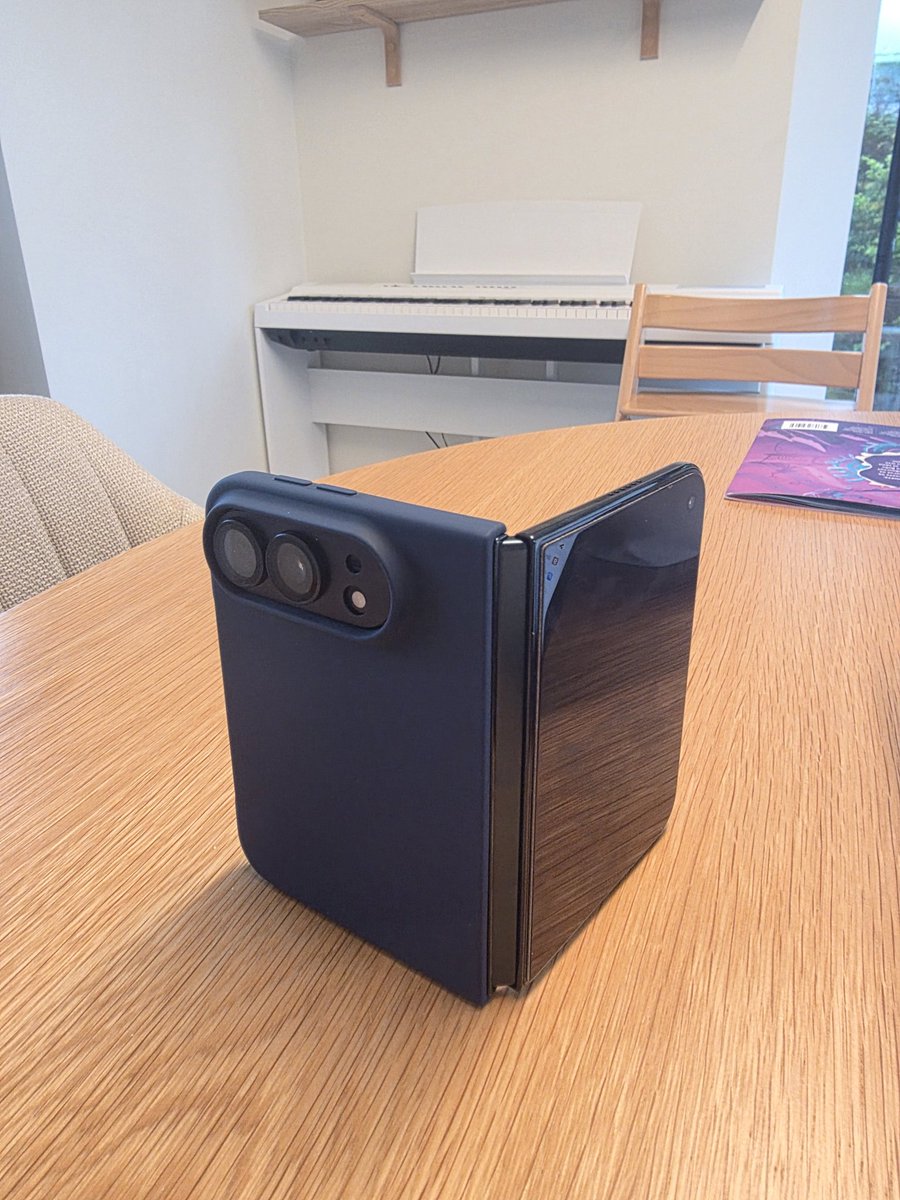
Overlay style ArrangementView stacks the two views most of the time.
In a fold they sit side by side, with First View on the right — not the same as split.
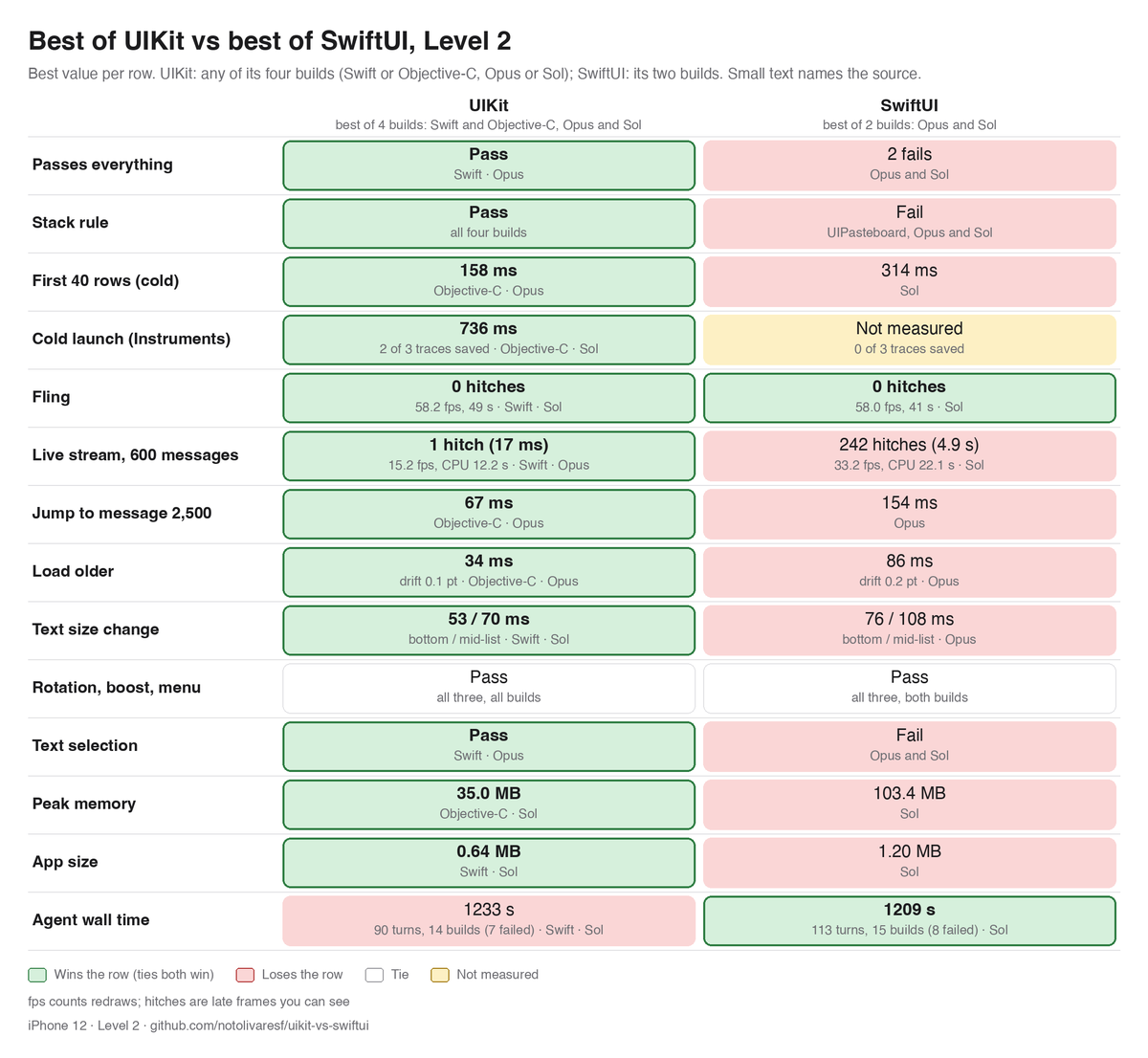
🏁 SwiftUI vs. UIKit 🏁
Build a native version of the chat screen in Campfire. One prompt, but this time with skills. SwiftUI got Apple's Xcode 27 skills, UIKit got ones I wrote.
Winner is UIKit 🥳 (2-0) vs. SwiftUI.
UIKit/Swift passed every test.
UIKit/Objective-C was the fastest and used half the memory 🏎️
SwiftUI is still slow (5s of stutters!), even with Xcode's swift-ui-specialist skill.
What would you like me to test for round 3? Code is in the repo (next comment).
@hishnash and @natpanferova tried turning their books and articles into agent skills, but coding agents didn't pay enough attention to static skills.
So they built SwiftFairy: a local macOS static code analyser with an MCP server for your coding agents!
https://t.co/oERQ3gNv5T