There's a lot of stupid commentary around Leopold raising funds. After names like $BE, $SNDK, $SHAZ, and others all had very sharp drawdowns in July.
Just remember... here's a man in finance that's
1. 6'5
2. Blue Eyes
3. Hedge Fund
Probably better looking than you, and was up 439% through June YTD.
Regarding the drawdown, Aschenbrenner acknowledged that the fund had "not been immune" to the market turmoil, particularly in Asia. FT separately reported that leverage amplified both its extraordinary gains and recent losses.
He described the sell-off as potentially the best buying opportunity since early 2025
I'd agree with him and hope he succeeds with the raise.
Since a lot of the current selloff looks like it overshot its mark through forced deleveraging.
$MU $SKHY $DRAM
For its entire history, LPDDR was phone memory. Low power, built for smartphones and tablets, the stuff inside every iPhone. Servers never touched it. They ran on DDR.
That changes next year. LPDDR is being pulled into the data center at scale through a new form factor called SOCAMM2, and it drops a wave of Apple-sized buyers into the exact memory pool Apple depends on.
For the first time, Apple is competing for its own memory type against customers the suppliers like better. The leverage Apple spent two decades accumulating over the memory trio is eroding, not because Apple got weaker, but because higher-margin buyers showed up for the same wafers.
It is not one buyer. It is the whole server industry converging on mobile memory.
When it was just Nvidia, you could call it a one-platform quirk. It is not just Nvidia anymore.
Nvidia is the anchor. Its Vera Rubin platform is built around SOCAMM2, co-designed with Micron, needing LPDDR at data-center scale.
Meta is the hyperscaler making the case. Micron and Meta co-authored a 2026 white paper validating LPDDR5X for hyperscale deployment on Meta's own production workloads. Their conclusion, in their words: LPDDR5X is no longer just an "edge" technology, but a vital and viable standard for hyperscale GPC and AI platforms. The supplier and the buyer, publishing joint proof together.
AMD is next in line. It confirmed LPDDR5X SOCAMM2 support on its EPYC "Verano" server CPU in 2027, positioned as the host CPU for future Instinct GPU generations in its AI rack-scale platforms. AMD's own engineers now call memory, not compute, the next data-center bottleneck.
Qualcomm is exploring it too. AMD and Qualcomm are now exploring SOCAMM adoption alongside Nvidia for agentic AI inference.
And JEDEC is standardizing the whole thing as JESD328, which is the signal that this is a permanent industry platform, not a proprietary experiment. When the standards body codifies it, every server maker gets to buy it, and every one of them competes for the same LPDDR Apple needs.
Four of the most important compute buyers on earth, converging on the memory type that used to be Apple's alone.
The memory market's reliance on Mobile is nearly halved in both DRAM and NAND by 2030. This is the structural change happening in the industry right now. Mobile used to be the biggest demand driver, and it is slated to become smaller and smaller.
Why they all want LPDDR?
The pull is structural, not fashion. Two reasons, both proven in the Micron/Meta data.
Power. LPDDR5X consumes about one third the power of DDR5, landing under 7% of total system power, with up to 75% lower DRAM power than DDR5. At rack scale, where power and cooling are fixed constraints, that decides TCO.
Capacity for inference. This is the agentic AI hook. SOCAMM2 suits inference workloads with large context windows and persistent KV caches, and Micron's 256GB module enables up to 2TB of LPDDR5X per CPU socket. In the Micron/Meta tests, doubling LPDDR capacity killed disk spill and delivered 2x to 3x throughput, with a 38x slowdown when memory ran short. Capacity is the binding constraint on token throughput, and LPDDR is now how the industry scales it.
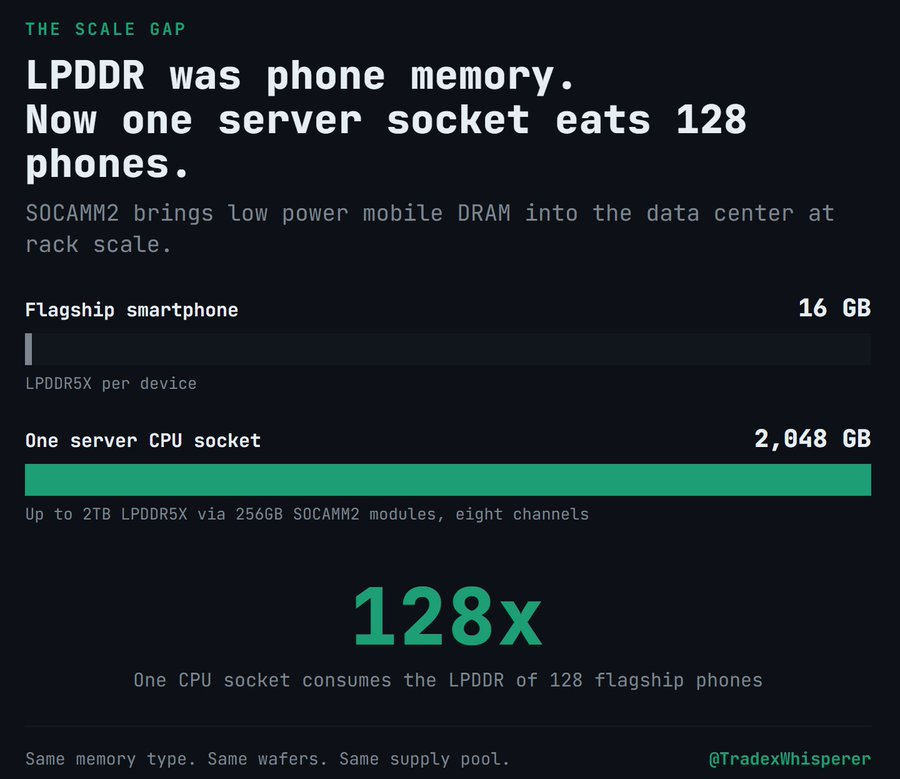
2TB of Apple's memory type, per socket, per server CPU. A flagship phone carries 12 to 16GB.
Why this specifically erodes Apple's leverage
Apple's power came from three things: the biggest volume in mobile memory, the willingness to prepay and lock long agreements, and the prestige of the design-in. It was the buyer the trio built their LPDDR roadmap around.
SOCAMM2 hands all three to the AI buyers, in the same memory. Nvidia, Meta, AMD, and Qualcomm bring enormous volume, roadmaps the suppliers now organize around, and design-in halos bigger than Apple's. And every AI bit carries far better margin per wafer than a phone bit. When buyers of equal scale want the same constrained wafers, the ones paying more set the terms. Those buyers are no longer Apple.
Apple has already conceded it out loud. Tim Cook described Apple as being in a supply chase mode for memory, currently constrained, with prices set to rise significantly. Sanjay once said certain customers, meaning Apple, drove pricing to a third of where it was. That customer is now standing in line behind the server industry.
And spare me the Chinese memory FUD. The memory pool is global and shared. Chinese CSPs buy from the US too, and if less supply is available, they buy more US memory, not less. Tighter global supply cuts the same way for everyone. There is no side door out of this for Apple.
So Fuck you Apple. This is the structural shift you never saw coming and you are stuck with it.
For my first post, I’m sharing a letter @NVIDIA signed on why open models matter.
AI will transform every industry, power every company, and be built by every country.
Open models strengthen safety and cybersecurity, accelerate innovation and diffusion, and enable sovereignty.
The world needs both frontier closed models and frontier open models.
https://t.co/AUKzoQ5Ikb
This is concerning. For the first time, a Chinese model Kimi K3 has taken #1 on the Frontend Code Arena and is scoring at or near the frontier on other benchmarks.
Meanwhile America is tying itself in knots: politicians and bureaucrats are banning new data centers, piling on state regulations, and pushing for new federal agencies to pre-approve frontier models.
This is how you lose the AI race. The rest of the world won’t play by our rules if we bog ourselves down. Permissionless innovation is how America won the internet and became the technological envy of the world. We can do it again with AI -- while addressing risks in a targeted way -- or we’ll watch our lead evaporate.
My favorite moment from the entire URKL Robot Fight!
One brutal kick sent the robot's head hanging loose. and it somehow kept fighting like nothing happened!
I completely lost it. Had to lower down the volume of my laugh 😂😂
Every secular bull market ends. This one isn't done yet.
The last two secular bulls ran 16.7 and 17.6 years (+594% and +1,391%).
The current one is 13.3 years old and up +377%. If history rhymes, there's potentially 3 to 4 more years left to squeeze. A probability but not a certainty.
And when the secular bear finally arrives? We keep making money. Great businesses compounded right through the 2000–2013 "lost decade," and range-bound markets pay options sellers — iron condors, calendar spreads, covered calls, cash secured puts. I'll be using all of them!
Until then, I'm riding this bull for as long as it runs.
$MU $DRAM Memory & Storage are dead.
Those words belong to the era of spreadsheets & PowerPoint. What sits next to a GPU in an AI Supercomputer is not "memory." It's the substrate of thought.
This is the Cognitive Capacity, the Thinking Layer.
Time to call it what it is $SKHY
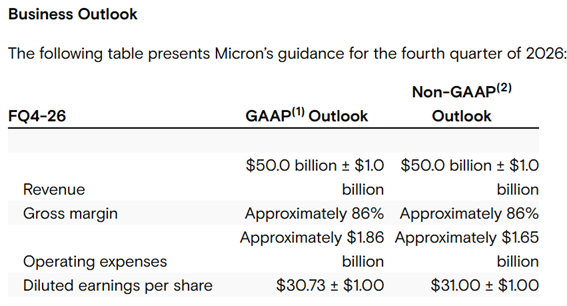
$MU $DRAM “Micron’s record fiscal Q3 financial results and even stronger outlook for Q4 reflect the strategic value of memory in the AI era,” said Sanjay Mehrotra, Chairman, President and CEO of Micron Technology.
“Micron is investing at record levels in technology, products and supply to address our customers’ rapidly growing demand. We believe our multi-year Strategic Customer Agreements will significantly enhance the durability and predictability of Micron’s strong financial performance.”