MUSKegon, we’re coming for you.
Come see @bradsferguson, @nerdalert, and @HenryInvests tomorrow at the @teslaownersmi Summer Meetup. We’re looking forward to connecting with fellow Tesla owners, talking EVs, and celebrating the community that keeps pushing things forward.
See you there. 👋🏻
A few weeks ago @nerdalert put his foot in his mouth on a call with the team at $LMND.
One throwaway comment turned into a much bigger question:
Are investors looking at Lemonade the wrong way?
Lemonade Autonomous Car is now live in Indiana.
@Tesla owners, you’re probably paying too much for your car insurance. Fix it here: https://t.co/q0UOjWNNgk
As a reminder, @Rebellionaire we are bullish on psychedelics - particularly AtaiBeckley $ATAI 🍄
President Trump's April 18th Executive Order titled 'Accelerating Medical Treatments for Serious Mental Illness' served as the first catalyst, removing any remaining questions on the regulatory picture.
Compass Pathways $CMPS COMP360 (a formulation of synthetic psilocybin) for treatment-resistant depression (TRD) will almost certainly be approved by the FDA later this year. This will serve as the second catalyst. The markets are starting to price this in, with @Polymarket assigning a 99% change the FDA approves a psychedelic for medical use in 2026.
AtaiBeckley's BPL-003 (5-MeO-DMT) Phase 2 results show a rapid and sustained drop in the Montgomery-Åsberg Depression Rating Scale (MADRS) among participants.
This comes with an extremely low dosage frequency model (1-2 times over months) versus the industry standard Spravato, where dosing is required twice weekly for the first four weeks, then weekly through week 8, and every one to two weeks indefinitely thereafter.
Each Spravato session requires two hours of monitored observation in a clinic. The same is true for BPL-003, which plugs into the existing clinic monitoring infrastructure already built, requiring substantially less dosage frequency, improving the experience for patients and the economics for clinics.
While BPL-003 Phase 3 results are not expected until early 2029, ATAI's Breakthrough Therapy Designation (BTD) as well as an improving regulatory picture potentially accelerate this timeline.
Additionally, as reported by @Bloomberg, AtaiBeckley is in talks with advisors to explore strategic options for BPL-003, its lead psychedelic drug candidate, seeking at least $2B in a potential deal. We view this as an underappreciated near/medium term catalyst.
Yesterday, @Rebellionaire, we purchased a position in Unusual Machines $UMAC, whose shares are trading 65% higher today on reports the Trump administration is negotiating direct funding for domestic drone companies to strengthen the defense supply chain.
Unusual Machines is a US-based manufacturer of NDAA-compliant drone components positioning itself as the "picks and shovels" supplier underneath the US drone industry. Originally, I was skeptical on the capital intensity of UMAC's buildout, but thank you to those here on X who helped change my perspective.
The History of Unusual Machines
UMAC's story starts inside another company. Red Cat $RCAT, a publicly traded defense drone company, ran a consumer FPV (first-person view) drone business through two brands: Rotor Riot (e-commerce / hobbyist drones, parts, and kits) and Fat Shark (the dominant Western FPV goggle brand). In November 2022, Red Cat agreed to divest those consumer assets into a vehicle that would later become Unusual Machines.
In February 2024, UMAC IPO'd at $4/share and closed on the Rotor Riot and Fat Shark acquisitions simultaneously. At that point, UMAC was essentially a small FPV hobby business with two well-known brands and not much else. CEO Allan Evans had previously been COO of Red Cat and CEO of Fat Shark, so he was running the same business as a standalone public company.
Over 2025, UMAC pivoted hard. Instead of staying a hobby FPV business, management recognized that the US needed a domestic, NDAA-compliant (National Defense Authorization Act) supply chain for drone components. That existing supply chain was almost entirely Chinese - 90% of commercial drones come from China. UMAC pivoted from selling drones / parts to hobbyists to manufacturing the parts that go inside every American-made defense drone.
The Pivot to Defense Components
The NDAA (National Defense Authorization Act) has been progressively closing the door on Chinese drone components for federal customers. Section 848 of the FY20 NDAA banned the DoD from buying drones with Chinese parts.
The American Security Drone Act of 2023 extended that to nearly every federal agency. The FY24/25 NDAA added critical components (flight controllers, ground control, data transmission). And the FCC has separately moved to revoke equipment authorization for DJI products (a Chinese drone manufacturer).
The result? Every US drone OEM serving federal customers now needs domestic suppliers for motors, ESCs, flight controllers, cameras, video transmitters, goggles, and batteries. There are very few companies actually building those parts domestically - UMAC is one of them.
Unusual Machines products are designed to meet the domestic manufacturing needs of the Department of War. UMAC manufactures motors, ESCs, flight controllers, FPV goggles, analog camera modules, and video transmitters. Their pending acquisition of Upgrade Energy would add NDAA-compliant battery packs. Unusual Machines is working towards an entirely vertically integrated drone manufacturing model.
Importantly, UMAC isn't trying to be a drone OEM. They're trying to be the preeminent supplier underneath ALL the OEMs. UMAC is not competing for contracts - they are instead supplying the parts to drone companies receiving them.
The Data and Demand Picture
Revenue is exploding. 1Q26 revenue came in at $8.1M, up 296% YoY and 65% sequentially, marking the 8th consecutive record-revenue quarter. Even more striking is what CEO Allan Evans said publicly in April/May: UMAC has "infinite demand for the next 18 months."
UMAC is essentially out of stock on everything. They can't even put their own products on their own website because every motor is pre-sold and backordered.
In May 2026, UMAC announced $75M in raw materials orders to secure inventory across product lines. Management has guided to ordering an additional $100–150M in 4Q26. They have explicitly said the constraint is supply, not demand.
UMAC's manufacturing is in Orlando and currently has ~72,000 sq ft of capacity, expected to scale to 100,000+ sq ft by end of 2Q26. They went from 19 employees in 2Q25 to 200+ today, and CEO Evans has told the team to plan for 1,000 employees. Motor production is currently 15,000–20,000 units/month. Automated motor equipment coming online in 2H26 is expected to scale capacity to 100,000–120,000 motors/month. That's a 6x increase.
The Drone Dominance Program
The biggest single tailwind for UMAC is the Department of War's Drone Dominance Program - a $1B initiative funded by the One Big Beautiful Bill to procure roughly 340,000 small drones over two years, in four phases.
UMAC supplies drone components to over half of the selected Drone Dominance vendors. Management has framed this single program as a $90M revenue opportunity in 2026 and $250M opportunity in 2027. And Drone Dominance is only one of several government programs. Consensus revenue estimates are $38M in FY26 and $54M in FY27. That's a pretty large gap.
Underneath all of this is a structural reshoring story for the American drone industry. The FCC ban on DJI (large Chinese drone manufacturer) alone removes roughly 1M drones/year from the US market, implying ~4M motors and ~8M battery packs that need a domestic alternative. UMAC management estimates total addressable market (TAM) for drone parts is $3–5B and growing.
The Capital Allocation Story
UMAC has had 5 capital raises in the last 12 months raising a total of ~$300M. Dilution risk is vastly mitigated following the news that the Trump administration is in active negotiations to provide direct funding to domestic drone companies - including Unusual Machines.
CEO Evans has never sold a share. He cancels his 10b5-1 plan every quarter and pays taxes out of pocket to maintain ownership. He believes UMAC is likely to be added to the Russell 2000 in 2Q26, which could drive meaningful institutional ownership. Donald Trump Jr. also joined UMAC's advisory board in November 2024 and owns ~331,000 shares.
Conclusion
UMAC is becoming the preeminent domestic manufacturer of drone components in the USA, with the Drone Dominance program providing the demand pull. CEO Evans has framed UMAC's potential at $1B+ in annual revenue, with 1,000+ employees, by the end of this initial build-out.
We believe UMAC could be building a mini Rocket Lab - a vertically integrated, vertically expanding, founder-led hardware company becoming a critical supplier to a rapidly growing industry that the USA cannot afford to miss out on.
The drone industry is going to be one of the defining defense and commercial technology shifts of the next decade, and the US either builds a domestic supply chain to support it or cedes the category to China the way it ceded consumer drones, solar, and rare earths. UMAC is one of the few public companies positioned to be a meaningful piece of that domestic supply chain across motors, ESCs, flight controllers, cameras, video transmitters, goggles, and batteries.
Not financial advice - please do your own research. We own Unusual Machines (UMAC) for clients and may change our position at any time without notice.
Initiated positions yesterday, up >60% today.
Our track record on stock picking has been really good, but I don't think we've ever nailed timing as well as we did with this one!
$UMAC
BREAKING: We’ve heard something highly unusual about how the SpaceX IPO allocation may work.
Retail investors may get something Wall Street almost never gives them:
A real shot.
@bradsferguson breaks it down. 👇
Elon DID make a special carveout for retail shareholders to be able to buy the SpaceX IPO $SPCX.
It flips the tables on the old boys network and allows retail investors—no matter how small—to get IPO shares of SpaceX.
ELON FLIPS THE TABLES!
Elon DID make a special carve out for retail shareholders and it’s not just about allocating $SPCX shares to Charles Schwab, Fidelity, Morgan Stanley, and Robinhood.
I just filmed a video about it and @Rebellionaire will be posting it ASAP.
$MU: Our financial outlook has strengthened since our last earnings call. We're on track for another substantial record free cash flow in fiscal Q3. We expect tightness for HBM, Dram, and Nand to continue well beyond calendar year 2026."
The Bible:
· 0 errors
· 66 books
· 40+ authors
· 0 contradictions
· 3 different languages
· 3 different continents
· 63K+ cross-references
· written over 1500 years
· all telling the same story
This is how we know it’s God-inspired and not man-made.
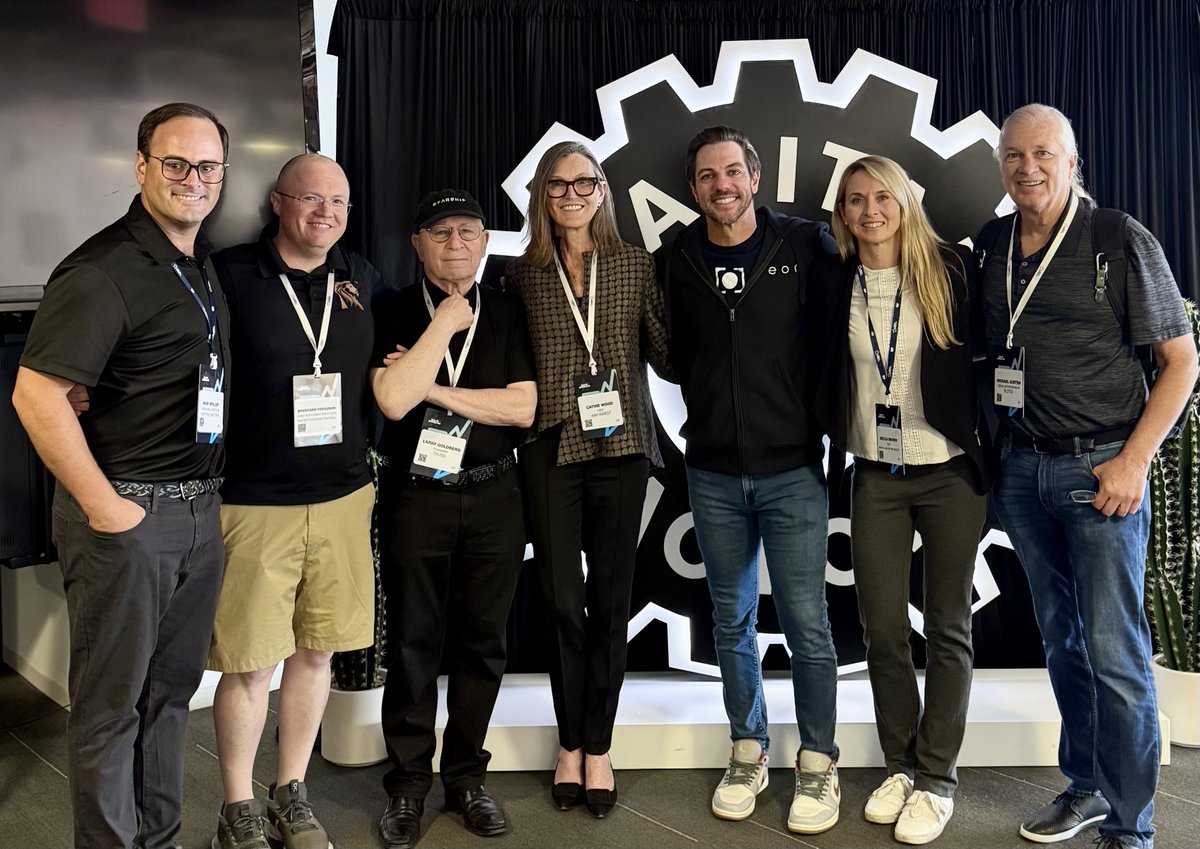
Great trip to the Capital Factory in Austin, got to meet over 20 healthcare startups, Cathie Wood & Becca Brown of ARK, and visit with @TeslaLarry and Michael Gorton. Bryan Chambers & Nick Spiller took us on a tour of @CapitalFactory impressive campus.
We sold the $450 strike covered call, I'm not sweating this move at all.
We use a significant margin of safety because the primary reason for holding $TSLA is to participate in the upside we believe in, not to maximize the yield at the risk of losing a huge % of your shares.
This has been a winning strategy for us over the past three years.