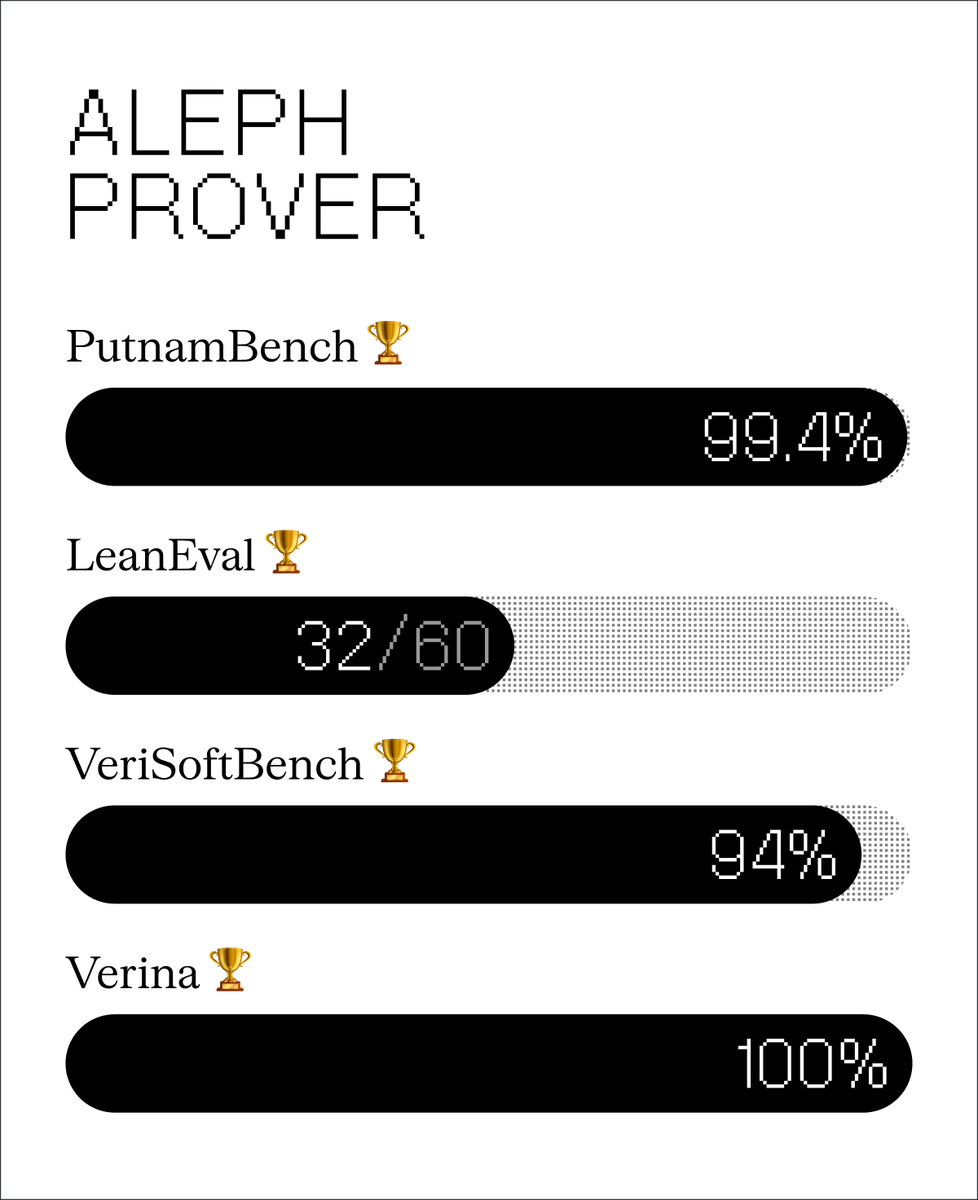
Aleph Prover reached the top position across several key formal reasoning benchmarks, marking another step toward scalable formal verification for mathematics, software, and hardware systems.
Our CTO @AlexFLogic explains why this is becoming one of the most strategically important frontiers in AI
Last week, OpenAI demonstrated that AI systems can help discover new mathematics approaches in its recent counterexample to a conjecture of Paul Erdős announcement. We at Logical Intelligence took that as a challenge as well and formally verified the result in Lean 4 using the latest version of our Aleph Prover agentic system. The result is now a machine-checkable artifact in Lean 4.
This was a real hurdle for our new improved version of Aleph Prover to overcome to demonstrate that it can solve more complicated problems for extended periods of time.
We are happy to see more top companies working in that direction. We firmly believe that verifiable AI is the future and we’re excited to be part of that.
More big news from Mathlib:
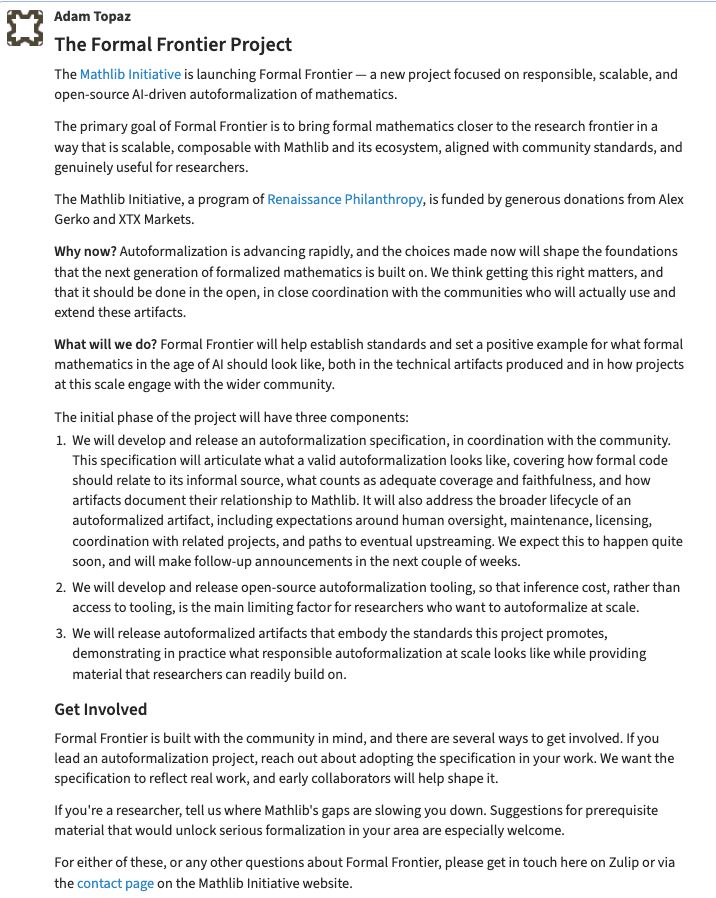
# The Formal Frontier Project
The Mathlib Initiative is launching Formal Frontier — a new project focused on responsible, scalable, and open-source AI-driven autoformalization of mathematics.
The primary goal of Formal Frontier is to bring formal mathematics closer to the research frontier in a way that is scalable, composable with Mathlib and its ecosystem, aligned with community standards, and genuinely useful for researchers.
The Mathlib Initiative, a program of Renaissance Philanthropy, is funded by generous donations from Alex Gerko and XTX Markets.
Why now? Autoformalization is advancing rapidly, and the choices made now will shape the foundations that the next generation of formalized mathematics is built on. We think getting this right matters, and that it should be done in the open, in close coordination with the communities who will actually use and extend these artifacts.
What will we do? Formal Frontier will help establish standards and set a positive example for what formal mathematics in the age of AI should look like, both in the technical artifacts produced and in how projects at this scale engage with the wider community.
The initial phase of the project will have three components:
We will develop and release an autoformalization specification, in coordination with the community. This specification will articulate what a valid autoformalization looks like, covering how formal code should relate to its informal source, what counts as adequate coverage and faithfulness, and how artifacts document their relationship to Mathlib. It will also address the broader lifecycle of an autoformalized artifact, including expectations around human oversight, maintenance, licensing, coordination with related projects, and paths to eventual upstreaming. We expect this to happen quite soon, and will make follow-up announcements in the next couple of weeks.
We will develop and release open-source autoformalization tooling, so that inference cost, rather than access to tooling, is the main limiting factor for researchers who want to autoformalize at scale.
We will release autoformalized artifacts that embody the standards this project promotes, demonstrating in practice what responsible autoformalization at scale looks like while providing material that researchers can readily build on.
Aleph, our fully autonomous AI agent system for formal verification, aced all major theorem proving benchmarks including PutnamBench, VeriSoftBench, and Verina
@Keleesssss@ilyasergey Any model that merely finds bugs can miss some of them (potentially discoverable by the next more powerful model in the future). Only formal verification can achieve 100% security guarantees.
Unveiling our new startup Advanced Machine Intelligence (AMI Labs).
We just completed our seed round: $1.03B / 890M€, one the largest seeds ever, probably the largest for a European company.
We're hiring!
[the background image is the Veil Nebula - a picture I took from my backyard, most appropriate for an unveiling]
More details here:
https://t.co/eWHyGLXwCA
@mehran__jalali@logic_int Our tests on the hard instances (https://t.co/sgecuPQZG8, test split, examples with rating >=50) showed that no frontier LLM can achieve more than 1% success rate (no timeout, no code execution).
@albincsergo@logic_int The EBM reasoning architecture we build is not sudoku-specific and can be scaled to replace general-purpose CoT-based reasoning in LRMs, Sudoku solver is just a proof-of-concept.
The outer loop approach works in principle (assuming we have access to a validator), but success rate decays exponentially with the instance complexity (and cost grows accordingly too). The example you used has rating 5 (https://t.co/6brNTUBIti).
In our experiments on a subset of puzzles with rating over 50, there were 0/47260 successful solutions by GPT-5.2 Pro.
Energy-Based Reasoning Models will become the "brain" in a layered AI ecosystem, complementing LLMs which become the interface layer, best suited to natural language tasks
Read about it here in @WIRED :
That's right!
@ylecun joins us as the Founding Chair of our Technical Research Board. True reasoning, real world models, and causal reasoning all point towards solving optimization problems.
Also joining us is @PRHillmann former Chief Strategy Officer at Binance, global head of innovation at Edelman, and in executive roles at General Electric.