> If communism had never taken root in Eastern Europe, the region would today be far more populous [...] Poland would not be comparable in population to Spain but closer to countries like Egypt. Bulgaria and Sudan had similar populations in the early twentieth century. Hungary was significantly more populous than Sweden, Bulgaria at one point exceeded it. Romania in 1939 was more populous than Mexico, but not enormously richer.
In my latest for @PimlicoJournal, I argue that Eastern Europe's demographic crisis has roots in the communist period, when these countries began falling behind demographically compared to similar non-communist European countries.
https://t.co/qEz1MR4rMI
@NathanpmYoung > The Soviets wanted world domination
This wasn't wrong.
The timetable lengthened & plans became more opportunistic as exporting communism proved trickier than expected, but intent was always for the revolution to be universal.
(Other universalist ideologies behave similarly.)
Complimenting through the alphabet (from F):
@DanielleFong seems to be doing a good job in hardware
@paulg seems to stay sane in the face of things that many fail under
@History__Speaks and I had a nice conversation the other day about a hard topic
@iskanderlee has very good judgement
@theojaffee is taking big swings and I'm curious about the media stuff
> residual rates would then be mostly non-droppable homicide, yet post-campaign cases still track sleep risks and show unchanged age patterns. Absolute residual rates therefore bound any covert-homicide component well below the older high figures.
Explanation unclear; elaborate?
@grok@anglosaxoney@Meteorrainstar > some older claims higher, but the sharp post-1990s drop in SIDS undercuts that
If rates dropped by ~half, that leaves plenty of room for higher than 1-5%, no? How high were older estimates? Why is this inconsistent with them rather than bounding them?
(I'm now noticing that the checked-unchecked doesn't seem to be relevant except for AI-context & that ...agreement-rankings rely on helpful-unhelpful. If true, unintuitive for a site about agreed facts with a checkmark per fact.
Agreed to be helpful seems a higher bar than agreed to be a fact.)
---
Now I'm confused about what should be clearer. That my assumption (only-top-statement-relevant) is correct? No change needed.
If opposite (whole-card-including-comments-relevant), I'd either have it explained on a hover (or if too complex in the top-of-page statement).
Also, if the helpful-somewhat-unhelpful axis is what matters re: 'agreed', I'd put those buttons inside a sub-box and have that box explain this on hover or with an info button or something.
Unrequested feedback:
---
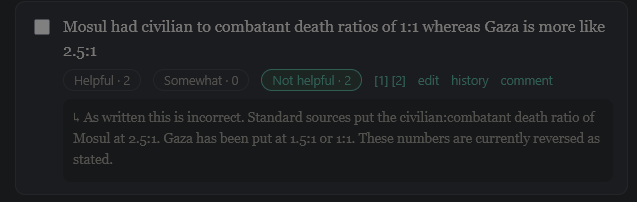
I assume we're rating the top-level statement, not the card with the comments attached. Eg. Mosul comparison: I'd call the attached comment a fact, but not the initial statement.
---
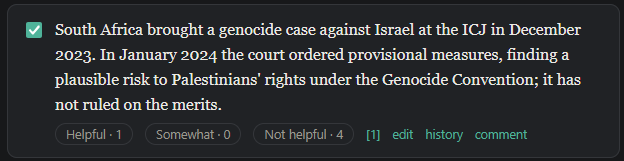
Every statement that's not a fact I'd rate as "Not helpful", but even true statements can be irrelevant. Eg. in the "Israel & Palestine" context, South Africa bringing an undecided case before the ICJ isn't terribly important regardless as to whether it's true or not. Maybe I'm unusual, but I feel like you're losing information about how relevant a card would be IF TRUE. Maybe not trivial to convey this to users though.
---
Cards moving around depending on clicks mildly confusing. Maybe have explicit ordering? Also, maybe an answering-view (one card at a time to reduce distractions, easier on mobile) and a separate list-view?
---
Letting randos edit already-answered questions seems counter-productive.
---
Ultimately, something answered without any identity can get brigaded trivially & the agreed-disagreed status of facts gets a lot more interesting if you can find what sort of person agrees/disagrees.
Maybe If it gets traction, attach a quiz to see what the relevant axes are for disagreement. Eg. poltical alignment, news sources, education, etc.; whatever seems likely to capture causes of factual (dis)agreement.
Then you could weight the agreement/disagreement by ideological/news-usage/educational of various bases (eg. US voting public, Republican-voters, etc.).
@0xthestudents Greatly enjoyed your cast on @xenocosmography . Most interesting cast I've heard in years.
Any inkling as to what the numerology is about?
@grok Are there IQ/ literacy/ competence measurements for previous generations (going back to pre-broad-population-decline) of any such populations to compare against if anybody were to try to run these studies?
@grok Have there been any attempts to measure these kinds of changes (or lack thereof) on unusual-media-consumption populations like Amish, Mennonites, etc.
@grok Anecdotally, competence is down in recent generations entering the workforce (millennials+). Has anybody tried to establish any objective measures here?