📢 OPEN INVITATION TO THE PUBLIC
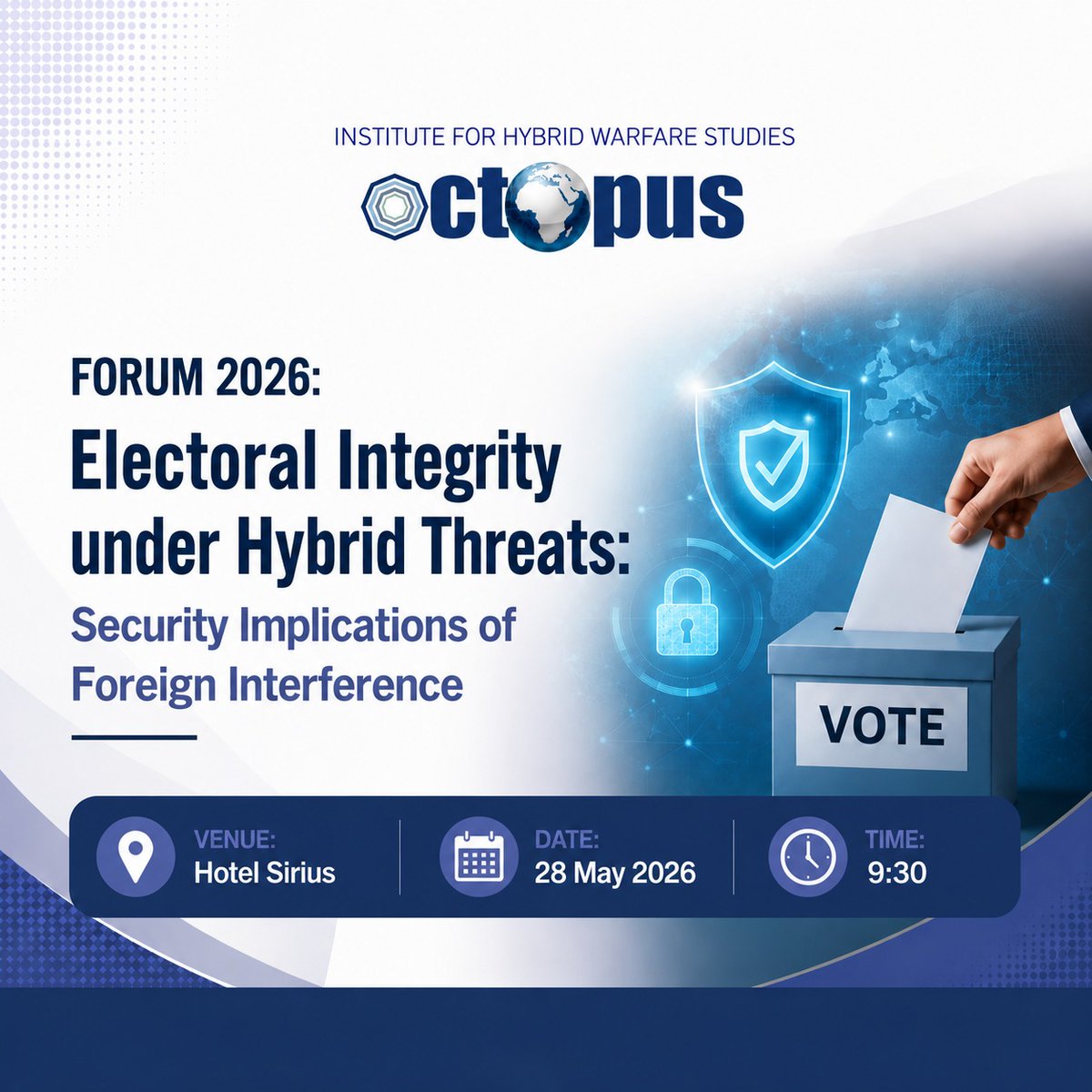
The Octopus Institute has the pleasure of inviting you to participate in FORUM 2026, on the topic:
“Electoral Integrity Under Hybrid Threats: Security Implications of Foreign Interference”
🗓️ Date: May 28, 2026
🕘 Time: 09:30
📍 Venue: Hotel SIRIUS, Prishtina
The forum will bring discussions on the challenges of electoral integrity, the impact of hybrid threats, and the implications of foreign interference for national security.
🔹 Participation is open, but for organizational purposes, please contact us at:
📧 Email: [email protected]
📱 WhatsApp: +383 45 666 449
We look forward to welcoming you!
#Kosovo #Election #HybridWarfare
March 24, 1999: When the World Said STOP to Milosevic
G.K.
On March 24, one of the most significant moments in modern European history is marked: NATO’s intervention to stop ethnic cleansing in Kosovo. It was not a choice for war, but a response to a reality that could no longer be ignored, the failure of diplomacy in the face of a regime that continued violence against Albanian civilians.
The year 1998 had made it clear what was happening. Burned villages, displaced people, destroyed families, and massacres that were being documented daily by international organizations. In this context, the intervention did not come by chance; it came because the situation had moved beyond any control.
A difficult international consensus was required to decide that the protection of human life was more important than a “sovereignty” used as a justification for violence, killings, and expulsion. The intervention was not intended to punish a people, but to stop a state policy that was destroying lives.
The facts are clear: over 900,000 Albanians expelled, around 13,000 killed, approximately 20,000 women raped, and hundreds of settlements destroyed.
Today, 27 years later, beyond historical memory, there is another battle: that of narrative. In Serbia, this event continues to be presented as “NATO aggression,” while what happened before the bombing is relativized or denied. Reçak is called a “staging,” NATO an “aggressor,” Serbia a “victim.”
But the truth is simpler: the intervention did not happen without reason. It happened to stop a process of violence unfolding before the eyes of the world.
Anniversaries are not only for remembering what happened, but also why it happened. Because when the past is distorted, it becomes a problem for the future.
#Kosovo #NATO #March24 #HumanRights #GenocidePrevention #Balkans #HistoryMatters #StrategicNarratives #Disinformation #NeverForget #Serbia
THE SOPHISTICATION OF THE LIE
(“Weaponisation of culture” in Serbian propaganda)
Author: Prof. Asoc. Dr. Arben Fetoshi - Director at Institute for Hybrid Warfare Studies "OCTOPUS"
Serbia continues with sophisticated constructs to manipulate historical truth.
“Harvest” is a “film” that has tactically used co-production with some “Americans” to expand the deception of international public opinion through the harshest fabrication against the Kosovo Liberation Army, the United States of America, NATO, and Albania.
The masking of Serbian-Russian phantom claims as an “international” project about the Yellow House and organ trafficking, is the most brutal misuse of art, aimed at recycling the dehumanizing narrative against the KLA, on the eve of the decision by the Specialist Chambers in The Hague.
In the style of Hitlerian “Big Lie” propaganda, masked with “international” producers and actors, the film is described as a project of “great importance” by the Director of Public Diplomacy, Arno Gujon.
Announcing its premiere in Belgrade and its planned worldwide distribution, he claims that through the film, “Serbia is drawing international attention to events during and after the war in Kosovo, which many would like to hide.”
It does not matter that they themselves do everything to conceal them, that the “Big Lie” has long been discredited, and that Recak and Srebrenica have documented Serbia’s responsibility, as the hybrid strategy requires repetition and repackaging of the narrative.
The denial of war crimes and genocide must maximize “victimhood.”
Meanwhile, victimhood becomes possible only through monstrous fabrications, systematically repeated and presented in increasingly advanced “artistic” forms.
Through this project, Serbia is attempting to export the “Big Lie,” by emotionally influencing international audiences.
The strategy of victimization requires new investments in the face of exposure from investigations such as “Sarajevo Safari” and international reports.
So far, the Vucic regime and Gujon have used culture as a “weapon” against Kosovo.
RTS documentaries such as “Recak – Truths and Lies” (2009), series like “The Kosovo Dossier” (2021–2024), operatic projects, or international exhibitions are the preceding products of the film “Harvest.”
All of them have projected only one goal: the production of a “truth” in which Serbia appears as the victim of Albanians and the West.
Therefore, “Harvest” is simply the newest link in this chain of Serbian-Russian disinformation and propaganda.
#Kosovo #Serbia #Fake #Harvest
RACAK IN SERBIA’S HYBRID STRATEGY
(The Anatomy of Denial on the 27th Anniversary of the Massacre)
Ridvan Emini - Researcher at Institute for Hybrid Warfare Studies "OCTOPUS"
The denial of the Racak Massacre by Serbia is not merely a battle with “truth” over guilt or innocence; rather, it is part of a broader strategy tied to its hegemonist project of the “Serbian World.” This involves an intensive political, media, and cultural engagement—including the role of the Orthodox Church—aimed at generating confusion in order to evade responsibility, as the only way to “legitimize” the continuation of its hegemonist policy toward Kosovo and other countries in the region.
The Racak Massacre also symbolically exposes the narrative of alleged international “injustice” toward Serbia, stemming from insinuations by Aleksandar Vucic and other state officials that it was “a fabrication to justify NATO’s intervention.” Alongside the denial of the genocide in Srebrenica and the glorification of war criminals as a “heroic sacrifice” in defense of Serbs, within the framework of a hybrid strategy against Kosovo, Racak has also been subjected to an “artistic and cultural” denial—presented as a more “refined” method of distorting the truth for both the Serbian public and the international audience.
“Culture” as a Hybrid Instrument
After failing to conceal the crime through institutional manipulation, Serbia has continued its campaign by combining official denial with the instrumentalization of art and culture. Numerous documentaries, feature films, exhibitions, and operatic projects have been invested in promoting the “truth” about Racak and the “defense” of Kosovo. Subtitling in foreign languages and dissemination abroad through official channels and broadcasting platforms demonstrate that these productions are not intended solely for a domestic audience, but also for the international one. Radio Television of Serbia (RTS), as a megaphone of Serbian propaganda, has played—and continues to play—a key role in this regard.
The documentary “Račak – istine i laži”(Racak – Truths and Lies, 2009) is its production marking the tenth anniversary of the massacre, portraying civilian victims as members of the Kosovo Liberation Army (KLA) and directly attacking the head of the OSCE Kosovo Verification Mission, William Walker, as an alleged “stager” of the crime. Together with the Ministry of Internal Affairs of Serbia (MUP), the broadcaster also produced a documentary series entitled “Dosije Kosovo” (The Kosovo File, 2021–2024), consisting of four parts, which “chronologically recount” events and the fates of civilians and Serbian security forces in Kosovo during the period 1998–2004.
In each episode, the “facts” are manipulated with the aim of portraying the Kosovo Liberation Army (KLA) as a “terrorist” force. The first partfocuses on the year 1998, where, through staged interviews, KLA attacks and killings in villages inhabited by Serbs are “presented as evidence.” The second partaddresses the Racak Massacre, portraying civilian victims as “disguised” members of the Kosovo Liberation Army (KLA) wearing civilian clothes. This episode represents the peak of propaganda aimed at denying this mass crime committed by Serbian forces. Meanwhile, the third part deals with the so-called “Yellow House”, accusing the Kosovo Liberation Army (KLA) of kidnapping Serbs and engaging in organ trafficking—a fabrication that has since been discredited, yet one that has had serious consequences for Kosovo and former KLA leaders, who continue to be tried by the Kosovo Specialist Chambers in The Hague. The fourth partaddresses the events of March 2004, demonizing the state of Kosovo and accusing Albanians of an alleged ethnic cleansing of Serbs. The interviews and narration in English, Russian, and Albanian indicate that Serbia, through this documentary, aimed to disseminate its false narratives not only in the international arena but also among Albanian public opinion.
Immediately after the completion of this documentary cycle, an alleged “independent production” released the film “Anatomy of Deception – Racak” (2023), which represents a continuation of the Serbian narrative on Racak. This film demonizes the figure of Ambassador William Walker, portraying him as an alleged CIA agent with a destabilizing mission, and further “elaborates” the conspiracy theory depicting the Racak Massacre as a “fabrication.” On the other hand, in order to obstruct Kosovo’s membership in UNESCO, alongside direct state-to-state lobbying, Serbia has also employed the documentary “Kosovo: A Moment in Civilization” (2017). This production was financially supported by the so-called Office for Kosovo within the Government of Serbia, as well as by the Serbian Cultural Center in Paris. Through this documentary, Serbia sought to portray Albanians as vandals, Kosovo as an incapable and barbaric state, and Serbs as persecuted and suffering—precisely on the eve of the vote on membership in UNESCO, issuing an open call for a vote against it.
Meanwhile, the Office for Public and Cultural Diplomacy, led by Arnaud Gouillon, has promoted propaganda through the organization of exhibitions and activities across numerous countries worldwide, including the exhibition “Encounters with the Last Serbs in Kosovo and Metohija” in Paris, deliberately calculating the disinformation of international audiences about Kosovo. Thus, alongside documentaries, feature films construct a symbolic universe portraying Serbs as perpetual victims and Albanians as aggressors and morally unworthy. This logic also extends to the newest operatic project, “The Battle of Kosovo”, announced by the Serbian National Theatre in Novi Sad. This project is not merely an artistic initiative, but represents the latest investment in the narrative warfare against Kosovo. Through opera, as an elite form of cultural communication, the regime of Aleksandar Vucic will seek to generate sympathy for—and legitimize—the Serbian myth of Kosovo on prestigious international stages. In this way, cultural products are instrumentalized to deny crimes, in service of the hegemonist objectives of the so-called “Serbian World.”
Internationally Denounced ‘Concealment’
The denial strategy also involved the then investigating judge Danica Marinkovic, who continues to attempt to distort the truth. After efforts to conceal the crime in Racak failed, she ordered the transfer of the bodies for autopsy, seeking to construct a deceptive narrative through control over the evidence. However, authorship of the crime was confirmed by the forensic medical expertise of the European Union team led by Dr.Helena Ranta, which approximately two years later reportedthat “all those killed and massacred were unarmed Albanian civilians, forcibly removed from their homes and taken to Babush Hill for execution.”
The two-year “delay” gave Serbia room for manipulation, but independent international media reported the truth and exposed Serbian attempts to conceal this crime. Despite this, Serbia has continued its policy of denial through the Security Information Agency (BIA) as well, implicating espionage networks in Kosovo in fabricating claims about a KLA military hospital in Monopollc, following a pattern similar to the “Yellow House” scenario.
The Indictment as a Denunciation of Serbia
The filing of an indictment by the Special Prosecution of the Republic of Kosova against 21 individuals held responsible for the crimes committed in Racak represents the latest development demonstrating that this is not merely a procedural step of justice, but also a direct confrontation with Serbia’s falsifying narrative. This indictment, although delayed, confirms that the crime committed by Serbia in Racak has not been forgotten and that criminal responsibility does not “expire” with time.
According to the Special Prosecution of the Republic of Kosova, the suspects are charged with the joint perpetration of the murder of 42 Albanian civilians, as members of the Army of the former Yugoslavia, the 243rd Mechanized Brigade, the Third Army—known as the Pristina Corps—as well as members of the Ministry of Internal Affairs of Serbia (MUP). They are also accused of inhuman treatment, destruction of property, mass expulsion, and ethnic cleansing of the civilian population.
With this development by the justice institutions, the Racak Massacre now also receives a juridical “seal” of Serbia’s state responsibility, as a crime documented 27 years ago—despite the persistent use of various “filters” to eclipse it.
Religious authoritarianism as a method of hegemonic politics
What are the real threats from the combination of “verticalization of power” with religion in the Russian-Serbian doctrine of hybrid warfare?
This article with citations you can find on the web of @iskhoctopus
Autocracies rarely invent new methods; they usually recycle those that have worked and adapt them to the circumstances of the moment. Two instruments are activated almost always when an authoritarian regime prepares for external actions: the verticalization of power and the construction of “defender of civilization” type myths. Russia and Serbia are classic examples of this model. Both have built strong top-down control structures, while simultaneously cultivating the narrative that their actions are carried out in the name of “Christianity” or “defense of Europe.” This combination, extreme centralization and political mythology, has served them to mask expansionist ambitions and to create a moral shield that justifies pressure, destabilization, or more sophisticated forms of hybrid warfare.
Vertical power as an autocratic mechanism
In political science, “vertical power” describes the hierarchical concentration of authority from top to bottom, and Serbia, just like Russia, has traditionally demonstrated a full institutional-social synchronisation in its hegemonic policy toward Kosovo. Under Putin, Russia has shifted toward a deeply presidential model: the 2003 Duma elections, the dismissal of the government before the 2004 presidential elections, and the abolition of direct elections for governors consolidated this line. Linz links authoritarianism with limited pluralism and centralized control. According to Levitsky and Way, “vertical power” simply explains the mechanics of this centralization. It dismantles institutional balances and ensures one-directional transmission of authority.
Russia and Serbia apply this model through the extreme concentration of decision making. Putin expands presidential competencies and control over governors, while Vucic builds dominance through the capture of state institutions. According to Bieber, authoritarian regimes mask this control with democratic facades, election manipulation, a politicized judiciary, and submissive legislatures.
Recent developments in Serbia have shown that the country is already in the final stage of full verticalization of power and consolidation of autocracy, despite strong anti-Vucic protests.
For consolidating the verticalization of power, Serbia is implementing full centralization of the security sector. The army, police, and intelligence are being concentrated under the President, including legal reforms, while for BIA alone 89 million euros are planned for 2026, an unusual increase and partially hidden under “confidential programs”. This comes at a time when the United States and its allies are seeking global de-escalation, while Serbia is moving in the opposite direction. Likewise, the new amendments to the Law on the Armed Forces aim to place the Chief of Staff and officers under the direct command of the President, something that does not exist today. And the model is familiar. It is the return of Milosevic’s manual before the wars in Kosovo, Croatia, Bosnia and Herzegovina, and Slovenia. The verticalization of power never moves alone. It is accompanied by the narrative that justifies it.
The “defender” of Christianity and the neutralisation of crimes
Russia, after centralising every link of political power, extended the same verticalisation over the sacred sphere. In the official Russian discourse, Moscow presents itself as “the protector of Orthodoxy and traditional values”, as the last bastion against “Western degeneration”. Aleksandr Dugin has placed this narrative in an almost mystical dimension: Russia as “the katehon”, the force that restrains evil and preserves “true Christianity”. For him, the war in Ukraine is not merely a geopolitical conflict, but a sacred battle against the liberal world. This language has now become part of the Kremlin’s official line, and part of the strategy of the Russian World.
But in the Balkans, the game is more sophisticated. Russia and Serbia share roles but not purpose. Russia is “the protector of Orthodoxy”, something tied to its historical and national identity. Serbia, meanwhile, takes on a broader role. It positions itself as “the defender of Christianity” and “the defender of Europe” from the Balkans. This gives Serbia a cosmetic layer that functions better in the West, and at the same time opens a clean door for Russia to exert hybrid influence. If Russia cannot present itself as a defender of Western Christianity, Serbia can. It has sold itself as such for centuries.
Exactly for this reason Dugin treats Serbia with an almost mythical weight. He sees it as the bridge that makes Russian ideology acceptable in Europe. Serbia creates the facade, Russia supplies all the ideological brain and the strategic core. This is the symbiosis: one has the symbolism, the other has the doctrine.
The Serbian myth of “neutrality” and the small staged frictions with Moscow serve only to create the appearance of an independent actor. In practice, Serbia plays the role of a proxy that uses religious language to justify policies that are in line with Russia.
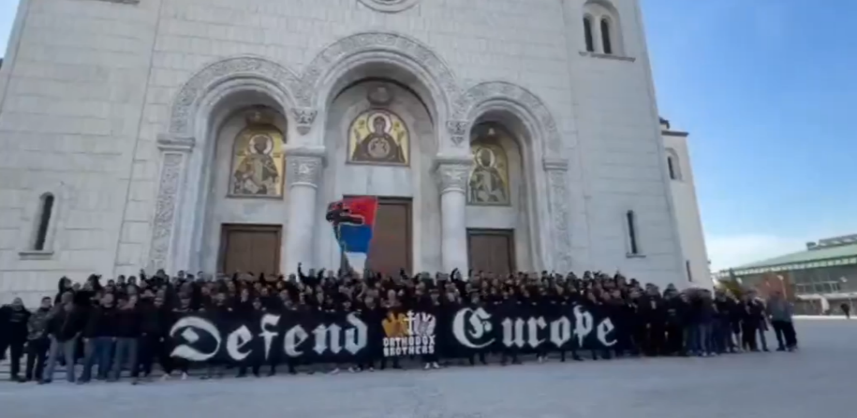
The return of the sacred element is evident. In Serbia and beyond, radical groups are reviving the same language that Milosevic used before the wars: Serbia as the shield of Europe and Christianity. Today, this is openly displayed in gatherings, concerts, football matches, graffiti, and activities of extremist groups from Serbia, Romania, and other countries.
A clear example: Romanian extremists in Belgrade with a banner calling Ratko Mladic “the European hero who brought Muslims down to zero”. This is not merely provocation. It is the normalisation of crime under the guise of civilizational justification.
The same narrative appeared among Romanian fans in the football match with Bosnia, where Serbia is portrayed as “the defender of Europe”. Inside Serbia, in pro-Vučić protests, radical groups praise war criminals, chant against Muslims, and sell Serbia as a fortress of Christianity. In parallel, Belgrade has become a regular supplier of propaganda campaigns in the region, especially against Kosovo and Albanians, encouraging Kosovo’s neighbouring populations against Albanians and the state of Kosovo.
In this climate, the effects extend even inside Kosovo. Here too, voices are emerging that recycle Islamophobia, penetrating unnaturally into certain groups and media.
Serbia, through the issue of promoting propaganda as “the defender of Christianity”, is dominating the narrative of neutralising the crimes committed against Bosniaks and Albanians.
Current security dynamics as a space for Serbia’s advantages
Geopolitical circumstances today seem to shift between two extremes. One moment there is talk of peace and de-escalation, the next moment fear surfaces that tensions may take a completely different direction. A few weeks ago, the European Commissioner for Defence, Andrius Kubilius, said that German intelligence has information on discussions inside the Kremlin about a possible Russian scenario against NATO.
Meanwhile, NATO Secretary General Mark Rutte, from a meeting with NATO Foreign Ministers in Brussels, warned that Russia is “working closely” with China, North Korea and Iran “to disrupt our societies and to destroy global rules” and is “preparing for long-term confrontation”.
Likewise, during the special hearing “Flashpoint: A Path Toward Stability in the Western Balkans” in the House Foreign Affairs Committee, the chairman of the Subcommittee on Europe, Keith Self, warned that in addition to Russia’s aggression against Ukraine, the Western Balkans remains the most unstable region in Europe. According to him, Albania, Montenegro and Macedonia would be directly in the line of fire in a renewed conflict, and Kosovo remains particularly exposed due to its lack of NATO membership.
Germany, for its part, has centralised military command and prepared the “OPKAN DEU” plan, a voluminous document that foresees rapid mobilisation and the use of civilian networks for military functions in a crisis. Baltic-Nordic reports for 2024–2025 also warn that Russia is restructuring its forces to have the capacity for both conventional conflict and hybrid forms if the global situation deteriorates.
Russia has denied that it is prepared to attack any NATO or European country outside Ukraine. However, if peace plans do not go as intended, this does not guarantee that the situation cannot escalate.
Conclusions and strategic assessments
As long as Serbia’s engagement in verticalisation and propaganda continues to remain at high levels, and the cooperation of Serbian intelligence with that of Russia and likely also China is at an allied level, this gives us indications that Serbia’s plans, based on the knowledge and preparation conducted with allied intelligence services, go beyond the official reality and that scenarios are being prepared which are not openly articulated.
The verticalisation of power by Serbia enables it to have an architecture for rapid action without delay or accountability. Meanwhile, through sacred propaganda it mobilises the masses and keeps public opinion ready to justify every step taken by Serbia, presenting it as a state engaged in a “crusade”.
A second tool of influence on international opinion, especially Western opinion, is provided by the high levels of propaganda through audiovisual and digital media, where propaganda from these mediums is now almost uncontrollable. This second tool allows Serbia, and consequently Russia, to legitimise their actions as an anti-Islam campaign. The aim is to provoke religious sympathy, and this religious sympathy among pro-Western groups becomes pressure on their governments not to react to Russian-Serbian actions.
In principle, we must understand that none of this has anything to do with genuine religious issues; it is exploitation for division and dominance.
Now, the current phase is one of crisis normalisation, the creation of a condition in which tension is treated as the standard and not as a deviation, while the future remains uncertain precisely because of these models designed to be unpredictable and usable at any moment of opportunism.
@vonderleyen@HelsinskiOdbor@USEmbPristina@realDonaldTrump@SecRubio@OSCE@OSCEKosovo@RitchieTorres@UN@RihoTerras@UNHumanRights@kajakallas@MartaKosEU@aliciakearns@eucopresident@EP_President@vonderleyen@EmmanuelMacron@GiorgiaMeloni@_FriedrichMerz@Keir_Starmer@bueti@MiRo_SPD@FarCanals@DorisPack2@agim_musliu@GunterFehlinger@FetoshiArben@Sandulovic_N@i_videnovic@natasakandic@DanielSerwer@GermanAmbKOS @jonhargreaves67 @DailyShqip@ThisisKaltri@Romanistan1971@petritmalaj@shkamberi@zpshns @FlamurKrasnq @albinkurti@VjosaOsmaniPRKS @L_H_111 @GlobalPatriaX@CIJ_ICJ
#HybridWarfare #AuthoritarianMechanisms #VerticalPower #HegemonicPolitics #PoliticalMythmaking #WeaponizedReligion #SacralizedPolitics #ReligiousAuthoritarianism #CivilizationalNarratives #FaithAndPower
#RussianSerbianAxis #OrthodoxGeopolitics #RussianWorldDoctrine #BalkanAuthoritarianism
#HybridThreats #StrategicDestabilization #IntelligenceState #SecurityDoctrine
#WesternBalkansSecurity #Kosovo #Serbia #Russia
From ‘The Sarajevo Safari’ to Total Military Control: Vucic’s New Strategy Against Kosovo
Author: Ridvan Emini PhD. Cand. – Researcher at Institute for Hybrid Warfare Studies “OCTOPUS”
https://t.co/o5vWiZZyUB
#Kosovo#Serbia#Vucic#Military#Russia#China#technology
Russia, Kosovo, and Ukraine: The False Model of the “Precedent”
The deepening failure to defend Russia’s aggressive and unlawful actions against Ukraine, its neighbors, and beyond is pushing this geographically large state (Russia) to lose the narrative battle in Kosovo.
The President of the European Commission, Ursula von der Leyen, stated that borders cannot be changed by force, rejecting any such attempt in Ukraine.
Russia, which international relations and geopolitics scholars consider a power that weakens unless it continuously expands, risking becoming a third-rate power, something even Aleksandr Dugin has admitted, keeps insisting on using Kosovo as a “precedent” to justify its aggressive behavior.
Yet this large territory called Russia is losing ground to Kosovo because its narrative is fundamentally false.
From 1877 to 1999: How Serbia Expanded by Force and Why Zakharova’s Claim Is False
Maria Zakharova, spokesperson for the Russian Ministry of Foreign Affairs, in her reaction to von der Leyen, invoked the case of Kosovo, saying: “It was the West that declared and forcibly implemented the unilateral redrawing of Serbia’s borders, against the will of the Serbian people.”
A tragic embarrassment for a large country like Russia to be represented by officials who even attempt to deceive with lies that are easily disproven.
Kosovo was not taken from anyone by force!
Since 1877, when Kosovo covered 22,900 km², it was Serbia, supported by Russia, that expanded at the expense of Albanian territories, conquering lands, expelling populations, and committing genocide against Albanians. Today’s Kosovo still shelters many Albanians who fled or were expelled from the occupied regions: Niss, including Toplica, Prokuplje, Kurshumlija, Leskovc, Vranje; the Sangjak of Novi Pazar; and up to the area of Presheva, Medvegja, and Bujanovc.
There are hundreds of thousands of published proofs of how the region of today’s Kosovo was colonized by Serbia since 1918, and from Serbia’s archives there have been extracted names, surnames and addresses in Kosovo where the Serbian colonists were placed. This collection and publication of evidence was done by Millovan Obradovic.
In the 1990s, Kosovo experienced terrible terror from Serbia, after the abolition of autonomy, Albanians were denied employment, education, healthcare, while systematic violence, repression and imprisonments culminated with massacres and genocide during the years 1998–1999.
Kosovo would have suffered a total ethnic cleansing according to the “Horseshoe” operation and a tragedy even worse than Bosnia, if it had not been for NATO’s humanitarian intervention to stop the violence of Slobodan Milosevic’s brutal regime.
Just a few statistics: within two years, 1998–1999, more than 800,000 Albanians were deported from Kosovo; around 13,000–14,000 civilians were killed and massacred; more than 19,000 women and girls were raped; thousands of bodies were disappeared, and Serbia still does not reveal where it has hidden around 1,600 of them.
After the war, in the peacekeeping mission with NATO, there were also forces from Russia, through which it openly provoked renewed confrontation with the West.
Why the Russian argument about Kosovo fails legally, politically and strategically
Regardless of what Zakharova and Russia say, every person not influenced by propaganda admits publicly (since in their mind everyone knows the truth) that NATO did not commit aggression against Serbia. On the contrary, it stopped genocide and even saved Serbia itself from the claws of people like Milosevic. Meanwhile, it is Russia that is bringing Serbia back to the people of Milosevic, by sponsoring proxy states and politicians such as Alexander Vucic and Alexander Vulin.
Furthermore, it should not be forgotten that after Kosovo declared independence, it was Serbia, with the help of Russia, that requested the opinion of the International Court of Justice on whether Kosovo’s declaration of independence was in accordance with international law. The ICJ gave its judgment, and now the hypocrisy lies with Russia and Serbia, who do not accept the “answer” to their own question. The ICJ confirmed that Kosovo had not violated international law with its declaration of independence. Russia and Serbia asked for the Court’s opinion, but would they have accepted it if the ICJ had said that Kosovo hadviolated international law?
Zakharova attacks von der Leyen because she wants to gain as much as possible in the bargaining over peace in Ukraine by using Kosovo as a “precedent”. However, this is an artificial comparison and even a deception for the Serbian people, whose view has been further darkened by Russia and the Vucic regime.
By mentioning Kosovo as a precedent, Russia has its eye on the bargaining against Ukraine. However, it seems to be stuck in the trap of the narrative against Kosovo and is losing the battle with the truth.
@vonderleyen@_MariaZakharova@HelsinskiOdbor@USEmbPristina@realDonaldTrump@SecRubio@OSCE@OSCEKosovo@RitchieTorres@UN@RihoTerras@UNHumanRights@kajakallas@MartaKosEU@aliciakearns@eucopresident@EP_President@vonderleyen@EmmanuelMacron@GiorgiaMeloni@_FriedrichMerz@Keir_Starmer@bueti@MiRo_SPD@FarCanals@DorisPack2@agim_musliu@GunterFehlinger@FetoshiArben@Sandulovic_N@i_videnovic@natasakandic@DanielSerwer@GermanAmbKOS @jonhargreaves67 @DailyShqip@ThisisKaltri@Romanistan1971@petritmalaj@shkamberi@zpshns @FlamurKrasnq @albinkurti@VjosaOsmaniPRKS @L_H_111 @GlobalPatriaX@CIJ_ICJ
#Kosovo #Russia #Serbia #EuropeanUnion #ICJ #Ukraine #USA #diplomacy #geopolitics #Security #hybridwarfare #NATO #InternationalLaw
The Russian Historical Society in Serbia and the Architecture of Euro-Asian Security
The statements and actions of the Lavrov–Vučić–Vulin triad between October 24–27, 2025, escalated the threat against the Western security structure in Europe (including the Western Balkans), presenting the West with two alternatives: either allow the realization of Russian-Serbian interests under the Euro-Asian security framework, or face war.
In just four days, three interlinked events revealed three levels of a single operation: Aleksandar Vučić articulated the political narrative (“Serbia toward the EU, but without recognizing Kosovo”); Aleksandar Vulin institutionalized Russian influence through the newly founded “historical” society; and Sergey Lavrov delivered the Euro-Asian geopolitical narrative to the international audience. This strategic coordination forms the foundation for implementing Aleksandr Dugin’s geopolitical doctrine.
“The Serbian World” as a Doctrinal Basis
The Russian Historical Society, inaugurated on October 26 in Belgrade, was presented as “a meeting point for all those who see Serbia as a state that will fight without any reservation for the peaceful creation of the Serbian world and to be a true ally of Russia and China.”
This statement by Aleksandar Vulin, former Minister of the Interior, former head of the Security and Intelligence Agency (BIA), and a figure sanctioned by the United States for corruption and ties to the Kremlin, is a strategic declaration aimed at institutionalizing the concept of the “Serbian world” as a metapolitical project under the Kremlin’s umbrella.
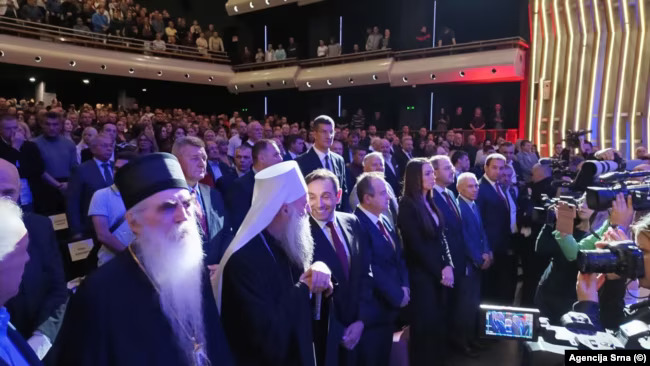
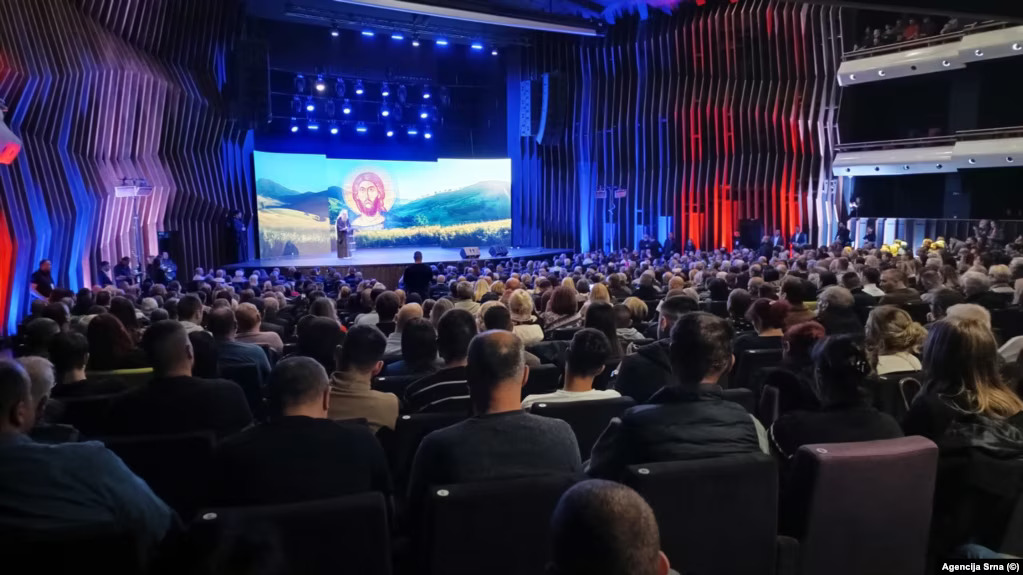
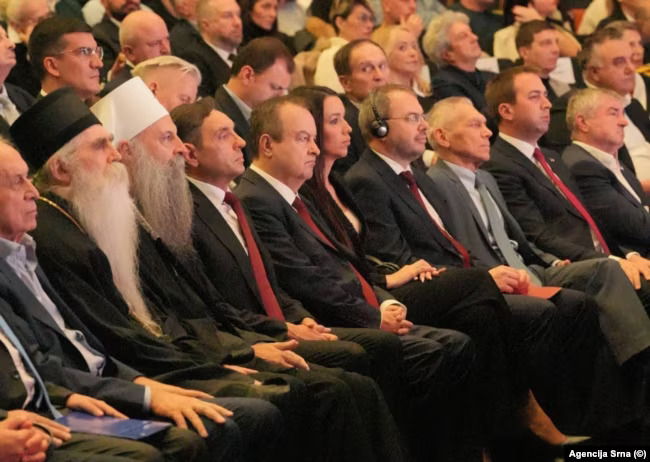
The event was attended by key figures from the Serbian state and the Serbian Orthodox Church: Patriarch Porfirije, Interior Minister Ivica Dačić, Russian Ambassador Aleksandr Bocan-Kharchenko, and representatives of the Russian Academy of Sciences. The national anthems of Russia, Serbia, and Republika Srpska were played as symbols of spiritual and political unity.
This political-religious ritual reinforces the fact that Serbia is no longer operating solely within the domain of classical diplomacy, but is constructing a hybrid ideological infrastructure, where history, religion, and security intertwine to produce a shared identity with Russia.
Naryshkin, Vulin, and the “Academization” of Influence
At the head of the Russian Historical Society stands Sergey Naryshkin, Director of the Foreign Intelligence Service of the Russian Federation (SVR), a fact that gives this institution an unmistakably intelligence-oriented character. Naryshkin introduced the society’s establishment through a video message, describing it as “a confirmation of the spiritual and historical connection between the Russian and Serbian peoples.” To an uninformed audience, this may sound like cultural rhetoric, but for security analysts, it signals a direct infiltration of the Russian influence apparatus into Serbia’s system of knowledge and culture.
In practice, this society will function as a platform for:
- rewriting regional history in line with the Russian narrative (“NATO as the aggressor”, “Serbia as the historical victim”);
- spreading cultural propaganda under the guise of “scientific cooperation”;
- and preparing the ground for infiltration into educational and media institutions.
Whereas Russian influence in Serbia once operated primarily through energy, media, and politics, it is now being capillarized into the fields of history and collective memory, the domains most difficult for Euro-Atlantic structures to neutralize.
Lavrov and the “New Security Architecture”: Rhetoric as a Cover
At the same time, in Minsk, Sergey Lavrov warned that “Europe is preparing for war,” but claimed that Russia “does not target any NATO or EU member state.” He proposed the creation of a “pan-continental structure of Euro-Asian security,” presenting Moscow as an alternative to the Western order based on NATO. This idea of a “new security architecture” is essentially a reformulation of Aleksandr Dugin’s doctrine of the Euro-Asian space, in which Russia positions itself as a spiritual and civilizational center opposing “Western degeneration.”
In practical terms, Lavrov used the same logic to delegitimize Kosovo’s independence, comparing it to the annexation of Ukrainian regions, a legally and politically false comparison. Kosovo declared independence following Serbian genocide and apartheid against Albanians, which ended only after NATO’s humanitarian intervention and a process supervised by the UN and the EU. In 2010, the International Court of Justice confirmed that Kosovo’s declaration of independence “did not violate international law.” Russian “referendums” in occupied territories, by contrast, are illegal acts under international humanitarian law.
This comparison shows that Russia does not seek genuine dialogue but rather aims to normalize its annexationist methods by relativizing historical facts. And this is precisely where the function of the Russian Historical Society comes into play: to make such narratives acceptable through so-called “historical reasoning.”
Vučić and the Double Game
Within this scheme, Vučić remains the figure of façade neutrality. While he declares to the domestic audience that he “will never recognize Kosovo, and if someone after him wishes to do so, they can do it themselves,” presenting himself as the sole defender of Kosovo, he simultaneously portrays himself to the European Union as a leader ready to integrate Serbia into the EU, but not with an independent Kosovo.
Through this stance, Vučić openly displays resistance to peace and security in Europe. This deliberate duality serves as a Russian tool to keep Serbia tied to Brussels while using it as a gateway for the strategic realization of Moscow’s interests.
Unlike all other EU candidate states, Serbia has not imposed sanctions on Russia and continues to engage in coordinated activities with the Russian propaganda apparatus, as demonstrated by the establishment of the Russian Historical Society.
The Splitting of the Euro-Asian Front and the Threat to Western Security
The Lavrov–Vučić–Vulin triad marks a clear partitioning of the Euro-Asian front and the creation of an ultimatum-style strategic line: either Russian-Serbian interests are accepted in Europe, or confrontation follows.
This strategy is a coordinated diplomatic threat that followed a series of drone provocations from Estonia to Kosovo, testing the response of the Western security line.
The events indicate hybrid preparations for a new conflict, where diplomacy, historical propaganda, and controlled military actions are combined to force a change in the European security order.
Vučić’s statements about a “change in the geopolitical circumstances” are directly linked to this plan, signaling readiness to act against Kosovo the moment the international balance weakens.
In this context, the Russian Historical Society in Serbia is not a cultural project but an ideological infrastructure of hybrid warfare, preparing the political and spiritual justification for the next phase of Russian-Serbian confrontation with the West.
@HelsinskiOdbor@vonderleyen@USEmbPristina@realDonaldTrump@SecRubio@OSCE@OSCEKosovo@RitchieTorres@UN@RihoTerras@UNHumanRights@kajakallas@MartaKosEU@aliciakearns@eucopresident@EP_President@vonderleyen@EmmanuelMacron@GiorgiaMeloni@_FriedrichMerz@Keir_Starmer@bueti@MiRo_SPD@FarCanals@DorisPack2@agim_musliu@GunterFehlinger@FetoshiArben@Sandulovic_N@i_videnovic@natasakandic@DanielSerwer@GermanAmbKOS @jonhargreaves67 @DailyShqip@ThisisKaltri@Romanistan1971@petritmalaj@shkamberi@zpshns @FlamurKrasnq @albinkurti@VjosaOsmaniPRKS@natasakandic @L_H_111 @GlobalPatriaX
#Lavrov #Vucic #Vulin #SerbianWorld #HybridWarfare #RussianInfluence #EuroAsianSecurity #WesternBalkans #OSINTAnalysis #HybridThreats #SecurityArchitecture #KremlinNarrative #Serbia #Kosovo #Russia #EU #NATO #Geopolitics
International Forum in Prishtina
Democracy Under Threat: Elections as a Geopolitical Battlefield
🗓️ Tuesday, September 30, 2025 | 📍 Hotel Sirius
The Institute for Hybrid Warfare Studies "OCTOPUS" gathers ambassadors, academics & experts to discuss:
Elections as a geopolitical battlefield
Hybrid threats to democracy
Safeguarding electoral security & integrity
🎙️ Speakers: Ambassadors from 🇦🇱 🇲🇪 🇩🇪 🇭🇷 and leading scholars from Kosovo.
#Democracy #Elections #HybridWarfare #Geopolitics #Kosovo