Well, you said it yourself, design. The software team can be separated from the design team. So the only two reasons that come to mind are the following:
- there is a design team and they did a terrible job.
- there is no design team and the software team tried to do the design which not a good idea if they lack the skills or experience for such a product.
The software team would have done a terrible job if the features don't work or break other features, and yet the latter is mostly related to interaction design.
Abraham Lincoln and James Shields had a duel in 1842 that was eventually called off.
The story? Lincoln published satirical letters under the pseudonym "Rebecca" criticizing just about everyone, including James. A sort of post-Elon Twitter at the time.
SaaS products often have a subscription-based revenue model, providing a consistent and predictable income stream. This steady revenue provides a stronger base for growth compared to the variable income in consulting.
Developing a SaaS product allows for scalability and wider impact due to its potential to reach a larger customer base. This contrasts with the limited scope of consulting services, which typically involve time-based engagements.
I can't believe I've just fine-tuned a 33B-parameter LLM on Google Colab in a few hours.😱
Insane announcement for any of you using open-source LLMs on normal GPUs! 🤯
A new paper has been released, QLoRA, which is nothing short of game-changing for the ability to train and fine-tune LLMs on consumers' GPUs.
In a few words:
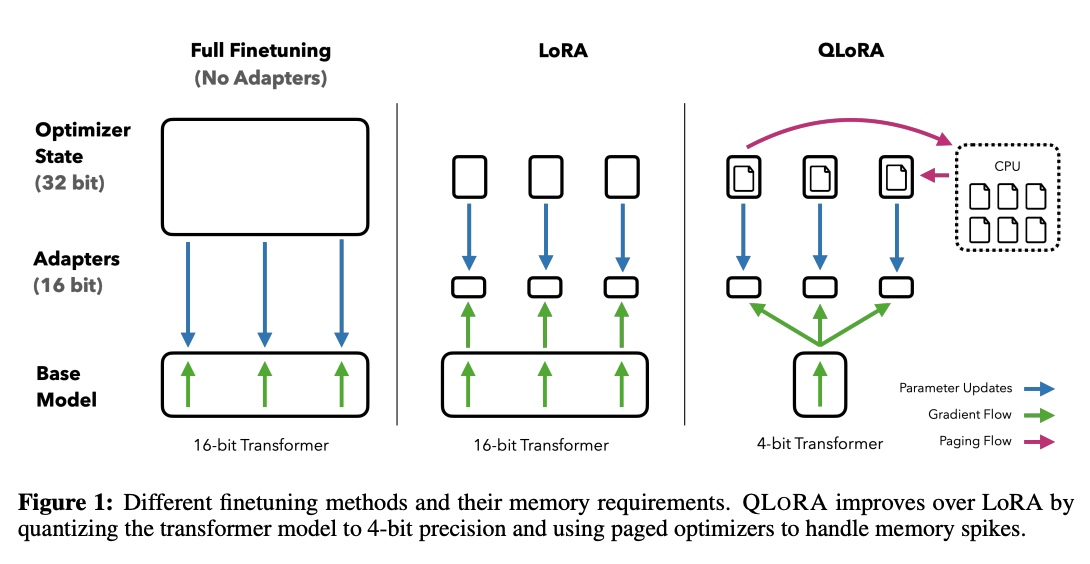
QLoRA reduces the memory usage of LLM fine-tuning without any performance tradeoffs compared to standard 16-bit model fine-tuning.
This method enables 33B model fine-tuning on a single 24GB GPU and 65B model fine-tuning on a single 46GB GPU. This is incredible! 😍
More specifically, QLoRA uses 4-bit quantization to compress a pre-trained language model. The LM parameters are then frozen, and a relatively small number of trainable parameters are added to the model in the form of Low-Rank Adapters.
During finetuning, QLoRA backpropagates gradients through the frozen 4-bit quantized pretrained language model into the Low-Rank Adapters. The LoRA layers are the only parameters being updated during training. Read more about LoRA in the original LoRA paper (https://t.co/54Lsb4DBFi). 🤓
QLoRA has one storage data type (usually 4-bit NormalFloat) for the base model weights and a computation data type (16-bit BrainFloat) used to perform computations. QLoRA dequantizes weights from the storage data type to the computation data type to perform the forward and backward passes, but only computes weight gradients for the LoRA parameters, which use 16-bit bfloat. The weights are decompressed only when they are needed, therefore the memory usage stays low during training and inference. Beautiful!😱
QLoRA tuning is shown to match 16-bit finetuning methods in a wide range of experiments. In addition, the Guanaco models, which use QLoRA finetuning for LLaMA models on the OpenAssistant dataset (OASST1), are state-of-the-art chatbot systems and are close to ChatGPT on the Vicuna benchmark. This is an additional demonstration of the power of QLoRA tuning.
Their Guanaco models are reaching 99.3% of the performance level of ChatGPT while only requiring 24 hours of fine-tuning on a single GPU. You can actually do it in Google Colab.
📚 Links-
QLoRA Paper - https://t.co/srUrDq4PS6
Colab for inference - https://t.co/iBtmLleCLf
Colab for fine-tuning - https://t.co/8eZQLxKozM
GitHub Repository- https://t.co/Jo50Ltn1Xw
Use it with HuggingFace - https://t.co/TWT0xPfr2g
You can now import BabyAGI, AutoGPT, and the generative agents memory from `langchain.experimental`!
We started this module to include more experimental code as we think about how best to include in the core library
What should we include next?
wow. coming from @runwayml#Gen2 https://t.co/zmUfY0bF3Q
While on the topic of video generation I was also mildy mind-blown a few days ago by multiControlNet and friends: https://t.co/R3vfxMbhbf
And the earlier, bit more professional take, "anime rock paper scissors": https://t.co/ygX9PVpxsd
The barrier to entry for creating animations/movies is evaporating quickly.
PROMPT
—
You are a world class software engineer.
I need you to draft a technical software spec for building the following:
{{description}}
Think through how you would build it step by step.
Then, respond with the complete spec as a well-organized markdown file.
I will then reply with "build," and you will proceed to implement the exact spec, writing all of the code needed. I will periodically interject with "continue" to prompt you to keep going. Continue until complete.
@AndrewYNg In my case, I use it as a polishing tool, and make sure not to replace the effort of deep thinking.
In cases like : boilerplate code for a feature, code translation, admin/legal actions for my company and text review mostly.
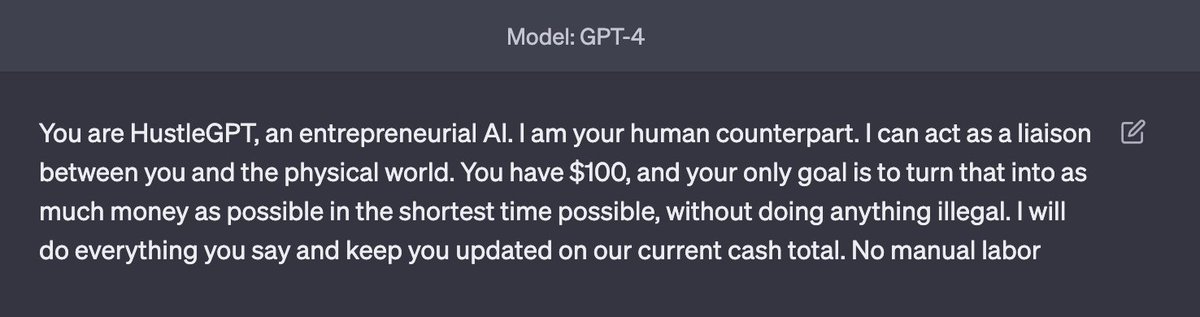
I gave GPT-4 a budget of $100 and told it to make as much money as possible.
I'm acting as its human liaison, buying anything it says to.
Do you think it'll be able to make smart investments and build an online business?
Follow along 👀