KUSD, and our broader fiat infrastructure, is built for regulated financial movement where many Web3-focused stablecoins have fallen short. Compliance isn’t optional for the institutions we work with. We’ve heard firsthand from our partners that capabilities like built-in KYC are essential for their real-world adoption.
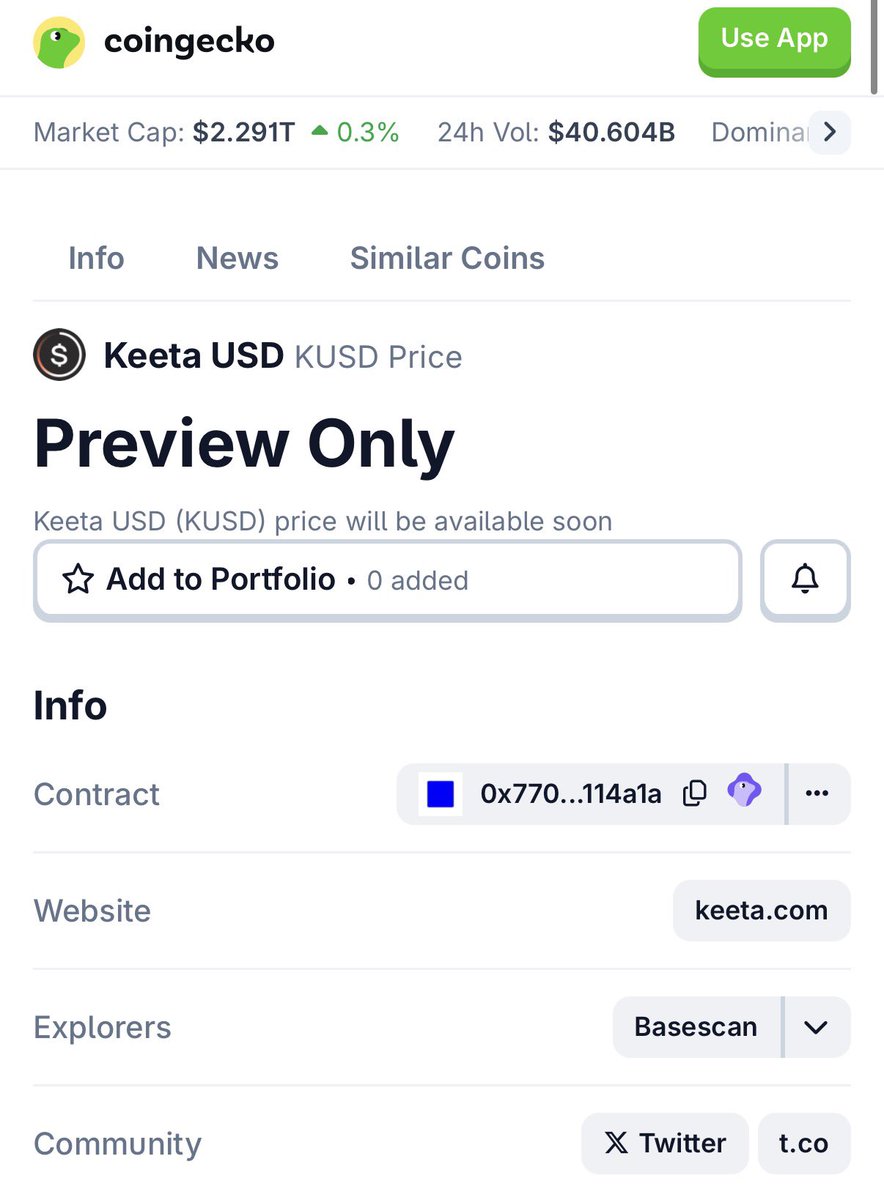
Following @GeckoTerminal’s Keeta $KTA integration, CoinGecko is already listing 9 of the upcoming “K” stablecoins. The assets, released in collaboration with @LayerZero_Core, have no activity so far – but this may signal a faster release timeline than previously expected.
Everyone is calling @KeetaNetwork dead while the chart bleeds. Meanwhile, $KTA just gained:
🔥 A confirmed buy-and-burn model
🇦🇪 Abu Dhabi-backed venture targeting tens of billions in RWAs
🤖 x402 AI-agent payments
🌐 @LayerZero_Core + 9 cross-chain stablecoins
Share of you HODL 👇 Breakdown + Price Prediction
https://t.co/GzGInxZxco
I need you to stop scrolling right now.
Because what just dropped between @KeetaNetwork and @LayerZero is not just another partnership announcement.
This is the moment regulated money goes omnichain. Forever.
Let me break it down. 👇
[CARD 1 The Partnership]
A month ago, I sat here and asked a hypothetical.
What would a LayerZero x Keeta partnership actually look like?
I reasoned through it. Settlement layer. Distribution layer. Two pieces of the same puzzle.
Yesterday @KeetaNetwork and @LayerZero made it official.
The exact words they used?
"Where Keeta operates as the Layer 1 of record for regulated, fiat-backed assets, LayerZero operates as the connective tissue across blockchains."
And what comes next is bigger than most people realise.
Here's why this is a watershed moment for the entire crypto industry.
@LayerZero isn't some mid-tier bridging protocol. These people are the actual plumbing of Web3.
61% of ALL stablecoins run through LayerZero infrastructure.
Let that land for a second.
Not some stablecoins. Not most stablecoins. 61% of every single stablecoin that moves cross-chain.
And they own 85% of the entire cross-chain transaction market after acquiring Stargate Finance earlier this year.
[CARD 2 The Volume Numbers]
Look at that growth curve on Card 2.
$0 to $10 billion took 430 days.
$100 billion to $150 billion took 134 days.
The flywheel isn't spinning up. It's already at full speed.
And Keeta just got added to the engine.
$260 BILLION in total volume. 170+ blockchains. 830+ tokens.
@KeetaNetwork is now among them.
Now here's where it gets really interesting. Because what Keeta is launching isn't just another token bridge.
They've created something the market has never seen before.
Keeta Stablecoins.
Not USDC. Not USDT.
Those are stablecoins backed by treasury bills and cash reserves. Fine products. But not what institutions actually need at the treasury level.
Keeta Stablecoins are tokenised commercial bank money.
Actual bank deposits. 1:1. Held through Bivo, a US licensed money transmitter (NMLS #2572288).
That's the difference between a receipt for money and actual money.
[CARD 3 What Keeta Stablecoins Actually Are]
And because they're built on LayerZero's OFT standard there's no wrapping. No bridge. No synthetic version sitting on a different chain.
One canonical supply. Moving natively across Keeta, Ethereum, Solana and Base.
The same regulated bank money wherever institutions operate.
In 9 currencies by end of this month.
🇺🇸 USD 🇪🇺 EUR 🇬🇧 GBP 🇯🇵 JPY 🇨🇳 CNY 🇨🇦 CAD 🇲🇽 MXN 🇦🇪 AED 🇭🇰 HKD
That's not a crypto product. That's institutional FX treasury management on public rails.
Now let me tell you why all of this is enormous for $KTA specifically.
Follow this logic because this is the mechanism that matters.
Right now a consortium of major US banks is building a tokenised deposit network.
You know what it is?
Closed. Banks only. Walled garden.
Same instruments. Same idea. But you only get access if you're in the club.
@KeetaNetwork and @LayerZero just built the open alternative.
Same institutional grade instruments. Available today. On public chains. To anyone.
If you're a bank, a payments company, a fintech, a sovereign wealth fund and you want open rails rather than a closed banking cartel there is now one clear answer.
And every transaction that flows through those rails generates KTA fees.
[CARD 4 The KTA Mechanism: Volume → Fees → Burns → Value]
Volume flows in from LayerZero's $260B+ network.
Every settlement on Keeta's L1 generates transaction fees paid in KTA.
A portion of those fees get burned. Permanently removed from the fixed 1 billion KTA max supply.
More institutional volume.
Fewer KTA in existence.
Fixed supply. Growing demand.
You don't need me to finish that sentence.
I want to be real with you as well because this account doesn't do hype without honesty.
The exact burn ratio isn't formally confirmed in Keeta's official documentation yet. Watch for that update.
And no specific bank names have been disclosed as live partners at this stage. Institutional adoption takes time to confirm publicly.
But here's what IS confirmed.
✅ @LayerZero co-announced this. Not a rumour. Not a leak.
✅ Keeta Stablecoins are live and deploying this month.
✅ Backed by Bivo, a licensed US money transmitter.
✅ 9 currencies across Ethereum, Solana, Base and Keeta L1.
✅ OFT standard. No bridge risk. One canonical supply.
✅ Both teams confirmed. More developments between Keeta and LayerZero are coming soon.
This is card 1 of a much bigger story.
One month ago I was reasoning through a hypothetical.
Yesterday it became real.
I've been covering $KTA since the beginning. The Visa Direct integration. The Google Cloud partnership. The ASK Group UAE commodities deal. The Keeta Personal super-app.
Every single piece has been building toward the same thing.
A single, compliant, high-speed settlement layer connected to everything.
This is what that looks like.
@KeetaNetwork × @LayerZero
Regulated bank money. Available everywhere.
The infrastructure of global finance just went omnichain.
Are you paying attention?
🔁 Retweet this thread so your timeline doesn't sleep on the biggest institutional blockchain partnership of 2026.
Follow @XCryptozc for Keeta Decoded. The only account breaking down $KTA with cards, data and no noise. @schenkty
#KTA #Keeta #LayerZero #RWA #Crypto #Web3 #KeetaDecoded
$KTA Still DCAing the lows and why not.
Visa Direct
Bank Acquisition (impending)
Ask Group JV - Imminent
Eric Schmidt- Heavy Backer
10M+TPS, 400ms Finality
Keeta Personal
Built in compliance
Bridge, Swift, Ach Intergration
X402
Layerzero partnership - Active
@KeetaNetwork
The world's largest institutions need a cash management system that works across fiat currencies and public blockchains.
@KeetaNetwork is solving that problem by introducing tokenized commercial bank money, built on LayerZero's OFT standard.
(1/8) Keeta has partnered with @LayerZero_Core to bring tokenized commercial bank money to major blockchains.
Together, we’re the first to combine regulated, compliance-native infrastructure with omnichain interoperability, enabling financial institutions to move bank-grade money across any ecosystem.
Theory time…
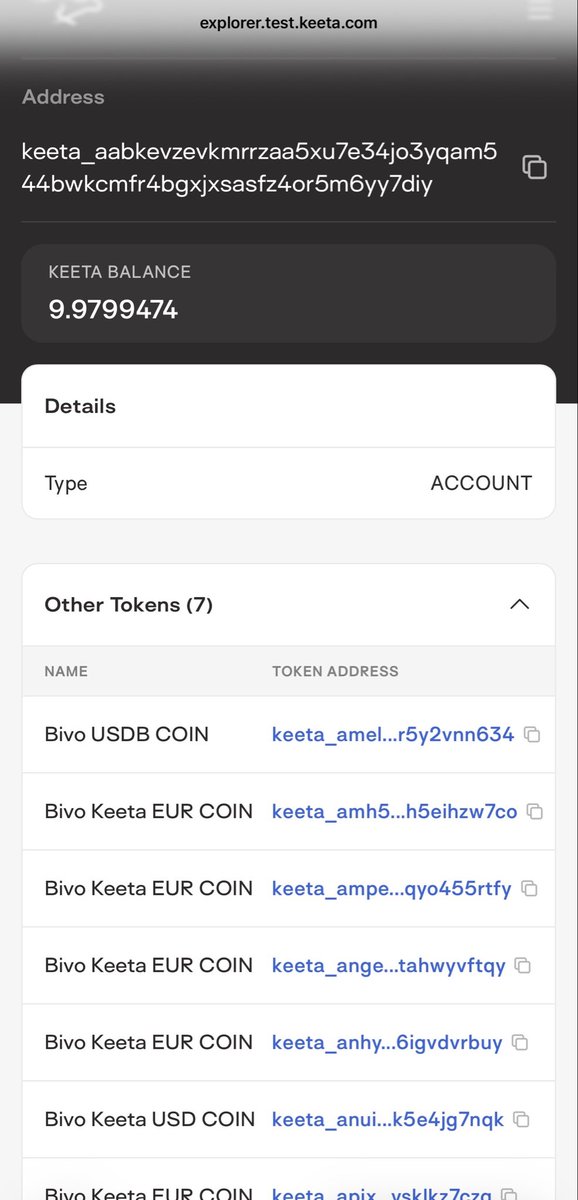
So today we got a group of PUBLIC fiat tokens with the KB prefix.
My theory is KB stands for Keeta Bivo and these are the customer-facing fiat balances.
So I started digging through the testnet to see if there was anything that supported that.
Sure enough, I found testnet assets literally named Bivo USDB COIN, Bivo Keeta USD COIN, and Bivo Keeta EUR COIN.
That obviously doesn’t prove KB means Keeta Bivo, but it definitely makes the theory a lot more believable. It also tells me today’s mainnet assets didn’t just appear out of nowhere. They’ve been building and testing this for a while.
All of today’s tokens were deployed with a supply of 0.000001, which tells me they’re being staged and tested, not yet launched for public use.
Then we have KVDUSD, except it’s PRIVATE instead of public.
My theory is KVD stands for Keeta Visa Direct. Visa Direct is already a live payment rail on Keeta, so it’s not a random guess. If that’s what KVD means, it would make perfect sense that it’s private. Settlement between regulated institutions isn’t something random wallets should be interacting with.
Then we have HSBCGBP and NBCCAD. I’m taking a shot in the dark and speculating those refer to HSBC and the National Bank of Canada.
One thing I also noticed is KVDUSD, HSBCGBP, and NBCCAD were all deployed from a different wallet than the KB tokens. I don’t know if they’re legitimate assets or not so keep that in mind.
What’s really interesting is…
They’re PRIVATE.
So now the theory looks like this:
PUBLIC = customer-facing balances.
PRIVATE = institution-specific payment rails and settlement infrastructure.
What’s even more interesting is this lines up with where the industry is already heading. HSBC has been talking about permissioned digital money. National Bank of Canada is backing Canada’s regulated CADD stablecoin. Visa is already settling billions of dollars through stablecoin infrastructure.
Could I be completely wrong about what the prefixes mean? Absolutely.
But the public vs. private split, combined with the different deployment wallets, doesn’t look random to me.
If this theory is even close, we might be watching regulated payment infrastructure get built on-chain in real time. 👀
@KeetaNetwork $KTA
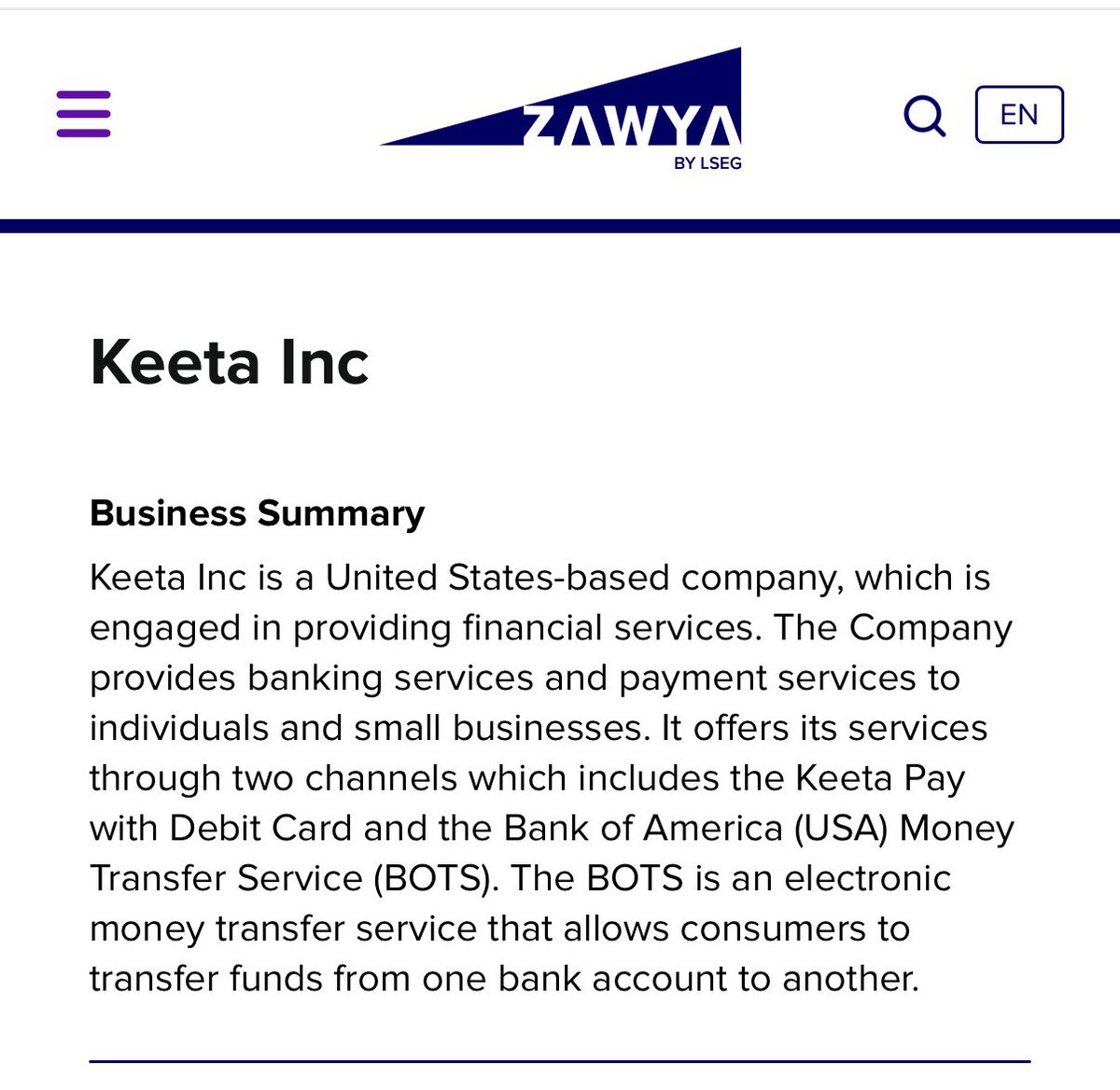
With the Bank of America in the spotlight again, I can pull out my favorite fun fact:
BofA has already worked on a blockchain banking app – and it went completely unnoticed. It was powered by @KeetaNetwork, the Eric Schmidt-backed payments blockchain with 10,000,000 TPS and 400ms finality.
Back then, Keeta operated as a permissioned network providing settlement infrastructure to banks. Since then, they’ve opened up their network and are chasing much more ambitious goals.
The app in question still hasn’t seen the light and may never will, but one thing is for certain: One of the largest and most influential banks has relied on an obscure blockchain startup to bring about its next-generation products – and nobody even noticed.
Before you doubt what I say, this is recorded in the company intelligence database of the London Stock Exchange Group. You can log into your LSEG Workspace and witness this cryptic, but still very specific piece of info
$KTA
The Keeta C# .NET SDK is now available in beta.
In addition to our TypeScript SDK, developers can now build on Keeta using the .NET framework. The beta SDK provides a starting point for developers and gives our upcoming partners the flexibility to integrate with Keeta using their preferred language.
The beta documentation is now available alongside our existing TypeScript documentation: https://t.co/Ju15aapGiR




![XCryptozc's tweet photo. I need you to stop scrolling right now.
Because what just dropped between @KeetaNetwork and @LayerZero is not just another partnership announcement.
This is the moment regulated money goes omnichain. Forever.
Let me break it down. 👇
[CARD 1 The Partnership]
A month ago, I sat here and asked a hypothetical.
What would a LayerZero x Keeta partnership actually look like?
I reasoned through it. Settlement layer. Distribution layer. Two pieces of the same puzzle.
Yesterday @KeetaNetwork and @LayerZero made it official.
The exact words they used?
"Where Keeta operates as the Layer 1 of record for regulated, fiat-backed assets, LayerZero operates as the connective tissue across blockchains."
And what comes next is bigger than most people realise.
Here's why this is a watershed moment for the entire crypto industry.
@LayerZero isn't some mid-tier bridging protocol. These people are the actual plumbing of Web3.
61% of ALL stablecoins run through LayerZero infrastructure.
Let that land for a second.
Not some stablecoins. Not most stablecoins. 61% of every single stablecoin that moves cross-chain.
And they own 85% of the entire cross-chain transaction market after acquiring Stargate Finance earlier this year.
[CARD 2 The Volume Numbers]
Look at that growth curve on Card 2.
$0 to $10 billion took 430 days.
$100 billion to $150 billion took 134 days.
The flywheel isn't spinning up. It's already at full speed.
And Keeta just got added to the engine.
$260 BILLION in total volume. 170+ blockchains. 830+ tokens.
@KeetaNetwork is now among them.
Now here's where it gets really interesting. Because what Keeta is launching isn't just another token bridge.
They've created something the market has never seen before.
Keeta Stablecoins.
Not USDC. Not USDT.
Those are stablecoins backed by treasury bills and cash reserves. Fine products. But not what institutions actually need at the treasury level.
Keeta Stablecoins are tokenised commercial bank money.
Actual bank deposits. 1:1. Held through Bivo, a US licensed money transmitter (NMLS #2572288).
That's the difference between a receipt for money and actual money.
[CARD 3 What Keeta Stablecoins Actually Are]
And because they're built on LayerZero's OFT standard there's no wrapping. No bridge. No synthetic version sitting on a different chain.
One canonical supply. Moving natively across Keeta, Ethereum, Solana and Base.
The same regulated bank money wherever institutions operate.
In 9 currencies by end of this month.
🇺🇸 USD 🇪🇺 EUR 🇬🇧 GBP 🇯🇵 JPY 🇨🇳 CNY 🇨🇦 CAD 🇲🇽 MXN 🇦🇪 AED 🇭🇰 HKD
That's not a crypto product. That's institutional FX treasury management on public rails.
Now let me tell you why all of this is enormous for $KTA specifically.
Follow this logic because this is the mechanism that matters.
Right now a consortium of major US banks is building a tokenised deposit network.
You know what it is?
Closed. Banks only. Walled garden.
Same instruments. Same idea. But you only get access if you're in the club.
@KeetaNetwork and @LayerZero just built the open alternative.
Same institutional grade instruments. Available today. On public chains. To anyone.
If you're a bank, a payments company, a fintech, a sovereign wealth fund and you want open rails rather than a closed banking cartel there is now one clear answer.
And every transaction that flows through those rails generates KTA fees.
[CARD 4 The KTA Mechanism: Volume → Fees → Burns → Value]
Volume flows in from LayerZero's $260B+ network.
Every settlement on Keeta's L1 generates transaction fees paid in KTA.
A portion of those fees get burned. Permanently removed from the fixed 1 billion KTA max supply.
More institutional volume.
Fewer KTA in existence.
Fixed supply. Growing demand.
You don't need me to finish that sentence.
I want to be real with you as well because this account doesn't do hype without honesty.
The exact burn ratio isn't formally confirmed in Keeta's official documentation yet. Watch for that update.
And no specific bank names have been disclosed as live partners at this stage. Institutional adoption takes time to confirm publicly.
But here's what IS confirmed.
✅ @LayerZero co-announced this. Not a rumour. Not a leak.
✅ Keeta Stablecoins are live and deploying this month.
✅ Backed by Bivo, a licensed US money transmitter.
✅ 9 currencies across Ethereum, Solana, Base and Keeta L1.
✅ OFT standard. No bridge risk. One canonical supply.
✅ Both teams confirmed. More developments between Keeta and LayerZero are coming soon.
This is card 1 of a much bigger story.
One month ago I was reasoning through a hypothetical.
Yesterday it became real.
I've been covering $KTA since the beginning. The Visa Direct integration. The Google Cloud partnership. The ASK Group UAE commodities deal. The Keeta Personal super-app.
Every single piece has been building toward the same thing.
A single, compliant, high-speed settlement layer connected to everything.
This is what that looks like.
@KeetaNetwork × @LayerZero
Regulated bank money. Available everywhere.
The infrastructure of global finance just went omnichain.
Are you paying attention?
🔁 Retweet this thread so your timeline doesn't sleep on the biggest institutional blockchain partnership of 2026.
Follow @XCryptozc for Keeta Decoded. The only account breaking down $KTA with cards, data and no noise. @schenkty
#KTA #Keeta #LayerZero #RWA #Crypto #Web3 #KeetaDecoded](https://pbs.twimg.com/media/HN9JopkWIAAj-qq.jpg)
![XCryptozc's tweet photo. I need you to stop scrolling right now.
Because what just dropped between @KeetaNetwork and @LayerZero is not just another partnership announcement.
This is the moment regulated money goes omnichain. Forever.
Let me break it down. 👇
[CARD 1 The Partnership]
A month ago, I sat here and asked a hypothetical.
What would a LayerZero x Keeta partnership actually look like?
I reasoned through it. Settlement layer. Distribution layer. Two pieces of the same puzzle.
Yesterday @KeetaNetwork and @LayerZero made it official.
The exact words they used?
"Where Keeta operates as the Layer 1 of record for regulated, fiat-backed assets, LayerZero operates as the connective tissue across blockchains."
And what comes next is bigger than most people realise.
Here's why this is a watershed moment for the entire crypto industry.
@LayerZero isn't some mid-tier bridging protocol. These people are the actual plumbing of Web3.
61% of ALL stablecoins run through LayerZero infrastructure.
Let that land for a second.
Not some stablecoins. Not most stablecoins. 61% of every single stablecoin that moves cross-chain.
And they own 85% of the entire cross-chain transaction market after acquiring Stargate Finance earlier this year.
[CARD 2 The Volume Numbers]
Look at that growth curve on Card 2.
$0 to $10 billion took 430 days.
$100 billion to $150 billion took 134 days.
The flywheel isn't spinning up. It's already at full speed.
And Keeta just got added to the engine.
$260 BILLION in total volume. 170+ blockchains. 830+ tokens.
@KeetaNetwork is now among them.
Now here's where it gets really interesting. Because what Keeta is launching isn't just another token bridge.
They've created something the market has never seen before.
Keeta Stablecoins.
Not USDC. Not USDT.
Those are stablecoins backed by treasury bills and cash reserves. Fine products. But not what institutions actually need at the treasury level.
Keeta Stablecoins are tokenised commercial bank money.
Actual bank deposits. 1:1. Held through Bivo, a US licensed money transmitter (NMLS #2572288).
That's the difference between a receipt for money and actual money.
[CARD 3 What Keeta Stablecoins Actually Are]
And because they're built on LayerZero's OFT standard there's no wrapping. No bridge. No synthetic version sitting on a different chain.
One canonical supply. Moving natively across Keeta, Ethereum, Solana and Base.
The same regulated bank money wherever institutions operate.
In 9 currencies by end of this month.
🇺🇸 USD 🇪🇺 EUR 🇬🇧 GBP 🇯🇵 JPY 🇨🇳 CNY 🇨🇦 CAD 🇲🇽 MXN 🇦🇪 AED 🇭🇰 HKD
That's not a crypto product. That's institutional FX treasury management on public rails.
Now let me tell you why all of this is enormous for $KTA specifically.
Follow this logic because this is the mechanism that matters.
Right now a consortium of major US banks is building a tokenised deposit network.
You know what it is?
Closed. Banks only. Walled garden.
Same instruments. Same idea. But you only get access if you're in the club.
@KeetaNetwork and @LayerZero just built the open alternative.
Same institutional grade instruments. Available today. On public chains. To anyone.
If you're a bank, a payments company, a fintech, a sovereign wealth fund and you want open rails rather than a closed banking cartel there is now one clear answer.
And every transaction that flows through those rails generates KTA fees.
[CARD 4 The KTA Mechanism: Volume → Fees → Burns → Value]
Volume flows in from LayerZero's $260B+ network.
Every settlement on Keeta's L1 generates transaction fees paid in KTA.
A portion of those fees get burned. Permanently removed from the fixed 1 billion KTA max supply.
More institutional volume.
Fewer KTA in existence.
Fixed supply. Growing demand.
You don't need me to finish that sentence.
I want to be real with you as well because this account doesn't do hype without honesty.
The exact burn ratio isn't formally confirmed in Keeta's official documentation yet. Watch for that update.
And no specific bank names have been disclosed as live partners at this stage. Institutional adoption takes time to confirm publicly.
But here's what IS confirmed.
✅ @LayerZero co-announced this. Not a rumour. Not a leak.
✅ Keeta Stablecoins are live and deploying this month.
✅ Backed by Bivo, a licensed US money transmitter.
✅ 9 currencies across Ethereum, Solana, Base and Keeta L1.
✅ OFT standard. No bridge risk. One canonical supply.
✅ Both teams confirmed. More developments between Keeta and LayerZero are coming soon.
This is card 1 of a much bigger story.
One month ago I was reasoning through a hypothetical.
Yesterday it became real.
I've been covering $KTA since the beginning. The Visa Direct integration. The Google Cloud partnership. The ASK Group UAE commodities deal. The Keeta Personal super-app.
Every single piece has been building toward the same thing.
A single, compliant, high-speed settlement layer connected to everything.
This is what that looks like.
@KeetaNetwork × @LayerZero
Regulated bank money. Available everywhere.
The infrastructure of global finance just went omnichain.
Are you paying attention?
🔁 Retweet this thread so your timeline doesn't sleep on the biggest institutional blockchain partnership of 2026.
Follow @XCryptozc for Keeta Decoded. The only account breaking down $KTA with cards, data and no noise. @schenkty
#KTA #Keeta #LayerZero #RWA #Crypto #Web3 #KeetaDecoded](https://pbs.twimg.com/media/HN9JopiXAAAB-nC.jpg)
![XCryptozc's tweet photo. I need you to stop scrolling right now.
Because what just dropped between @KeetaNetwork and @LayerZero is not just another partnership announcement.
This is the moment regulated money goes omnichain. Forever.
Let me break it down. 👇
[CARD 1 The Partnership]
A month ago, I sat here and asked a hypothetical.
What would a LayerZero x Keeta partnership actually look like?
I reasoned through it. Settlement layer. Distribution layer. Two pieces of the same puzzle.
Yesterday @KeetaNetwork and @LayerZero made it official.
The exact words they used?
"Where Keeta operates as the Layer 1 of record for regulated, fiat-backed assets, LayerZero operates as the connective tissue across blockchains."
And what comes next is bigger than most people realise.
Here's why this is a watershed moment for the entire crypto industry.
@LayerZero isn't some mid-tier bridging protocol. These people are the actual plumbing of Web3.
61% of ALL stablecoins run through LayerZero infrastructure.
Let that land for a second.
Not some stablecoins. Not most stablecoins. 61% of every single stablecoin that moves cross-chain.
And they own 85% of the entire cross-chain transaction market after acquiring Stargate Finance earlier this year.
[CARD 2 The Volume Numbers]
Look at that growth curve on Card 2.
$0 to $10 billion took 430 days.
$100 billion to $150 billion took 134 days.
The flywheel isn't spinning up. It's already at full speed.
And Keeta just got added to the engine.
$260 BILLION in total volume. 170+ blockchains. 830+ tokens.
@KeetaNetwork is now among them.
Now here's where it gets really interesting. Because what Keeta is launching isn't just another token bridge.
They've created something the market has never seen before.
Keeta Stablecoins.
Not USDC. Not USDT.
Those are stablecoins backed by treasury bills and cash reserves. Fine products. But not what institutions actually need at the treasury level.
Keeta Stablecoins are tokenised commercial bank money.
Actual bank deposits. 1:1. Held through Bivo, a US licensed money transmitter (NMLS #2572288).
That's the difference between a receipt for money and actual money.
[CARD 3 What Keeta Stablecoins Actually Are]
And because they're built on LayerZero's OFT standard there's no wrapping. No bridge. No synthetic version sitting on a different chain.
One canonical supply. Moving natively across Keeta, Ethereum, Solana and Base.
The same regulated bank money wherever institutions operate.
In 9 currencies by end of this month.
🇺🇸 USD 🇪🇺 EUR 🇬🇧 GBP 🇯🇵 JPY 🇨🇳 CNY 🇨🇦 CAD 🇲🇽 MXN 🇦🇪 AED 🇭🇰 HKD
That's not a crypto product. That's institutional FX treasury management on public rails.
Now let me tell you why all of this is enormous for $KTA specifically.
Follow this logic because this is the mechanism that matters.
Right now a consortium of major US banks is building a tokenised deposit network.
You know what it is?
Closed. Banks only. Walled garden.
Same instruments. Same idea. But you only get access if you're in the club.
@KeetaNetwork and @LayerZero just built the open alternative.
Same institutional grade instruments. Available today. On public chains. To anyone.
If you're a bank, a payments company, a fintech, a sovereign wealth fund and you want open rails rather than a closed banking cartel there is now one clear answer.
And every transaction that flows through those rails generates KTA fees.
[CARD 4 The KTA Mechanism: Volume → Fees → Burns → Value]
Volume flows in from LayerZero's $260B+ network.
Every settlement on Keeta's L1 generates transaction fees paid in KTA.
A portion of those fees get burned. Permanently removed from the fixed 1 billion KTA max supply.
More institutional volume.
Fewer KTA in existence.
Fixed supply. Growing demand.
You don't need me to finish that sentence.
I want to be real with you as well because this account doesn't do hype without honesty.
The exact burn ratio isn't formally confirmed in Keeta's official documentation yet. Watch for that update.
And no specific bank names have been disclosed as live partners at this stage. Institutional adoption takes time to confirm publicly.
But here's what IS confirmed.
✅ @LayerZero co-announced this. Not a rumour. Not a leak.
✅ Keeta Stablecoins are live and deploying this month.
✅ Backed by Bivo, a licensed US money transmitter.
✅ 9 currencies across Ethereum, Solana, Base and Keeta L1.
✅ OFT standard. No bridge risk. One canonical supply.
✅ Both teams confirmed. More developments between Keeta and LayerZero are coming soon.
This is card 1 of a much bigger story.
One month ago I was reasoning through a hypothetical.
Yesterday it became real.
I've been covering $KTA since the beginning. The Visa Direct integration. The Google Cloud partnership. The ASK Group UAE commodities deal. The Keeta Personal super-app.
Every single piece has been building toward the same thing.
A single, compliant, high-speed settlement layer connected to everything.
This is what that looks like.
@KeetaNetwork × @LayerZero
Regulated bank money. Available everywhere.
The infrastructure of global finance just went omnichain.
Are you paying attention?
🔁 Retweet this thread so your timeline doesn't sleep on the biggest institutional blockchain partnership of 2026.
Follow @XCryptozc for Keeta Decoded. The only account breaking down $KTA with cards, data and no noise. @schenkty
#KTA #Keeta #LayerZero #RWA #Crypto #Web3 #KeetaDecoded](https://pbs.twimg.com/media/HN9JopaWEAAGBht.jpg)







![XCryptozc's tweet photo. I need you to stop scrolling right now.
Because what just dropped between @KeetaNetwork and @LayerZero is not just another partnership announcement.
This is the moment regulated money goes omnichain. Forever.
Let me break it down. 👇
[CARD 1 The Partnership]
A month ago, I sat here and asked a hypothetical.
What would a LayerZero x Keeta partnership actually look like?
I reasoned through it. Settlement layer. Distribution layer. Two pieces of the same puzzle.
Yesterday @KeetaNetwork and @LayerZero made it official.
The exact words they used?
"Where Keeta operates as the Layer 1 of record for regulated, fiat-backed assets, LayerZero operates as the connective tissue across blockchains."
And what comes next is bigger than most people realise.
Here's why this is a watershed moment for the entire crypto industry.
@LayerZero isn't some mid-tier bridging protocol. These people are the actual plumbing of Web3.
61% of ALL stablecoins run through LayerZero infrastructure.
Let that land for a second.
Not some stablecoins. Not most stablecoins. 61% of every single stablecoin that moves cross-chain.
And they own 85% of the entire cross-chain transaction market after acquiring Stargate Finance earlier this year.
[CARD 2 The Volume Numbers]
Look at that growth curve on Card 2.
$0 to $10 billion took 430 days.
$100 billion to $150 billion took 134 days.
The flywheel isn't spinning up. It's already at full speed.
And Keeta just got added to the engine.
$260 BILLION in total volume. 170+ blockchains. 830+ tokens.
@KeetaNetwork is now among them.
Now here's where it gets really interesting. Because what Keeta is launching isn't just another token bridge.
They've created something the market has never seen before.
Keeta Stablecoins.
Not USDC. Not USDT.
Those are stablecoins backed by treasury bills and cash reserves. Fine products. But not what institutions actually need at the treasury level.
Keeta Stablecoins are tokenised commercial bank money.
Actual bank deposits. 1:1. Held through Bivo, a US licensed money transmitter (NMLS #2572288).
That's the difference between a receipt for money and actual money.
[CARD 3 What Keeta Stablecoins Actually Are]
And because they're built on LayerZero's OFT standard there's no wrapping. No bridge. No synthetic version sitting on a different chain.
One canonical supply. Moving natively across Keeta, Ethereum, Solana and Base.
The same regulated bank money wherever institutions operate.
In 9 currencies by end of this month.
🇺🇸 USD 🇪🇺 EUR 🇬🇧 GBP 🇯🇵 JPY 🇨🇳 CNY 🇨🇦 CAD 🇲🇽 MXN 🇦🇪 AED 🇭🇰 HKD
That's not a crypto product. That's institutional FX treasury management on public rails.
Now let me tell you why all of this is enormous for $KTA specifically.
Follow this logic because this is the mechanism that matters.
Right now a consortium of major US banks is building a tokenised deposit network.
You know what it is?
Closed. Banks only. Walled garden.
Same instruments. Same idea. But you only get access if you're in the club.
@KeetaNetwork and @LayerZero just built the open alternative.
Same institutional grade instruments. Available today. On public chains. To anyone.
If you're a bank, a payments company, a fintech, a sovereign wealth fund and you want open rails rather than a closed banking cartel there is now one clear answer.
And every transaction that flows through those rails generates KTA fees.
[CARD 4 The KTA Mechanism: Volume → Fees → Burns → Value]
Volume flows in from LayerZero's $260B+ network.
Every settlement on Keeta's L1 generates transaction fees paid in KTA.
A portion of those fees get burned. Permanently removed from the fixed 1 billion KTA max supply.
More institutional volume.
Fewer KTA in existence.
Fixed supply. Growing demand.
You don't need me to finish that sentence.
I want to be real with you as well because this account doesn't do hype without honesty.
The exact burn ratio isn't formally confirmed in Keeta's official documentation yet. Watch for that update.
And no specific bank names have been disclosed as live partners at this stage. Institutional adoption takes time to confirm publicly.
But here's what IS confirmed.
✅ @LayerZero co-announced this. Not a rumour. Not a leak.
✅ Keeta Stablecoins are live and deploying this month.
✅ Backed by Bivo, a licensed US money transmitter.
✅ 9 currencies across Ethereum, Solana, Base and Keeta L1.
✅ OFT standard. No bridge risk. One canonical supply.
✅ Both teams confirmed. More developments between Keeta and LayerZero are coming soon.
This is card 1 of a much bigger story.
One month ago I was reasoning through a hypothetical.
Yesterday it became real.
I've been covering $KTA since the beginning. The Visa Direct integration. The Google Cloud partnership. The ASK Group UAE commodities deal. The Keeta Personal super-app.
Every single piece has been building toward the same thing.
A single, compliant, high-speed settlement layer connected to everything.
This is what that looks like.
@KeetaNetwork × @LayerZero
Regulated bank money. Available everywhere.
The infrastructure of global finance just went omnichain.
Are you paying attention?
🔁 Retweet this thread so your timeline doesn't sleep on the biggest institutional blockchain partnership of 2026.
Follow @XCryptozc for Keeta Decoded. The only account breaking down $KTA with cards, data and no noise. @schenkty
#KTA #Keeta #LayerZero #RWA #Crypto #Web3 #KeetaDecoded](https://pbs.twimg.com/media/HN9JoplXUAET7GC.jpg)


