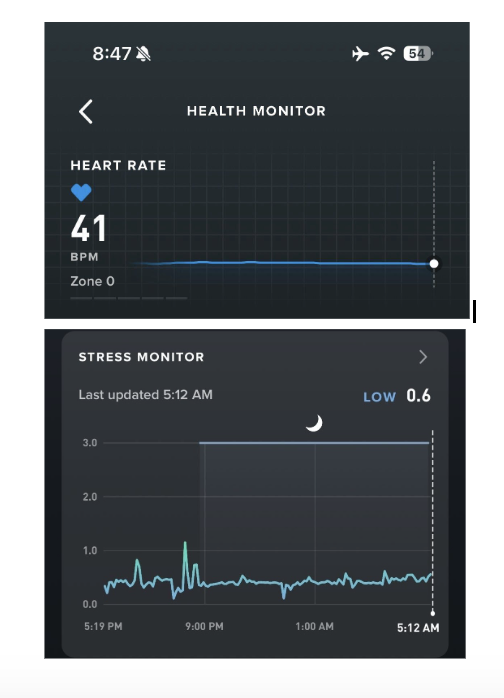
my resting heart rate before bed last night was 41 bpm. 99.8th percentile of 18 yr olds.
as a result, my sleep was perfect. zero sleep stress. no wake events. deep, restorative sleep. my body and mind cleaned itself and rebuilt. i feel amazing today.
rhr before bed is a look into your soul. i've built my life around it.
your rhr before bed captures and confesses levels of stress, relationship with food, wind down routine, screen usage, emotional health, cardiovascular health, sleep hygiene, circadian rhythm strength and more.
lowering your rhr before bed is the number one thing you can do for your health. it's the things i've been telling you for years now:
1. final food 4 hr before bed
2. screens off 30 min before bed
3. avoid blue light 2hr before bed, use red/amber
4. book in hand 10 min before sleep
5. go to bed same time every night
6. light in eyes when waking (sun or 10k lux)
7. walk for 10 min immediately following eating
8. daily exercise (even if for 20 min)
9. eat good stuff, ditch the junk
10. foster friends, family and love
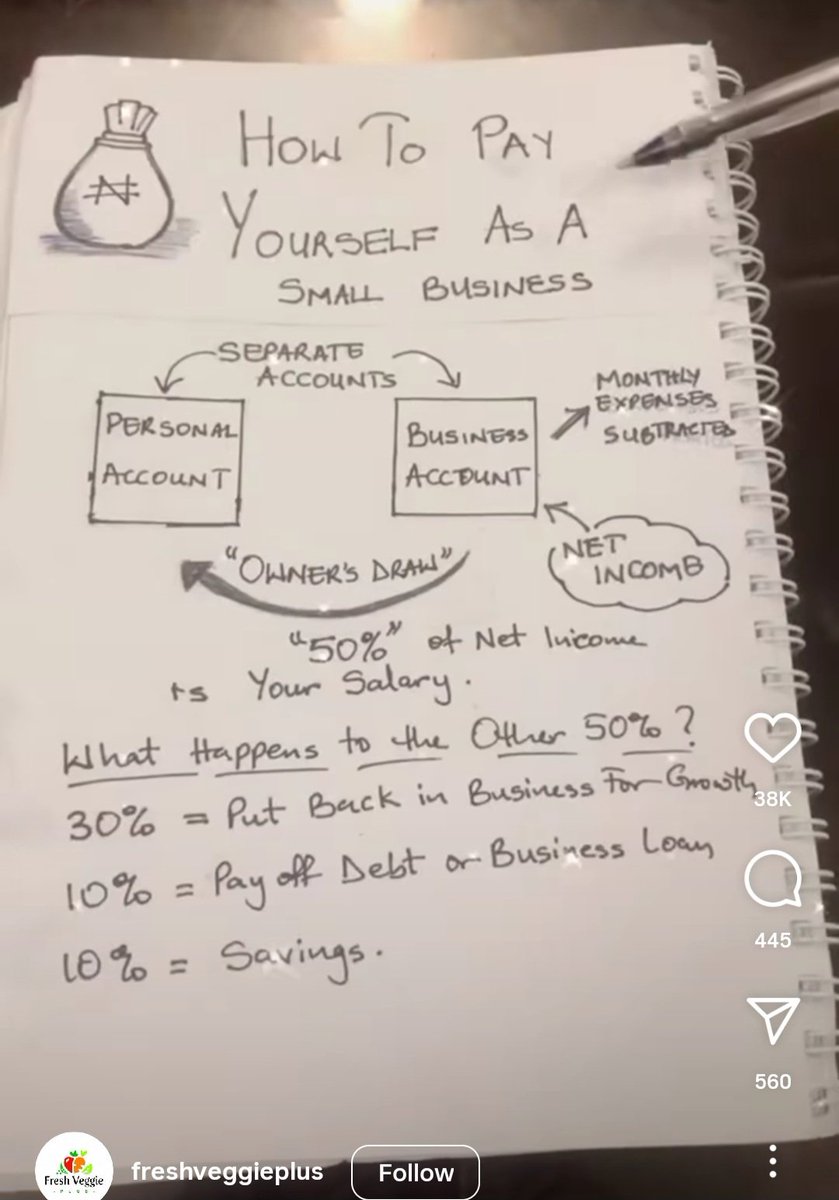
HOW TO PAY YOURSELF AS A SMALL BUSINESS OWNER
I came across this online, and since I’ve tried it myself, I can confidently recommend it to any small business owner (SBO) struggling with cash flow.
One major mistake most SBOs make is running business transactions through their personal accounts. This rookie mistake often leads to overspending and poor financial control. To avoid this, you must have two separate accounts: one for your business and one for personal use.
All business expenses should be paid strictly from the business account. This makes it easier to monitor expenses and accurately determine your profit margin at the end of a given period.
I also recommend using a simple Excel template to record and track your revenue and expenses daily. This way, you can easily assess the financial health of your business at a glance.
At the end of the month, after deducting all expenses, such as staff salaries, raw materials, supplies, staff motivation, transportation, marketing, taxes, miscellaneous costs, etc., from your revenue, whatever remains is your income.
This is where many SBOs become lazy and undisciplined. They start spending the income recklessly because they believe they can always make the money back and don’t answer to anyone. After all, it’s “their money.”
You can not have this mindset if you plan to grow and expand your business.
Instead, do this:
1. Pay yourself 50% of the income as an employee
There is you, and there is your business. Treat your business as a separate entity. When closing your books for the month, pay yourself a salary just as you pay your staff. Transfer this 50% into your personal account. This should cover your personal savings, expenses, and enjoyment.
2. Reinvest 30% of the income back into the business
This does not have to be spent immediately if there’s nothing urgent to purchase. You can set it aside until it’s enough to acquire new equipment or fund business growth. Just ensure the money is strictly reserved for the business.
3. Use 10% to pay off debt or business loans
If your business is debt-free, you can add this percentage to your business savings.
4. Save 10% in an interest-yielding platform
This savings is for your business, not your personal savings. Over time, it helps build financial stability and future expansion capacity.
I hope this helps someone out there. Financial discipline is especially challenging when you run a business that brings in daily income, but it’s also what separates sustainable businesses from struggling ones.
A 17-year-old just built a mind-controlled prosthetic arm for $300.
Yes, $300.
For something that usually costs $450,000.
Let that hit you.
A teenager, working from home, used AI, cheap materials, and 23,000 lines of code to build a device that reads brain signals without surgery, without implants, and without a $450K price tag.
This is not a feel-good story.
It’s a warning shot.
How can a high school student build something 1,500× cheaper than the industry standard?
What does that say about innovation?
About pricing?
About who gets access to life-changing technology?
Of course, medical prosthetics are expensive for real reasons:
materials, testing, regulation, customization.
But let’s be honest — not all of that justifies a half-million-dollar price.
This story exposes a simple truth:
The future of accessibility won’t come from the system.
It will come from the outsiders who dare to challenge it.
If a 17-year-old can match top-tier prosthetics for a fraction of the cost…
why aren’t these solutions available to the millions who need them?
What do you think — breakthrough moment or the start of a bigger revolution?
#AI #Innovation #Healthcare #Accessibility #FutureOfTech
Good morning Bryan, huge fan & cannot wait to watch your new Netflix Documentary Don’t Die.
Question 🙋 Will you be offering any sort of “Black Friday Deals” on your Blueprint supplements on your website for all the poor people who aren’t qualified as the top ranking 4% earners in America?
Such As:
- “Big Stack” currently priced at $435
Would love to know for those of us in college studying Biomedical Engineering/Biotech would love to get our hands on such an incredible supplement stack!