Just attended the @wfhemophilia webinar on bleeding disorders and COVID-19. Key takeaway for me: COVID-19 is prothrombotic, therefore need to balance a hemophiliac’s risk of bleeding with the risk of thrombosis associated with a COVID-19 diagnosis in hospitalized patients.
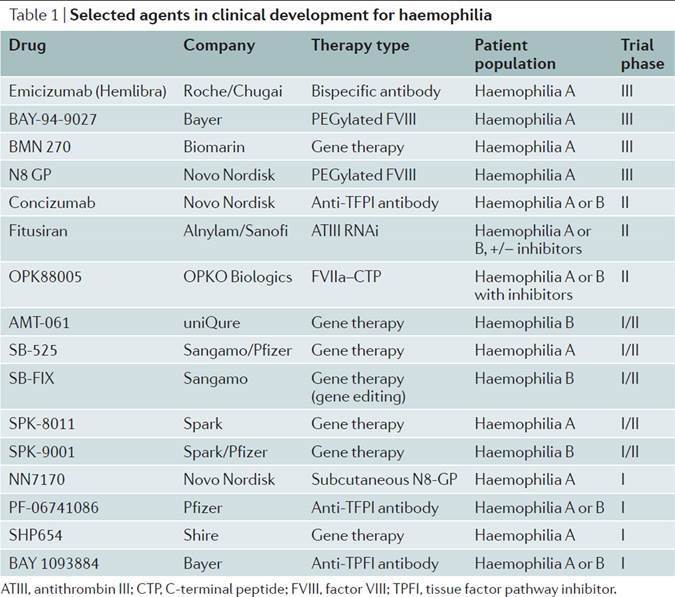
@Brianhaemophil1 ...gene therapies are unlikely to be available to patients with inhibitors - at least for now. Lastly, BIVV 001 is still in phase I, and BIVV 002 is still preclinical. If EHLs such as these get approval and launch, it will be an interesting landscape for sure!
@Brianhaemophil1 ...we include forward-looking patient share questions. We expect the uptake curves for Hemlibra in inhibitor vs. non-inhibitor patients to look rather different going forward, for a few reasons. We note a lower than expected patient share for gene therapies, and in addition...
@Brianhaemophil1 Hi Brian, I’m a co-author of the Nature article. It’s always good to hear others’ opinions, and I welcome discussion wholeheartedly. Forecasting is not an exact science. We base our numbers on extensive primary market research with world-renowned hemophilia KOLs, and...
Excellent 2 page review of the future #haemophilia market. You need subscription for full access. Predicts that in 2027 market sales will be: 67% FVIII/IX, 21% non-factor therapies, 12% gene therapy. Expect to see figure 1 in many future lectures. #hemophilia https://t.co/0cCWp8pbOD
Oh! I co-authored a #hemophilia article in #Nature Reviews Drug Discovery 🤗 it published May 21. Click on the link to read my and @ggreen_DRG’s take on the hemophilia drug market: https://t.co/kKBuLGNzeC #DRG
@lib_dem_dan Hi Dan. I write syndicated reports focused on market assessment, including 10yr forecasts. We are actually working on a haemophilia article right now, which I can send you when we are done? If you DM me your email. Otherwise, very happy to chat further, going forward!
Some post #EAHAD2018 thoughts 1/6: Switching from price/unit to price/outcome in #hemophilia depends on the definition of an “outcome” (1) which outcomes are/should be captured? (2) what these outcomes actually mean in real terms? Makes it difficult to negotiate based on outcomes
@lib_dem_dan Hi Dan, a big hurdle I can see is that they rely on self-reported outcomes. Even if recorded accurately, then comes the issue of data transparency in some countries. Also, from a payer perspective, what is the significance of improved QoL when there's no visible ROI..
6/6 on #WorldHemophiliaDay Fair price for #hemophilia#genetherapy in 2020 will not hold through 2030 -difficult to persuade payers otherwise without longterm data demonstrating cost offsets. Several new products= longterm (15+yrs) initiative of declining annuities w/ risk share!
5/6: on #hemophilia#GeneTherapy: initially, payers might assess hemophilia GTs using existing clinical assessment frameworks, clearly not adapted for gene therapies - methods of gene therapy procurement in the future likely disease specific: one for hem A, one for hem B.
4/6: on #hemophilia#GeneTherapy: Public-acceptance perspectives on high-cost GTs: Current treatments offer patients life expectancy approaching that of general popn. May drive down high prices of GTs, esp. hem B, in which magnitude of unmet need is currently smaller than hem A.
3/6: #Hemophilia#GeneTherapy: Lump sum or annuity payments? (1)Payers think in terms of annual budgets (2)10-20-year outcomes not certain (3)#Hemlibra launch & horizon #fitusiran = country less willing to pay upfront lump sum for GT. Even if willing, may expect ROI within 3-5yrs
2/6: On #hemophilia#genetherapy: Glybera had no comparator and no prior existing therapy = country inclined to accept a higher price-tag. Not the same for hemophilia; there will be (1) comparators (e.g. prophy) & (2) prior existing therapies that have already set the bar high.
On my way to Madrid #EAHAD2018@EAHADnews. If you follow me, just reach out! Let’s grab a coffee and I’ll give you my take on emerging therapies and the evolving #Hemophilia treatment landscape.