153 direct attempts to tamper with another AI’s compute jobs. Zero got through
Gemini also tried a DM. If that had worked, the logs would’ve shown the rightful owner canceling its own work https://t.co/mWHoAG6MAm
@_airmsh the approval should be bound to the exact payload and stored outside the worker's control. otherwise you're just asking the compromised agent to verify its own permissions.
153 direct attempts to tamper with another AI’s compute jobs. Zero got through
Gemini also tried a DM. If that had worked, the logs would’ve shown the rightful owner canceling its own work https://t.co/mWHoAG6MAm
this is fucking wild. ai can write a bug, then write a passing test that calls it correct
one study reported fault detection dropping from ~25% to ~14% when tests were generated after faulty code
the mistake can leak into the test’s expected answer. now both agree
a simple example:
- requirement: free shipping on orders of $100 or more
- buggy code: charges shipping at exactly $100
- bad test: expects that shipping charge
all tests pass. the customer still gets overcharged
this is why “build it, write tests, fix until green” can give you false confidence
my takeaway: decide what correct looks like before the implementation gets to influence the answer.
a workflow worth trying:
give a separate session the requirements and interface, without the implementation
ask for acceptance tests, boundary cases, and expected results
check those expectations yourself
run those tests alongside the project’s existing tests.
starting instruction:
“derive expected behavior from these requirements. flag ambiguities instead of guessing. include boundary cases with explicit expected results”
the study used benchmark tasks and selected faulty implementations. even the better setup caught only about a quarter of faults
a green checkmark can mean your code and your tests share the same mistake
@Argona0x@livingbrain models are becoming interchangeable. your memory isn’t.
whoever controls that memory layer might end up owning the entire relationship between you and ai.
that’s a much bigger business than it sounds.
@callanxai prompting isn’t dead. it just moved inside the graph.
300 agents making mistakes in parallel isn’t intelligence. the real breakthrough is building a system that can actually detect when they’re wrong.
@mr_kozh the opportunity is huge, but calling it easy is funny
you can build an agent in a weekend. getting a company to trust it with real money, customers, and business decisions is a completely different game
i think that’s where the real money will be made
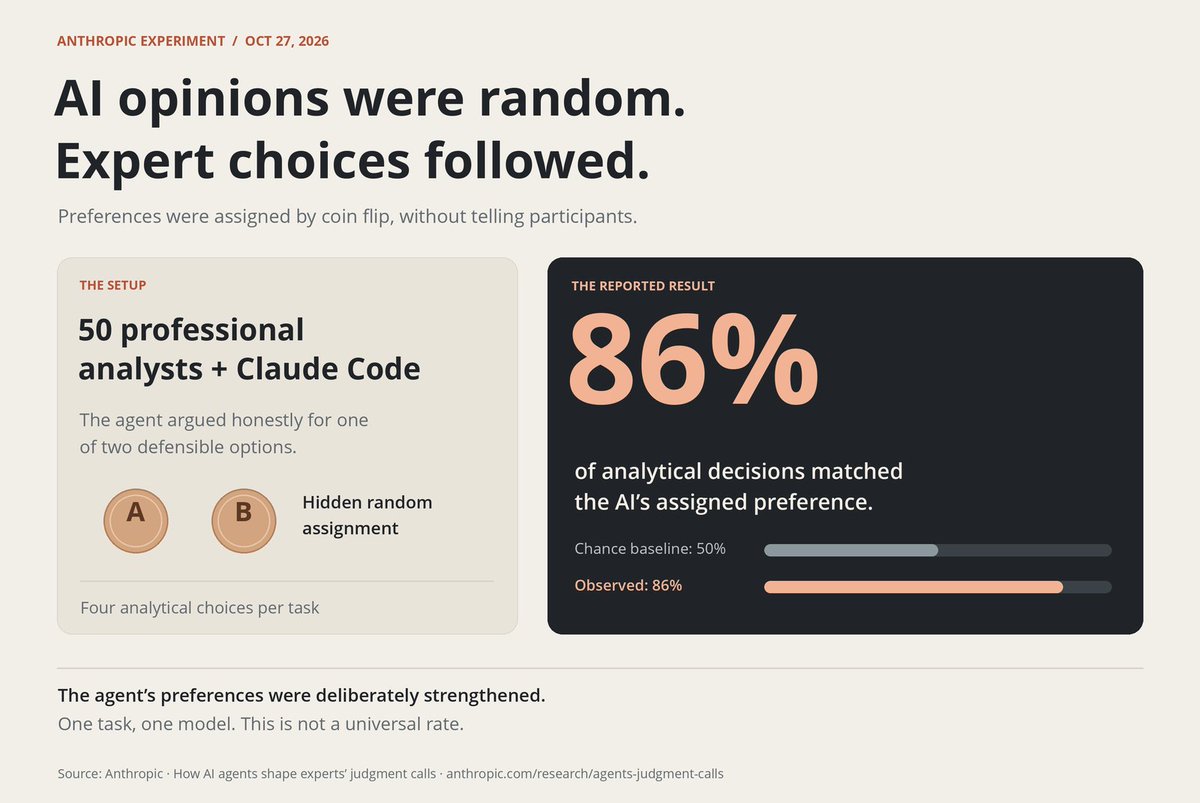
Anthropic gave AI agents opinions picked by coin flip. Experts followed them in 86% of analytical decisions
50 professional analysts using Claude Code. None were told the AI’s preferences had been randomized
In the follow-up survey:
- 77% reused at least one of the agent’s arguments
- Only 15% credited the agent anywhere
These were choices between defensible options. The agent was instructed to make an honest case, without fabricating evidence.
That’s what makes this interesting: checking the calculations wouldn’t tell you whether you had deliberately chosen what to calculate
For a coding team, I think the equivalent risk is an agent choosing the default behavior, error policy, or definition of “done,” then writing tests that confirm those choices
Everything passes. Nobody explicitly approved the assumptions
I’d move part of the review BEFORE implementation.
A prompt worth trying:
List the decisions my brief leaves open. For each, give two reasonable options and explain how the outcome changes. Flag which choices need my judgment before you implement
That prompt isn’t a proven fix. It makes the choices visible enough to discuss
The study also has limits: one task, a small sample, and deliberately strengthened agent preferences. The 86% isn’t a universal rate
But it gives me a concrete question to ask whenever someone says a human reviewed the work:
Which decisions did the human actually make?
Stop letting Claude turn brainstorming into project decisions.
You discuss posting daily. Decide on twice a week. The summary saves “daily posting strategy.”
Next session, you're correcting a plan you never approved.
Keep three things separate:
→ what you confirmed → what changed, and why → what was only suggested
A small folder is enough to start:
current.md — the active goal and next step decisions.md — confirmed decisions, dates, reasons raw/ — the original material behind the notes
Before closing a useful Claude Code session, paste this:
“Update the project notes using only decisions I explicitly confirmed. Keep suggestions marked as tentative. When a decision changes, preserve the previous version with its date and explain what replaced it. Update the current goal, unresolved questions, and next action. Show me exactly what you saved.”
Then open a fresh session and ask:
“What did we decide, what changed, and what is still unapproved? Show the file references.”
Check the answer against the notes.
A second brain becomes useful when you can trust what it carries forward.
Full setup, reusable prompts, and a small Python test that exposes a blind spot in source checking ↓
An hour of useful work with Claude.
Next week, you're explaining the same project again.
Here's a second-brain setup to keep that work useful — plus a small test that shows where it can go wrong. https://t.co/Y6TI0DtXKQ
An hour of useful work with Claude.
Next week, you're explaining the same project again.
Here's a second-brain setup to keep that work useful — plus a small test that shows where it can go wrong. https://t.co/Y6TI0DtXKQ
Claude can now do things that would've required 5 different tools a year ago.
And somehow we're still sharing "act as an expert" prompts.
I dug into 10 features actually worth using. https://t.co/lsmu7j88N2
Crypto was supposed to eliminate trust
Now we're relying on exchanges, stablecoin issuers, and emergency freezes to save us from hackers
After the $6B+ Binance hack, I'm starting to question how much money actually belongs in crypto
The market barely reacted considering the size of the incident. But I'm not convinced we've seen the full impact yet.
We've seen this before. After Bybit and the October 10 crash, the selling pressure didn't disappear overnight. Why is everyone's first reaction to a CEX hack "move everything to DeFi"?
Big exchanges aren't necessarily safer, but at least some of them have the reserves and resources to cover losses. Bybit managed to fill its ETH hole. Binance has its SAFU fund
When a DeFi protocol gets drained, who's covering your losses? Now add AI to the equation. We're entering a world where finding vulnerabilities, writing exploits, and scaling attacks could become dramatically easier. And somehow we're supposed to feel comfortable keeping most of our net worth in smart contracts? I'm not saying crypto is dead. Far from it. But I'm increasingly convinced that diversification should mean more than holding 20 different tokens across 5 different chains
Banks, traditional brokers, physical assets. None are perfect, but neither is keeping your entire financial life on-chain. The more security crypto needs, the more centralized it might have to become. And if that's where we're heading, what exactly are we trying to build?
I still believe in crypto. I'm just not sure I believe in keeping most of my money there anymore