12 Biases that distort your Decision-Making:
1. Confirmation Bias - We interpret new information as confirmation of our existing beliefs.
2. Availability Bias - We tend to rely on information that comes to our mind easily/the quickest.
3. Action Bias - We favor action over inaction. That's why we sell or buy prematurely.
4. Zero-Risk Bias - If a risk is considered small, we assume there is no risk at all.
5. Overconfidence - We overestimate our own knowledge and ability.
Often because we know too little to know better. (Less knowledge => more confidence)
6. Survivorship Bias - This is a sample bias that occurs when we assess only successful outcomes and disregard failures.
7. Gambler’s Fallacy - We tend to think that past events affect future possibilities.
8. Dunning-Kruger Effect - The less you know, the more confident you are.
The more you know, the less confident you are.
9. Cause-Effect Fallacy - We always look for cause-effect relationships.
Thus, we find patterns even in totally random data.
10. Hyperbolic Discounting - We are wired to prefer instant gratification (e.g. payouts).
Even when offered significantly more in the future.
11. False Consensus Effect - Too often, we overestimate the degree to which others agree with us.
12. Psychological Denial - When something terrible happens, we tend to fall into a state of denial.
How a retired executive built $70 million?
Theodore Johnson was born in last century and died at the ripe age of 91 in 1993.
From 1923 to 1952, for 29 years, he worked in United Parcel Service (UPS).
He joined the company at $25 a week, rose through the ranks and retired in 1952. At the time of retirement he was making $270 a week, which is $14,000 per year. For ease of understanding, in today’s dollar, it is worth around $1,25,000.
He had a habit of saving around 25% of his income every month and he invested it in stock. When I say stock, he invested only in one stock, that of his employer UPS.
When he retired in 1952, he has accumulated UPS stock worth $7,00,000.
He never touched the corpus. He might have been living on his dividend income. Assuming a dividend yield of 2%, he would have lived very comfortably with dividends itself.
Thirty nine years after his retirement, in 1991, the stock has grown to the value of $70 million. Please note that he might have received a dividend of $1.4 million a year for that corpus.
He gave a sizeable portion of this wealth to his son and two grand children.
After the same, he donated $36 million for various charitable organisations supporting education for poor and disabled.
He passed away next year. His wife died few years before him. They had a long married life.
From what I read, he has lived a well balanced and good life.
No doubt he was a high earner of his times. Still building a corpus of $70 million is a huge achievement.
Many of you are high earners. You can also save 25% of your income. Instead of investing in only one stock (we would not suggest that), you’re investing in equity funds. Shareholders would receive dividends and mutual fund unit holders can do SWP (Systematic Withdrawal Plan).
Four equity funds or index or a portfolio of 10 to 12 stocks can do wonders if you save and invest for two decades with discipline. Higher the corpus, even a small withdrawal would ensure an excellent life style.
You can pass on wealth to your children and grand children and also provide for underprivileged in the society.
Leading a good life style, passing on wealth to next generation and giving it back to society, what more a life well lived needs?
Aim big and work for it.
All the best.
Few investors blogs are worth reading:
- Vijay Malik
- Sanjay Bakshi
- Vishal Khandelwal
- Ankit Kanodia
- Rohit Chauhan
Just google them and you will get the link of their website. Most of the content is free of cost.
Skill is the result of consistent practice and hard work. Talent helps in learning faster, but everyone has the potential to develop and improve. 🌱
#NeverTooLate
AN OPEN LETTER TO ALL NORTH INDIANS
Dear North Indians,
I am a South Indian, Tamilian to be specific, who has lived over two decades in Tamil Nadu and now living in Delhi for the last 10 years and has travelled to almost all North Indian states, except Chhatisgarh. Yes, we Tamilians also migrate for better opportunities like anyone else does and I have never, never, ever felt unwelcomed or discriminated against in any part of north India.
On behalf of my fellow southern folks, I sincerely apologize to all so-called Hindi belt people for the ignorant, arrogant, and unruly behaviour of some South Indians who have been criticizing every North Indian after Congress suffered a humiliating defeat in three out of four large states in the recent elections.
There’s nothing called the North-South divide. Our diverse language system across the country since times immemorial united us. The language was never a hurdle for Sankaracharya when he stepped out of Kerala to unite all diverse sects/sampraday of what we now call Sanatan dharm or Hinduism but today unfortunately in the era of Western social media tools, it is dividing us.
I am sorry for all Gaumutr racist and Islamist slurs targeted at you. In my opinion, the entire Bharat i.e. India is a cow-belt region as cow is sacred to all of us.
It is the faulty ideology of secularism and Muslim appeasement that dominated the states of North India for so long, which is responsible for the backwardness of some of these states. Under the Hindutva regime today:
- A law-abiding Uttar Pradesh is progressing towards a $1 trillion economy,
- Madhya Pradesh is no longer in the BIMARU category,
- Gujarat and Maharashtra collectively contribute to GST collection than Kerala+Tamil Nadu+Karnataka+Telangana combined.
- While Bihar, despite its "secular and socialist" label, is still grappling with significant backwardness due to misplaced priorities of divisive caste politics and religious appeasement,
- Bengal is, for some reason, competing with Bihar in going backwards, (I really don't get why Bengalis are abusing north India!)
- Punjab, under AAP rule, is burdened with the highest public debt at 47% of its state GDP.
Similarly, in the South, the situation is very challenging:
- Kerala has one of the highest debts at ₹4 lakh crore, implying that every child in the state is born with a debt of more than half a lakh rupees. With limited opportunities for employment, the state has one of the highest suicide rates and out-migration
- Karnataka, after a Congress victory, struggles with financial constraints, with the CM seeking additional funds from the Centre for funding its freebies.
- Tamil Nadu, with its pathetic infrastructure stands exposed during present floods and who’s helping us? When the system has collapsed and no DMK (@arivalayam) leaders can be seen on the ground, it is @BJP4TamilNadu and #RSS volunteers, who despite their own challenges, are on the ground helping us with food and relief materials.
Similarly, I can go on and on about the advantages/disadvantages of every state but let us stop here.
Thus, every state, whether in the North or South, has its unique challenges and problems, but what matters is the intent of the elected government. If UP can be reformed under @myogiadityanath, then any state can be.
Building a nation requires the efforts of everyone, and I am committed to being a part of it. We are India, and we are Bharat—no difference, division, or distinction. We’re united.
Once again, on behalf of some bigoted and misguided sections of South Indians, I apologize to all my fellow North Indians.
Love,
Logical GenZ
#NorthSouth #UnitedIndia
P.S.: With humility, I say that I am a very small account. I don't know if my voice will reach any of you. Hence, I request all of you to kindly repost this so that it reaches the targetted audience i.e. all Bharatiya.
Thank you.
IT Cell must keep their long nose out of our matter.
When Virendra Singh Nyangli was shot by Jats, Vasundhara was CM.
When Chatur Singh died, Vasundhara was CM.
When Anandpal died, Vasundhara was CM.
When Samrau happened, Vasundhara was CM.
When Sikar Prakaran happened, Vasundhara was CM.
The Makeshift government is the best time for such operations, as the outgoing government has almost no power and the incoming government can't be blamed for it.
We know who wants all the strong Rajput leaders gone, so please shut up.
Hearing some context on Societe Generale:
Societe Generale #India fund is managed by 7-8 fund managers. Out of these, one manager was found guilty of front running and has been fired. His PF stocks are being sold (main board, sme etc) and not entire societe Generale india PF
Today’s correction was mainly because of #Kotak cautionary note
Some other factors :
Advance tax payment, arbitration unwinding.. portfolio churning at 20000
Ray Dalio explaining how the economy works in 30 minutes.
Here are my key takeaways from Ray Dalio:
Embrace Radical Transparency: Dalio is a strong advocate for open and honest communication within organizations. He believes that transparent feedback and data-driven decision-making lead to better outcomes.
Understand Economic Principles: Dalio emphasizes the importance of understanding economic cycles and the impact they have on investments and business decisions. He's known for his economic model, the "Debt Cycle," which he uses to analyze macroeconomic trends.
Diversify Your Portfolio: Dalio advises diversifying investments across different asset classes to manage risk effectively. He's a proponent of the "All-Weather Portfolio," designed to perform well in various economic environments.
Learn from Mistakes: Dalio encourages learning from both your own mistakes and the mistakes of others. He believes that embracing failure as a learning opportunity is key to personal and professional growth.
Principle-Based Decision-Making: Develop and adhere to your own set of principles and values. Dalio's book "Principles: Life and Work" outlines his own principles and how they've guided his career.
Avoid Emotional Decision-Making: Dalio stresses the importance of separating emotions from decision-making, especially in high-stakes situations. A rational and systematic approach is more likely to lead to success.
Seek Diverse Perspectives: Encourage diverse viewpoints and engage in thoughtful disagreement. Dalio believes that the best decisions are made when multiple perspectives are considered.
Balance Risk and Reward: Understand the risks associated with your decisions and investments. Balancing risk and reward is crucial for long-term success.
Continuous Learning: Dalio is a lifelong learner and advocates for continuous education and personal development. Stay curious and open to new ideas and experiences.
Radical Truth and Radical Transparency: Dalio's concept of "radical truth" involves facing harsh realities and candidly addressing problems, both personally and within organizations. Radical transparency is closely related, promoting open and honest feedback and communication.
We spoke with Pankaj Tibrewal of Kotak AMC.
He says caution is warranted in midcaps & smallcaps.
10 points.
1. While over the last decade, Small-Midcaps have been the best-performing equity class, it is crucial to exercise caution in the short-term now
1/9 @CNBCTV18Live
Wow! He can trade & simultaneously drive, even on a single way road with heavy vehicles. He must be good at trading. I should learn from him.
~ Innocent Retail
https://t.co/OEwzuZMeNR
Finished the 2nd Batch of TA Classes. No more live classes will be held this year.
Those who are interested to watch the recordings can fill out the below form👇
Registration Form : https://t.co/D5EC8Imc3W
Thanks
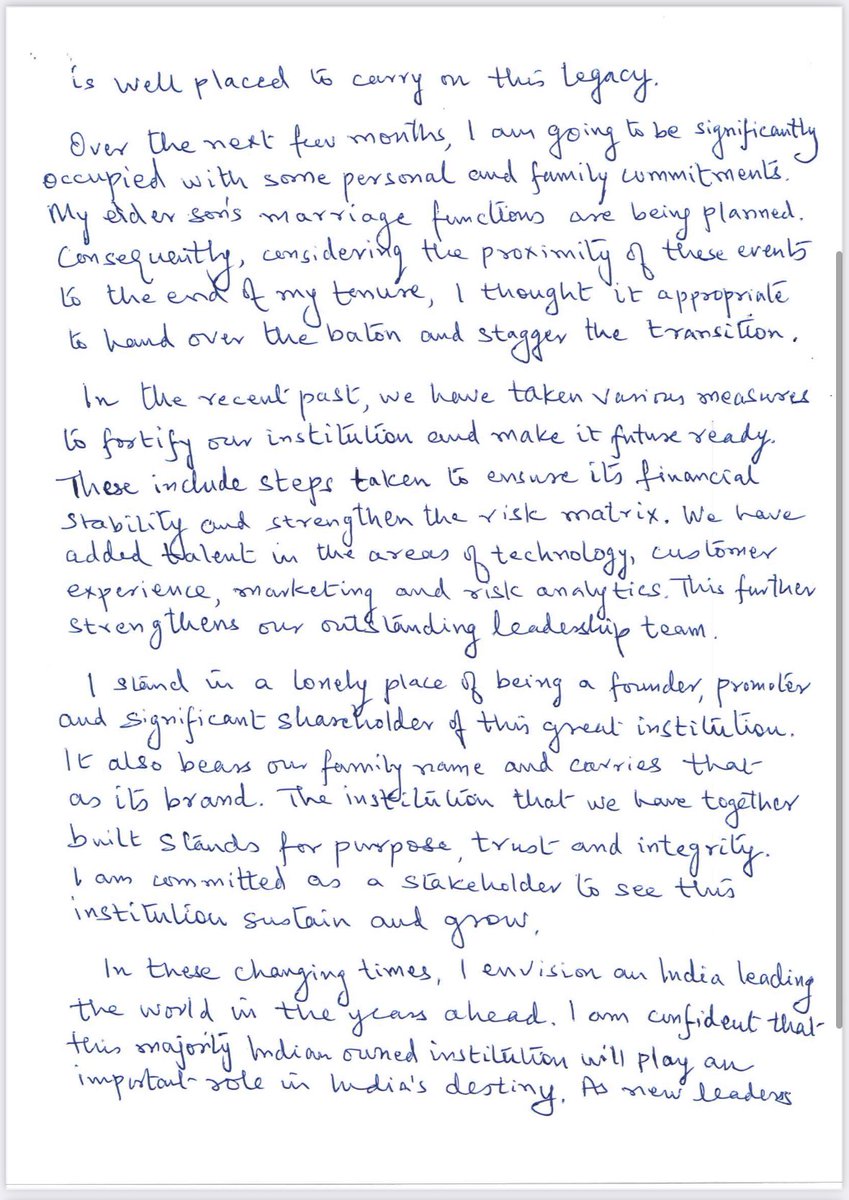
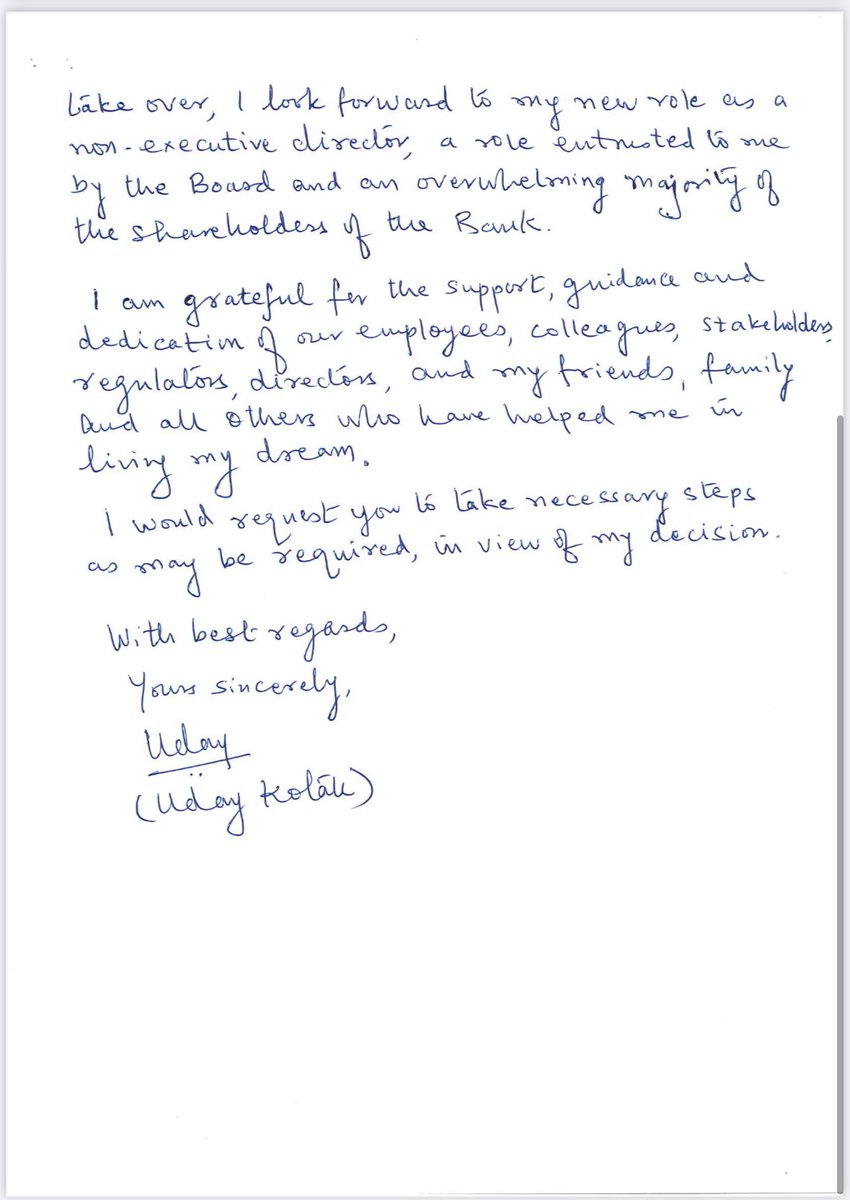
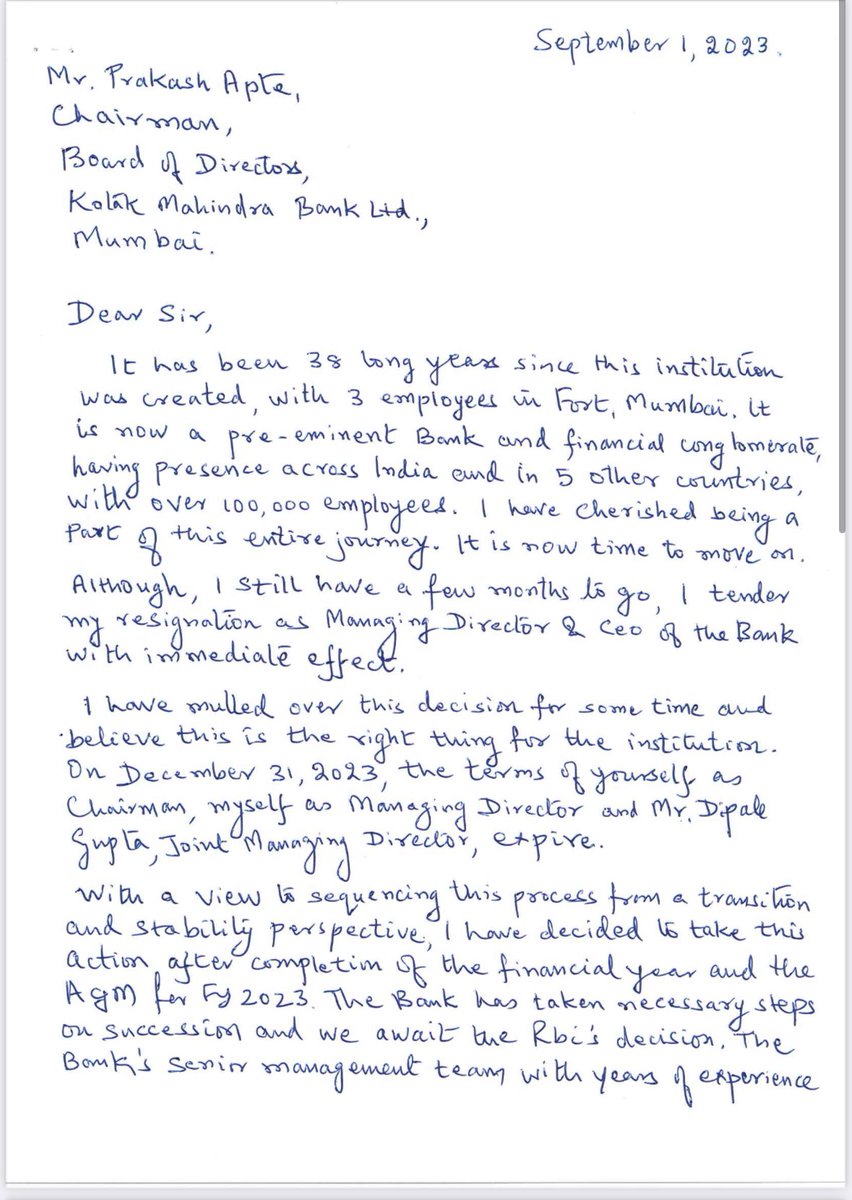
Succession at Kotak Mahindra Bank has been foremost on my mind, since our Chairman, myself and Joint MD are all required to step down by year end. I am keen to ensure smooth transition by sequencing these departures. I initiate this process now and step down voluntarily as CEO.
The bank awaits RBI approval of the proposed successor. In the interim my dear colleague Dipak Gupta - currently Joint MD, will function as MD & CEO, subject to approvals.
As Founder, I am deeply attached to brand Kotak and will continue to serve the institution as Non-Executive Director and significant shareholder. We have an outstanding management team to carry the legacy forward. Founders go away, but the institution flourishes into perpetuity.
A long time ago, I saw names like JP Morgan and Goldman Sachs dominate the financial world and dreamed of creating such an institution in India. It is with this dream that I started Kotak Mahindra 38 years ago, with 3 employees in a 300 sqft office in Fort, Mumbai. I have deeply cherished every bit of this memorable journey, living my dream.
We are now a pre-eminent bank & financial institution, created on the basic tenets of trust and transparency. We have created value for our stakeholders and provide over 1 lakh direct jobs. An investment of ₹10,000 with us in 1985 would be worth around ₹ 300 cr today.
I am confident that this Indian owned institution will continue to play an even more important role in India’s transformation into a social and economic powerhouse.