Open source gives you the code—but not the map.
A seemingly simple change in Codex can quickly turn into a search across 14 implementation sites and 10 files. Miss one, and the change may be incomplete.
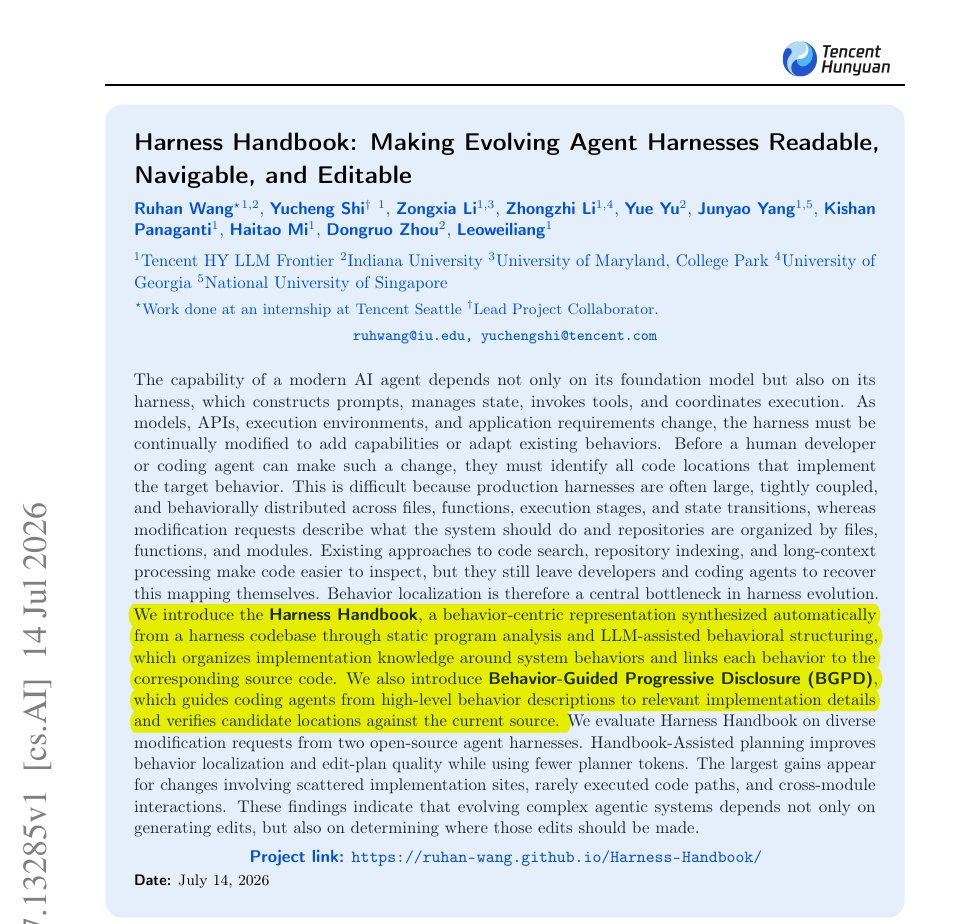
Harness Handbook turns the codebase into a human-readable behavior map, showing what the system does, how behaviors connect, and where each one is implemented.
Start from the behavior, follow the map, and inspect only the code that matters.
Want to understand or customize Codex without getting lost in the repository?
https://t.co/0PRZOR0eLo
Beautiful paper on agent harness
Agent harnesses fail to evolve cleanly because developers often know what must change, but not where the behavior lives.
A behavior-based code handbook helped coding agents find more required edit sites while using fewer planning tokens.
Agent harnesses control prompts, tools, memory, and execution, but one behavior often spans distant files, functions, and states.
This makes code changes risky because a request describes what should change, while repositories reveal only where code lives.
Harness Handbook reorganizes a repository around runtime behaviors, then links each behavior to verified source locations.
It combines static analysis with LLM descriptions, 3 detail levels, shared-state maps, and automatic updates after edits.
Its guided search starts broad, narrows to likely code, follows call and state links, then checks live source.
Across Codex and Terminus-2 requests, it raised plan win rates by 10.0 and 18.9 points while cutting token use by 12.7% and 8.6%.
– arxiv. org/abs/2607.13285
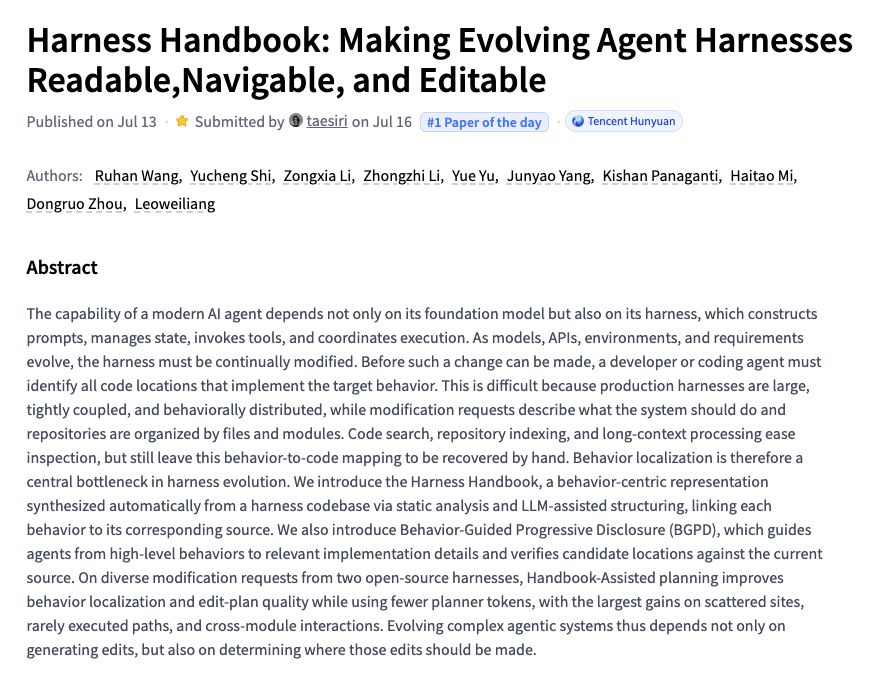
Title: "Harness Handbook: Making Evolving Agent Harnesses Readable,Navigable, and Editable"
Great paper on self-improving agent harnesses.
(bookmark it)
If you maintain a production agent harness, finding every file behind one behavior is often harder than writing the edit.
Harness Handbook builds a three-level map from runtime behaviors to source locations using static analysis and LLM-assisted structuring.
Its BGPD workflow guides coding agents from the system overview to relevant stages, functions, and files, then verifies every candidate against current source.
Across 60 modification requests on Codex and Terminus-2, handbook guidance raised planning win rates from 28.3% to 38.3% and from 26.7% to 45.6%.
Planner token use fell 12.7% and 8.6%.
File- and symbol-level F1 improved in all 24 comparisons against GPT-5.5 and Opus 4.8 reference plans. Complete localization misses fell by as much as 25.9 points.
This is a strong pattern for coding agents that need to evolve large harnesses without losing scattered or rarely executed behavior.
Paper: https://t.co/DW7mIEuPr5
Learn to build effective AI agents in our academy: https://t.co/1e8RZKs4uX
New paper drop 🔥
As agent harnesses evolve, the hard part isn't the change itself. It's finding where to make the change
🔗https://t.co/wXABY0rMtu 🔗https://t.co/QyzYgpEwcT
Async RL boosts throughput, but staleness causes instability. SAT solves this by adjusting PPO clipping based on policy drift. By measuring log-ratio mismatch, SAT identifies high-staleness tokens and tightens clipping boundaries for updates that push them further off-policy.
Recursive self-improvement and continual learning research drops every day, and people keep asking me what those concepts actually mean.
@TuXinming and I tried to unwrap the popular papers and products a bit: WHAT agents update, and WHEN agents update.
⬇️Blog: https://t.co/U5zkPTtgNz
Big thanks to @_akhaliq for sharing Harness Handbook 🙌
Really happy to see the project reaching more people and sparking more discussion around agent harnesses.
- Blog: https://t.co/0PRZOR0eLo
- GitHub: https://t.co/3IpVrt6MTq
- Codex Handbook: https://t.co/e47HFkUCCT
- Terminus-2 Handbook: https://t.co/kCHSYohkD6
- Studio Demo: https://t.co/nECJtD8Y6O
- Paper: https://t.co/8EJGnIgJmS
Harness Handbook
Turn any complex agent codebase into a navigable behavior map. Organize by what the system does, not by file structure — with every behavior linked to its code evidence.
This is the best site on the internet to learn harness engineering.
Free. Completely.
Most AI engineers have never heard the term.
https://t.co/bwDbTTYsjM
Bookmark this site.
Then read this setup ↓
new post on harness engineering for AI self-improvement: https://t.co/ZYvGfVs61k
It is hard to forecast how much the future of RSI will rely on harnesses. Likely harness engineering will evolve in the direction of self-improvement and enable auto-research, and, in turn, smarter models keeps harnesses simple.
Even when many harness improvement get eventually internalized into core model, the need to specify goals and context will not disappear.
Most agent benchmarks end in minutes. Real terminal work doesn’t.
We’re introducing Long-Horizon Terminal-Bench (LHTB), a benchmark designed to measure whether AI agents can sustain progress across hundreds of dependent actions, not just start a task and solve the easy first steps.
LHTB includes:
→ 46 reproducible terminal tasks across 9 categories
→ 18 frontier models evaluated under the same Terminus-2 harness
→ Up to 90 minutes and ~120–320 agent steps per task
→ Hidden, replay-based verifiers that resist shortcuts and reward hacking
→ Continuous partial credit, so meaningful progress isn’t flattened into a binary zero
What did we find?
• The best mean reward is only 0.505
• No model solves even one-third of the benchmark
• 29 of 46 tasks have never been solved by any model
• Higher inference cost does not necessarily mean better performance
Today’s agents can often begin difficult workflows. The harder question is whether they can preserve state, recover from dead ends, verify their work, and actually finish.
Long-horizon execution remains a wide-open frontier.
Watch the video and explore the paper, code, results, sample runs, and leaderboard:
https://t.co/LhCvYrLP0E