On November 18 Cloudflare experienced a service outage, triggered by an issue with a Bot Management feature, impacting multiple Cloudflare services. Here's a detailed breakdown of what happened. https://t.co/7WArlr5ghI
@brankopetric00 Interesting take — our small startup runs fine on K8s: one dev, two EKS clusters, Terraform-managed infra, ArgoCD for GitOps, Istio for traffic. In our case, no pain. Sometimes it’s not the tool, it’s the setup.
You should have the power to change anything and everything about your computer, your framework, and your server. End-to-end open source is your ticket to tell Apple — or anyone! — to go fuck themselves when they seek to dictate how you compute. https://t.co/HZXnRlvYQG
✨ Gemini CLI is now integrated into @zeddotdev. Developers can generate and refactor code, get instant answers on confusing code or error messages, and chat naturally in their terminal. https://t.co/td8tVl5QqI
Now you can sell your film bypassing traditional streaming platforms, controlling pricing, geo-distribution, and revenue via unique links.
Join us 👇🏼
https://t.co/cZO9EMuIEk
#filmmakers#contentCreators#moviemakers#coursecreators
When we started AWS, we looked at the undesirable situation of developers spending 70% of their time on the undifferentiated muck of managing infrastructure (vs only 30% on what differentiated their customer experiences) and aimed to flip that equation on its head. It’s made a pretty big difference in innovation and developer productivity.
Roughly 18 years later, we’re trying to solve another 70-30-like misalignment for developers, where developers are telling us that they’re spending roughly 70% of their time on repetitive and tedious tasks and code.
Today, we’re launching the general availability of Amazon Q, the world’s most capable GenAI-powered assistant for accelerating software development and leveraging companies’ internal data—and that aims to remove much of the muck of repetitive and tedious coding and data tasks for developers and employees at large.
On the software development side, Q doesn’t just generate code, it also tests code, debugs coding conflicts, and transforms code from one form to another (today, developers can save months using Q to move from older versions of Java to newer, more secure and capable ones; in the near future, Q will help developers transform their .net code as well). Q Agents does multi-step planning and reasoning to allow developers to string together multiple requests and have Q implement them.
On the internal data side, most companies have voluminous troves of internally relevant data that resides in wikis, intranet pages, Salesforce, storage repositories like Amazon S3, and a bevy of other data stores and SaaS apps that are hard to access. It makes answering straightforward questions about company policies, products, business results, code, people, and many other topics hard and frustrating. Q makes this much simpler. You can point Q at all of your enterprise data repositories, and it’ll search all this data, summarize logically, analyze trends, and engage in dialog with customers about it.
We also introduced today a powerful new capability called Q Apps, which lets employees describe, in natural language, what apps they want to build on top of this internal data, and Q Apps will quickly generate that app. This is going to make it *so* much easier for internal teams to build useful apps from their own data.
Customers are gravitating to Q, and we already see companies like Brightcove, British Telecom, Datadog, GitLab, GoDaddy, National Australia Bank, NCS, Netsmart, Slalom, Smartsheet, Sun Life, Tata Consultancy Services, Toyota, and Wiz using Q. And, we’ve only been in beta til today.
Very excited about how Q will change what’s possible for our customers, and being a part of helping them innovate more quickly. https://t.co/Bcf7k7huOX
The Humanode Biomapper Saga campaign series on @Galxe is underway!
As we gear up for the unveiling of Humanode Biomapper, join us in a campaign series designed to enlighten and celebrate🎉
Participate to earn OATs and a chance at a share of $10,000 in HMND 💰 Plus, watch out for surprise airdrops from Humanode partners.
Over three weeks collect loyalty points and OATs for your participation in Biomapper Saga. The highest scorers will share the HMND prize pool. Don't miss out!
Join the fun here: https://t.co/r5v85iHevm
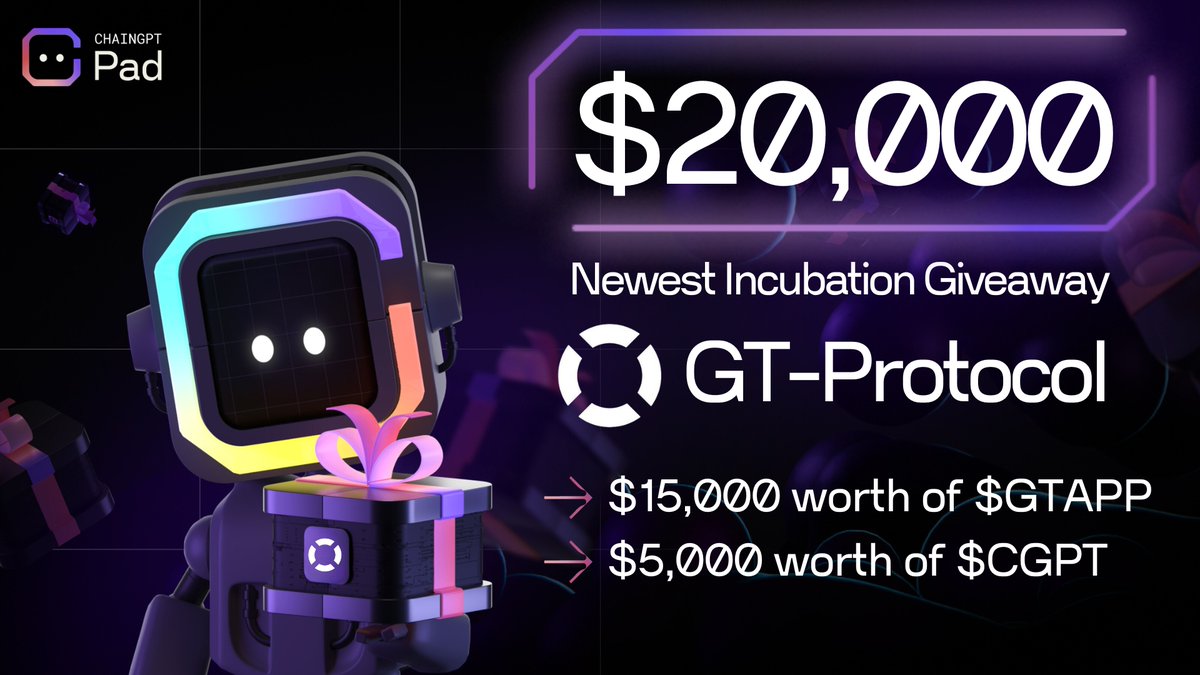
🚀 Exciting news! Together with our newest incubation partner @GT_Protocol, we are hosting a $20,000 worth giveaway!
🪂 Join to win:
- $15,000 in $GTAPP
- $5,000 in $CGPT
How to enter:
🔶 Gleam: https://t.co/N51IkU5XIt
🔶 Telegram bot: https://t.co/U4n5trDBe3
Verifying my account on nostr
My Public Key: npub1908t8y5nkgvqe65lt8a0qpllq88nqyekt3w9ul7q3r7yusenrmwswjekl6
Find others at https://t.co/VT0wPrwg2a @nostrdirectory#nostr
I'm in the top 2% of users on StackOverflow. My content there has been viewed by over 1.7M people. And it's unlikely I'll ever write anything there again.
Which may be a much bigger problem than it seems. Because it may be the canary in the mine of our collective knowledge.
A canary that signals a change in the airflow of knowledge: from human-human via machine, to human-machine only. Don’t pass human, don’t collect 200 virtual internet points along the way.
StackOverflow is *the* repository for programming Q&A. It has 100M users & saves man-years of time & wig-factories-worth of grey hair every single day.
It is driven by people like me who ask questions that other developers answer. Or vice-versa. Over 10 years I've asked 217 questions & answered 77. Those questions have been read by millions of developers & had tens of millions of views.
But since GPT4 it looks less & less likely any of that will happen; at least for me. Which will be bad for StackOverflow. But if I'm representative of other knowledge-workers then it presents a larger & more alarming problem for us as humans.
What happens when we stop pooling our knowledge with each other & instead pour it straight into The Machine? Where will our libraries be? How can we avoid total dependency on The Machine? What content do we even feed the next version of The Machine to train on?
When it comes time to train GPTx it risks drinking from a dry riverbed. Because programmers won't be asking many questions on StackOverflow. GPT4 will have answered them in private. So while GPT4 was trained on all of the questions asked before 2021 what will GPT6 train on?
This raises a more profound question. If this pattern replicates elsewhere & the direction of our collective knowledge alters from outward to humanity to inward into the machine then we are dependent on it in a way that supercedes all of our prior machine-dependencies.
Whether or not it "wants" to take over, the change in the nature of where information goes will mean that it takes over by default.
Like a fast-growing Covid variant, AI will become the dominant source of knowledge simply by virtue of growth. If we take the example of StackOverflow, that pool of human knowledge that used to belong to us - may be reduced down to a mere weighting inside the transformer.
Or, perhaps even more alarmingly, if we trust that the current GPT doesn't learn from its inputs, it may be lost altogether. Because if it doesn't remember what we talk about & we don't share it then where does the knowledge even go?
We already have an irreversible dependency on machines to store our knowledge. But at least we control it. We can extract it, duplicate it, go & store it in a vault in the Arctic (as Github has done).
So what happens next? I don't know, I only have questions.
None of which you'll find on StackOverflow.
(I write on AI from a technical and product perspective. If you find that interesting then please do follow me for more)
Smart contracts are immutable. Once they're deployed, they can't be changed.
The natural question for every #Web3 developer is then: How do projects update their applications?
Here's how👇
Challenging was to understand ownership, traits and lifetime. They felt alien at the beginning and it took me a while to wrap my head round, but in the end it all make a lot of sense. I used it to write smart contracts on the solana network.
I found myself in the same situation. After I finished the rust book, I continued with the zero2prod book by @algo_luca. I tried to keep up with it and followed all the bits from start to finish.
You can also read more about design patterns here: https://t.co/Auozk4fOOd
Trying to learn rust this year as a side hobby. Any good repo to learn well known design patterns and well designed code architecture after having red the book? (besides foundry)