Brilliant mathematician Paul Erdős had no home and no job. He traveled around the world, collaborating with hundreds of other mathematicians and publishing over 1500 papers. He also had a quirky sense of humor and a fondness for amphetamines.
The reason why the shape of a lot of pianos looks like an exponential is because for waves on a string, doubling length means reducing a music pitch by an octave (2x the frequency).
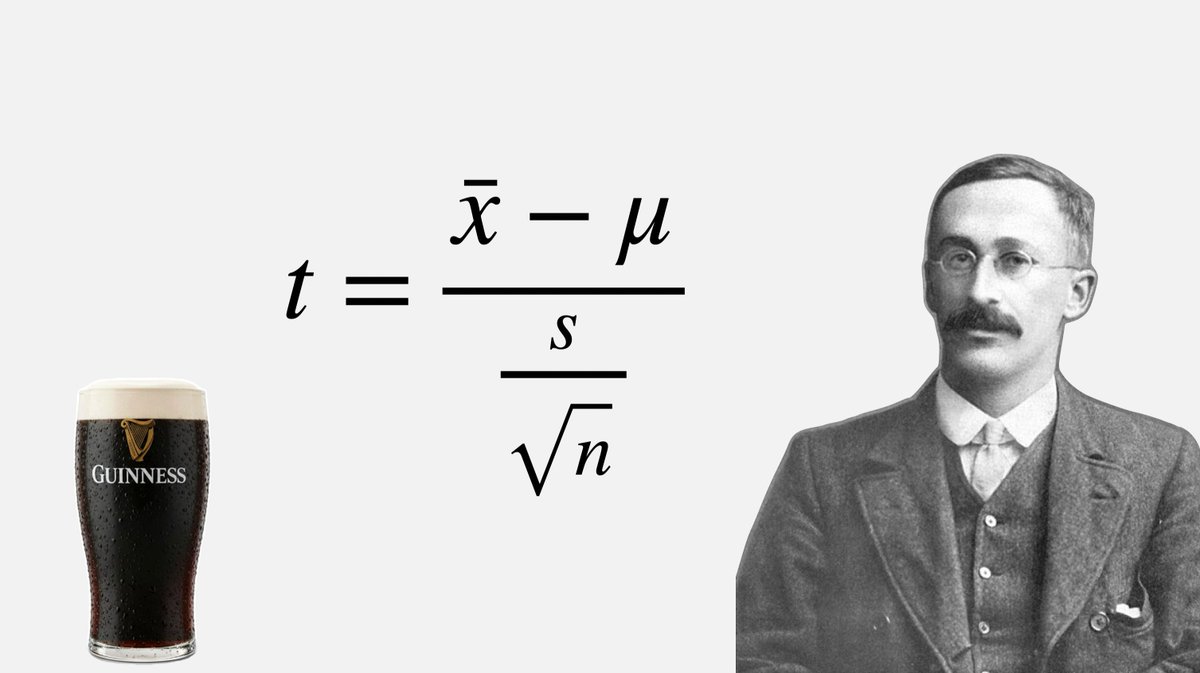
On this day 150 years ago William Sealy Gosset was born. He spent his whole career as a brewer at Guinness, working on a problem the textbooks ignored: how to draw conclusions from tiny samples, like four plots of barley or a handful of hops. The statistics of the day assumed large samples so Gosset invented the statistics of small ones.
Guinness barred its employees from publishing after one of them leaked trade secrets, and did not want competitors knowing it used science to brew beer so when Gosset published his method in 1908 he signed it with a pseudonym: Student.
Every clinical trial, lab experiment and A/B test that runs a t-test today is using the work of Student. The most famous name in statistics is a fake one.
Noether’s theorem is one of the deepest bridges ever built between pure mathematics and physical reality.
Her theorem says that every continuous symmetry gives a conservation law.
If the laws of physics do not change with time, energy is conserved.
If they do not change from place to place, momentum is conserved.
If they do not change under rotation, angular momentum is conserved.
After Noether’s death, Albert Einstein wrote:
“In the judgment of the most competent living mathematicians, Fräulein Noether was the most significant creative mathematical genius thus far produced since the higher education of women began.”
This was published in The New York Times in 1935.
(📷Kate LaVoie/ Alamy)
Creator of C++, Bjarne Stroustrup:
AI-generated code isn't ready — it generates more bugs, more bloat, more security holes, and is nearly impossible to validate
"senior developers are already retiring rather than deal with it"
The problem is that even a small prompt change can shift the entire codebase in unpredictable ways
EBM are so back!
@ylecun has been pointing here for years: AI reasoning needs systems that check structure before they answer.
Aleph from @logic_int now leads the major formal reasoning benchmarks – let me explain what it is -> 📺
Yann LeCun says LLMs are strongest in domains where language itself is the substrate of reasoning, like math and code
They can solve problems, prove theorems, and write programs — but they are not creative mathematicians, software architects, or computer scientists
"their role is to help humans build"