Trained a tiny 210M text-to-image diffusion transformer from scratch on one GPU in 3.5 days. 4.2M images, 256². It draws. Every decision, with sources, is in the repo: https://t.co/8ikezEzLs5
In the spirit of @karpathy nanoGPT. More images and details below 👇
Got stuck at Montenegro airport with barely usable public Wi-Fi. Airalo app (I use it for 5 years) wasn't loading.
I remembered my friend @denisyurchak’s https://t.co/JLZE9nlvLR - super simple & lightweight, loaded instantly and eSIM installed perfectly on the weak connection 🫶
@MParakhin as pre gpt ml person - i think capabilities difference with bert-like encoders is orders of magnitude
It's intellgence of frontier llms for fraction of price and inference speed +typesafety :)
Trained a tiny 210M text-to-image diffusion transformer from scratch on one GPU in 3.5 days. 4.2M images, 256². It draws. Every decision, with sources, is in the repo: https://t.co/8ikezEzLs5
In the spirit of @karpathy nanoGPT. More images and details below 👇
Registers tokens work in diffusion transformers too. Gave my from-scratch 210M text-to-image DiT 16 register tokens (@TimDarcet idea). They grow to 4–13× the norm of an image patch, every patch reads from them, and each one locks onto a few spots: tractor, hull, corners.
Trained a tiny 210M text-to-image diffusion transformer from scratch on one GPU in 3.5 days. 4.2M images, 256². It draws. Every decision, with sources, is in the repo: https://t.co/8ikezEzLs5
In the spirit of @karpathy nanoGPT. More images and details below 👇
Honest failure grid: text, faces, crowds, counting. That is what the next phase is for.
🤗 Weights: https://t.co/86FMCQWfih
💻 Site: https://t.co/FBpXxiJNII
Trained a tiny 210M text-to-image diffusion transformer from scratch on one GPU in 3.5 days. 4.2M images, 256². It draws. Every decision, with sources, is in the repo: https://t.co/8ikezEzLs5
In the spirit of @karpathy nanoGPT. More images and details below 👇
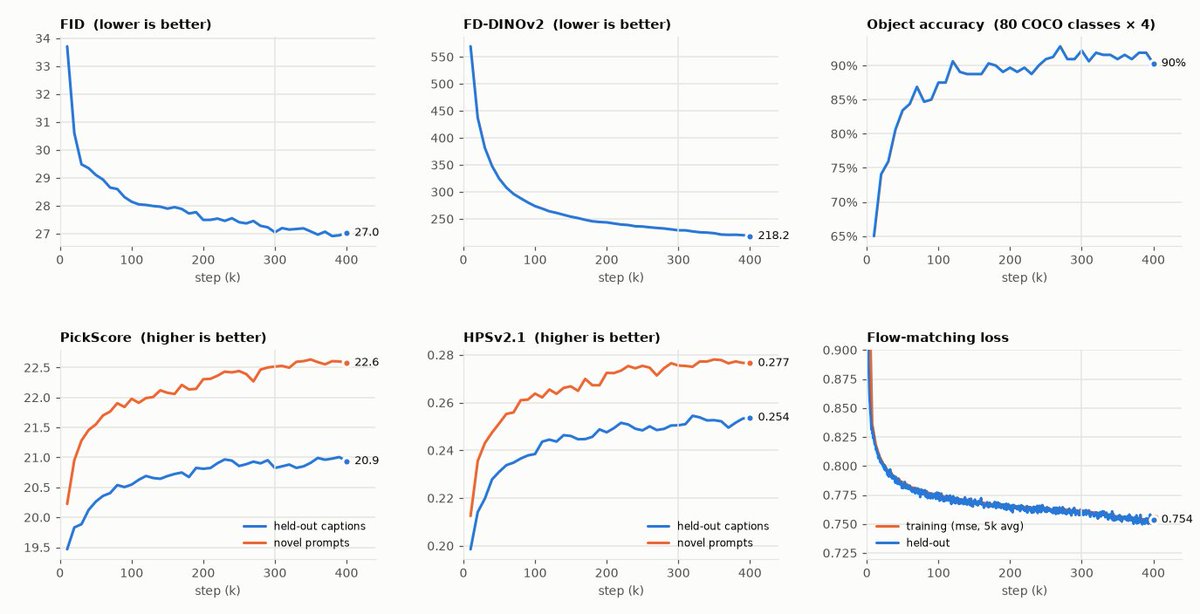
The loss keeps falling, but barely moves images change completely: most of it is irreducible noise variance.
So quality is tracked with FID, FD-DINOv2, object accuracy via a detector, PickScore and HPSv2.
Next: RL with Flow-GRPO, using those same preference models as rewards.
Underrated: post-training a SMALL model on your specific task can buy you big gains for little compute, if the task has checkable outputs.
Proof of concept: Qwen3.5-0.8B on GSM8K, reward = "is the final answer correct". That's it. No human labels, no reward model. About 10 hours per method on a single RTX A6000 Pro.
12.8% → 57.1%
To compare methods fairly, I implemented PPO, GRPO, and DPO from scratch (pure PyTorch, no TRL). Same model, same task, same budget:
PPO 51.6% | DPO 53.5% | GRPO 57.1%
Surprise: PPO peaked at step 25, then slowly degraded. Critics struggle with sparse binary rewards at this scale. GRPO's group baseline just works.
The catch: this is only cheap when correctness is checkable (math, code, extraction, structured output). For fuzzy tasks like style, helpfulness or tone, you need preference data and usually a reward model, and building that is a big part of the real work.
Other caveats: single seed, one task, and part of the lift is eliciting what the base model already knew.
Code + logs + curves: https://t.co/cDiQkH77dr
Next: same algorithms on image/video models.
It aligns with great research by @adihaviv & @OfirPress (2022): https://t.co/PdH5dC5Fxj and @a_kazemnejad (NeurIPS 2023): https://t.co/G9UFKzX4QE
Worth noting:
- positional encoding is not redundant - it's a helpful bias, especially for longer sequences.
- for bidirectional models (BERT-style), removing positional encoding is actually devastating due to absence of autoregressive mask.
There is a popular misconception that transformers are agnostic to token order without positional encoding. I often see examples "my cat drinks milk" becomes {"cat", "milk", "drinks", "my"}.
It's not true for most transformers and I even trained a transformer myself to prove the point.
Here's why 👇
I've implemented a small GPT (25M params) and trained it on 500M tokens data (500k wikipedia articles) with and without positional encoding to validate the point.
With 256 tokens context the val loss difference is really small: 2.9772 (with pos encoding) vs 3.0073 (without it).
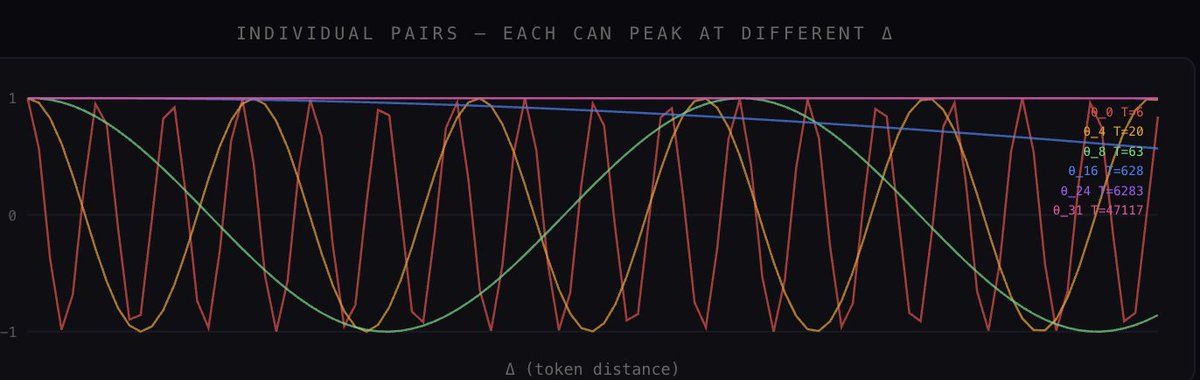
Rotary positional embedding (RoPE) is such a genius idea @Jianlin_S - and it's funny that text based transformers most probably even don't utilize all of its nice properties, like cycles, since there are not much of that in text data.
Imagine time series with natural cycles: game turns in RL, seasonal patterns, music bars. RoPE's multi-frequency structure could let attention automatically match those periodicities. Credit assignment across repeating game phases seems like a natural fit.
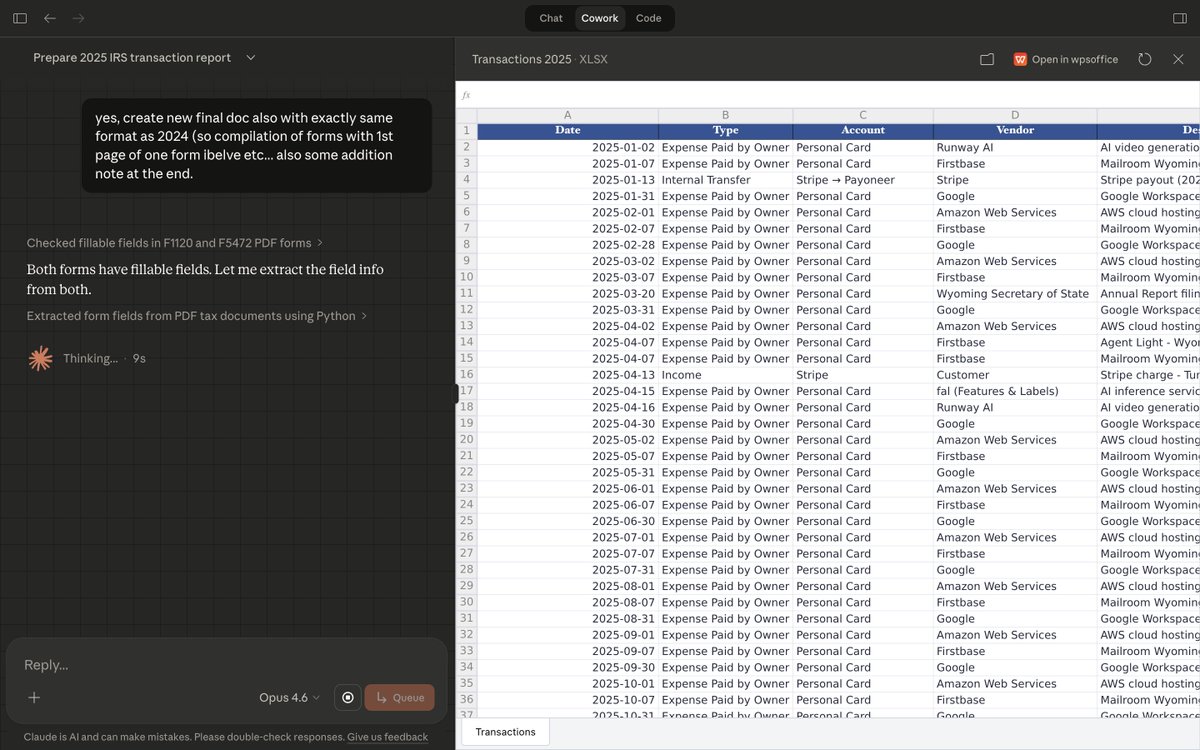
just had claude cowork handle my LLC's entire annual IRS filing - compiled all transactions from receipts into a table, filled the forms, done in ~10 minutes tax prep used to take me half a day a year ago.
@VitalikButerin Респект. Открыто называть зло злом, особенно когда это может иметь последствия - значит иметь принципы. Круто, что они у тебя есть - большинство людей отказываются их иметь.
Думаю для будущего ethereum это также важно.