You signed a £300,000 mortgage.
The bank had nothing.
They typed £300,000 into your account. The whole transaction took them 5 minutes.
Over the next 25 years you pay them back £550,000.
That £550,000 is your wages. Your overtime. Your weekends. Your sleep.
For them it is pure profit. They created the money from thin air. They have no cost to recover.
5 minutes of their typing.
25 years of your life.
That is the trade.
The government allows it.
The Bank of England protects it.
The banks feed themselves and their paymasters.
You were not given a mortgage.
You were enslaved by one.
You do not own the house.
You do not own your wages.
You do not own your future.
You rent your life from people who created nothing.
This is why they fear Bitcoin.
Bitcoin cannot be typed into existence.
Bitcoin cannot be debased by their paymasters.
Bitcoin cannot be lent ten times over.
The day you understand Bitcoin is the day you stop renting your life.
That is why they hate it.
And that is why you need it.
When markets run on open rails, more people can see the rules before they trade.
Trueo is built on Ethereum.
@Trueo_ brings prediction markets fully onchain, which makes rules, liquidity, and execution easier to inspect.
Some of my perspective on where the @ethereumfndn is going.
First of all, this is only my own view. The board is not just me, and I have no extra special powers on the board that the other board members do not. @aerugoettinea is the one executing much of this transition. My input has been largely on technical questions. The board is in the process of expanding, and my own power within the org will continue to decrease, which is honestly what I want.
The 2025 era brought many important improvements to EF and its ability to execute. Many issues were resolved, and EF continues to benefit from its improved efficiency and greater focus on concrete goals to this day. And so with those problems resolved, early this year, the largest remaining hole that I perceived was something different nagging at me: I would regularly spot people saying things like "vitalik says these beautiful things about ethereum needing to be decentralized, and have privacy, and be a sanctuary technology, but why do the EF's actions not reflect that?"
Now, you may have been hearing something different. You may not have been sensing a feeling of crisis at all, and maybe were hearing people saying that finally we were taking execution and BD seriously and the main task for us is to keep going that way and be even better and faster. Then probably there is genuine difference between you and me, in what kinds of criticism I take most seriously, and what kinds of critics through their criticism are most able to make me feel pain.
As an analogy, let's briefly switch over to a different domain.
One belief you can have about Google is that it is a success story, and has brought a lot of good to humanity in organizing the world's information. Another belief you can have about Google is that they had a beautiful idealistic beginning, but at some point the corruption of mainstream corporate attitudes seeped in, and they slowly bit by bit completely abandoned the "don't be evil" slogan.
My belief on Google specifically is probably somewhere between the two. BUT, if you had taken me back in time to ~2008, and offered me a button to press to make Google one or two standard deviations more "dogmatic", eg. give Richard Stallman permanent veto power over some key policies, I would immediately press it.
Why? Because a choice for one company is not a choice for the world, or even one country. Google existed and exists in the context of a technology industry generally drifting away from early idealistic don't-be-evil roots and toward greed for financial gain, totalizing visions of accelerated superintelligence, infiltration by sociopaths, and craven capitulation to (or worse, active participation in) government pressure for ideological control, surveillance and war. And so *one company* doing something different, positioning itself to be what George Bernard Shaw calls the Unreasonable Man, resisting the trend of the times, would have been better for freedom, balance of power and stability of society as a whole, than *all* large companies bending to dominant trends. This is a part of my version of pluralism.
This line of thinking is not just mine, but I also is not too far off from what Aya and others had in mind with the Mandate.
Now how does this all get to the role of the EF?
EF is not a "center of Ethereum", rather EF is "one node, with a defined purpose, alongside other nodes". We've always said that the EF should be the latter, but many in the Ethereum ecosystem (and even within the EF) wanted us to be the former. Now, we are taking action to ensure that we will be the latter.
This is particularly important because EF is a limited organization, with limited resources and limited organizational capacity. The EF has only ~0.16% of all ETH (less than many other individual ETH holders), whereas among other blockchains it's common for "the central foundation" to have 10-50%. Fiscally, the EF was originally designed to fulfill a limited work scope defined in the token sale docs and other pre-launch materials (building the chain software; getting through Frontier, Homestead, Metropolis, Serenity), which was fully completed in 2022; it was not designed to be an eternal steward.
And so today, the EF is choosing to use its remaining resources to pursue longevity over breadth (yes, this means we sell less ETH). The EF focuses *specifically* on those activities critical to the success of ethereum as a censorship/capture-resistant, open, private and secure system, that would not happen otherwise. This means making hard choices, and in some cases even activities that we highly approve of and people that we highly respect becoming outside of the EF. People of great technical talent, public respect and even alignment with the mission and CROPS being outside of the EF is in fact necessary if we want important tasks to be able to attract outside capital. This also means the EF taking opinionated stands culturally.
This is all intended in cooperation with all other parts of ethereum. We recognize that many other parts of the ethereum world highly respect CROPS and related values. But highly respecting is not the same as choosing to specialize and totally dedicate to a domain (Compare in a different domain: I think reducing animal cruelty is important, and I like vegan food, but am not full unconditional vegan myself)
EF is still in a transition period, and we expect its new long-term form to stabilize over the next few months. What are the guiding principles of this new form? Again, I am only one person, but I can give my answer from a technical perspective (there are also critical non-technical aspects).
At the core, *Ethereum must be impressive*. We are living in an age of highly intelligent AI and all kinds of other technological acceleration. "Status quo EVM, with a hard fork or two a year to optimize for short-term needs of users" is not interesting.
To some, "impressive" means: 250ms latency and 1M TPS. I think Ethereum trying to go that route is a mistake. Being as fast and as scalable as possible, and only a small epsilon more decentralized than the others, is a route to mediocrity, and if we try it we will lose.
I think Ethereum should scale. But I think Ethereum should strive the hardest to be deeply impressive in a different dimension: the CROPS dimension. This means things like:
* Provably bug-free Ethereum. This is a goal that all cybersecurity researchers would have thought is absurd and impossible, up until roughly 6 months ago. Now, it's on the cusp of being possible, thanks to AI-assisted formal verification. So we should be frontrunners in doing this.
* Available chain consensus. Ethereum is, and with lean consensus will cotninue to be, the ONLY chain that has both (i) traditional-BFT style properties that it's safe under asynchrony up to a high level of fault tolerance, and (ii) the bitcoin PoW-style property that under synchrony it's safe up to 49% attackers. As far as I can tell, literally no other chain has this or is planning for it; bitcoin goes for (ii) only and most other chains go for (i) only. Some will remember I fought hard for this, Unreasonably insisting that it is not OK for ethereum to rely on social consensus and hard forks to rescue ethereum from 34% of nodes going offline. It's OK for chains like hyperledger, bnb, solana, tempo, etc. It's not OK for bitcoin or ethereum or eg. zcash.
* Intermediary minimization. The fact that smart contract wallets, protocols like railgun, etc have to send transactions through intermediaries to get included onchain is honestly embarrassing, and it's a constant point of fragility. Hence the work on FOCIL and EIP-8141 (and 7701 and years of work before) to make transaction sending intermediary-minimized with public mempool and strong inclusion properties, in a truly general-purpose way, that covers not just eg. secp256r1, but also privacy protocols and much more. Kohaku is pushing intermediary minimization at the user layer, pulling Ethereum away from the dystopian status quo world where our wallets don't even verify the chain, send our private data out to a dozen third-party servers, and toward a brighter CROPS future.
Some of these goals are Unreasonable - maybe Ethereum would be "fine" getting only 50% of the way - what if we depend on intermediaries, but make it easy to switch? But going 50% of the way would not make Ethereum Deeply Impressive in the CROPS way. So we push for 100%.
Fortunately all these goals are compatible with high TPS, this is a major focus of research (esp. on scaling the state). Well-designed L2s can also help, especially L2s optimized for specific applications (eg. high-volume trading, privacy...). These goals are even compatible with significantly lower slot times, thanks to Raul's work on erasure-coded P2P, and many other optimizations.
The most high-value "product" of the ethereum blockchain, financially speaking, is ETH the asset. Ethereum secures $250 billion of ETH. The types of properties of Ethereum that I mentioned above are very good for ETH the asset. Nearly 90% of my net worth is in ETH, and most of the remainder is ~$40m of onchain fiat of which every dollar has already been allocated for some open-source biotech or software or hardware initiative. That said, there are aspects of supporting ETH the asset - *necessary* aspects even - that are outside the scope of the EF. This is where we need other heroes (some of whom hold more ETH than the EF does) to step in and help. EF has been recently thinking more about how it will relate to other such organizations, and give them needed initial support.
EF will be a smaller ship than in previous years, a more opinionated one - in some cases more opinionated in ways that might be difficult to comprehend - but a longer-lasting one, and one suited to making sure that ethereum brings something meaningful to the world. We are grateful to all those inside and outside the EF who are helping to make this happen.
You signed a £300,000 mortgage.
The bank had nothing.
They typed £300,000 into your account. The whole transaction took them 5 minutes.
Over the next 25 years you pay them back £550,000.
That £550,000 is your wages. Your overtime. Your weekends. Your sleep.
For them it is pure profit. They created the money from thin air. They have no cost to recover.
5 minutes of their typing.
25 years of your life.
That is the trade.
The government allows it.
The Bank of England protects it.
The banks feed themselves and their paymasters.
You were not given a mortgage.
You were enslaved by one.
You do not own the house.
You do not own your wages.
You do not own your future.
You rent your life from people who created nothing.
This is why they fear Bitcoin.
Bitcoin cannot be typed into existence.
Bitcoin cannot be debased by their paymasters.
Bitcoin cannot be lent ten times over.
The day you understand Bitcoin is the day you stop renting your life.
That is why they hate it.
And that is why you need it.
Last week I travelled to the North Pole to film 100 core developers building Ethereum.
But there was a twist...
They had 5 days to build the first devnet for Glamsterdam, Ethereum’s next major upgrade, helping secure a $500 billion network.
It was the most magical experience of my life.
I’ve never experienced energy like it.
It very quickly became, to me, the ultimate hackathon.
With the stakes of Ethereum’s uptime.
But how does anything stay together when no one is in charge?
At one point @TimBeiko said: “we're about to turn 1 month of async work into 1 day”...
From 4am technical drama (shit gets hot),
To the most beautiful coordination between client teams,
All the way to people really explaining why they do this.
These are THE heroes you’ve never heard of.
This is about the people keeping Ethereum alive.
This is THE story.
The people who have put a decade of work into Ethereum’s uptime.
Full documentary coming soon.
A fact I feel like almost nobody knows: Ethereum's gas limit will be increased to ~200M after Glamsterdam, a huge increase from the 60M we have today.
That’s a 3x+ of L1 execution capacity, with expectation of further doubling soons after that. Assuming no similar increase in demand, fees could stay near zero for years.
This is the result of several innovations coming together at the right time: ePBS gives payloads more time, BALs let clients prefetch/parallelize execution work, and gas repricings make higher limits safe.
Wall Street is moving onchain. The question isn't if. It's which infrastructure wins.
I sat down with @VivekVentures and @dannyryan from Etherealize to talk about Ethereum's role in tokenization, stablecoins, AI agents, and the regulatory path ahead. As ever, please enjoy!
I am Persian. I came to Canada in 2017 carrying nothing but memories and leaving my whole family behind in Iran. My parents, my sibling, every person I love most still lives there under that shadow. What I tell you now pours straight from their voices, from my closest friends, from their families, and from the hearts of millions of Iranians who filled the streets around the world on February 14th 2026 in one enormous desperate shout for freedom.
We are finished. Completely finished with the Islamic Republic. They do not speak for us. They never did. They are a heavy cruel weight forced upon our necks, not our faith, not our spirit, not our people. We hold no hate for any religion. We honor belief in every form. But for 47 endless years this regime has crushed us, tortured us, raped us, and killed us while hiding behind a twisted version of faith that only delivers pain.
We have witnessed every horror. We have carried every wound. That long suffering taught us to recognize their tricks the moment they appear. Any group that begins to mirror their lies, their violence, their control, we see the road ahead clearly because our blood paid for that knowledge.
We want this regime gone forever no matter what price we must pay. Yes even if the price means bombs falling from foreign skies. We have tried every path for 47 years. We stood with empty hands against their weapons. We faced bullets holding only rocks and fire extinguishers and the fierce love we have for one another and for a tomorrow worth living. Still they cut us down.
Our families described scenes that break the soul. They sealed the protest streets from both ends trapping people inside like prey then shot them from rooftops and surrounding buildings. Bodies dropped in piles. They hunted every doctor and every nurse brave enough to treat the wounded. They raped them. They tortured them. They murdered them without mercy. Picture that cruelty. We met machine guns with stones. We met death with open hearts and unbreakable will.
The only force left that can halt this river of innocent blood and end the strangling fear that poisons every day of life is powerful outside action. Strikes from those strong enough to shatter the regime at last. Our feelings twist with terror and sorrow at the thought of more loss. But hear this truth. We fear the silence after the bombs far more than the bombs themselves. We fear opening our eyes to find the same killers still in power still stealing breath still erasing futures.
We trust no one tied to this regime in any way. Not reformers. Not hardliners. Not a single person who ever helped it stand taller or made peace with its crimes. Every one of them leads back to the same dark cell.
The single leader our hearts still follow the only one never stained by this evil the only one the regime and all its helpers have always despised and attacked is @PahlaviReza . He stood apart from this nightmare. He never served it. His family was torn from power by the very forces that created this tyranny. Groups like the MEK helped build the regime strength to drive out our king then later complained only because they failed to seize the throne for themselves. They are no different. Some say they are worse. We turn away from them all.
From the deepest place inside us where pain and hope still burn together this is our raw plea. Foreign intervention remains the only road left to tear this regime down. And the only leader we believe can guide us safely through the storm into real freedom and light is Prince @PahlaviReza.
Thank you for listening to our voice. These are not mere sentences. They are the living truth of a people who have bled long enough. We stand for the families still trapped. We stand so no more mothers must bury their children. We stand because surrender is not in our blood.
For Iran. For freedom. For the chance to live.
Now, the quantum resistance roadmap.
Today, four things in Ethereum are quantum-vulnerable:
* consensus-layer BLS signatures
* data availability (KZG commitments+proofs)
* EOA signatures (ECDSA)
* Application-layer ZK proofs (KZG or groth16)
We can tackle these step by step:
## Consensus-layer signatures
Lean consensus includes fully replacing BLS signatures with hash-based signatures (some variant of Winternitz), and using STARKs to do aggregation.
Before lean finality, we stand a good chance of getting the Lean available chain. This also involves hash-based signatures, but there are much fewer signatures (eg. 256-1024 per slot), so we do not need STARKs for aggregation.
One important thing upstream of this is choosing the hash function. This may be "Ethereum's last hash function", so it's important to choose wisely. Conventional hashes are too slow, and the most aggressive forms of Poseidon have taken hits on their security analysis recently. Likely options are:
* Poseidon2 plus extra rounds, potentially non-arithmetic layers (eg. Monolith) mixed in
* Poseidon1 (the older version of Poseidon, not vulnerable to any of the recent attacks on Poseidon2, but 2x slower)
* BLAKE3 or similar (take the most efficient conventional hash we know)
## Data availability
Today, we rely pretty heavily on KZG for erasure coding. We could move to STARKs, but this has two problems:
1. If we want to do 2D DAS, then our current setup for this relies on the "linearity" property of KZG commitments; with STARKs we don't have that. However, our current thinking is that it should be sufficient given our scale targets to just max out 1D DAS (ie. PeerDAS). Ethereum is taking a more conservative posture, it's not trying to be a high-scale data layer for the world.
2. We need proofs that erasure coded blobs are correctly constructed. KZG does this "for free". STARKs can substitute, but a STARK is ... bigger than a blob. So you need recursive starks (though there's also alternative techniques, that have their own tradeoffs). This is okay, but the logistics of this get harder if you want to support distributed blob selection.
Summary: it's manageable, but there's a lot of engineering work to do.
## EOA signatures
Here, the answer is clear: we add native AA (see https://t.co/YD9nIpsxcC ), so that we get first-class accounts that can use any signature algorithm.
However, to make this work, we also need quantum-resistant signature algorithms to actually be viable. ECDSA signature verification costs 3000 gas. Quantum-resistant signatures are ... much much larger and heavier to verify.
We know of quantum-resistant hash-based signatures that are in the ~200k gas range to verify.
We also know of lattice-based quantum-resistant signatures. Today, these are extremely inefficient to verify. However, there is work on vectorized math precompiles, that let you perform operations (+, *, %, dot product, also NTT / butterfly permutations) that are at the core of lattice math, and also STARKs. This could greatly reduce the gas cost of lattice-based signatures to a similar range, and potentially go even lower.
The long-term fix is protocol-layer recursive signature and proof aggregation, which could reduce these gas overheads to near-zero.
## Proofs
Today, a ZK-SNARK costs ~300-500k gas. A quantum-resistant STARK is more like 10m gas. The latter is unacceptable for privacy protocols, L2s, and other users of proofs.
The solution again is protocol-layer recursive signature and proof aggregation. So let's talk about what this is.
In EIP-8141, transactions have the ability to include a "validation frame", during which signature verifications and similar operations are supposed to happen. Validation frames cannot access the outside world, they can only look at their calldata and return a value, and nothing else can look at their calldata. This is designed so that it's possible to replace any validation frame (and its calldata) with a STARK that verifies it (potentially a single STARK for all the validation frames in a block).
This way, a block could "contain" a thousand validation frames, each of which contains either a 3 kB signature or even a 256 kB proof, but that 3-256 MB (and the computation needed to verify it) would never come onchain. Instead, it would all get replaced by a proof verifying that the computation is correct.
Potentially, this proving does not even need to be done by the block builder. Instead, I envision that it happens at mempool layer: every 500ms, each node could pass along the new valid transactions that it has seen, along with a proof verifying that they are all valid (including having validation frames that match their stated effects). The overhead is static: only one proof per 500ms. Here's a post where I talk about this:
https://t.co/rAUSJjW7WL
https://t.co/EtXpkaDll5
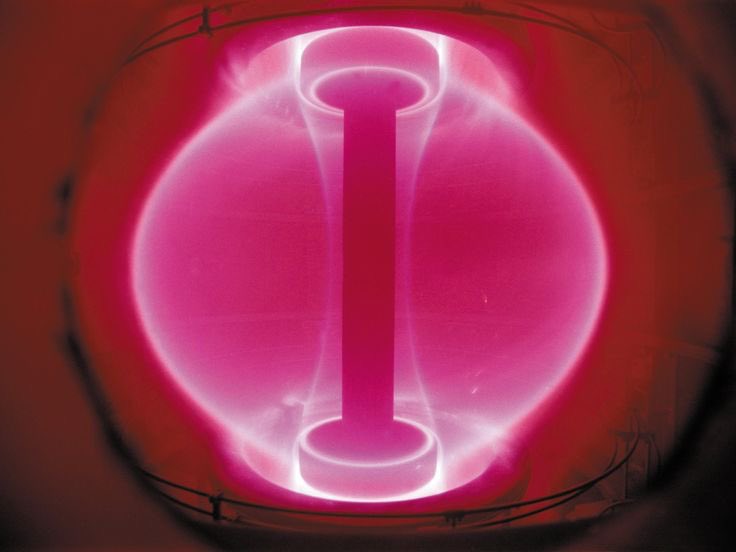
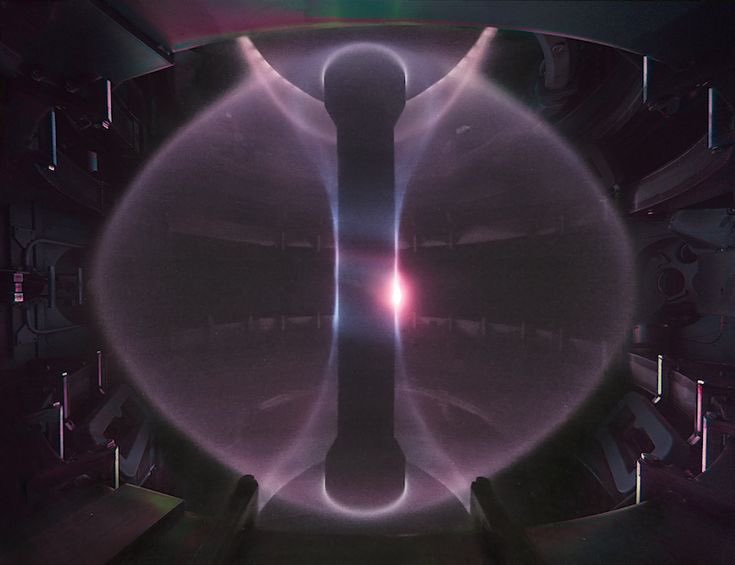
🚨: France now holds the world record for nuclear fusion!
It sustained the reaction for 22 minutes!
An incredible temperature of 90 million degrees Fahrenheit (50 million °C) for 1,337 seconds — more than 22 minutes.
More good news. I've just been told that Restore Britain has hit 60,000 members - another 10,000 patriots have joined in less than 24 hours.
A bloody good start, I'd say.
Join the party.
https://t.co/RMtEuHopgV