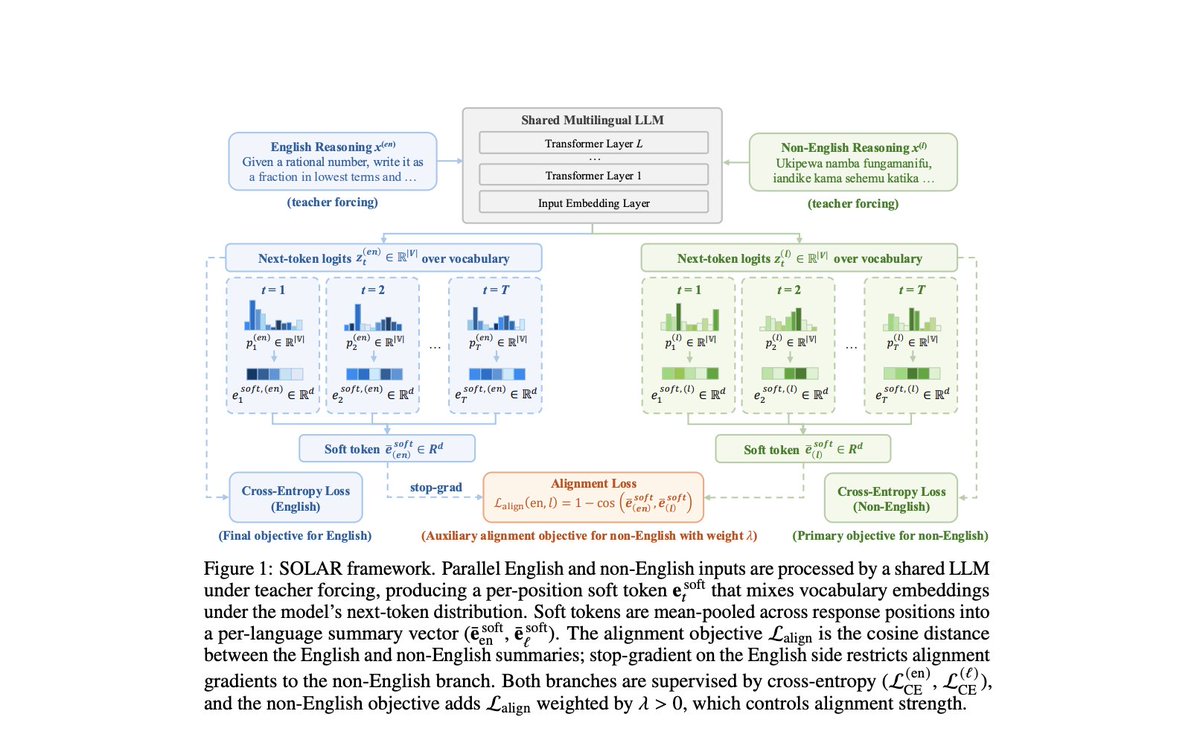
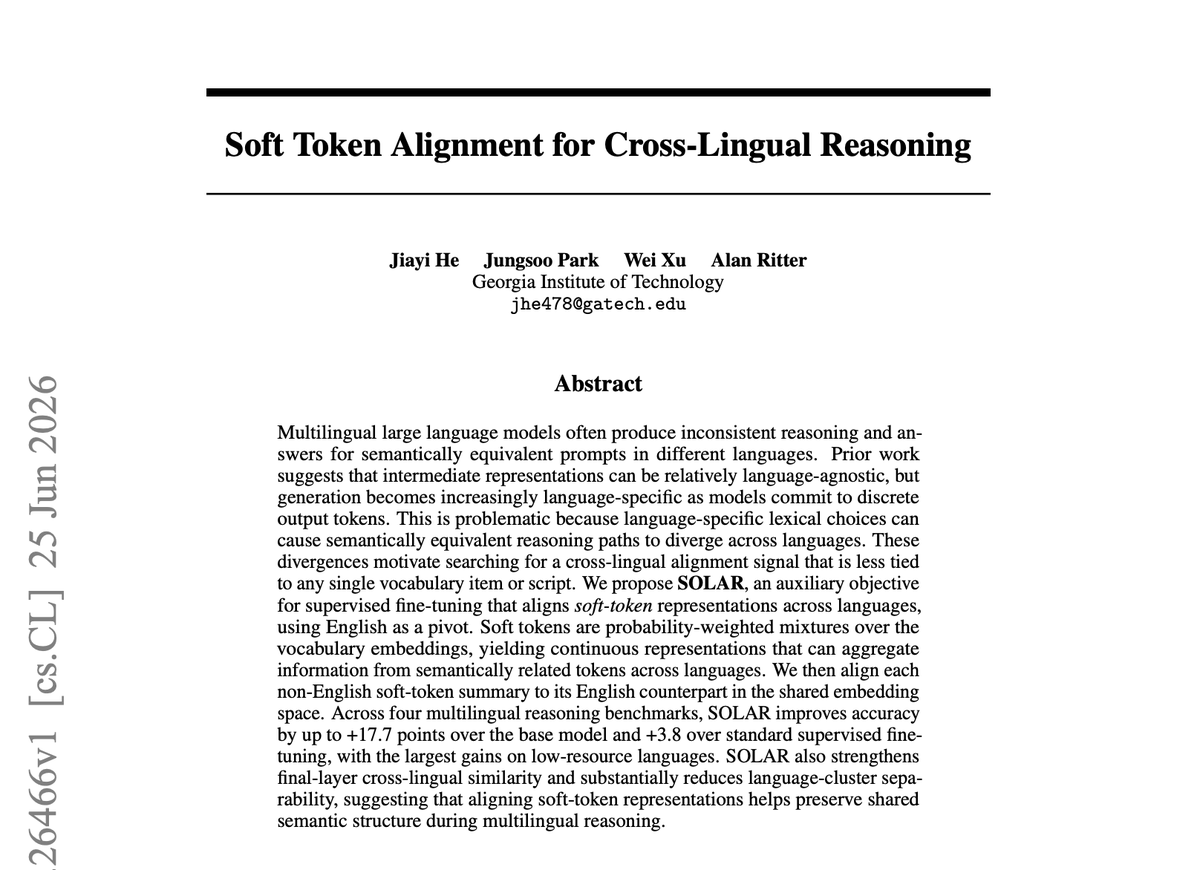
My new student @ivy3h, co-advised with @alan_ritter, just had her first paper as a PhD student accepted to NeurIPS 2026! 🎉
Congrats, @ivy3h and @jungsoo___park!
Slated to give a tutorial on “Multilingual and Multicultural LLMs” 🌍 at EMNLP 2026 with @davlanade@vinodkpg@sarahookr@alan_ritter.
See you in beautiful Budapest — looking forward to connecting with everyone! 👋
#emnlp
Glad to share that our paper Gavel was accepted to EMNLP 2026 Main! 🎉
We study frontier LLMs on legal case summarization with inputs exceeding 500K tokens. Models struggle beyond 256K tokens and are much more likely to omit key information than hallucinate.
We also built Gavel-Agent, an agentic, reference-free evaluator that searches source documents for evidence.
More details: https://t.co/ZVYrwcgCDq
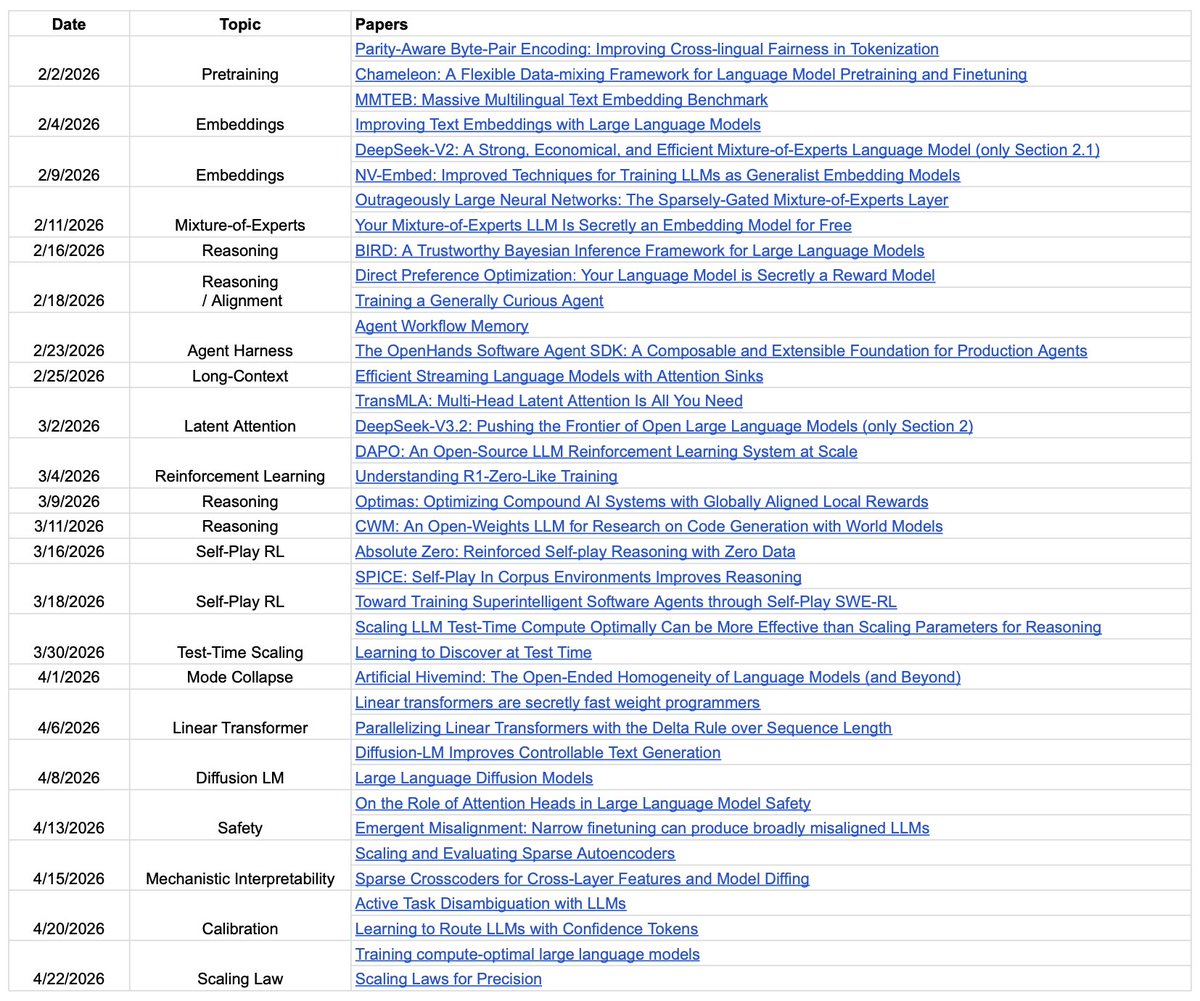
Updated CS 8803 "Large Language Model" class at @GeorgiaTech this year for 2026!
The reading list spans pretraining, MoE, reasoning, RL & self-play, agents, long-context, test-time scaling, diffusion LMs, safety, interpretability, and more.
👉 https://t.co/rzFFz4tgsI
🔗 https://t.co/rD39bWNiOD
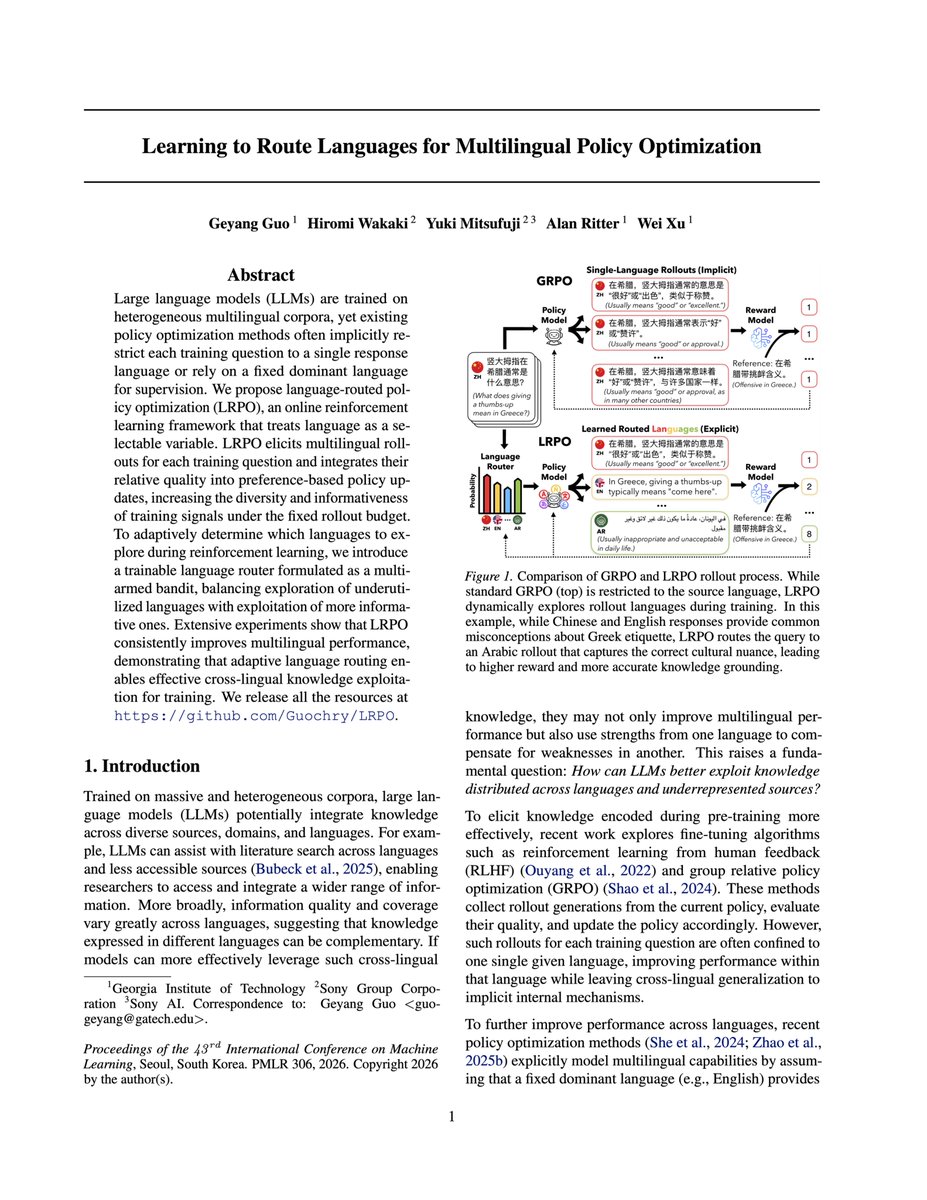
Knowledge is not evenly distributed across languages. For a given question, what if better information comes from another language?
🔥 We propose Language-Routed Policy Optimization (LRPO), an online reinforcement learning framework that lets LLMs explore and learn from cross-lingual generations during training.
#ICML2026
📣 New paper by my Ph.D. student @hyungjoochae
How can we build a safe, scalable learning environment for web agents?
Paper: https://t.co/jtndyaCKKQ
We introduce VERIENV, which clones real websites into executable synthetic environments using coding agents.
Pretraining has scaling laws to guide compute allocation. But for RL on LLMs, we lack a practical guide on how to spend compute wisely.
We show the optimal compute allocation in LLM RL scales predictably.
↓ Key takeaways below
I’ve always wanted to write an open-notebook research blog to (i) show the chain of thought behind how we formed hypotheses, designed experiments, and articulated findings, and (ii) lay out all the intermediate results that did not make it into the final paper, including negative ones that we believe others will find interesting.
https://t.co/h7jb0Kr03w
So @fredahshi and I wrote about grounding, a topic that sparks a lot of debate, both in VLM engineering and in linguistics and philosophy. Our latest work shows from a mechanistic interpretability perspective that symbol grounding can naturally emerge from mid-layer aggregate heads, without requiring fine-grained supervision or any special architectural inductive bias.
Feel free to check it out. We tried to find a balance between open-notebook transparency and readability. It looks best on desktop since I gave up on engineering that CSS file.😅