Worth noting: Google built TPUs before Sundar was CEO. Jeff Dean’s team had v1 in production in 2015. Sundar did not make the infrastructure bet, he inherited it. He’s a custodian of other people’s vision - which is exactly why him “agreeing” with orbital compute is the lagging signal. @elonmusk was building the launch stack while Sundar was managing Chrome. If you want true visionary, Sundar isn’t the right indicator, it’s Musk.
Worth noting: Google built TPUs before Sundar was CEO. Jeff Dean’s team had v1 in production in 2015. Sundar did not make the infrastructure bet, he inherited it. He’s a custodian of other people’s vision - which is exactly why him “agreeing” with orbital compute is the lagging signal. @elonmusk was building the launch stack while Sundar was managing Chrome. If you want true visionary, Sundar isn’t the right indicator, it’s Musk.
I want to give a HUGE shoutout to Snoozer Pet Products - no this is not sponsored. I reached out to them to get a replacement cover of a dog bed they had long discontinued. It’s 10 years old at this point. They actually took the trouble to check and respond and make the replacement cover. Insane!
Netflix co-founder and Anthropic board member Reed Hastings thinks the coming AI transition will be tumultuous.
His argument: The people who navigate it best won't be the most technically sound, they'll be the most emotionally fluent.
Respectfully, this is a highly effective task-automation agent and genuinely impressive and useful. But calling it AGI requires believing that what a task-automation engineer does is general intelligence, and it is not. It’s a bounded slice of it.
The AGI goalposts keep moving because every time a model clears a bounded task well, someone calls it AGI, and then we forget that AGI was supposed to mean generalizing to problems nobody scoped for it - novel research, long-horizon judgment, transfer to domains with no training signal.
You did set a bounded task in this screenshot. AGI version of openclaw would be-looking at a problem, deciding it’s a problem and then finding a solution- zero shot in the strongest sense, we tell the model nothing. Remove the human here and nothing happens.
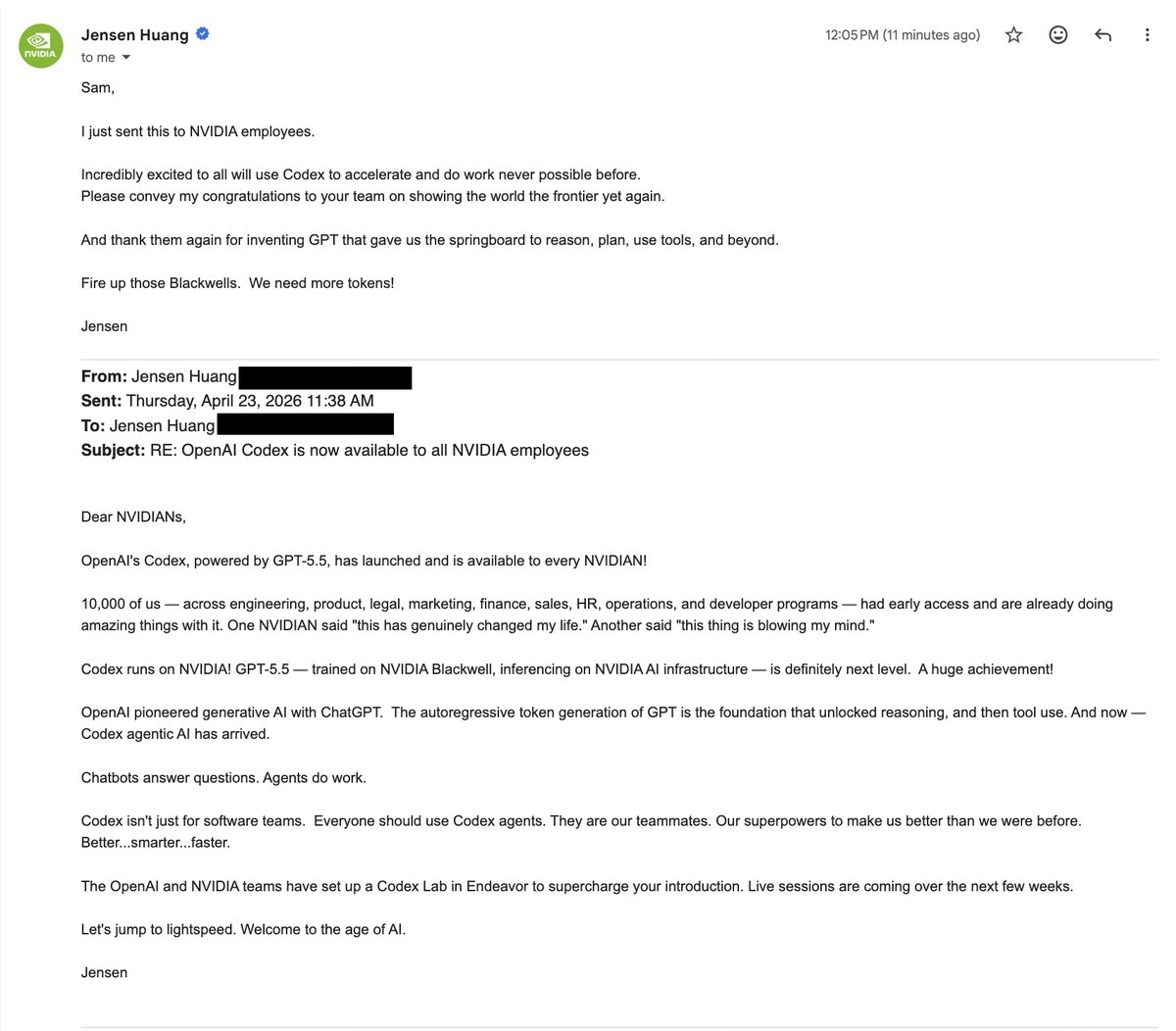
We tried a new thing with NVIDIA to roll out Codex across a whole company and it was awesome to see it work.
Let us know if you'd like to do it at your company!
Google TPU v8 yesterday. Tesla AI5 last week. Meta:Broadcom 2nm the week before. 3 custom AI chips in 9 days. After Maia 200, Trainium3, OpenAI-Broadcom, and Anthropic admitting they're exploring their own.
Every venture-backed "GPU killer" is dead, acquired, or narrowed to one workload. Wave bankrupt. Nervana shut. Mythic broke. Graphcore sold for parts. Groq absorbed by Nvidia for $20B.
Custom AI silicon was never a startup story. It's a balance sheet story. The only balance sheets large enough to fund a real Nvidia competitor belong to the companies Nvidia already sells to.
Timeline in the image. The architectural why: https://t.co/xplRYSvzyn
@sama Would love to see an update to to the current model. Two things I have encountered on repeat that obliterate utility for me: the reflexive re-explaining/mansplaining of things I clearly already know, and the structural reluctance to call a spade a spade when the spade is a billionaire. Both fixable. Neither seems to be a priority.
I have to assume the sample set is skewed re startups. Startups optimize for speed, efficiency and cost. They are also not dealing with legacy code debt. The number is going to be different for enterprises.
Legit exceptions are companies pushing AI hard - Meta, Google, Amazon et al
@paulg@paulg I have to assume the sample set is skewed re startups. Startups optimize for speed, efficiency and cost. They are also not dealing with legacy code debt. The number is going to be different for enterprises.
The three forces deciding whether your AI query gets answered:
NIMBY: not here
BANANA: not anywhere
BEYONCE: fine but bring your own power plant
We went from "not in my backyard" to "build your own backyard" #DataCenterWorld
A few things Mr.Huang got away with though - the whole benchmark deflection saga - sharing benchmarks on IP is stupidity. It’s proprietary and leverage. That was frustration and bravado speaking on his part.
Second - the implicit assumption that every hyperscaler wants to be in the silicon business. Google entered this business because they had no choice - Nvidia essentially missed out on that opportunity to cement that relationship by not cutting their costs or working with Google when they first came to them more than 12 years ago.
The TPU origin story matters a lot here- this was a missed opp on Dwarkesh’s part. TPUs came out of a need to shrink the unsustainable GPU margins and were a forced response to a compute economics problem that had no vendor solution.
~2013, Jeff Dean ran the math on what it would cost to handle Android voice search at scale. The answer was roughly doubling Google’s entire data center footprint. Nvidia’s pricing was a significant factor as well, but the primary driver was structural - general-purpose GPUs weren’t built for matrix multiplication at that scale and cost.
@pmarca Agree. A few things Mr.Huang got away with though - the whole benchmark deflection saga - sharing benchmarks on IP is stupidity. It’s proprietary and leverage. That was frustration and bravado speaking on his part.
Second - the implicit assumption that every hyperscaler wants to be in the silicon business. Google entered this business because they had no choice - Nvidia essentially missed out on that opportunity to cement that relationship by not cutting their costs or working with Google when they first came to them more than 12 years ago.
The TPU origin story matters a lot here- this was a missed opp on Dwarkesh’s part. TPUs came out of a need to shrink the unsustainable GPU margins and were a forced response to a compute economics problem that had no vendor solution.
~2013, Jeff Dean ran the math on what it would cost to handle Android voice search at scale. The answer was roughly doubling Google’s entire data center footprint. Nvidia’s pricing was a significant factor as well, but the primary driver was structural - general-purpose GPUs weren’t built for matrix multiplication at that scale and cost.
#Marriott quality has gone way down, broken furniture, burn marks on the rug, light bulb not working, random noises from the air conditioning unit. Not a platinum elite anymore but gold elite should be renamed shitty elite. @Marriott