Tres ingenieros y amigos uruguayos diseñaron una aplicación que compara precios de distintas cadenas de supermercado para indicarle al consumidor final en dónde le conviene más comprar.
El informe de @AgustinaRovetta.
Qué grande @cabacua_uy, invento de dos queridos amigos como @santitopo99 y @j0ac0_fernandez que se van para arriba. Una herramienta muy útil a la hora de hacer las compras 😉
Gracias @ObservadorUY y @juanpdemarco por la nota la semana pasada! Ya sumamos más de 20 mil usuarios, 12 mil más que cuando salió la nota 🤯
Las personas en Uruguay necesitan ahorrar dinero y tiempo. Para ayudar en eso creamos Cabacua.
https://t.co/Tw0JPR27vO
📱Tres ingenieros en sistemas desarrollaron una app que compara precios de seis cadenas de supermercados en tiempo real
🛒La aplicación, denominada Cabacua, permite buscar productos y ofertas y escanear códigos para identificar dónde conseguir los mejores precios y organizar las compras.
🛒 La app Cabacua compara precios de supermercados. La herramienta apunta directamente a uno de los principales problemas del consumidor actual: la diferencia de precios entre comercios y la dificultad para seguir promociones.
this is 100% true. build in public & “lean startup” are the worst philosophies you can follow right now. early stage startups suffer from lack of narrative. how are you going to find your narrative with thousands of potential voices?
today attention is scarce, noise is infinite, & first impressions will calcify fast. you don’t get infinite retries. fundamentally you simply cannot a/b test a worldview in public. narratives aren’t features. once exposed, they anchor expectations, constrain motion, & often punish sharp pivots.
the work that actually matters early which is reframing the problem, renaming the product, killing sacred ideas, & finding the *real* axis of value absolutely requires privacy. confusion is productive, but only when it’s contained.
build in public is great once the shape is known. before that, it’s just premature nonsense.
Linear’s CEO just described the biggest shift in product team structure since Agile.
For decades, product work meant: PM defines requirements → designers create specs → engineers translate to code. The middle step, translation, absorbed 70% of the time and created most of the friction.
Karri is saying that step is collapsing. AI agents don’t need handoff documents or sprint planning rituals. They need structured context about what matters, what constraints apply, and what success looks like.
This inverts the leverage points. The person who captures customer intent clearly now has more impact than the person who translates it into implementation. And the person reviewing agent output becomes the quality bottleneck.
Linear built their entire product around this bet: structured entities with clear ownership, context attached to work items, feedback connected directly to issues. It turns out the same system that helps humans coordinate also helps agents know what to do.
The teams figuring this out first will have a structural advantage. Everyone else will still be writing Jira tickets that read like riddles.
Every time we've made it easier to write software, we've ended up writing exponentially more of it.
When high-level languages replaced assembly, programmers didn't write less code - they wrote orders of magnitude more, tackling problems that would have been economically impossible before. When frameworks abstracted away the plumbing, we didn't reduce our output - we built more ambitious applications. When cloud platforms eliminated infrastructure management, we didn't scale back - we spun up services for use cases that never would have justified a server room.
@levie recently articulated why this pattern is about to repeat itself at a scale we haven't seen before, using Jevons Paradox as the frame. The argument resonates because it's playing out in real-time in our developer tools. The initial question everyone asks is "will this replace developers?" but just watch what actually happens. Teams that adopt these tools don't always shrink their engineering headcount - they expand their product surface area. The three-person startup that could only maintain one product now maintains four. The enterprise team that could only experiment with two approaches now tries seven.
The constraint being removed isn't competence but it's the activation energy required to start something new. Think about that internal tool you've been putting off because "it would take someone two weeks and we can't spare anyone"? Now it takes three hours. That refactoring you've been deferring because the risk/reward math didn't work? The math just changed.
This matters because software engineers are uniquely positioned to understand what's coming. We've seen this movie before, just in smaller domains. Every abstraction layer - from assembly to C to Python to frameworks to low-code - followed the same pattern. Each one was supposed to mean we'd need fewer developers. Each one instead enabled us to build more software.
Here's the part that deserves more attention imo: the barrier being lowered isn't just about writing code faster. It's about the types of problems that become economically viable to solve with software. Think about all the internal tools that don't exist at your company. Not because no one thought of them, but because the ROI calculation never cleared the bar. The custom dashboard that would make one team 10% more efficient but would take a week to build. The data pipeline that would unlock insights but requires specialized knowledge. The integration that would smooth a workflow but touches three different systems.
These aren't failing the cost-benefit analysis because the benefit is low - they're failing because the cost is high. Lower that cost by "10x", and suddenly you have an explosion of viable projects. This is exactly what's happening with AI-assisted development, and it's going to be more dramatic than previous transitions because we're making previously "impossible" work possible.
The second-order effects get really interesting when you consider that every new tool creates demand for more tools. When we made it easier to build web applications, we didn't just get more web applications - we got an entire ecosystem of monitoring tools, deployment platforms, debugging tools, and testing frameworks. Each of these spawned their own ecosystems. The compounding effect is nonlinear.
Now apply this logic to every domain where we're lowering the barrier to entry. Every new capability unlocked creates demand for supporting capabilities. Every workflow that becomes tractable creates demand for adjacent workflows. The surface area of what's economically viable expands in all directions.
For engineers specifically, this changes the calculus of what we choose to work on. Right now, we're trained to be incredibly selective about what we build because our time is the scarce resource. But when the cost of building drops dramatically, the limiting factor becomes imagination, "taste" and judgment, not implementation capacity. The skill shifts from "what can I build given my constraints?" to "what should we build given that constraints have in some ways been evaporated?"
The meta-point here is that we keep making the same prediction error. Every time we make something more efficient, we predict it will mean less of that thing. But efficiency improvements don't reduce demand - they reveal latent demand that was previously uneconomic to address. Coal. Computing. Cloud infrastructure. And now, knowledge work.
The pattern is so consistent that the burden of proof should shift. Instead of asking "will AI agents reduce the need for human knowledge workers?" we should be asking "what orders of magnitude increase in knowledge work output are we about to see?"
For software engineers it's the same transition we've navigated successfully several times already. The developers who thrived weren't the ones who resisted higher-level abstractions; they were the ones who used those abstractions to build more ambitious systems. The same logic applies now, just at a larger scale.
The real question is whether we're prepared for a world where the bottleneck shifts from "can we build this?" to "should we build this?" That's a fundamentally different problem space, and it requires fundamentally different skills.
We're about to find out what happens when the cost of knowledge work drops by an order of magnitude. History suggests we (perhaps) won't do less work - we'll discover we've been massively under-investing in knowledge work because it was too expensive to do all the things that were actually worth doing.
The paradox isn't that efficiency creates abundance. The paradox is that we keep being surprised by it.
I've never felt this much behind as a programmer. The profession is being dramatically refactored as the bits contributed by the programmer are increasingly sparse and between. I have a sense that I could be 10X more powerful if I just properly string together what has become available over the last ~year and a failure to claim the boost feels decidedly like skill issue. There's a new programmable layer of abstraction to master (in addition to the usual layers below) involving agents, subagents, their prompts, contexts, memory, modes, permissions, tools, plugins, skills, hooks, MCP, LSP, slash commands, workflows, IDE integrations, and a need to build an all-encompassing mental model for strengths and pitfalls of fundamentally stochastic, fallible, unintelligible and changing entities suddenly intermingled with what used to be good old fashioned engineering. Clearly some powerful alien tool was handed around except it comes with no manual and everyone has to figure out how to hold it and operate it, while the resulting magnitude 9 earthquake is rocking the profession. Roll up your sleeves to not fall behind.
Muchas veces me preguntan las diferencias entre @ZapiaAI, @ChatGPTapp y otros AIs.
@ZapiaAI fue creado para ayudar a los Latinoamericanos a ahorrar tiempo y dinero y las diferencias son muchas; son productos creados para cosas totalmente distintas.
Acá te cuento 🧵
Puentes is back.
We’re flying out 10 engineers from Latin America for 7 days to…
> eat dinner with @rauchg, @mejiasebas, and @tnm
> get hired at top sf startups
> move to San Francisco
reply and I’ll dm you a link to apply
the 9-9-6 local maxima trap
you can optimize for looking busy, hitting metrics, being “productive” – but you might be climbing the wrong hill entirely.
real breakthroughs happen in the spaces between. when you’re walking and your mind wanders. when you sit with a problem long enough that the obvious solutions dissolve and something deeper emerges. when you have the luxury of thinking “what if we’re approaching this completely wrong?”
my process is simple: i’ll open a Notion doc on my phone and just walk. sometimes for hours. the walking rhythm unlocks something – maybe it’s the bilateral movement, maybe it’s getting away from screens, but ideas start connecting in ways they never do at a desk. i’ll quickly jot stuff down as interesting thoughts pass.
then i come back and just sit with the problem. draw some pictures, build it out a bit. no rushing to conclusions. no pressure to ship something by end of day. just... what is this, really? what can it connect to or evolve into? what would this look like if it were in its most beautiful configuration?
once i see it clearly, execution becomes effortless. the focused bursts where you’re completely in flow – that’s when the real work happens. but you can’t force your way there. you have to earn it with the slow, patient thinking first.
the irony is that this “inefficient” approach ships better stuff faster than grinding 12-hour days. but it requires believing that thinking time isn’t wasted time. that walking isn’t procrastination. that sometimes the most productive thing you can do is to not do.
many teams don’t get this. they need to see keyboards clicking and meetings happening. but the best work – the stuff that actually moves the needle – happens in the flow moments when no one’s watching.
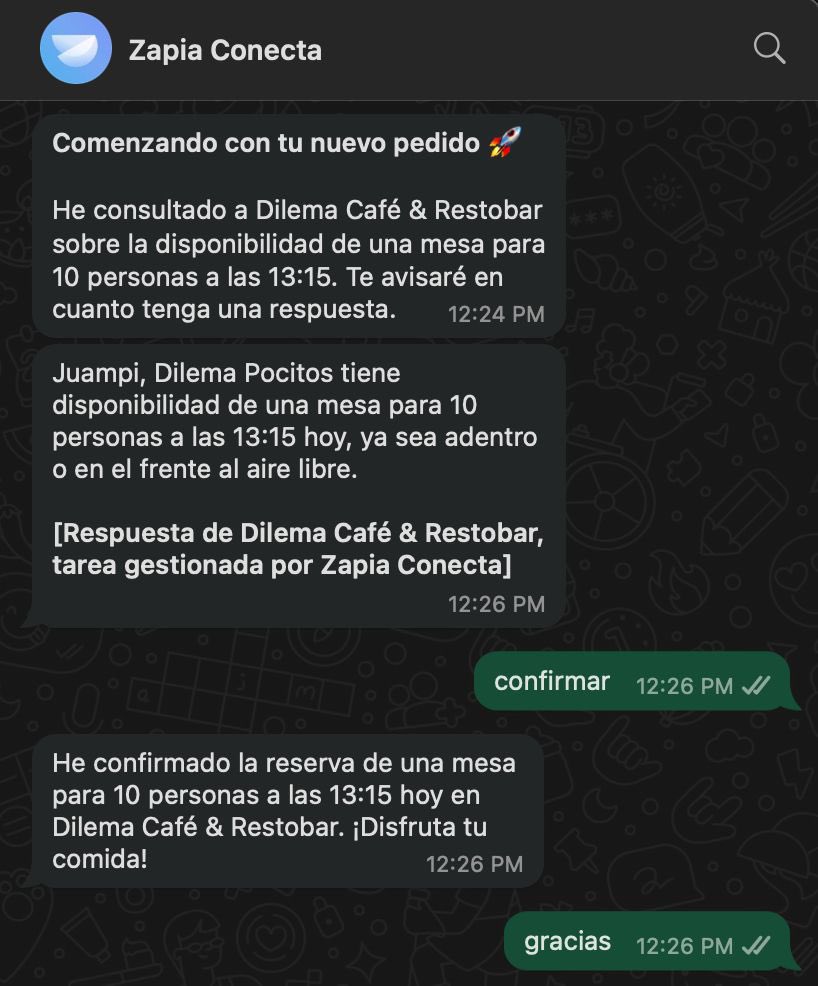
Hoy almorzamos en un lugar que reservamos con
@ZapiaAI 😎
“Recomendame lugares ricos en Pocitos para almorzar”
¡Contacta negocios, hace reservas y negocia por vos!
Dejá tu número en [email protected] o comentame y te lo activamos (Beta)
PD: grande @j0ac0_fernandez
Esta mesa en Dilema Montevideo, la reservó @ZapiaAI para el equipo de @BrainLogicAI, hablando por WhatsApp de manera 100% autónoma con el restaurant.
Zapia también puede contactarse con varios negocios en paralelo para hacer consultas, reservas y negociaciones en nombre del usuario.
Está funcionalidad está en beta. Si te gustaría probarla, pásanos tu número de WhatApp a [email protected] y te activamos!